WEDU Arts Plus
Episode 1026
Season 10 Episode 26 | 26m 45sVideo has Closed Captions
Kimberli Cummings, Ramon Lavarro Jordan, Scenic Solutions, Photography Exhibition
Tampa artist Kimberli Cummings discovered her passion for working with clay. Mixed media artist Ramon Lavarro Jordan creates works using a wide variety of materials. Scenic Solutions has spent the last 20 years bringing artistic visions to life through set building. A photography exhibition celebrates diversity by showcasing portraits of older transgender and gender non-conforming subjects.
Problems playing video? | Closed Captioning Feedback
Problems playing video? | Closed Captioning Feedback
WEDU Arts Plus is a local public television program presented by WEDU
Major funding for WEDU Arts Plus is provided through the generosity of Charles Rosenblum, The State of Florida and Division of Arts and Culture and the National Endowment for the Arts, and the Hillsborough County Board of County Commissioners.
WEDU Arts Plus
Episode 1026
Season 10 Episode 26 | 26m 45sVideo has Closed Captions
Tampa artist Kimberli Cummings discovered her passion for working with clay. Mixed media artist Ramon Lavarro Jordan creates works using a wide variety of materials. Scenic Solutions has spent the last 20 years bringing artistic visions to life through set building. A photography exhibition celebrates diversity by showcasing portraits of older transgender and gender non-conforming subjects.
Problems playing video? | Closed Captioning Feedback
How to Watch WEDU Arts Plus
WEDU Arts Plus is available to stream on pbs.org and the free PBS App, available on iPhone, Apple TV, Android TV, Android smartphones, Amazon Fire TV, Amazon Fire Tablet, Roku, Samsung Smart TV, and Vizio.
Providing Support for PBS.org
Learn Moreabout PBS online sponsorship- [Narrator] This is a production of WEDU PBS.
Tampa, St. Petersburg, Sarasota.
(gentle music fading) Major funding for WEDU Arts Plus is provided through The Greater Cincinnati Foundation by an arts loving donor, who encourages others to support your PBS station, WEDU.
And by the Pinellas Community Foundation, giving humanity a hand since 1969.
- [Dalia] In this edition of WEDU Arts Plus.
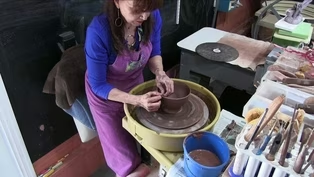
A Tampa artists finds her passion in clay.
- It is just so not cliche.
I touched clay and something happened to my body, it was like an electric current.
And I immediately wasn't thinking about anything else.
- [Dalia] A mixed media artist explores the many possibilities of art.
- [Ramon] Anything that I pretty much see that I wanna do, I pretty much visualize it and meditate on it.
And they'd all come together.
- [Dalia] Providing a backdrop to live productions.
- [Chadwick] We make the magic happen.
Mostly backstage, behind the scenes, because we are a custom shop, not a single job is the same.
- [Dalia] And a photographer's mission to educate and inspire.
- [Jess] I feel that photography is a very powerful storytelling vehicle.
And so I often have my subjects look right out at the camera because I really want the viewer to be engaged in a moment, and a relationship with them, and through being met by their gaze and have to think about how they feel.
- It's all coming up next on WEDU Arts Plus.
(lively jazz music) Hello, I'm Dalia Colon, and this is WEDU Arts Plus.
For Tampa native, Kimberli Cummings, the arts have always been part of her life.
But it wasn't until later in life that she discovered her passion for pottery and her talent for creating unique functional pieces that others can enjoy.
(clay stomping) - I was born and raised here in Tampa, Florida.
I spent 11 years in Los Angeles acting, and I came back to try to take my kids and remove myself from a broken marriage.
And I needed some joy.
What I could do is find a way of making something to put my focus and my hands into something important, joyful, happy.
And I was 10 blocks from the clay factory on Dale Mabry, and I kept passing the sign.
And I thought that it was flashing, saying, "You know you've always wanted this, call today."
And it was clay class.
And for some reason that particular day, I said, "You know, I have always wanted to do that."
My first clay class was with Kim Kirchman.
Kim and I were invited to start the Tampa Tour De Clay together along with me and 14, 15 other potters, and it's my clay family.
- My name is Katie Deits, and I'm the executive director of Florida CraftArt.
Florida CraftArt was founded in 1951 by two art professors at Stetson University.
A whole concept was to promote fine craft as art.
Kimberli has been a gallery artist here for many years.
Her work is absolutely perfect, beautiful, you'd see every finish, every drawing, the firing, you don't see any cracks or problems with it.
The craftsmanship is beautiful, also it's very original.
- Wedging the clay is something you have to do, whether you're throwing on the wheel or hand building.
And you're basically forcing the air out of the clay.
This is a hollow handle, it's just amazing, Hayne Bayless taught me how to make this.
It's one of his signature attachments, but I do make it my own.
Thank you, Hayne.
And I usually have to make quite a few to get the one that I like, for the sangria pitcher that we're making.
There's so many people who have inspired me and I don't wanna lose track of that, and I never take that for granted.
That is the inspiration that I use to create a piece of what I make.
So I always knew how to make a bowl, but one of those people taught me how to smash the side of a bowl and make it be more than acceptable, make it be a point of interest to that bowl.
The butterflies are out in the garden, the butterflies, the birds, the sound of the fountain inspire me.
So that when I go to sleep, whatever I didn't realize had given me so much joy from the garden that morning, that day, that evening when Bill and I sit in front of the fireplace, that I go to sleep and then I dream these things on pieces of pottery that I've never seen anywhere else.
It is just so not cliche.
I touched clay and something happened to my body.
It was like an electric current.
And I immediately wasn't thinking about anything else.
My mom became a fashion illustrator for Moss Brothers and Wolf Brothers.
I was thinking about this two days ago and never ever made the connection that that could be why I was driven to pottery.
But she didn't teach me ever how to draw, or paint, or anything.
I would just look over her shoulder and she knew I wanted to be an actress, so there was no reason for her to teach me that.
But now of course, all I wanna do is draw like she did.
- Kimberli's ceramic work is extremely detailed and meticulously created, and she creates them with the people in mind.
Just particularly if she has a commission for someone for a wedding, she'll think about the couple that's been married, or an anniversary and she'll create it in that manner.
- So this is my first ever sloth, and he is not going to be this mucky green, that's all wax, so I could scrape off this wax.
But I waxed everything here so that I could just paint all over with a blue sky.
So this white that you see in the background is a base glaze that I start all of my pieces with.
And then when it dries the next day, I pencil draw the sloth, the letter S, the trees, and the University of Florida and Florida State University.
I draw all of that for hours and hours.
Right now, I'm going to finish it and carry these little polka dots around the perimeter of the sangria pitcher.
And then this will go in the county today.
What I think of every single time I'm making a bowl, a plate, a platter, a mug, is the connection that that person that receives that piece is then going to have.
Their fork is going to scrape along the platter.
Their mouth is going to touch the rim of the mug that I made.
Their spoon is going to go into the ice cream bowl or cereal bowl.
And then someone nourishes themselves on that piece.
- Learn more about her work at kimberlipottery.com.
Up next, meet an artist who chooses to work with a wide variety of materials.
From wood to steel, and acrylics, to musical instruments.
His creations are full of unexpected discovery.
(gentle guitar music) - Life shows you how to be artist.
If that's what you wanna be, life will show you.
(gentle guitar music) I grew up in Detroit.
My uncle, he was the cartoon artist.
He painted buildings and he showed me a lot, and I pretty much picked it up and just did it for recreation and get my frustrations out.
School frustrations, relationship frustrations when I was young.
And it helped me understand life more 'cause I started to pay attention to people, and how they act, and things like that, and I started to portray it in my art.
He like to paint so many people before it all started looking the same.
And I was trying to figure out a way that I can actually set myself apart.
My art medium, it consists of different things.
It consists of woods, acrylics, acrylic paint, two-part epoxy, steel, instruments, anything that I pretty much see that I wanna do.
I pretty much visualize it, and meditate on it, and it all comes together.
I got into meditation since 12 years ago because I was going through a rough time in my life and I needed an outlet.
I figure I can help myself by calming myself, being more patient with myself, and it helped me a lot.
Certain works I get, it comes from trying to have peace in the world.
And I have one piece that's actually, this done from Japan.
They have a forest, they had the suicide forest, and I did a piece on that.
Depression, it's in many forms.
It can be slight, it can be overwhelming.
And when I deal with depression, it's like, I deal with in a way of painting something beautiful.
So I can change a person's mind state 'cause you really can't change depression like, it doesn't jump from sad to happy.
So I try to just columnize it and break it down for people to look over at a timeline at back at what they were doing until now to being happy.
It's progression in one piece.
(gentle guitar music) The meaning behind what I'm creating right now, we'll call it, atmosphere.
(gentle guitar music) I'm actually building the height of the distance between coming up off the canvas so I can see how it looks in three, so it can be look 3D.
The shape, I wanted to choose the shapes that actually shows a lot of dimensions, 'cause I wanted to be able to create the illusion of like a foreground in the background and the distance.
I'm a huge music lover.
When I'm actually creating, I actually listen to classical, a lot of classical music, and a lot of soft rock, and classical rock.
A lot of the instruments inspire me because I used to play in middle school and I'm not very good at it, but I figured I could do something else with it.
One day I went to this place where they sell cellos.
I was like, "I wanna buy two cellos so I can take apart, and do some art with them."
And the ladies was like, "Can you show me what you wanna do with them?"
I drew it out first, and she was like, "Oh, that is nice."
And she gave me two of those.
I want the audience to take from my paintings.
I want them to take a change.
I want them to see that everything doesn't have to be 2D or of somebody to be good art.
It can actually mold, you can mold art into what you wanted.
Instead of calling it art, you can actually call it creation because that's where we're actually doing.
This is a friend of mine.
She's actually in the bathroom mirror, and she's actually planning out her month.
And her mother is in the the mirror as well.
She, instead of having an iPhone in her hand, she has a day planner.
So she's following what her mother did and that's how she becomes successful in her life.
And I have my butterfly and she is actually about life.
She's pretty much showing you the understanding of life and how it has beautiful and having many dimensions it has.
It's just a woman who's looking towards her future, pretty much.
And I have this called, neural human, because all of the desires I have on there is pretty much the neural electric in your head.
And it's pretty much showing you that life and love can be separated, but yet it still has its own line to be linked back to itself.
People love, they love it.
Sometimes they are confused 'cause they don't understand it, because they haven't really seen it in person.
When they seen in person, they like, "Wow, I didn't think it really looked like that."
It looked flat, but when they seen it, they're like, "Okay, this is a beautiful piece of work."
(gentle music) - For more arts and artists in Detroit visit detroitmi.gov.
For over 20 years, Scenic Solutions has been bringing a variety of shows to life.
Based in West Carrollton, Ohio, this scenery shop creates singular designs that reach audiences across the globe.
(mellow dramatic music) - Anybody can build the scenery, and it's the details that really make it a show and help create this whole environment.
As opposed to just scenery on stage, we kind of build an atmosphere and an environment into everything we do.
We are a small company but we produce big, big things.
We just got done with a national tour of Blue Man Group, which will be all over the country.
And the amount of scenery that we turned out for that show was just astronomical.
That's what blows my mind the most is that we're able to produce such large productions with such a small group of people.
- We serve a multitude of industries.
We work anywhere from high school theater level to first run Broadway tours.
We also build entertainment for the cruise line industry.
We make the magic happen.
Mostly, backstage behind the scenes, because we are a custom shop, not a single job is the same.
Not a single client needs the same thing, not a single material we use is the same.
There are days when there's no one in the shop and there are days when there's 40 people in the shop.
There are days when I have six crews all over the world.
At any given point in time, we might have eight to 20 projects in different stages within the company.
We have a lot of good people working here.
- Scenic Solutions has been in business for 24 years.
We started with a sewing room in the basement of our old house.
Dan was working for the Dayton Valley's lighting designer, and I was freelancing as a custom designer and seamstress.
And pretty soon Scenic Solutions became our life.
Dan is my business partner, he's president of scenic solutions, he is my husband.
It's a very busy place.
I sometimes say it is so chaotic that you can't keep up.
There's never two days that are the same.
- The clients come up with the creative designs.
And then myself, and the other production managers, and drafters, take all of their ideas and turn them into something we can actually build and create all of the drawings that we give to the carpenters.
- I take drawings from designers, and draftsmen, and engineers, and communicate them to the guys working under me.
And we turn it into reality.
I feel like the welding department is the backbone of most of the things that are built here.
We always start with a structure, it's just the nature of scenery that you have to start with a structure, and then you make it look like something entirely different.
The way scenery is today, most of it has to be portable, be lightweight, durable, and that's what the metal structure gives you.
With touring shows, it has to last for a year, if not more.
As far as a cruise ship show goes, we do have weight constraints when it comes to cruise ships, so you gotta keep things light.
- The cruise line industry definitely presents unique challenges.
Typically when you go to a Broadway show, the theater does not move.
On a cruise line, the theater moves.
That base is a lot of our decision making on how to build stuff.
The other unique challenge of a cruise line is getting your scenery, lighting props into the theater.
They never designed big enough doors to get the items into the cruise ship.
Typically the crew will have to carry the scenery through the cruise ship in the middle of the night, when everyone's asleep, up the stairwells and of the theaters.
And that is a unique situation.
- I recently went to Italy for a single day to do a site survey on a cruise ship that we're working on there.
This is the room everything will load into through that door.
I also took all of the measurements of the doorways and the hallways and our path from getting everything from the loading dock through the ship and into the theater.
And made sure that everything broke down into a small enough piece to fit through that path.
- It's definitely worth the cost because we know things are gonna fit, as opposed to sending a piece of scenery or an entire show to the other side of the world.
And then it not being able to fit through the door to get it onto the ship.
That would be a big expense.
One thing that would blow their minds, I would say probably that they've seen a lot of our work and they just haven't realized it.
We've got a lot of stuff all over the Dayton area, but you'd never, unless you work there, you'd never know that we actually did it.
We kinda sneak in, sneak out.
So we're not visible out to the general public.
- [Chadwick] We help Kettering Fairmont school district, consult and install reading lighting in the orchestra shell for their new theater.
We work for the Schuster Center, Downtown Dayton, Victoria Arts Association.
- [Mary Beth] That's really hard to think of what's the coolest thing that came through Scenic Solutions is.
Blue Man Group's pretty cool, but getting to do the Rike's boxes.
(bouncy gentle music) Starting in the 1940s, Rike's department store did a display every year at Christmas.
People that have lived here or grew up here, if you say something about the Rike's elves, they talk about how they used to go see them when they were kids.
It's a very big part of Dayton's Christmas holiday.
We originally built the boxes that the Rike's elves were in about 15 years ago.
And then last year they approached us and asked for new boxes with new scenes inside.
(bouncy gentle music) It feels amazing to give this gift to Dayton.
We've been part of the Dayton community for a long time, but to get the chance to give such a big project back to the community feels great.
(bouncy gentle music) To see more, head to scenicsolutions.com.
Photography has the ability to tell people's stories and create meaningful connections.
In this segment, visit an exhibition that features portraits of older, transgender, and gender non-conforming individuals, whose lives have been marked by both hardship and joy.
(inspiring music) - My name is Jess T Dugan.
I'm a photographer who works primarily with portraiture and often within LGBTQ communities.
I'm here at the Frost Art Museum because my exhibition To Survive On This Shore, photographs and interviews with transgender and gender nonconforming older adults is on display in Miami.
In this exhibition, one of my missions is to educate about issues faced by transgender older adults.
- Jess is More than on the rise.
She's really quite established now as a photographer who has very much a humanitarian view of different communities.
- I feel that photography is a very powerful storytelling vehicle.
And so I often have my subjects look right out at the camera because I really want the viewer to be engaged in a moment, and a relationship with them and to be met by their gaze, and have to think about how they feel being in that situation.
I want them to reflect on their own assumptions about the person that they're looking at.
And for the act of viewing the photograph to be a really energized engaged one, rather than a passive one.
I want them to be in a moment with them, and look them right in their eyes and feel this very human connection that I think makes it very difficult to discriminate against someone or to be hateful towards someone, if you've really come that close to understanding who they are.
And I made this project in collaboration with my partner, Vanessa Fabbre, who's a social worker and assistant professor at Washington University in St. Louis.
And her research focuses on the intersection of LGBTQ communities and aging.
So when we met, we realized we had overlapping interests from working within the trans communities.
And we decided to create this project that had both the portrait and the interview narrative from each person.
- And it is funny because there's always this conversation in museums about how much text do you want in your text?
You should be looking at the work.
But I think in this exhibition, the stories they enhance the work of art, they are a necessary component.
- The portraits immediately capture people's attention, but then the stories allow us to talk about some of the other issues, some of the things like housing discrimination, or employment discrimination, or our fear that people have, about growing older as a transgender person, or conversely joys that they experience, or triumphs of their life.
One of the subjects in the exhibition, Justin Vivian, identifies as non-binary.
And she spoke about her decision to take estrogen, being motivated in part by wanting to have a medical record of her transness because she was worried if she grew older and lost her ability to advocate for herself, that she would end up being treated as a man.
(upbeat music) I met Susie and Cheryl a few years ago, and it's been really great to get to know them because there's such love between them.
And there's such a grounded-ness and commitment that I think is really amazing.
- All we do is go out in public and just be public.
You know, don't hide 'cause we're proud of who we are, we love each other.
We're not interfering with anybody's lives.
We just want to live our life the best we know how.
And to show everybody that it's okay.
- Having their story and reading about how they work together before Susie transitioned, and their marriage has morphed and changed, but they're more committed and in love than ever before is really beautiful and really exciting.
And I think it gives a lot of hope to people who may be struggling with that question.
I think there is this focus on youth and there's not a lot of representations of transgender older adults.
And so they wanted to share their stories and provide a kind of roadmap for what a life could look like for younger trans folks, who in most cases have never seen an older transgender person.
And they've never seen an image of what it might look like to grow older.
And so I was incredibly moved by the extent to which people wanted to help others by sharing their own story.
(upbeat music) - To find out more, visit tosurviveonthisshore.com And that wraps it up for this edition of WEDU Arts Plus.
For more arts and culture, visit wedu.org/artsplus.
Until next time I'm Dalia Colon.
Thanks for watching.
(dramatic music) - [Narrator] Major funding for WEDU Arts Plus is provided through The Greater Cincinnati Foundation by an arts loving donor, who encourages others to support your PBS station, WEDU.
And by the Pinellas Community Foundation, giving humanity a hand since 1969.
(gentle music fading)
Video has Closed Captions
Clip: S10 Ep26 | 6m 21s | Kimberli Cummings, Tampa artist (6m 21s)

Preview: S10 Ep26 | 29s | Kimberli Cummings, Ramon Lavarro Jordan, Scenic Solutions, Photography Exhibition (29s)
Providing Support for PBS.org
Learn Moreabout PBS online sponsorship

- Arts and Music
The Best of the Joy of Painting with Bob Ross
A pop icon, Bob Ross offers soothing words of wisdom as he paints captivating landscapes.













Support for PBS provided by:
WEDU Arts Plus is a local public television program presented by WEDU
Major funding for WEDU Arts Plus is provided through the generosity of Charles Rosenblum, The State of Florida and Division of Arts and Culture and the National Endowment for the Arts, and the Hillsborough County Board of County Commissioners.