WEDU Arts Plus
Episode 1027
Season 10 Episode 27 | 26m 45sVideo has Closed Captions
Tom Kramer, Massachusetts Museum of Contemporary Art, Desiree Kelly, Scott Hildebrandt
St. Petersburg dance photographer Tom Kramer captures the essence of performances by talented local dancers. An exhibition at the Massachusetts Museum of Contemporary Art showcases the life journey of singer-songwriter Annie Lennox. Artist Desiree Kelly creates vivid portraits of historic icons in Detroit, Michigan. Colorado artist Scott Hildebrandt builds magical, miniature worlds.
Problems playing video? | Closed Captioning Feedback
Problems playing video? | Closed Captioning Feedback
WEDU Arts Plus is a local public television program presented by WEDU
Major funding for WEDU Arts Plus is provided through the generosity of Charles Rosenblum, The State of Florida and Division of Arts and Culture and the National Endowment for the Arts, and the Hillsborough County Board of County Commissioners.
WEDU Arts Plus
Episode 1027
Season 10 Episode 27 | 26m 45sVideo has Closed Captions
St. Petersburg dance photographer Tom Kramer captures the essence of performances by talented local dancers. An exhibition at the Massachusetts Museum of Contemporary Art showcases the life journey of singer-songwriter Annie Lennox. Artist Desiree Kelly creates vivid portraits of historic icons in Detroit, Michigan. Colorado artist Scott Hildebrandt builds magical, miniature worlds.
Problems playing video? | Closed Captioning Feedback
How to Watch WEDU Arts Plus
WEDU Arts Plus is available to stream on pbs.org and the free PBS App, available on iPhone, Apple TV, Android TV, Android smartphones, Amazon Fire TV, Amazon Fire Tablet, Roku, Samsung Smart TV, and Vizio.
Providing Support for PBS.org
Learn Moreabout PBS online sponsorship- [Announcer] This is a production of WEDU PBS.
Tampa, St. Petersburg, Sarasota.
Major funding for WEDU Arts Plus is provided through The Greater Cincinnati Foundation by an arts loving donor who encourages others to support your PBS station, WEDU and by the Pinellas Community Foundation, giving humanity a hand since 1969.
- [Dalia] In this edition of WEDU Arts Plus a local photographer captures the essence of dance.
- It is essential for the dancers to trust the photographer to show their best work in order for them to relax and perform to their capabilities.
- [Dalia] The life and career of Annie Lennox through art.
- You are first faced with objects from Annie's past as a music maker.
And as you move around the mound, it gets increasingly personal.
- [Dalia] Creating portraits of public icons.
- My paintings are all about the subjects, and it's all about telling their story.
And I wanna tell it in a very vibrant, energetic way that people wanna know about these people.
- [Dalia] And an artist who sees the world in miniature.
- [Scott] I would describe the personality of my work as more whimsical.
I think miniatures in general reminds adults of that same imagination that sometimes you repress and put away.
- It's all coming up next on WEDU Arts Plus.
(upbeat music) Hello, I'm Dalia Colon and this is WEDU Arts Plus.
This first segment was produced by students at St. Petersburg College in partnership with WEDU.
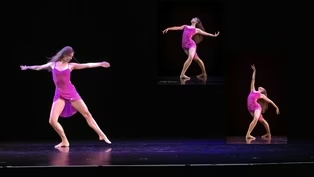
St. Petersburg dance photographer Tom Kramer captures the essence of performances by talented local dancers.
His organic approach and collaborative attitude help to produce striking images of dancers in motion.
(soft music) - I'm Tom Kramer, I'm a dance photographer.
I've been photographing dancers for over 50 years now.
I love dancers, I love dance, and I love what I do.
Many, many years ago, my wife joined a professional company.
Local dance companies are by nature impoverished.
They cannot afford professional photographers.
So they employ husbands, boyfriends, whomever knows which end of a camera works.
I was an amateur photographer, I was called into service.
Eventually I learned how to do it, and I enjoyed it and I grew and it became one of my great loves.
The process of photographing dancers is by its very nature collaborative.
- Working with Tom is a exercise and joy.
(laughing) He's really easy to work with in the sense that when we're on stage or he's photographing you, you almost don't know he's there.
So there's a freedom that comes with that.
Tom's ability to collaborate with dancers that he's working with is really quite amazing.
He hears what you have to say.
He sees how your body's moving in the space and then he can sort of direct a little bit without being overbearing.
And I think that ability to be flexible in the moment and to listen to someone else that you're working with it's how collaborations can be successful.
When I see Tom's photos, I'm just filled with gratitude that there is a photographer who can capture dance the way Tom does, and in a way that conveys to the viewer an emotional quality that I was trying to convey in my dancing and he's caught it in that moment.
And I think that's really hard to do.
- It is essential for the dancers to trust the photographer to show their best work in order for them to relax and perform to their capabilities.
It's really amazing when you can meet a dancer, begin to work with them and within a matter of minutes, be able to develop a rapport, a sense of trust, a commitment to each other and to the development of a photographic process.
- I felt like Tom was very open to our ideas.
I felt like it wasn't so much of him telling us what to do.
It felt more like a collaboration between Tom and the artist was very much give and take, just be you, just dance, just do what you do best and I'll capture that.
- Working with Tom we just got to dance.
And it was outside of my comfort zone to just not be told what to do and not to pose.
It felt like Tom cared about knowing who we were as artists and really wanting to show us and not just his own vision of what he wanted us to be.
- Before I publish any dance photographs I always have them reviewed by dancers.
I make sure that there are no mistakes from a dance perspective in that photograph.
And many times photographs that I think are quite wonderful, have to be cut.
Anything that is not good technique will be eliminated.
It simply will never be shown, no matter how much I may like it.
I happened to walk into the studio of a friend of mine and I saw this magnificent dress.
It occurred to me that different dancers may feel differently performing in this dress.
And so we offered it to several dancers.
They put on the dress, they felt it.
And they created their own movement.
All of the photographs that evolved from this series are improvised by the dancers based upon their feeling and how they responded to this beautiful fabric that they were working with.
I wish I could set up a show in the lobby after a performance to take the photograph, show them instantly as the audience walks out.
And if at that time they looked at the photographs and said oh yes, that's what I saw, that to me would be magical.
I'd like them to have the feel of the dance.
And that's rather difficult because dance is three dimensional, it's movement, it's with music or sound score, and I'm presenting it two dimensionally as a flat photograph, an instant in time, an instant in the performance.
I would like them to feel what I feel when I see the dance.
- Tom has a unique knack and skill with his eye and with a sense of timing to really kind of capture a moment in time and summarize the whole communication in one frame.
When you can suggest things to a photographer or you can do other things that the photographer would look and says well okay, well let's go in that direction, That's always exciting so that it's not one-sided.
And the other thing about Tom is that he leaves something for the viewer's imagination.
In collaborating with him, he would mention, what do you wanna do?
What are you interested in?
As a professional that's something that really kind of wets your appetite.
It's not just being dictated to and working together creates a nice kind of union.
Otherwise for me, it's just dry.
- I like being part of the dance community.
I like doing what I can to promote dance, to make it possible for more people to see this wonderful art form and these beautiful dancers.
I wish I could dance, but I can't.
So I work in the medium that I know and understand and love.
(soft music) - [Dalia] To see more of his work visit tomkramerphoto.smugmug.com.
At the Massachusets Museum of Contemporary Art, artists are given the space and the freedom to display monumental works that may not find a home anywhere else.
Singer songwriter Annie Lennox is just one artist exploring her life journey through an installation at the museum.
♪ And I've got so little left to lose ♪ ♪ That it feels just like I'm walking on broken glass ♪ ♪ Walking on, walking on ♪ - [Narrator] She is a singer and songwriter of soulful and palpable depth.
Annie Lennox's career can be easily recorded in awards and some 90 million albums sold.
But at Mass MoCA, the Massachusetts Museum of Contemporary Art, we find her life lived and left.
- Annie is Scottish and is thinking about the form of a burial mound as a space where we place objects after people die.
- [Narrator] Alexandra Foradas is a curator at Mass MoCA where Lennox approached the museum a year ago about creating this installation.
A giant dirt mound crowned with a piano.
Lennox describes it as a dreamscape of memory made manifest.
- You are first faced with objects from Annie's past as a music maker and as you move around the mound, it gets increasingly personal.
- [Narrator] Lennox has titled the piece Now I Let You Go, a decidedly definitive title for someone who continues to wrestle with her bond to material memories and what materials she has.
You'll find David Bowie here and her own lyrics.
There are momentos of her work as an activist, fighting HIV and AIDS in Africa.
Closer to home, her children's shoes.
- [Alexandra] She wishes that everyone could have a mound.
This idea that we don't have a way of metabolizing memory of working through the objects that are left behind.
- [Narrator] But not all of us can be as sparkly as Annie Lennox, who's mound shimmers.
- [Alexandra] Annie talked about the mound as looking like a performer standing under a spotlight on stage wearing something glittery.
And that notion of the mound as a performer, the knowledge that sharing these things and being vulnerable in this way is in its own way a performance.
- Mass MoCA is a place that people come to experience full on, they wear it like clothes.
- [Narrator] Joseph Thompson is the founding director of Mass MoCA.
He opened the place in 1986, in a series of brick factory buildings, that once served as a textile mill and later an electronics plant.
Today, it's where art and ideas are made, unlike anywhere else.
Since it doubled in size two years ago, this has become the museum where artists come to create work that often can't be shown anywhere else sometimes because of size, often for audacity.
- This is not necessarily a perfectly polite place where the walls are white and the light is coming from above and the guards are dressed up in suit and tie, you get to work for it here just a little bit.
Mass MoCA rewards curiosity.
- [Interviewer] Is museum the right word for this place?
- No, this is not a museum, I don't know what it is.
I mean we stick with that word because it's in Mass MoCA.
It's a center, it's a lab, it's two turntables and a microphone.
(laughing) - [Narrator] Right now you'll find mammoth sculptures by late artist Louise Bourgeois.
A fully immersive and enveloping series of light installations by James Turrel and more mounds.
These from the mind of artist Trenton Doyle Hancock.
- [Joseph] If there's anything that's our specialty at Mass MoCA, it's providing space and time to artists with big ideas.
- Trent takes us into The Moundverse.
The Moundverse is a space that he created beginning with Torpedo Boy, when he was 10 who is sort of the Superman to his Clark Kent.
- [Narrator] A world, all his own, the Moundverse is charted out along a Candy Land like lane in Mass MoCA's largest gallery, one nearly the size of a football field.
The mounds according to Hancock are depositories from memories and bits of discarded humanity.
For children of the 1980s, it's a colorful climb into nostalgia.
- [Alexandra] Trent is drawing on everything from the Cabbage Patch Kids and the Garbage Pail Kids to the Marvel Cinematic Universe to Greek gods.
He is reaching back not only into the depths of his memory back to his childhood in Paris, Texas as the child of a family of evangelical Baptists, but also back into mythology.
- [Narrator] Now thirty-five years into her career, artist Jenny Holzer has long ruminated over language.
- She is interested in the way that language is read differently based on context and also material.
- [Narrator] In this installation at Mass MoCA, she returns to painting.
Her focus here, government documents obtained through the Freedom of Information Act.
- [Alexandra] The texts are referring to violence as a wishlist for interrogation techniques, or they are referring to abuses obliquely as treatment.
So it is this way of using language to shield rather than to uncover.
- [Interviewer] How political is the work?
- Extremely political.
The work deals in terms of its subject matter, with the lead up to the attacks on September 11th, fundamentalism and the violent tendencies that might arise out of it.
And from there, she moves on to the alleged abuses of the detainees at Guantanamo Bay.
- [Narrator] At Mass MoCA, it's a moment of memories.
From the harvesting to the harrowing.
- [Dalia] For more about the museum, go to massmoca.org.
In Detroit, Michigan, artist Desiree Kelly creates memorable vivid portraits of public historical icons.
With each portrait she renders, she highlights her subject's life and personality.
(upbeat music) - I try to go beyond the boundaries.
I just wanna speak really through my art.
I find it really powerful to be able to tell a story visually, without any words.
My paintings are all about the subjects and it's all about telling their story.
And I wanna tell it in a very vibrant, energetic way that people wanna know about these people.
So I've studied art and I wanted to make it more interesting.
I came to the point where I was in college and I wanted to decorate my first apartment and I don't wanna hang a flower on my wall.
That's not the type of person I am and I wanted to make something that was just something you would never find it.
So I had to create it myself.
So the subject that I pick are people that I'm interested in and music is just always kept with me.
So you find a lot of musicians that I paint like Louis Armstrong, Jimmy Hendrix.
And I just want to tell their personality, what I feel about them, 'cause it is their portrait.
And I wanna make it more interesting and sort of tell their story, and that someone that is 10 years old can look at a piece that I create and learn a little bit of something by looking at the piece.
(upbeat music) The foundation is oil paint, spray paint, and collage.
I have evolved to use other mediums like markers, acrylic paint.
It really depends on the subject or what I wanna convey and how to do it.
And there's some things that you can't paint.
Like you have to use physical items that you find, and it really creates another depth for my art.
It gives it texture.
If the person is a little bit more edgy or contemporary, reserved, it's really what I want to convey from their personality.
So for example, I have like a Danny Brown piece and he's really like wild and Detroit and edgy.
And so I used a lot of collage and spray paint to build up the background of that piece.
But the foundation is oil paint for the actual figure.
Abe Lincoln is one of my most iconic pieces that I've done.
I thought he was just a really interesting guy 'cause he was a boxer and all these crazy things that no one would ever know about him.
So when I did my research about him, all you could find are black and white photos, and I wanted to bring that to modern day.
So you have to add color, put him out of context, sort of like in modern day.
And what I did for my first rendition of him was put him in front of a graffiti wall that's at Fourscore And he's like taking a picture of himself with like a 35 millimeter camera and he has like a tuxedo on it.
It just made like him as a character, that brought him to life.
And since then, I've done several murals of him actually with these kaleidoscope glasses that I think are just pretty cool.
And it sort of just makes him like an icon of today instead of just being stale in history, I use a lot of color and movement to try to capture you as long as possible and maybe put like a little bit of details, hidden things that you may not see until you look at it for maybe like the fifth time.
And my pieces are very diverse and they could be placed anywhere, they could be placed in a home or in a restaurant or for any particular venue.
So it's really interesting that you can find or learn something by looking at a piece of mine.
I have a Misty Copeland piece that I did.
She's like a phenomenal person and she's accomplished so many things and broken so many barriers.
And so throughout her piece, I incorporated a lot of magazine covers and sort of iconic pieces, like out of her timeline.
And I chose this pose that was really sort of beautiful.
Today I'm working on a Rob Zombie portrait.
It's actually a part of a bigger project that I'm doing with a local restaurant Vegan, and I'm doing a series of vegan musicians.
It's in the early phases of painting.
I do multiple layers, I first tone it with the brown.
And then I go back and add color.
And I'm also working on a N.W.A piece, which I'm picking back up after a year of sitting it down, I had to really think about what I wanted to do for the background and how I wanted to capture their essence within the piece.
Like if I wanted to do a little bit more graffiti, add a little bit more of a spray paint and collage to that piece.
And this guy Eazy-E, he's like right in the center, he's sort of in the forefront of this and these guys are behind him.
So I wanna highlight him, but also not have like the background overpower it.
This is probably why I covered up a lot of this.
It lends itself to being more of a quiet background 'cause they're so in your face, just with their gesture and look.
The phrases that I typically use for a portrait are song lyrics from that musician themselves, maybe movies that they were in.
If it's something more closer to home like Danny Brown, I did do a bunch of Detroit streets in the background.
Like a welcome to Detroit city limits sign.
Whatever that's pertaining to that subject, I would include.
And a lot of artifacts, like albums and included that part of the piece.
My message is all about telling the stories of iconic figures, historical figures.
The way that I capture them, can be placed in any setting really and spark a conversation.
(upbeat music) - [Dalia] For more information visit desireekellyart.com.
Colorado based artist Scott Hildebrand, also known as Mr. Christmas, builds magical miniature worlds.
In repurposing vintage and antique items, he creates playful, special scenes on a very small scale.
(upbeat music) - [Scott] The way people react to my art is different and fun and priceless all at the same time.
When they see that the pieces light up and then it's fun to see their faces light up and I see their imagination light up.
And it's really kind of a fun thing to sit back and watch.
It's really such a humbling experience to hear people tell me about how it moves them and the feelings that it invokes in them.
There's nothing in the world like it, it feels a wonderful.
(soft music) My name is Scott Hildebrand and I'm a miniature artist.
And I work with repurposing old clocks, cameras, radios, and TVs.
I would say for over the last 10 years, I've probably built close to about maybe 3000 pieces, all different shapes and sizes.
Nothing is really off limits.
And this is actually airplane salvage.
So this is an old wheel cover from an old landing gear an old Cessna 182.
The love of miniatures probably started when I was close to six or seven.
My grandfather used to put up his old train set from when he was a boy.
And I just remember being in awe of how beautiful it was and how it ran and all the little miniatures that went with it.
And I was just fascinated with it.
And as I got older, I would build models and I loved the scale of trying to recreate these scenes in minature format.
Like this is an old hardback case and there's a little switch on the bottom.
It makes them portable so you can put them somewhere, but you can open it up and have a nice little display.
- Oh my, yeah.
(laughing) - [Scott] Mr. Christmas is a term or a name that was given to me probably about 10 years ago when I first started doing this.
- This is very creative, what you've done.
- Thank you, I appreciate it.
- Beautiful work.
- I focused on vintage Christmas pieces.
And my piece that I ever made actually was a little Christmas village that was under glass.
People took interest in that style of art.
And so I just sort of absorbed the name Mr. Christmas.
I would describe the personality of my work as more whimsical.
I think miniatures in general reminds adults of that same imagination that sometimes you repress and put away and it brings you back to a really good place in your life that you remember when you were younger.
And it's almost like a safe place.
And it creates these warm memories that people love.
- Where do you source your antiques?
- I go to a lot of estate sales and flea markets, garage sales.
A real interesting weekend for me is thrifting.
(laughing) A fun weekend like that will turn into fun weeks of (laughing) finding these pieces and then getting a chance to build into them.
This poor clock, it stopped working and the motor burned out.
So I'm going to repurpose the face.
I never put people inside of my artwork.
I feel like the scene itself creates a wonder or mystery, and I want the focus to be on the quaintness of the scene itself and that you can imagine yourself maybe there.
The thing that really inspires me to continue with my art is the ability to create something that connects people together.
And that's also a very endearing challenge to me to be able to create something that I can imagine.
There's nothing more satisfying than to be able to complete something that you've thought about.
It's just such a form of accomplishment.
And it's so satisfying that it kind of makes me feel complete as an artist.
- [Interviewer] Do you title all your pieces?
- I try to.
- [Interviewer] What would you call that?
- A clear sunset.
(laughing) I can't imagine not doing it.
It's part of my life and it's really part of who I am.
- [Dalia] To learn more visit clevermrchristmas.com.
And that wraps it up for this edition of WEDU Arts Plus.
For more arts and culture, visit wedu.org/artsplus.
Until next time I'm Dalia Colon, thanks for watching.
(upbeat music) - [Announcer] Major funding for WEDU Arts Plus is provided through the Greater Cincinnati Foundation by an arts loving donor who encourages others to support your PBS station WEDU and by the Pinellas Community Foundation, giving humanity a hand since 1969.
(lively music)

Preview: S10 Ep27 | 29s | Tom Kramer, Massachusetts Museum of Contemporary Art, Desiree Kelly, Scott Hildebrandt (29s)
Video has Closed Captions
Clip: S10 Ep27 | 7m 5s | Tom Kramer works with dancers to create photographs that capture the art of their motion. (7m 5s)
Providing Support for PBS.org
Learn Moreabout PBS online sponsorship

- Arts and Music
The Best of the Joy of Painting with Bob Ross
A pop icon, Bob Ross offers soothing words of wisdom as he paints captivating landscapes.












Support for PBS provided by:
WEDU Arts Plus is a local public television program presented by WEDU
Major funding for WEDU Arts Plus is provided through the generosity of Charles Rosenblum, The State of Florida and Division of Arts and Culture and the National Endowment for the Arts, and the Hillsborough County Board of County Commissioners.