
Episode 105
Season 1 Episode 105 | 26m 45sVideo has Closed Captions
Learn about the emerald ash borer, and meet a comic book artist and an inspiring Iowan.
Learn how the emerald ash borer is impacting Iowa neighborhoods, meet a comic book artist who is writing a new series aimed at kids, learn about an inspiring musician and dancer, and take a ride on a train in Missouri Valley.
Problems playing video? | Closed Captioning Feedback
Problems playing video? | Closed Captioning Feedback
Iowa Life is a local public television program presented by Iowa PBS
Episode 105
Season 1 Episode 105 | 26m 45sVideo has Closed Captions
Learn how the emerald ash borer is impacting Iowa neighborhoods, meet a comic book artist who is writing a new series aimed at kids, learn about an inspiring musician and dancer, and take a ride on a train in Missouri Valley.
Problems playing video? | Closed Captioning Feedback
How to Watch Iowa Life
Iowa Life is available to stream on pbs.org and the free PBS App, available on iPhone, Apple TV, Android TV, Android smartphones, Amazon Fire TV, Amazon Fire Tablet, Roku, Samsung Smart TV, and Vizio.
Providing Support for PBS.org
Learn Moreabout PBS online sponsorshipComing up on this episode of Iowa Life.
Learn how communities are coping with an invasive species.
Emerald ash borer is kind of a unique insect.
It's an invasive insect, like you mentioned.
Meet a comic book artist who has launched his own series.
Writing and Drawing Your Own Stories kind of took more precedent, too.
You want to create your own characters.
You want to tell the stories that mean something to you.
And enjoy a ride at the Watson train depot in Missouri Valley.
Are we ready for our train ride?
All right.
It's all coming up next on Iowa Life.
Funding for Iowa Life is provided by the Gilchrist Foundation, founded by Jocelyn Gilchrist, furthering the philanthropic interests of the Gilchrist Family in Wildlife and conservation, the arts and Public Broadcasting and Disaster Relief.
Mark and Kay De Cook Charitable Foundation.
Proud to support programs that highlight the stories about the people and places of Iowa.
The Strickler family in loving memory of Lois Strickler to support programs that highlight the importance of Iowa's natural resources on Iowa PBS and by the Lainey Grimm Fund for inclusive programing at the Iowa PBS Foundation.
Neighborhoods like this are becoming an increasingly common sight Ash trees with thinning, upper canopies, flecked bark damage and shoots of new branches at the trunk.
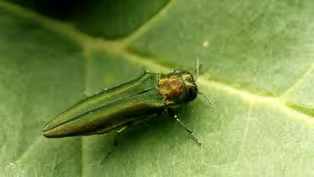
All telltale signs that these trees have been infected by the emerald ash borer.
Should be emerging right here.
That's an exit hole.
The smaller ones are emerald ash borer leaving the tree.
According to the Iowa Department of Natural Resources.
There are roughly 3.1 million community ash trees in Iowa, as ash is one of the most commonly planted street trees in the state.
The emerald ash borer is having huge economic impact on the forest resources of cities and towns.
You look at history and we had Dutch elm disease come through in Iowa.
The biggest years were kind of in the sixties and seventies and wiped out the elms, and then we had to replace these trees and this was the number one tree.
Green ash is highly resistant to salt and heat and handles a variety of soils and grows very quickly.
And so we didn't learn from Dutch Elm disease.
We kind of went in, replanted lots and lots of ash or lots and lots of maples.
And so when we have an invasive pest like emerald ash borer and it came and it was able to run down those streets like we see here pretty quickly.
Emerald ash borer is kind of a unique insect.
It's an invasive insect, like you mentioned, not native to United States.
It comes from China, Korea, some of those Asian continent areas.
It was introduced in 2002 to Detroit, Michigan, and it's a primary killer of all Fraxinus or ash trees.
The emerald ash borer was first discovered in Iowa in 2010 on an island in the Mississippi River.
Despite the Iowa Department of Natural Resources putting a quarantine on moving the wood, the beetle continued to make a westward push through the state.
It went through the state tremendously fast.
But I have a publication we put out.
It was looking at the railroad, and the railway is what moved it quickly through Iowa.
They fly around in the spring, get on the cars, take a ride.
So the rail communities were hit the hardest.
Adult beetles live on the outside of trees and feed on the leaves during the summer months.
The larva feed on the living plant tissue underneath the bark.
The tunneling and feeding activity of the larva is what ultimately kills the trees.
When the bark is peeled back, you can see the dizzying patterns left behind from the larva.
As millions of these trees are cut down.
Several factors come into play.
How do communities efficiently remove wood from neighborhoods?
What's the financial cost of cutting down the trees?
And what should communities do with such a volume of wood when most of it is perfectly usable for other purposes?
Are these trees worthless?
It's a tough one.
So the ash market, believe it or not, pre 2002 was pretty good.
You know, you could sell and mill out most trees, urban trees.
They're tough because you don't know what's inside of that tree.
So it's really hard to dispose of these trees.
And what do you do with all of this wood when it comes down?
You know, just on this block alone, we're probably looking at, I don't know, maybe five, 600 trees that are going to come down in the next year or two.
That's a lot of wood material.
And we really don't have answers for it.
According to the U.S. Forest Service.
If recovered and repurposed wood from the country's urban forests could produce nearly 4 billion board feet of lumber each year.
Upcycling is becoming a popular trend for urban wood.
The Iowa DNR Forestry has been working to connect people all along the supply chain to build community, business and consumer interest to embrace this underutilized resource.
There are some creative things happening.
There are a few smaller communities that have the wood milled out and they take the wood to work in their shop classes.
Others have turned them into benches.
The city of Waterloo ended up mulching the wood and turn them into pellets and then they get turned into power.
Pellets are burned for power.
So everybody's got some creativity with it.
A little different use, but not it's not universal.
It really depends on where you're at in the state.
We've got a lot more ash now than we ever had before.
Monty and Betty Button owned Bear Creek Hardwoods outside of Earlham, Iowa.
They were a full service lumber mill and kiln that takes locally sourced wood and repurposes it.
Used to be that they would just cut down all the trees, mulch them up, or take them to a landfill.
And that was such a waste that wood is so beautiful and it's so purposeful that there has to be a better way to do it.
It's an easy one to cut.
It's not really, really hard.
It's got great characteristics.
It's got a lot of nice grain edge like like Oak has, but it's a lighter wood.
As more and more ash comes into mills like Bear Creek Hardwoods.
They are using the repurposed wood for a variety of projects.
We've done a lot with Ash is we will make dinner tables, Mantels.
We do a lot of flooring with Ash.
There's really no limit on what you can do with Ash because it's just a real nice stable wood.
The fight in stopping this pest from infecting trees is over and it is not clear if ash will ever rebound again in the state.
But like the local craft beer movement or the local food movement, mills like this are building a local wood movement, all of which can help improve local economies, repurpose a waste product and create something of lasting value for years to come.
And it's neat just to know that this item that we have was grown in our own soil as is just being repurposed.
And it's it's just very interesting to know that this is from Iowa.
Emily has that glow around her of like, I'm here.
Thank you.
Thank you.
Thank you.
She walks in room and everyone is like, Wow.
I like her.
Hi, everyone.
This is my house.
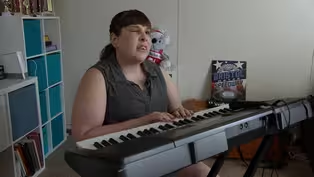
I'm Emily Brown, and let's go through it.
What you just heard over there was my cat, and she's going to come with us, hopefully.
There it is.
I can't see.
I'm visually impaired.
I'm blind.
Fully blind, to be exact.
Because I am on the autism spectrum, you don't see that when I sing like I'm in my happy place.
It feels special.
It's peaceful.
It feels like I can be myself.
Sing along, you'll be fine.
I sang for our former president Barack Obama in 2016 at North High School, and it felt so great to actually tell people I can do anything.
If you want to be happy, do what it is that makes you a happy person.
Emily wanted to take dance class when she was younger.
She likes to dance, especially when she gets to make noise with those feet.
But she was told no.
But we also had to wait to a point.
In Emily's development that she was ready to do that.
Believe me.
I understand what discrimination is like.
Like you can't do this.
Well, can I try it?
What things do you believe I can't do?
And then I'll show you my techniques of how I can do stuff.
I have lots of training from the Iowa Department for the Blind in Des Moines that has helped me throughout my 26 years of life.
So when I think of love, especially unconditional love, my mom always comes into my mind because she's always there for me and she has done so much to stick up for me, even through my tough times.
So that's why I love her, the pieces.
And I say thank you not only for adopting me, but for raising me to be who I really am, because I wouldn't be where I'm at if it wasn't for her.
Ready?
There you go.
Grilled cheese!
Okay.
When Emily was a baby, she was a very good baby.
Everyone was saying yes, she has an eye disorder, but they're not telling you the severity of what's going on.
Slowly it starts unfolding into this good baby.
Turns into a very upset baby.
At first it was hard, I will admit.
Like when I was trying to ask for something, I couldn't.
So I threw fits.
I hit myself, threw myself on the ground.
I screamed and cried.
Through a lot of work and a lot of people not giving up on Emily.
She became successful to continue to grow.
Emily ended up graduating a normal high school with a 3.5 GPA.
I'm really proud of Emily.
For all the things that she's accomplished.
She's overcome a lot of issues with even being scared to try new things.
It can be scary.
Let me win.
But if I cannot win, let me be brave in the attempt.
That's right.
Special Olympics.
We found Miss Amazing.
And it's a pageant for people with special needs.
And then my favorite part is passion presentation.
And it's like a talent portion.
And for me, mine was singing and I did At Last by Etta James.
At last my love has come along.
Emily loves to do pageants.
She loves to sing.
Her heart is to prove to others she has abilities.
I did the Iowa and Illinois Miss Heart of the USA because I wanted to see what it's like doing a pageant with people without special needs.
I'm like, you know what?
It's time to integrate my theme.
You guessed it, dirt track racing.
I always have a huge heart for dirt track racing.
I love the feel of it.
The vibration.
We started with Braille plate drivers, and it's a Braille plate the size of a credit card that's metal.
And it has the name and car number of the person.
And now we have spread across the United States, Australia and Canada with 800 Braille plate drivers for dirt track racing.
I'm very proud of her because she volunteers in lots of ways to give back to the community and shows everyone I care about you.
I'm on a national steering committee for mental health.
It's to help people that have a disability and mental health, including myself, you can tell us what you need.
You matter to us and you're here for a reason.
There's a special college at National Federation for the Blind, and you have to be certified to be a Braille transcriber and then go through to be the Braille proofreader.
I'm hoping to do that soon because then it could improve lots of things for those who are blind.
And I believe in that.
We are here to show the world just because an individual has special needs doesn't mean that you cannot give to others, doesn't mean that they don't have something extremely special to share with the world.
So I'm hoping in the future I want to be a singer and show people my life story.
And I want to tell them how far I came on this journey.
I'm excited to see where this journey goes.
I just honestly, from a really young age.
I was in the third grade when I read my first comic book, Amazing Spider-Man number 350, and I was hooked from that point on.
I mean, comics are cool, superheroes are cool, superpowers, all of it.
The bright colors, the cool costumes.
And so I think I was just so energized by, you know, that that world was so much more sensational than the one I was living in.
Phil Hester is another cartoonist in Iowa, and he invited me to his studio and he's done it at the time, probably a 20 year career writing and drawing for Marvel and DC Comics, and he saw a lot of potential in the work I was doing.
My first gig was a cover of Green Hornet and just, I mean, just riding that, you know, high of finally doing something that was going to be published in a comic book, not too long later, we worked on the Justice League.
I got to work on my favorite character Superman.
A couple of issues of Action Comics, Batman Beyond.
So personally, a really gratifying gig.
And eventually, you know, writing and drawing your own stories kind of took more precedent, too.
You want to create your own characters.
You want to tell the stories that mean something to you.
Yeah, a former librarian wrote to all these illustrators and artists and was like, Could you send us an original drawing.
They just did.
You don't want to know what that is worth now.
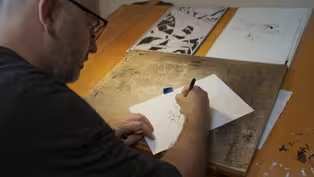
What I'm working on right now is a graphic novel series called Sort of Super.
Now, speaking of original see, mine, you can tell and there's all kinds of pencil lines and stuff.
So the genesis of this is I wanted to be and I mentioned I wanted to be a comic strip artist, and this started out as a comic strip pitch.
So I worked on this pretty relentlessly 2002 to 2017.
I think I just kind of came to conclusion that it was just not going to happen.
A best case scenario, it was going to take years and I was putting so much time into these drawings and these writings that, you know, I just wasn't getting a return.
But as it would happen, another friend of mine, Jason Platt, he's another Iowa cartoonist.
And but I saw he had a book deal and he had taken his characters and he was working on a comic strip and he had made them into a graphic novel.
So I just called him out.
I said hey, like, tell me about this.
How did this come about?
I didn't know that those graphic novels were really blowing up.
How many in here read graphic novels?
A lot of hands.
And there was such an appetite for young readers to read the kind of stories that we were trying to tell.
I combined those into a graphic novel and that graphic novel was sort of super.
And so, like I said, it's kind of a mash up of, you know, kind of a love letter to comic books and comic strips, taking all of that humor and whimsy that I really loved about comic strips.
Kind of mashing that up with all the action drama and adventure of comic books.
It's about an 11 year old kid named Wyatt Flynn.
Was kind of impulsive, a little bumbling, and he accidentally gets a bunch of superpowers.
Wyatt He wants to be a superhero.
His dad doesn't want him to, but his sister whos two years younger than him.
She's super smart, and she is a little more clear eyed and doesn't see the world in such black and white.
So she's like, No, we can do this.
What Dad doesn't know doesn't hurt him.
Yeah, it's been great.
I kind of felt I knew I was doing something right because I had, you know, just this immediate and such an excitable response.
Yeah this is the sequel to sort of super.
But kids, you know, they devour these in an afternoon.
And so almost immediately, the second book just came out in July and immediately I was getting emails, kids who, you know, when's the third coming out.
And so I was really gratifying, but I can't make these fast enough.
So it's been a really positive response.
And I'll just do a quick headshot of my main character, Wyatt Yeah, just make comics and it sounds like such a cop out of an answer, but really, you know, it takes such a long time to get well.
It took me such a long time to get good at it.
I still I'm still learning.
And you're always going to be learning.
A lot of kids come up and say that, you know, I have all these ideas, but, you know, I'm scared or I don't, you know, I can't get to draw them or they're perfectionist.
So honestly, just sitting down, making comics, that's going to be, you know, your biggest educator is getting on the page and making those mistakes and finding those victories and just keep going.
Well, this is Watson Station.
We're located in Missouri Valley City Park, and our station, it's made to look like a train station of the days gone by.
Johnny Watson used to drive the steam train here in the park until sometime in the mid sixties.
And he loved kids.
And so that's why we named the station after Johnny Watson.
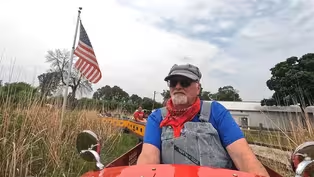
I'm Engineer Farley, and I'll be driving your train today.
I come up here just so you guys can have a train ride.
Have any of you ridden with us before?
Oh, all right.
That's terrific.
Good job.
Okay.
Now, the name of our train is the Jimmy King Express.
Are we ready for our train ride?
All right.
Just got a 750 Kawasaki engine in it.
It's 26 horsepower.
We pulled three cars behind it.
We try to keep it under five miles an hour, and we go through a tunnel across the bridge.
And the tunnel is called Hoover Tunnel.
So we tell the kids when they go through that we want to hear a big woo-hoo!
My favorite part about the train would probably be in the tunnel, on the train when everybody like decides to scream.
It's really good when you're down at the lower end going across the bridge and a big train comes by and the engineer waves to the kids and blows his horn.
And of course, he drowns out my horn.
But it's a lot of fun.
And the kids love it.
The kids enjoy it.
I enjoy it because I like to ride it, too.
And we do it every year.
Every year we come here at least once a year, and then we go over to the park and play afterwards.
It's not just for kids its for all us big kids too.
So sometimes I think the older people enjoy it more than the younger ones.
We had one lady 98 years old.
She was our oldest rider I know of.
Well, everybody likes to reminisce.
Yeah, smiles.
I just hope the kids are happy.
And of course, I want them to come back.
If they didn't let me volunteer, I would pay them to work here.
It is so much fun.
Funding for Iowa Life is provided by the Gilchrist Foundation, founded by Jocelyn Gilchrist, furthering the philanthropic interests of the Gilchrist Family in Wildlife and conservation, the arts and Public Broadcasting and Disaster Relief.
Mark and Kay De Cook Charitable Foundation.
Proud to support programs that highlight the stories about the people and places of Iowa.
The Strickler family in loving memory of Lois Strickler to support programs that highlight the importance of Iowa's natural resources on Iowa PBS and by the Lainey Grimm Fund for inclusive programing at the Iowa PBS Foundation.
Video has Closed Captions
Clip: S1 Ep105 | 6m 47s | What Iowans are doing with the wood when ash trees are cut down. (6m 47s)
Video has Closed Captions
Clip: S1 Ep105 | 7m 48s | Emily Brown is a gifted musician and dancer who is also fully blind and autistic. (7m 48s)
Video has Closed Captions
Clip: S1 Ep105 | 5m 36s | Comic Artist. Drawn for Superman and the Flash. Started his own kids-based comic book. (5m 36s)
Video has Closed Captions
Clip: S1 Ep105 | 3m 6s | Take a ride back in time to Watson Station in Missouri Valley’s City Park. (3m 6s)
Providing Support for PBS.org
Learn Moreabout PBS online sponsorship













Support for PBS provided by:
Iowa Life is a local public television program presented by Iowa PBS