
Episode 106
Season 1 Episode 106 | 26m 46sVideo has Closed Captions
Explore the lyceum movement, refugee support and the history behind one Iowa love story.
Learn about the lyceum movement happening in central Iowa, meet a young couple whose love story is one for the history books, find out how volunteers support refugees in Des Moines, and meet a flower and vegetable farmer in Pleasantville.
Problems playing video? | Closed Captioning Feedback
Problems playing video? | Closed Captioning Feedback
Iowa Life is a local public television program presented by Iowa PBS
Episode 106
Season 1 Episode 106 | 26m 46sVideo has Closed Captions
Learn about the lyceum movement happening in central Iowa, meet a young couple whose love story is one for the history books, find out how volunteers support refugees in Des Moines, and meet a flower and vegetable farmer in Pleasantville.
Problems playing video? | Closed Captioning Feedback
How to Watch Iowa Life
Iowa Life is available to stream on pbs.org and the free PBS App, available on iPhone, Apple TV, Android TV, Android smartphones, Amazon Fire TV, Amazon Fire Tablet, Roku, Samsung Smart TV, and Vizio.
Providing Support for PBS.org
Learn Moreabout PBS online sponsorshipComing up on this episode of Iowa Life.
Explore a community movement that aims to create spaces to have better, more meaningful conversations.
We can have public conversations that aren't always fights.
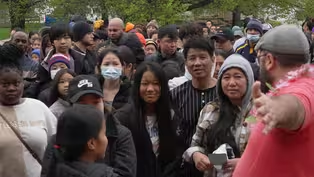
Learn about a support system, helping refugees get settled and find a new life in Iowa.
So Des Moines refugees support is here to fill in the gaps for refugees that come to live in Iowa.
And meet an athlete who has participated in several events at the Special Olympics.
Special Olympics is just really been a great avenue for Marissa to build her self-esteem and confidence.
It's all coming up next on Iowa Life.
Funding for Iowa Life is provided by the Gilchrist Foundation, founded by Jocelyn Gilchrist, furthering the philanthropic interests of the Gilchrist family in Wildlife and Conservation, the Arts and Public broadcasting, and disaster relief.
Mark and Kay De Cook Charitable Foundation.
Proud to support programs that highlight the stories about the people and places of Iowa.
The Strickler family.
In loving memory of Lois Strickler to support programs that highlight the importance of Iowa's natural resources on Iowa PBS and by the Lainey Grimm Fund for Inclusive Programing at the Iowa PBS Foundation.
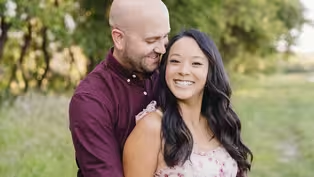
In many ways, the tale of how Jasmine and Jeffrey Newland met and got married is a typical American love story.
Oh, this is a good one.
You and your grandma.
They met in high school, started dating in college and got engaged a few years later.
What makes their story unique, though, is they would have never met had it not been for one man who extended a helping hand in a time of need.
Jasmine's parents moved to Iowa as part of the historic Tai Dam refugee resettlement that began in the 1970s.
My grandma, this was when she was in Laos.
Jeffrey's grandfather is the late governor Robert Ray, the man who made that possible.
Their story is one borne of an immense amount of love, trust and hope.
As America retreated from the war in Vietnam and Saigon fell to the North Vietnamese in 1975.
A flood of refugees would fan out across Southeast Asia.
One group known as the Tai Dam would flee Vietnam to Laos and later seek refuge in America.
As they escaped the brutal communist regimes consolidating power in Southeast Asia.
Their story kickstarted Governor Ray's most pivotal legacy.
Welcoming refugees to Iowa.
It starts with the Tai dam relocation.
They'd already been relocated out of Vietnam and Laos, Thailand, and then were in the United States, and they petitioned every one of the 50 governors to please allow them to come to their state as a group.
But the Tai Dam, were going to be scattered all over.
And they had their own distinct religion, their culture, their religious beliefs, their kinship.
And they said all of that's going to be lost for us because they're not many of us, and we're going to be scattered all around.
And we won't be able to keep any of this intact.
So they wrote letters to all the American governors.
So I responded thinking maybe we could do that.
And to my amazement, I was the only governor who responded.
Were welcoming people.
Were open minded people.
Were honest people.
Were good people.
We have a heart.
And so Iowa did its part and led the nation Last fall, 633 Tai Dam refugees flew into the Des Moines Airport from their resettlement camp in Fort Chaffee, Arkansas.
Iowa had offered the Tai Dam a home.
They came seeking a new life in a complex society.
Very different from the one they had known.
To preserve this culture and closeness.
Iowa has offered a home to all Tai Dam refugees who have come to America.
Jasmine's mom, Pastor Somkong Vong was born in Laos and moved to Iowa when she was eight years old.
She later met Jasmine's dad, Nib at Hoover High School in Des Moines.
They got married in 1990 and had three children, including Jasmine.
Sam Khong sadly passed away in 2021 after a ten year battle with ovarian cancer, but not before leaving a tremendous impact on those who knew her.
She taught me how to look at the good in people and to not judge people by their cover.
Through watching his grandfather, those same life lessons were taught to Jeffrey.
No matter where we were.
Or what I do in today's world.
You know, I don't judge a book by its cover.
I treat everyone kind of as family.
And I certainly believe that he always did that.
And I think I think the Tai Dam Refugee relocation is a big part of that.
He taught me the importance of respect.
Being loyal and being honest, I think are the big three that I could see through him growing up.
And that's resonated with my life moving forward.
Though they had known each other for years, Jasmine and Jeffrey didn't realize the significance of the history behind their relationship until they were in college.
I didn't appreciate the magnitude of it, probably until the latter half of when we started talking a little bit more, and she started inviting me to Thanksgiving parties with her family.
Her aunts would come up to me and, you know, first time meeting them, it's like they knew me for ten years.
It was it was pretty remarkable.
And that's when I learned, you know, their path getting here and how my grandfather influenced that.
So that was full circle and pretty incredible stuff.
In August 2023, the Newlands had their wedding reception at a fitting venue, the Greater Des Moines Botanical Garden, which is located on Robert D. Ray Drive.
Down the street is the Robert D. Ray Asian Gardens, a public park that tells the story of Iowa's Asian community.
Just as it didn't start with them.
Both Jasmine and Jeffery know that their story doesn't end with them.
By volunteering with local cultural organizations, making traditional Tai Dam dishes and sharing their story, the Newlands hope to preserve and carry on the intertwining of their cultures.
It was a coincidence, but I also think that it was very meant to be.
It's special to us.
We didn't think it was special on a kind of a regional or global scale.
But I think the message I would like to demonstrate here is, you know, the sacrifices you make can have a lasting impact decades later.
And you may think they're minuscule or irrelevant, but doing the right thing, being respectful, I mean, that can alter generations moving forward and really form communities.
And set people up for success.
So I think that's the main message I like to portray here and show that there's still some good in the world.
In 2016 - 17 is when a lot of families from Congo came also and a lot of families from Syria came.
And then 2021, a thousand Afghans started showing up in Des Moines.
And so we stepped in where we could.
And, you know, we had this entire basement set up as a store so that people could come and take what they needed for their houses.
We had people going grocery shopping and worked on helping people find jobs, getting kids signed up for school, all kinds of stuff.
So Des Moines Refugees support is here to fill in the gaps for refugees that come to live in Iowa.
Whatever they say that they want to take with it, you're going to help them walk it out.
You're going to take it.
So I am the only employee.
Everyone else is a volunteer.
We have like a private little Facebook group.
And that's where people will go.
And, you know, somebody goes, hey, you know, this person needs a ride, this person, whatever.
And there's over a thousand people in that group.
Then I also have, you know, several text groups of people that I'm just like desperately, hey, please, somebody needs to take this person on this day blah blah blah.
I mean, sometimes it still ends up being my mom.
I have five other board members, but all as volunteers.
I need you to get a single file line and go down the sidewalk.
So the refugee story varies a lot, but when they get here, they're most of them need to learn a lot of English.
You know, they're showing up in this new place.
They don't know what's going on.
Their life before this was either a refugee camp or war.
A lot of the women that are here are like just old enough that they didn't get to go to school, really.
So they don't have a lot of education.
And then there's just I mean, there's a lot of trauma.
Right.
And, you know, especially for the Afghans, like these little kids, like their whole life has been war and then like suddenly leaving their country and leaving, you know, their grandparents probably, and just leaving everything that they know.
So it was chaos when the Afghan government collapsed.
Everyone was trying to get out because Taliban took control of Afghanistan.
And we decided, my and my other fellow soldiers to go to the Kabul airport and find a way to go to be evacuated from Afghanistan to the other country.
I was heartbroken, injured, tired, so I decided to go somewhere which don't remind my past.
They asked me, Where do you want to go?
So I saw the Iowa in the middle and I never heard that name from any Afghan.
I said, I want to go to Iowa.
I came to the Iowa on October 7 stayed in Urbandale Hotel, and after two days, when I wake up in the morning, came out of the hotel and I saw some Afghan the people in Afghan dress they were walking around the hotel.
So I went close to them and talked to them and they said like, yeah, we cannot speak English.
We are looking for like a food.
We are looking for buy things for spring and I decided again to start working with the Afghans.
If I could lead a battalion in Afghanistan why I can not help them here in America.
So then I came up with the idea of Afghan partners and as a nonprofit organization in June 2022.
And so we knew that Safi was the perfect person to be in charge of that because he knows every single Afghan in this city.
He has all of their phone numbers and then he's done a bunch of other things just, you know, to kind of try to bring the community together.
You know, there's a line between like, how can I help you and how can I get you to a point where, like, you are on your own?
And what it is, is it's people from Afghanistan helping people from Afghanistan, people from southeast Asia, helping people from Southeast Asia.
There's a lot of assistance out there.
But knowing how to get it and keep it is it's a lot, especially when you don't speak or read the language.
There's over 100 languages spoken in Des Moines public Schools.
There's a ton of people that are from other countries that have come to Des Moines and the kids need something to do, right, because they are going to school and then they're going home and they have nothing to do, right.
And so I was like, okay, they all love soccer.
You know, the joke is that the U.S. soccer is a sport.
To the rest of the world it's a religion.
Last year, Alison's group did 55 kids.
This year it's over 80.
He was patient.
And this is everything you want as a defender.
I think on my select team right now, I was counting up.
We speak somewhere in the neighborhood of nine different languages.
The club here wanted to focus on kids who can't afford the transportation and who can't afford the fees and can't afford the equipment.
This is a place for them to come together and, you know, to do something that they're truly love and truly passionate about.
So it's immense.
Everything that we take for granted is of a job and transportation and safety net.
These kids are living without it.
And soccer can be a vehicle to college or to some sort of degree.
It's some sort of employment down the line.
That's that's kind of the dream that I think about.
It's crazy.
Like, I will get messages on our Facebook that say, Oh, I just started following your group.
I didn't know that there were refugees in Iowa.
What?
What?
It's shocking to me.
They're just like people like just like us.
And they just they're like, trying to make it.
Like.
Yes, exactly.
Like, they're just people.
They're just trying to do their thing.
And they also have just have this background of trauma and, you know, other things.
And so they just might need a little extra help, a little extra love, extra friendship from people that already live here.
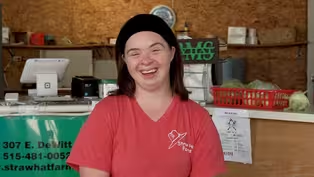
Marissa will tell you that she is the boss because she is the owner of Straw Hat Farms.
And I just work for her.
We grow some flowers from seeds.
And we grow vegetables summer into fall.
We watch the plant grow.
So when Marissa was in high school was the time we were thinking about what she would be doing as she graduates and being in a rural area, there's not a lot of opportunities for individuals with special needs to do a variety of different jobs.
We decided to pursue the opportunity of Marissa owning a greenhouse business.
It's hard to believe that Straw Hat Farms has been in existence for ten years now.
Oh, so her oldest daughter, Andrea, is married now.
So we have two grandchildren and Marissa as an aunt.
And so Grace and Sam.
Grace is five.
Sam is three.
We usually play a lot.
We play in the backyard a little bit.
Play the, uh.
football and other stuff.
Yeah, I do that.
Uh, we do the chalk.
Marissa is 29, and she loves her birthdays.
She's always saying how old she's going to be.
And she also reminds me how old I am going to be.
For my birthday.
We are going to Des Moines for my cousin.
Have a celebration for my birthday.
Uh, Ill be 29.
I have fun I guess.
When she was born, she didn't cry.
And the doctor and the nurse that was there in the delivery room, they were examining Marissa.
They were looking at her hands and her feet.
And before long they said, We think she has Down syndrome.
That sent us off on a journey.
We didn't know where we were going, but through the help of many people, we gradually learned what we needed to do to help Marissa.
Having an older sister and brother were a great plus for Marissa because those early days she followed them and she continue to follow them all through her years.
We took the approach with school that we want her included with the rest of the kids in her class.
For the most part, that worked out really well.
We always told people, especially early on, they would ask, How do you approach her?
Just approach her like you would any other kid.
Special Olympics is just really been a great avenue for Marissa to build her self-esteem and confidence.
One event was over the edge, and over the Edge was a fundraiser in downtown Des Moines, where you repelled off of the financial building.
I think she ended up doing it four times.
She loved.
That.
Well, Im not really afraid and then I went to the top and Im not scared at all.
And then I went down and thought oh its different.
2018, she and a boy from Oklahom were selected to go be the Big 12 Special Olympics athletes of the year and got to go to the Big 12 championship game in Dallas.
When you see 80,000 people standing up, giving your daughter a standing ovation at, you just soak it in.
We have done dance for probably about six years.
Five, six, seven, eight.
We learn and dance the skills and we moved the steps a bit slower for me because the easier for me to do it.
For families that are wondering what they're dealing with.
My approach has always been Marissa's probably going to be about a permanent 12 year old.
She's never going to drive, but she drives the lawn tractor.
Out in the.
Garden.
That's her way of contributing.
Some planting seeds are way too difficult for her, but she can mix dirt and prepare the pots for the seeds with the best of them.
We don't often think we're learning from her, but we are.
I like cucumber is my favorite.
And the watermelon.
And squash.
I guess I'm just proud of Marissa.
She enjoys her life and that's what we want everybody to do.
And she just reminds you about that, how simple life should be and th We've seen such a decline in community life.
People belong to fewer clubs.
They know fewer of their neighbors names.
They trust each other less.
We have fewer friends than we've ever had in the past.
And so right now is a time where we need to be purposeful about being in community with the people we live with, we can have public conversations that aren't always fights.
And we don't need to just talk at election time.
There are lots of things to talk about, lots of things that we care about.
I see them as a revival of an old tradition of public learning in the United States.
In Des Moines, its history goes back to the founding of our city.
Actually, before the founding of our city in the early 1850s.
And as soon as people moved here to Des Moines, one of the most important things on their minds, one of the first things they built was a Lyceum, which was a place where the community could come and think together.
It was founded by a farmer and with the intent of reaching mechanics, of working people of all kinds.
The idea is that these kinds of big ideas don't just belong in big coastal cities or important places or in universities, but are things that actually lots of people think about in the quiet moments of their lives.
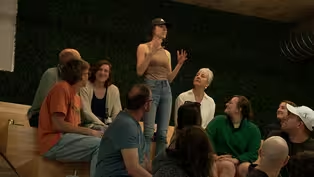
These questions about how to live well, how to govern our community well, welcome to the Lyceum movement for this afternoon on this beautiful Saturday.
I'd like to get started now.
Ill introduce our panelists.
We don't do.
The hot topics of the day where people already have sorted themselves in to boxes and already have their pre-made opinions.
We try to go deeper into the philosophical issues.
So today we're talking about artificial intelligence and something that's in the public air but we're going to try to talk about it in a deeper and more thoughtful way.
One of my worries is not so much that robots are going to replace us, but that that we are becoming increasingly indistinguishable from robots.
So at the Lyceum, we don't just hear from our wise sages on the stage, but we're going to get into small groups now.
And if you came with somebody, I encourage you to mix it up and try to go out a group with somebody you didn't come with.
That's what the shape of our typical kind of event is, is you get this expertise and this new knowledge, and then you get to really know your neighbor, understand where your neighbor is coming from, and together work towards some kind of progress on the questions that we're considering.
Now, obviously, it's not intelligent necessarily, but it's smart enough.
Because that would be a guardrail that I would love to see.
And that's what we've been doing to date, and that makes no sense.
So, yeah, we try to read the words of what somebody else is saying, the best way to use them and give it as generous and understanding as we can.
We try to look for something to love and whoever we're talking to, even if they disagree, we try to talk for the sake of truth and understanding, not for winning or for victory.
And then at the end of each of our events, we end with a toast and a commission.
Our toast, what came up a lot in our conversation was that we really do resonate with each other.
So to those nice understandings, those deeper, more qualitative aspects that come up in our human interactions that are really valuable to us.
And that's what we wanted to test for.
Our mission is that we want to build the context of hope so that when we encounter AI the context of hope and not a context of fear, the things that come out of it a lot of times tend towards a commitment to being more neighborly.
We've had multiple people who came and spoke here and they said, you know, this is so Iowa what this is says, something about the energy of it and the culture we had coach Kirk Ferentz here last night.
We talked about sports, you talked about food.
It could be all kinds of topics.
And it's been really nice to see that people have seen their lives, something missing.
And so to get around that toxicity of the online fights and instead we can engage with each other and disagree.
And so, yeah, thanks for coming, everybody.
Funding for Iowa Life is provided by the Gilchrist Foundation, founded by Jocelyn Gilchrist.
Furthering the philanthropic interests of the Gilchrist Family in Wildlife and Conservation, the Arts and Public Broadcasting and Disaster Relief.
the arts and Public Broadcasting and Disaster Relief.
Mark and Kay De Cook Charitable Foundation.
Proud to support programs that highlight the stories about the people and places of Iowa.
The Strickler family.
In loving memory of Lois Strickler to support programs that highlight the importance of Iowa's natural resources on Iowa PBS and by the Lainey Grimm Fund for Inclusive Programing at the Iowa PBS Foundation.
Video has Closed Captions
Clip: S1 Ep106 | 6m 24s | Many refugees struggle managing their trauma while retaining vital parts of their culture. (6m 24s)
Video has Closed Captions
Clip: S1 Ep106 | 6m 17s | Meet a young couple whose love story is one for the history books. (6m 17s)
Video has Closed Captions
Clip: S1 Ep106 | 4m 58s | The lyceum movement is a revival of an old tradition of public learning. (4m 58s)
Video has Closed Captions
Clip: S1 Ep106 | 6m 5s | Marissa Schletzbaum, who has Down Syndrome, is a Special Olympian from Pleasantville, Iowa. (6m 5s)
Providing Support for PBS.org
Learn Moreabout PBS online sponsorship













Support for PBS provided by:
Iowa Life is a local public television program presented by Iowa PBS