
Episode 108: Illinois Eliminates Cash Bail
2/27/2021 | 26m 46sVideo has Closed Captions
Illinois Becomes the First State to Eliminate Cash Bail
Host Bruce Rushton (Illinois Times) and guests Raymon Troncoso (Capitol News Illinois) and Dave Dahl (WTAX Radio) - Illinois becomes first state to eliminate cash bail.
Problems playing video? | Closed Captioning Feedback
Problems playing video? | Closed Captioning Feedback
CapitolView is a local public television program presented by WSIU
CapitolView is a production of WSIU Public Broadcasting.
Episode 108: Illinois Eliminates Cash Bail
2/27/2021 | 26m 46sVideo has Closed Captions
Host Bruce Rushton (Illinois Times) and guests Raymon Troncoso (Capitol News Illinois) and Dave Dahl (WTAX Radio) - Illinois becomes first state to eliminate cash bail.
Problems playing video? | Closed Captioning Feedback
How to Watch CapitolView
CapitolView is available to stream on pbs.org and the free PBS App, available on iPhone, Apple TV, Android TV, Android smartphones, Amazon Fire TV, Amazon Fire Tablet, Roku, Samsung Smart TV, and Vizio.
CapitolView
CapitolView is a weekly discussion of politics and government inside the Capitol, and around the state, with the Statehouse press corps. CapitolView is a production of WSIU Public Broadcasting.Providing Support for PBS.org
Learn Moreabout PBS online sponsorship(upbeat music) - Welcome to Capitol View, the weekly program where we talk about state politics and government and how it might just affect you.
Joining us this week on Capitol View is Raymon Troncoso correspondent for Capitol news, Illinois.
Welcome Raymond.
- Thanks for having me Bruce.
- And also Dave Dahl, long-time correspondent for WTAX radio.
Welcome Dave.
- Hello.
- Well, let's get right into it.
Illinois made history this week by becoming the first state to pass a law that does away with cash bail.
There've been other entities throughout the country that have done similar things but not to the extent that the new bill just signed by Governor JB Pritzker does.
It takes effect in 2023.
It's been strongly opposed by Sheriff's or police chiefs.
It contains a lot more than just cash bail to be sure, extra training requirements, body cams, revitalizations of the way police do business in terms of use of force and a lot of other things.
Raymond you've been covering this very deeply for a long time.
Tell us a little bit about first off.
It doesn't seem to me at least that it was a surprise that the governor had signed this bill he'd seen that no real opposition to it but the timing to me perhaps does seem interesting.
The thing that folks are most has gotten the most hype for lack of a better word is the end of cash bail.
And that's not gonna happen tomorrow.
Raymond, what's your take?
- Well, you know, when you look at the opposition to the bill, it's a lot more than just cash bail.
Like you said before, it's the reforms to use of force.
It's the new police certification system that allows for anonymous complaints to be filed against the officers for misconduct.
In terms of cash bail.
What we've heard from Republican lawmakers from some States attorneys who have opposed this specific provision is that they're actually in favor of getting rid of cash bail.
They just don't like the system that this bill replaces it with, which is what they call harm reduction system.
So now instead of being detained because you can't afford bail, what the new system is that you will be assessed on an individual basis.
Whether you're dangerous to the community or a specific person.
And what your likelihood is of appearing in court.
And then the judge will, based on those parameters decide on whether to detain you.
- Certainly, it's not something where the jails will be empty.
We will still hold folks in jail.
It's a question of trying to assess how dangerous is this person to the community.
And sheriffs are saying, I think the head of the Sheriff's association says, "Look what we had wasn't perfect.
This is overkill."
Again, the timing of it.
This will take place after the 2022 elections.
It seems, could this be set up as a campaign issue?
I mean, and what happens between now and 2023 to go from what's in the bill, to where the rubber meets the road.
- That is a possibility, the original version of the bill actually eliminated cash bail immediately.
As soon as the bill was passed and signed into law, it was going to eliminate cash bail.
However, representatives of the Supreme court actually reached out to the crafters of the legislation and said that if you try to implement this legislation we don't have a system in place that can do this.
So they actually asked the legislators, knowing that this was likely to pass for two years for the court to sort of bring together commission to decide what the actual parameters will be for judges to decide on a case-by-case basis.
From what the Supreme court has released since the passage of the bill in January before Pritzker signed it this Monday.
They've said that by 2023 they will have a robust system ready to handle this sort of massive change.
In Illinois we'll be the first state to completely do away with cash bail.
So this is treading new ground.
Washington DC also doesn't have cash bail, but compared to Illinois, you know, it's not a state, it's not as large, there's not as many jurisdictions.
So that's a completely different animal.
New Jersey has approached something similar.
In most cases, they actually don't have cash bail.
That's a reform they passed in 2017 but they still have it in some cases.
But Illinois will be the first to approach this sort of harm reduction scheme.
- You mentioned Washington DC.
There was an incident at the Capitol, I believe January 26th that involved a number of folks.
Did they just street them or did folks actually who had posed some sort of discernible danger, did they get thrown in jail, and required a bail after this insurrection at the capital.
I think they did.
Did they not?
- There were a few people arrested.
However, just because of the incident that occurred, a lot of people are being arrested in their home jurisdiction.
So they'd be under the purview of whatever bail systems are in their home state.
- Yeah, I guess my point was in Washington DC.
It wasn't a case of when something very serious happened.
It wasn't a case where, well we'll just throw the jail house doors open and everybody gets out.
Has the sky fallen Raymond in so far as anybody can see.
In New Jersey and then DC and places like that.
I mean, what's the take?
- The take is actually Republican's I've actually called the New Jersey system, the gold standard.
So when I've heard from Senator John Curran who's actually been leading the Republican opposition to this bill based on his 19 years as a assistant state's attorney in cook County.
He says that he would have preferred something more like the New Jersey approach, which that could be lip service, just because they're saying, "Oh we would have accepted a non-cash bail system just not this one."
But you know that that's been the consistent messaging that they would approve of a non-cash bail system, they just don't like what Illinois Democrats have specifically proposed.
- And they never put out in so far as I know.
And you would know better than perhaps anybody here.
It has to have the loyal opposition put out, here's a model.
I mean, here's something that could work here or have they pointed, I hate to use the word vaguely more or less to New Jersey and said, "Do it that way."
Has there been any sort of a detailed, here's a way to do this in a better way than we've seen.
And is there an opportunity between now and 2023 to address those concerns?
- Yeah, so this is something Senator Elgie Sims, one of the main sponsors of legislation.
He's a Chicago Democrat.
He brought this up as a frustration that he's willing to work with the opposition, but that they haven't proposed any specific language that they would rather see in the bill.
That's been a major frustration.
He's brought that up repeatedly.
In terms of what can be done before 2023, both the heads of the Illinois association of chiefs of police, and the Illinois Sheriff's association have said that they're already working with legislators on what they call trail legislation.
The sponsors of this bill have admitted that there's problems with it.
Some of the language may not be as perfect as some would like.
There might be a lot of unintended consequences.
This legislation is over 700 pages long.
So they fully intend to fix it by working with law enforcement on some of the technical language before it actually comes into effect.
There's a lot of different effective dates in this bill.
Some things in it don't even come into effect until 2025.
And basically they're saying that was by design.
They knew some things would be messed up, and they're gonna fix them, but that it was important to get this passed first so that we knew there was a hard date that we were going to have an end to cash bail.
- Well, we're talking about law enforcement, crime and punishment, life and death.
In some instances, Dave I'm not sure I feel personally comfortable with we'll fix that later.
Am I misplaced in my concern that we're talking about some pretty serious issues.
And I mean, it's also body cams.
I think that's one of the things that goes out until 2025 to get some of these smaller jurisdictions in line, to be able to do what folks wanna do.
When I hear trailer bills.
And I get a little nervous, should I be Dave?
- I think you should be You know, like anything else, if you think you can get it to pass.
That's time to put it to a vote.
And as far as Senator Curran goes is there a version of this the Republicans would approve.
Yeah, we would have approved it if you really.
And the other thing is it's only gonna take one non-cash bail person committing a serious crime for the Republicans and the police and prosecutors to point to it and say, "See, that's the Willie Horton of Illinois."
Willie Horton being the furloughed killer, who helped build a case for a George HW Bush presidential campaign against then Massachusetts governor Dukakis.
So it certainly fraught with possibilities where it could go wrong.
The police groups hate it.
But as I said, referring to the Republicans, what kind of things in favor of the defendants, and what kind of things that might restrict the police or in the words of the proponents, make the police more accountable?
What kinds of things would they really approve?
- No, you raise a good point.
It's not the job of the minority to come up with with here's my alternative that rarely if ever happens, I think, in Illinois or any other state.
It's their kind of job to shoot holes in whatever's there.
You got a lot of folks shooting lots of holes right now, and there's stuff in there.
I mean, you get down to the weeds of it, so to speak.
And there's bans on purchasing bayonets from the big part of defense.
I called a few sheriffs, "How are you doing on your bayonet supply?"
"We've got all we need."
(Bruce laughs) So, you know, there's that kind of stuff.
That's had the scratches, but again, there's kind of more serious stuff here in play.
Big, larger issues.
And I think it's is with trailer bills, and the 2023 date for cash bail and the 2025 for body cams.
I mean, at some point in time, maybe if you can't afford body cams maybe you can't afford to have your own police department.
I don't know whether that's- - Just us.
- Raymond doesn't it put out till I think 2025 body cams for Illinois state police.
Refresh my memory on that.
I thought at one point it did.
- So the way the bill is staggered is that by 2023 it's gonna be smaller jurisdictions.
The smallest ones by 2024 medium-sized.
And by 2025, the very, or, sorry, that's backwards.
Basically by 2023, large departments are gonna have body cameras.
And then by 2025, some of the very smallest departments somewhat less than 20 officers, 15 officers, five officers are going to need to have body cameras.
And to a lot of departments they've said that without federal money, this is a prohibitive cost.
When I've talked to the crafters of the legislation they say that the state of Illinois is providing five to $6 million for departments to move to this body camera system.
When I talked to the heads of the Illinois association of chiefs of police, they say the target number to realistically do this is closer to 10 million or $12 million annually.
- And that's for all the departments or, I mean the 10 million - Well, that's that's for all departments.
So body cameras themselves are inexpensive, but part of this law is that you need to store the actual footage for quite a considerable amount of time.
And that takes a lot of money to have that much data storage when someone's required to have their body camera on their entire shift.
And when you're talking, you know, 20, 30, 150 officers.
That's a lot of data storage.
That's a lot of money.
- Well, perhaps Amazon or Microsoft or someone else could between now and then could come up with a solution to that issue.
Let's move on for a second if we could.
Lots of other stuff going on here in the state of Illinois recently.
The replacement for Mike Madigan lasted two days or three.
I can't quite recall.
How do they screw this up?
Because it does seem like a series of pitfalls for the Democratic party.
Not that they've ever been a lockstep sort of political organization here or other places.
But they seem to be nominating folks who crash and burn or have histories.
What do you do?
What does that say about the Democratic party?
Or if anything, is this just a blip?
What do you think Dave?
- Well, what I think is interesting is perhaps we've been conditioned that Mike Madigan is above making mistakes because the gentleman who resigned a couple of days after.
I think he tried to resign Tuesday, and officially resigned Wednesday after being appointed Sunday.
You know it's supposed to be the kind of mistake Mike Madigan wouldn't make.
Is the guy that he picked with the weighted vote.
And it turned out there were many too skeletons in his past.
And I don't think it's come out as we're speaking now.
- Not to interrupt Dave but I'm gonna interrupt.
It has not come out and should it come out because there's this mysterious stuff we don't know what it is.
But go ahead I'm sorry to interrupt.
- That's what I said as we're speaking now it hasn't come out exactly what he's accused of doing.
It's apparently I'm way too thin.
And on the one hand should Madigan have known because he knows everything.
Is it some kind of devious goodbye gift to the party?
(Bruce laughs) Or was it just something that a background check wouldn't have turned up because there was no complaint about it?
No record of it.
We don't know.
Now they have now named another person, a candidate for whom Madigan agrees with Alderwoman, and former state representative Silvana Tabares.
And we're only talking about that 22nd district representative, by the way who replaced Madigan in the legislature.
You've got another thing to raise eyebrows with on Sunday they named the failed replacement, and Madigan told reporters, "I don't have any plans to quit the Democratic party chairmanship."
And then the next day he did exactly that.
So what are the underpinnings here?
What's this really about?
- And everybody has, you know, rightly so, has recognized Michael Madigan as perhaps the best politician in the way he practices politics.
- The smartest, carefullest.
- The three dimensional chess player who Spock would lose to nine times out of nine.
And so, yeah, I mean, what you just brought up was it some sort of a devious, parting gift?
Are we gonna find out more maybe about Michael Madigan?
And since he he's had to go away more or less quietly than we have.
And not quickly - And who will we hear it from?
- Pardon me.
- Who would we hear it from?
- U.S. attorney?
Is that what you'd say?
- Well, no, I wonder, I mean, who knows?
I mean, are there ticking time bombs left in legislation that nobody really knows about.
There was a sunset date that I would have taken care of but I didn't tell anybody about it.
I don't know.
I mean, but he has been such, I don't wanna use a word exalted figure because that's the wrong terminology, but he has been so recognized that his shadow lasts, his cast and lasts.
- I don't know about, you know, exploding bills or landmines that he's planted for down the road.
What I think is interesting is the process to replace place him with now, speaker Chris Welch.
How long did Madigan plan on not being speaker?
I don't think he woke up that Monday or whatever it was when we were at the Bank of Springfield center for a lame duck session.
I don't think he woke up that day and said, "Gosh I don't think I have the votes.
I better drop out.
Oh, what am I gonna do?"
He probably had an inkling back over the summer that he may not survive the election and that he had to have a plan.
- Yeah it was a plan B.
Things are realist.
Whether it's Madigan or not things around here are rarely as simple as they look.
Maybe they're in this case, but I doubt it.
- Let's not pick just on Democrats today.
What about the Republicans?
We have one new candidate for governor- - Their calliope is just as loud as the Democrats.
(Bruce laughs) - Well, I was gonna use something about banjo but I won't.
Mr. Bailey, Darren Bailey.
Republican of Xenia, is that how you pronounce it.
Illinois.
The standard bearer against JB Pritzker approach to coronavirus is now a candidate for governor.
It doesn't seem in the scheme of things he has a ghost of a chance of becoming governor of Illinois, given the politics.
But could he win the Republican primary?
I mean, is he a catalyst or just a bomb for.
- Well, his final legislature so far it's been the letter.
He's one of the people who you know wanna kick Chicago out of Illinois.
And I've gotta wonder how that's gonna resonate statewide.
And I think it's also, you know not just statewide.
But for example, you know, DuPage.
You know housewife Republican voter, now that I've offended all parts of the state.
You know it doesn't have a lot of money and the momentum he has.
I mean, it's concentrated in the lower third, two thirds of the state.
And in the State there aren't that many people in that area.
And I don't think there are that many people of that persuasion, the anti mask crowd that is.
I think there's certainly some sediment against Governor Pritzker.
There are gonna be some reasons by election time not to vote for him, just this bill being one.
The Corona virus strategy, being another.
Those are things that we can reasonably argue.
You've got now Senator Bailey.
We'll see how much money he attracts.
We've got Paul Schimph, former state Senator also from Southern Illinois.
We'll see what kind of support he gets.
And then apparently a businessman from the Chicago area.
And you know who else.
You don't need a zillion dollars to win but you're probably gonna need more than Bailey has which is in the low six figures.
- Well, generally speaking the folks that get in early are the folks that are behind and need to make up some ground from the start.
I mean, and Bailey I think is probably a good example of that.
He's perhaps wrongly, I see him as the Donald Trump stand in.
And how popular is Donald Trump gonna be outside of...
Pick a downstate County?
Maybe Trump's time has passed.
You've got Paul Schimpf obviously.
State Senator who is much more centrist compared to Darren Bailey but not particularly centrist in the scheme of things.
And it seems like other folks are keeping their powder dry.
Raymond I mean, if you had a thousand dollars to bet who's gonna be the next Republican that is going to throw us out in the ring and what are the odds?
- I don't think I'd bet on any of the current candidates in the race.
Like you said, the people who go in earlier are usually the ones who have to make up the most ground.
There's a lot of time between now and when the election seasons actually gonna heat up.
So it's impossible to say, you know, who's gonna assess the strength of the crowd and decide that they have a fair shot- - Out of the ones Darren Bailey is the best to getting publicity for himself.
And that publicity could last.
Will it translate to primary votes or it translate to dollars from the party.
You know, they've got new leadership.
We talked about the Republicans kind of re-organizing themselves.
Don Tracy of Springfield is the new chair.
- Go ahead.
- Yeah, there's a void in fundraising because Rauner's not around anymore to help fund it.
So the Republicans, I think, have a tall task to bring the necessary support behind somebody.
And will the Republicans coalesce behind Bailey and make him the guy?
I dunno.
I mean, there are a lot of people that have been in Effingham.
but you're gonna need a lot more than that to get votes.
And how many people there are out there who agree with Senator Bailey?
- I'm sorry, go ahead.
- Bailey's primarily popular or I guess famous now because of last year his challenges to the emergency COVID orders.
As next year, you know, we're gonna start seeing more vaccinations.
The orders are gonna be lifted.
It's hard to see if his popularity is going to last if it's based on such a singular issue, like COVID.
You know, people are certainly gonna remember but is it really gonna be a campaign issue?
Remember how I got my lawsuit tossed out against the governor?
It doesn't really seem like a very potent campaign strategy in the future, even if it might- - And I would agree with that.
I mean, you know, two points there I think.
For every Bruce Rauner, there's a Ken Griffin.
And I can't wait to see that campaign video of here's Darren Bailey being escorted leaving the floor of the legislature because he refuse to wear a mask.
That'll look- - Great in ear to ear.
(Bruce laughs) - Real quickly we're winding down on time.
This is a story that I had reported.
So that's all fair, full disclosure here.
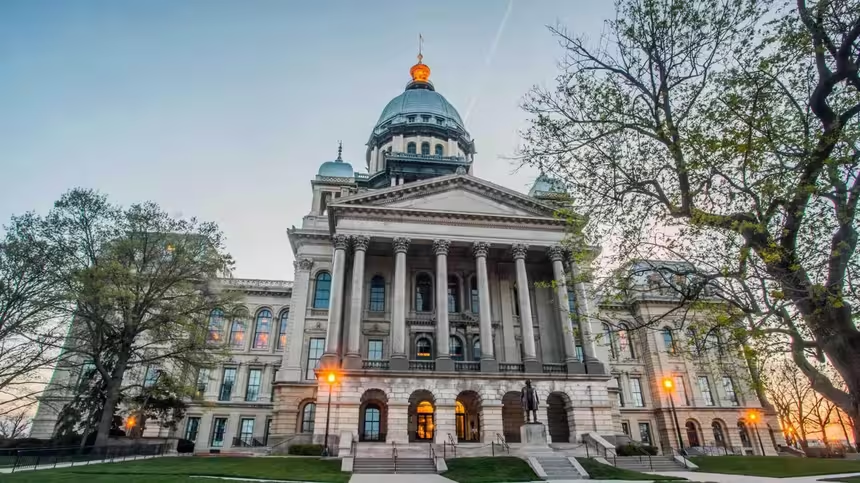
But I spoke recently with the architect of the state Capitol and said plans to renovate continue with renovations of the state Capitol building here in Springfield are full speed ahead.
And they might cost as much as $170 million.
And she wants to start work on next year.
They've taken some preliminary steps already.
Let's throw it open How's that gonna work?
In terms of we're in a state where we're a really tight budget year.
This is pursuant to capital bills that were passed.
So that's different than operating expenses.
Is this handing something to the Republicans on a silver platter or thrown out to copper door?
Go ahead.
- Well, I don't think we're gonna see one more copper door but you know, it's like having a kid.
If you can wait till you can afford it you're never gonna do it.
And we've got an historic thing.
I dunno if it's golden, but it is historic.
It's a giant tourist attraction.
It's something that we as Illinoisans should be proud of.
It's been in use since 1888, took 20 years to build.
Do we really want a shabby looking capital?
It doesn't have to have copper doors but we want it to look nice.
We want it to look historic.
We want people to come in and be proud of it.
And you know, you're not gonna have some, you know painting contractors saying 170 million.
Well, heck they'd do it for 50 bucks.
You know, exactly is 170.
We at Bruce wood and look what it look like.
It looked like it you trying to turn on your computer to start this program.
(Bruce laughs) What is $170 million bill for, and how far does that go in this kind of work?
I think before the program began we were talking about the governor's office.
You know, sweet looks a little timeworn.
I think we want things to be nice.
And if you're gonna have an 1888 building you are gonna run into some costs.
It is capital money.
And I think even though it's a flash point I'm sure it'll be a flash point for anybody, you know who wants to get that kind of publicity.
Yeah, it's an easy target.
What would you do?
Let it be in disrepair?
There is probably in disrepair on day one.
- Well, there is precedent for that as anybody who's been in downtown Springfield knows just by looking at the old state Capitol, paint's been peeling on that sucker for a long time.
Paint the old state Capitol fix the new Capitol later.
That's what I say.
And at this point in time, we are out of time.
And so thanks for joining us on Capitol view.
And we'll see you all next week.
(upbeat music)

- News and Public Affairs

Top journalists deliver compelling original analysis of the hour's headlines.

- News and Public Affairs

FRONTLINE is investigative journalism that questions, explains and changes our world.












Support for PBS provided by:
CapitolView is a local public television program presented by WSIU
CapitolView is a production of WSIU Public Broadcasting.