
Episode 109
Season 1 Episode 109 | 27m 45sVideo has Closed Captions
Explore the Underground Railroad Ride, the Groundswell Cafe and a non-profit in Clinton.
Meet a singer/songwriter in Clinton who helps people retrofit their homes, learn about Iowa’s Underground Railroad from a unique perspective and visit a cafe in Cedar Rapids that is providing fresh, healthy meals to those in need.
Problems playing video? | Closed Captioning Feedback
Problems playing video? | Closed Captioning Feedback
Iowa Life is a local public television program presented by Iowa PBS
Episode 109
Season 1 Episode 109 | 27m 45sVideo has Closed Captions
Meet a singer/songwriter in Clinton who helps people retrofit their homes, learn about Iowa’s Underground Railroad from a unique perspective and visit a cafe in Cedar Rapids that is providing fresh, healthy meals to those in need.
Problems playing video? | Closed Captioning Feedback
How to Watch Iowa Life
Iowa Life is available to stream on pbs.org and the free PBS App, available on iPhone, Apple TV, Android TV, Android smartphones, Amazon Fire TV, Amazon Fire Tablet, Roku, Samsung Smart TV, and Vizio.
Providing Support for PBS.org
Learn Moreabout PBS online sponsorshipComing up on this episode of Iowa Life.
Learn how a Cedar Rapids nonprofit fights food insecurity with a pay it forward system.
Join us on the Underground Railroad ride and gain a new perspective on the freedom seekers journey.
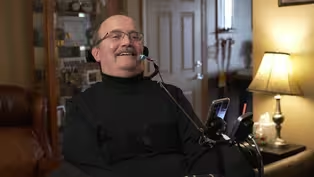
And meet Greg Fier a singer, songwriter, volunteer and disability advocate in Clinton.
It's all coming up next on Iowa Life.
Funding for Iowa Life is provided by the Gilchrist Foundation, founded by Jocelyn Gilchrist, furthering the philanthropic interests of the Gilchrist Family in wildlife and conservation, the arts and public broadcasting and disaster relief.
Mark and Kay De Cook Charitable Foundation proud to support programs that highlight the stories about the people and places of Iowa.
The Strickler family in loving memory of Lois Strickler to support programs that highlight the importance of Iowa's natural resources on Iowa PBS.
And by the Lainey Grimm Fund for Inclusive Programing at the Iowa PBS Foundation.
In many ways, Iowa is the land of plenty.
We produce about 10% of the entire U.S. food supply.
But some Iowans have difficulty accessing the food they need to live their fullest lives.
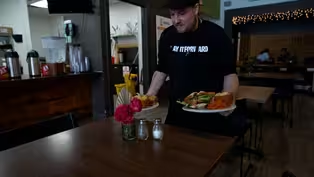
In Cedar Rapids, the Groundswell Cafe hopes to make a difference by providing affordable and healthy food in Iowa's second largest city.
We do soups, we do sandwiches, we do salads, we do smoothies.
We're cafe that focuses on organic when we can local food.
We have a farm, so we try to incorporate as much fresh produce.
We cater to the downtown business crowd and professionals and people who live in the condos and also anyone who can't afford a meal can come in and eat for free.
The Groundswell Cafe operates with a pay it forward system.
Customers with the ability to pay have the option to leave a tip that goes in the Pay it Forward fund.
Anyone who needs a free meal can grab a card on their way in and order off the menu.
I have been working at Groundswell for a year and a half.
I want it to look really nice so when people come in here that's what they see.
I've been homeless for a couple of years and so between the derecho and between Covid, I went through a lot of different changes.
The concept is providing dignity and healthy food and a space where people can enjoy themselves when they may be having a hard time otherwise in their lives.
And that may include homeless folks or people who are unhoused.
It may include people who are just going through a difficult time.
I've had people the first time they come in, a lot of times they just they've literally said, I I'm I'm so sorry.
Like, I'm I'm really ashamed to say this, but I don't have any money and I need a meal.
And I'm like, no one should feel bad that they're hungry.
No one should feel like they did something wrong.
No questions asked is the first step to saying you're welcome here.
Whatever reason that you came.
So I was a chef for about ten years and I'd been feeding the very wealthy for a long time.
I was really excited to feed everybody with the same care and quality.
And we also have what we call the community table.
We have puzzles that get started.
It's a good way to break the ice for a lot of people to come in here that might be intimidated by some of the things that are going on or think that they're not good enough to sit in this restaurant, which is not true.
Currently out here with my friend working on a puzzle.
About two and a half months ago me and him met right here, and we've been friends since.
Its actually a great place to meet people in.
Its also a really good place to find out information.
I think it was 2019.
I was staying at the overflow shelter and theyd only been open for a short time.
And one of the guys there was like, Hey, you, you ever been here to eat?
I thought maybe the hipster crowd would probably look at me and think, Oh, stay away from him.
But, no, everybody here was nice.
The Groundswell Cafe is operated by Matthew 25, a nonprofit organization that focuses on the strengths of the Northwest neighborhood.
We're at the Cultivate Hope Corner Store in Cedar Rapids, Iowa.
We're just trying to bring healthy food into this neighborhood for people to have a greater access to fresh foods.
We're in an area that's had some crime problems.
That building had originally 100 years ago been a grocery store.
Then it turned into a series of bars and just it was the highest crime corner in the neighborhood.
So when it came vacant, we said, we need to buy this and think about putting something positive in there.
We have a small area for free produce.
We aren't a food pantry, but we want to be able to provide people with fresh produce to help them stretch their food dollar.
Some people have a hard time being able to make ends meet.
We also know food security, strangely in this country is tied to obesity and diabetes because all of this unhealthy food is what low income people often are able to afford and access.
The Cultivate Hope Corner Store is in an area known for being a food desert, which means residents are more than one mile away from healthy, affordable food.
Not many businesses would actually build a grocery store in this neighborhood.
There are a lot of people that live in this neighborhood that have limited transportation or no transportation at all.
So by being right here, people can, you know, walk to the store to get their food items.
Just in my time here, I've seen that, you know, there is a great need in this community and in this area.
A lot of people are struggling.
So doesn't take very much for for one small thing to happen in your life for to become a snowball and you just don't know what to do or where to reach out.
What I see is, you know, we just want to be able to to help people as much as we can.
And we do that through food and we try to do it in relationships with people as well and and try to be neighborly to the people that live in this community and the people that use the store.
Here we go.
My name is Eugenia DeMello.
Um, I've been in the United States for 20 years, and I'm Kamilla Freeman's mom.
Ok, Kamilla, see we have friends over.
-Seriously?
-Yes!
and they want to know about you.
How old are you?
Camila Freeman.
Im 14.
And how old are you going to be on your birthday in September?
Oh, 15.
That's right.
What do you usually do for your birthday?
Do you have a party?
Do you invite your friends?
Friends?
Friends.
Kamilla was born on her due date and she hit all her milestones, somewhere around her first birthday, we noticed that she was not really sitting up or she was really, really small for her age at the time.
We addressed that with our family doctor, and we were referred to Iowa City Center for Disabilities and Development.
We met with different specialists they just said, you know, it was developmental delays.
I asked for a referral to Mayo Clinic, and they found that she has spots on her brain.
And the kind of an official verdict was that it's not genetic, it's possible brain damage.
Almost every day we had at least one therapy.
Either it would be occupational and physical or speech therapy.
I'm originally from Turkmenistan and my first language is Russian.
it was important for me to have Kamilla speak Russian.
However, when we started going to the speech therapist, I had to make a decision to speak English, and I make sure that she speaks at least, or understands at least, one language.
Where do you go in August?
High school?
High school!
That's right.
Is that your first year in high school?
Do you like doing chorus and band?
Yeah, of course.
Band is best ever.
She makes friends at school in the same class.
But then those kids grow up and they change and they have different priorities, different friends, different interests where Kamilla kind of stays behind in this early childhood.
So every summer, Kamilla goes to... -camp.
What's the name of the camp?
Camp Sunny Side.
-Thats right.
What did you start doing at the camp?
Did you start writing these stories?
Yeah.
She will tell the story and counselors would write them.
Once upon a time there was King Max and Queen Emma and baby Kamilla.
Well, then lightning strikes in the castle.
Our team members who support the role of summer camp counselor come from all over the world.
And when we ask our counselors why do you come back year after year, they will name you specific campers, and they're the reason why.
And time and time again, Kamilla is that camper.
Last November, Kamilla got... -award.
It's a Spirit award.
-Yeah, -Where did you get that?
-Because were you... -drink -kind or were you not kind?
-Kind!
-You were kind.
Were you happy or you were not happy?
-Happy!
-You were happy all the time!
Were you friendly to all your friends?
-Yeah.
-Yes.
We tried dance without limits, I think, at least seven years ago.
And she just struggled so much.
I think I want her more to dance than she actually wanted to.
And this time she did it.
She did it.
And she had such a great success.
So a lot of things that were tried when she was younger.
I try to try it right now because the way she looks at the world a little bit differently and it's not scary anymore.
What kind of musical are you going to do for the theater?
The High School Musical?
Yeah.
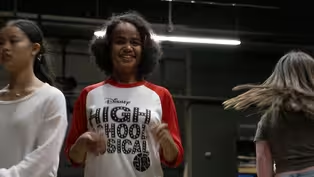
Kamilla is a part of 28 penguin artists that are doing a high school musical junior here at the Des Moines Playhouse alongside their peer mentors.
When we first started this process, Kamilla was a little shy, she has blossomed into this thriving artist here on our stage.
What I've learned because the world of people with disabilities, it's a new for me as well.
I never grew up around disabled people or not on my close family had any disabilities.
So I, I grew with Kamilla.
And one of the things that I noticed with Kamilla and I think that greatest thing about her, that she sees people differently than anyone else she doesn't have this jealousy judgment or that's not part of her personality that that innocence.
But I think main thing you, you will need to be your advocate for your kid.
Maybe be entire their life.
When you grew up and you're going to be big are you going to finish high school?
Who you want to be Kamilla?
-I be a scientist.
What kind of scientist?
And an inventor.
You're going to invent something What are you going to invent?
A potion.
A potion?
-Yeah.
Is that what that potion going to do?
Is it going to give someone super powers, or make someone better?
-Super powers.
From evil scientist.
What kind of super powers your potion going to have?
Super strength.
I don't know how her disability is going to play out when she's 18 or 25.
When her brain is fully developed.
So a lot of unknown.
So that is why we're going to just, you know, live day by day and enjoy her the way she is, you know, and she's incredible.
When you're out there and it's just you and your bike, things are happening within you.
Change is happening.
Things are going on.
My big takeaway that I want riders to have and to experience is really thinking about not only the people that helped those freedom seekers along, but really what did those individuals look like?
Those folks that were coming, what plantation did they come from?
What food were they carrying?
How many miles were they traveling?
Who did they have with them were they alone or were they a family?
I want people to take their stories because we haven't really put a lot of time on who they were as people, not so much as being enslaved people, but people.
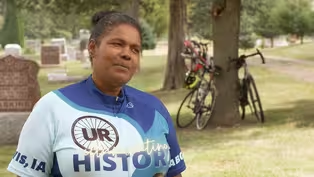
In the fall of 2023, on an idyllic weekend in southwest Iowa, a group of bikers set out on the inaugural Iowa Underground Railroad ride, a bike ride honoring the journey to freedom enslaved people took in the mid 1800s and Iowa's place along that route.
It's a two day ride, and we ride from Tabor, Iowa, out to Lewis.
We picked Tabor as one of the destination because of the Todd House, and that was a point of entry for some of the freedom seekers that came through there and stayed at Reverend Todd's house and they helped move them through.
In Lewis, where we ended up, they have the Hitchcock house there, and it was one of the other homes that helped those freedom seekers find their way to safety.
It is a fun ride.
There is an element in there that we want you thinking and we want to build on what you already know and maybe offer some things that you did not.
It's difficult to get an accurate picture of the underground railroad's history.
With freedom on the line, it was too dangerous for escaped slaves and those helping them to document the journey.
The ride is bookended by two homes that are well known for having been outposts for those seeking freedom.
The Todd House and the City of Tabor may have been one of the first stops in the state for freedom seekers traveling north from Missouri.
One of the town's founders, Reverend John Todd, was adamantly opposed to slavery.
George Hitchcock was a stonemason and abolitionist.
When he built his home in 1856, he included a secret room in the basement.
From the Hitchcock House in Lewis, escaped slaves would travel north and east toward free states beyond the Mississippi River.
Both homes had hiding places built within their walls, but most often, freedom seekers would find refuge in outbuildings, barns and the abundant prairie grass.
There was no actual train on the Underground Railroad.
Escape slaves would travel by foot in the cover of night.
I was sitting there thinking about the fact that you had these people who were enslaved were seeking freedom just to live their lives following a path that they might have taken granted.
The roads weren't paved, but being able to just to see the land and the places where they resided, where they moved, and thinking about how they would move through darkness, they would have to deal with the terrain and that they were willing to risk their lives to be able to live their lives.
It really gave me a perspective as I'm riding, I'm thinking, all right, what do I think about when I'm riding?
They're thinking about their safety, all right?
I'm thinking about my safety as these cars are passing by.
They're thinking about just making sure that they are aware of the environment around them, checking for potholes or making sure I don't go off the road.
It's definitely not the same in comparison to what they went through, but you get a better feeling for what it might have been like having to traverse the terrain.
Talk about people being brave and having courage, and that's the epitome of it.
To be able to see a place where, you know, people were fighting this fight was really, really impressive.
It's not a history that's really talked about or highlighted or celebrated enough.
The 68 mile bike ride gives riders the opportunity to connect with an important piece of Iowa's history.
History is instrumental in knowing who you are and having the identity that grounds you.
The reason for the ride is because riding is fun.
It's something I love to do.
So what better way than engage people in something that they already love and immerse them in history in a way that they may not have experienced before.
If you know ten people with multiple sclerosis, you know, ten different stories.
It's a low percentage of people with MS that wind up like this.
And MS - no movement, you know, from the shoulders down.
But it wasn't until 1995 that I was diagnosed with multiple sclerosis.
The thing that really got me at first, I used to golf a lot and finally a walk on a round of golf just got to be really hard to do.
My ankles would just get so sore.
I started a band back in 1990 called One Brick Shy.
Yeah, that just came a time where I just couldn't stand through the whole gig.
Finally, just came to the terrible realization that I had to retire from music.
You know, truly, it was my identity.
You don't determine a multiple sclerosis.
You basically eliminate all other possibilities.
Multiple sclerosis is lesions that form on the myelin sheath of the nerve endings and sort of like holes in a garden hose and disrupt the flow of the signal around the brain and from the brain to the rest of the body.
In 2011, I was telling people about SmartNav, its a hands free mouse.
Maybe notice I got on my glasses.
There's a little piece of kind of reflective tape.
Well, this I have a special camera on top of my computer that follows us so I can move the cursor around just by moving my head.
A friend who was standing behind me I didn't realize he was there, said hey, can you do emails and and Facebook with that?
I said, Yeah, lots more things.
And he said, we got to get one of those for Bob.
And I said, Bob who?
Bob Finch, who has MS and is living in a nursing home.
Another great friend, Dave Leighton, took me over there to see him at the nursing home.
And while I knew where Bob was at, he was like me.
And then one day, as we were, as Dave Leighton and I were leaving Bob's room, Dave said, He recalls that I said, boy, he doesn't have to live like that.
Because I remember not being able to change the channel.
I joked, imagine getting stuck on the Lifetime Channel all night.
The horror.
We'll get him hooked up so he can, you know, run the lights and the TV and let's let's get him a laptop and one of those SmartNav cameras.
And Dave said, well, you know, yeah, how are we going to do that?
I thought, we'll just email all of our friends and tell them what's up and see if theyll donate some money.
And man, and tell them what's up and see if theyll donate some money.
we figured we needed about $1400 dollars and we had well over 2000 before we knew it.
In 2017, Bob Finch passed away.
So the notion just hit Dave, why don't we take this memorial money and what's left of that money in a bad fund and put them all together and create an actual 501C3?
We just try to get people together, let them know that their life isn't over, that it's just going to keep going.
And and I've had MS since I've been 22 and I'm much older now, and that's kind of what this whole event is about.
You know, life is not over just because of a diagnosis.
The events like this do two things.
First and foremost, I think awareness is critical.
Increasing awareness helps people understand needs of their community members, but also it helps with that early intervention.
Raising funds is really important.
We need to raise funds to accelerate these cures and to provide the programs and services that we do for people.
And I guess I'd add a third part, which is community building.
Our tagline for our walks is Stronger Together, and these are moments where people can come together and feel like they're not alone.
Right.
And that's really, really important.
I think maybe probably the most important thing is to have a sense of community.
For the Finch fund.
Our mission statement is to provide resources.
People are aware of MS. To help them maintain their independence.
And quality of life.
Right now, 35 different projects The Finch Fund has granted money for totaling a little over $91,000 in our five years.
We're really proud of that.
Anything from a grab bar and a shower to a ramp, just being able to stay like for me at my home is everything.
Being able to live out in the community and experience things, it just gives me peace of mind.
Hi, my name is Greg, and we're going to demonstrate for you a little about the process of writing and recording a song you're about to hear.
I know I played some piano and I'd written some things years before that.
I found some software.
I could actually write the sheet music out and it would play it back to me.
And then I well.
I have a terrific friends that would come in one at a time.
And, you know, maybe play a guitar part.
Gave me a chance to express myself again, and I spent a lot of time concentrating on things that I'm grateful for.
And it really does help to yeah, its huge to have independence.
Iowa wherever I may roam.
Cradled by two rivers I, will always call you home.
Funding for Iowa Life is provided by the Gilchrist Foundation, founded by Jocelyn Gilchrist, furthering the philanthropic interests of the Gilchrist Family in Wildlife and conservation, the arts and Public Broadcasting and Disaster Relief.
Mark and Kay De Cook Charitable Foundation proud to support programs that highlight the stories about the people and places of Iowa.
The Strickler family in loving memory of Lois Strickler to support programs that highlight the importance of Iowa's natural resources on Iowa PBS.
And by the Lainey Grimm Fund for Inclusive Programing at the Iowa PBS Foundation
Video has Closed Captions
Clip: S1 Ep109 | 6m 45s | Greg Fier is a singer/songwriter battling multiple sclerosis. (6m 45s)
Video has Closed Captions
Clip: S1 Ep109 | 5m 59s | Matthew 25 is reducing food insecurity by providing fresh, healthy food to those in need. (5m 59s)
Video has Closed Captions
Clip: S1 Ep109 | 7m 3s | Meet Kamilla Freeman, a 14 year old who loves music, performing and more! (7m 3s)
Underground Railroad Bike Ride
Video has Closed Captions
Clip: S1 Ep109 | 5m 4s | This ride gives participants a unique lesson on Iowa's role in the Underground Railroad. (5m 4s)
Providing Support for PBS.org
Learn Moreabout PBS online sponsorship













Support for PBS provided by:
Iowa Life is a local public television program presented by Iowa PBS