
Episode 110: Redistricting, Covid-19, Budget, and More
3/19/2021 | 26m 46sVideo has Closed Captions
Discussion on redistricting, relaxing Covid-19 restrictions, the budge, and more.
Host Bruce Rushton (Illinois Times) and guests Amanda Vinicky (WTTW) and Dave Dahl (WTAX) discuss redistricting, relaxing COVID-19 restrictions, the budget and decoupling, cannabis bill, and Republican candidate for governor Paul Schimpf.
Problems playing video? | Closed Captioning Feedback
Problems playing video? | Closed Captioning Feedback
CapitolView is a local public television program presented by WSIU
CapitolView is a production of WSIU Public Broadcasting.
Episode 110: Redistricting, Covid-19, Budget, and More
3/19/2021 | 26m 46sVideo has Closed Captions
Host Bruce Rushton (Illinois Times) and guests Amanda Vinicky (WTTW) and Dave Dahl (WTAX) discuss redistricting, relaxing COVID-19 restrictions, the budget and decoupling, cannabis bill, and Republican candidate for governor Paul Schimpf.
Problems playing video? | Closed Captioning Feedback
How to Watch CapitolView
CapitolView is available to stream on pbs.org and the free PBS App, available on iPhone, Apple TV, Android TV, Android smartphones, Amazon Fire TV, Amazon Fire Tablet, Roku, Samsung Smart TV, and Vizio.
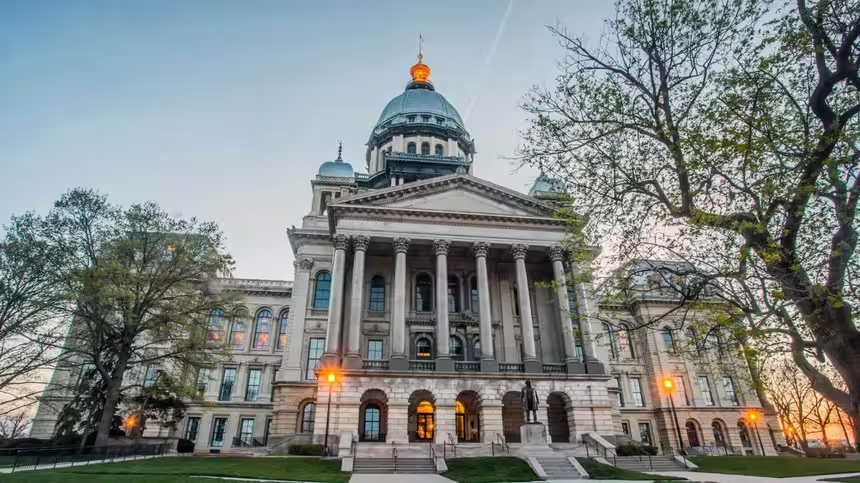
CapitolView
CapitolView is a weekly discussion of politics and government inside the Capitol, and around the state, with the Statehouse press corps. CapitolView is a production of WSIU Public Broadcasting.Providing Support for PBS.org
Learn Moreabout PBS online sponsorship♪ (upbeat music) ♪ - [Bruce] Welcome to "Capitol View," the weekly program where we just talk about state politics and government and how it might just affect you.
Joining us this week on "Capitol View" is Dave Dahl, Statehouse Reporter for WTAX Radio.
Welcome, Dave.
- [Dave] You're looking good, Bruce.
I'll take two scoops of chocolate there.
- [Bruce] Hey, I'm out of it, but got lots of a strawberry left.
And also, Amanda Vinicky, corespondent with WTTW television in Chicago.
Welcome, Amanda.
- [Amanda] Thanks so much for having me, Bruce, and I of course prefer chocolate ice cream, if you're asking'.
(laughs) - [Bruce] Well, I'm a pistachio guy, but we can get that figured out later.
- [Amanda] Whoo!
All right.
- [Bruce] This, going on now in the Flavor of the Month Club at the Illinois state legislature, many things are happening.
Number one, let's start with redistricting.
This has been a topic of concern, not just here in Illinois, but all around the nation, as the census numbers come in and lawmakers are being asked to divvy up the state in districts that would promote democracy and make things good.
Unfortunately, the census numbers are lacking, and here in Illinois, we have to get this done by, I believe, the end of June.
Otherwise, it could be thrown to a bipartisan commission that would include both Republicans and Democrats.
Is that- - [Amanda] Bipartisan?
(gasps) The horror!
(Bruce laughing) - [Bruce] The horror, well, since you brought it up, Amanda, (laughs) how likely is this to happen?
What's the endgame to this?
- [Amanda] So, bipartisan in that right now, because Democrats control supermajorities, of course, in both chambers of the legislature, as well as the governor's office, and frankly, every other statewide office, that they would be able to draw the map on their own, and they would say, taking into consideration input from Republicans, as well as a whole lot of other organizations, entities, experts, et cetera.
But right now, they can draw the map, really, themselves, and that is challenged because due to the coronavirus, also, I suspect, some of the legal back-and-forth, transition at the federal level from the Trump to the Biden administration, they're not getting the data that they need.
Normally, you would have staffers in a back room, concocting all sorts of different situations, districts in one shape and another, and sort of figuring this out.
they're not really able to do that, but...
So that's the complication for Democrats, if they want to give up that power, or they don't want to give up that power, it seems.
And so right now, they have heard some of the options for how, without that data or with that data coming later, what they can do, so maybe, you know, drop a map based on best guesses, other estimates, and then worry about fixing it, fine-tuning it later, and that would really allow Democrats to be able to have that control, ostensibly to draw maps that give them a little bit of favor at the very least, or a whole lot of favor, (chuckles) depending on who you talk to.
That's really what's at stake here.
- [Bruce] Okay, and so, yeah, it is, you know...
The governor, J.B. Pritzker has said, "I want a fair map here.
I want something that's gonna work for everybody," but we're not getting the sense...
I guess, perhaps, I would be surprised if the Democrats said, "You know what?
Because this year is so different, let's everybody sit around the table and say 'Kumbaya,'" and might lawsuits be likely?
I mean, might somebody go to court over something like this, ultimately?
Has that ever happened before?
Well, of course it's happened before.
So what do you do, I mean, is there any way out of this, in a sense, you know?
Or for the Democrats to be able to say, "Look, it's been problematic, but we did the work of the state on behalf of what's best for everybody," keeping in mind that Harmon,ú I think, recently said, "It's not...
Some of the weird-shaped districts aren't necessarily bad.
We need them to promote equity," and that is in some sense, true.
Folks, neighborhoods, are different.
Can they emerge from this with looking good, or will it inevitably be another, okay, this is a partisan map, what do you think, Dave?
- [Dave] I think it'll be the latter, because people like to find things to complain about, and some people are quite good at that, and hearings are underway, but there aren't very many of them scheduled, and that has some people concerned, as well.
- [Bruce] Sure, yeah- - But I'm inclined to think that we'll get a lot of complaints.
- [Bruce] Fair enough, yeah, and as you say, Amanda, at this time of year, folks are supposed to be in back rooms concocting things.
(laughs) - [Amanda] Sort of a mapped motion, if you will.
Yeah, you know, Bruce, I mean, it's sort of one of those things where I think there is going to be criticism from perhaps, no matter... From some of the good government groups, potentially, but it really depends on what this map looks like.
And again, when you have Democrats in supermajorities, they're not really going to point fingers at one another.
And so I think that also, one of the primary focus, as you mentioned there, is equity.
We're going to see how this plays out as Illinois' black population is dwindling some, and the Latino population is on the rise, how that's going to look, what that will look like in Chicago.
That might be where you really have some voices that get strong in this.
That said, if many of the organizations that really are concerned with representation of blacks, Latinos, people of color, diverse voices, if they work with Democrats, and Democrats sort of protect those interests, well, sure!
They're not going to perhaps complain at the end who you would have complained at the end, instead, would, again, be more Republicans, if they lose out on any districts, particularly at the congressional level, this isn't just the statehouse, but their voices are not as strong and loud, as is evidenced again by the fact that they're a superminority status.
- [Bruce] Oh, and it's not simply, I'm glad you brought this up, I mean, because at the federal level, we're likely going to lose one representative in Congress, given how population has gone, and there's concern about that, I think, downstate.
Certainly, Rodney Davis is keeping a close eye on this because who knows who he might be cast into a battle with.
And so there's speculation that redistricting could force his hand in terms what happens in the future.
Whether this could affect, perhaps, on a state level, again, downstate we have a very... Andy Manar's former district...
I'm not sure anything's gonna happen with that.
At this point in time, it would seem to be staunchly Republican.
Is there anything that might happen in the offing that might be able to affect the likelihood of who might prevail in the coming election through redistricting?
So I don't think it's just a Chicago issue.
It's an issue- - [Amanda] No.
- [Bruce] Practically everywhere.
- [Dave] Well, I think it's, for sure, as you indicated, that one of the five Republican members the delegation is going to be left standing when the music stops, just question which one and when do you hear who it might be?
You know, at first when Shimkus said he wasn't gonna run again that might've been an obvious choice.
The vacancy now felt by Congresswoman Mary Miller but it could be any of them Boss, Kinzinger, Davis, or well, Hood.
- [Bruce] Yeah.
Yeah.
It will be interesting, you know, obviously to see.
And for right now, it seems like the Democrats, is as always whether it's, you know, the party that's in power gets to deal the deck and start the game.
So we'll see how that obviously, again plays out later today, we're taping but by the time this comes out we might know more about it, but already we know a bit this COVID restrictions on the way to be relaxed by governor JB Pritzker, who has taken quite a bit of heat in the past year for the measures he's taken, which he's been accused of of shutting down unnecessarily economic prosperity.
There has been spawned some, a measure of of candidates, politicians who are, have pointed out things that they believe to be wrong in the handling of the COVID crisis.
And, now we're kind of on, you know hopefully fingers crossed we're seeing the light at the end of the tunnel.
Will we be able to watch Bacher, Cubs games Lollapalooza?
How, I mean, again, we think that these things are going to be relaxed in some respect if you're the governor, can you claim victory out of this?
Or is this just, well, you know this was a worldwide pandemic and we were cast in the ocean with everybody else.
- [Amanda] First.
I think what you're asking is really like are we going to be able to have any fun is what that sounded like?
And I think that really, again, this is a nobody runs for office thinking that knowing what they're going to handle, at least of all a pandemic, certainly some very difficult decisions.
And as you noted, there are some folks that are very angry at governor Pritzker for taking so strong a hand to others that are unduly thankful or that are that are incredibly thankful, not unduly.
So for his taking all the precautions that they did to protect people's lives because clearly this is a virus that is no joke.
But now that we are at a point where the phase five was supposed to be reopening and when you read the state's guidance, that says when there's a vaccine it doesn't really give any metrics for how many individuals what percentage of the population needs to be vaccinated.
And I think that's where even those that have stood by the protections are saying, Hey, wait a second.
We had all these metrics for shutting down.
What about opening back up?
Because as it stands, as of this taping the phase four revitalization period where I think gatherings are only, you know, 50 people 50% capacity in restaurants, that sort of thing that that's too strict given that cases are on the decline and more and more people are getting the vaccine.
So we're going to get this sort of bridge this intermediate phase.
And I do think that's where you're going to perhaps see some conventions allowed because the governor has talked about that.
Now it seems as if every breath where he says, yes, we're we're ready to ease up.
He also has the asterisk, the caveat of, by the way that and this is something that I know I've heard from folks that are really frustrated.
They see it as him trying to usurp power, and just sort of scare people.
He says, uh-uh, I'm not kidding that when you talk about these variants, that is another time when we might have to God forbid, roll back again.
So one thing to keep in mind, no matter what changes those masks are here to stay for quite some time.
- [Bruce] Certainly, I mean, he has been, I think Pritzker to some degree has been the Andrew Como of the Midwest without certain other baggage.
I.E I'm taking a very conservative approach here.
I'm taking a worst case scenario.
And as opposed to other states, notably, Texas, I think which is entirely reopened and Florida which never really shut down.
And at least to the extent that we have.
And so as this, as we go on into, I mean, we always look at in the campaign season, is this going to be, I mean is it too early to say that, that the governor couldn't can say this is a merit badge on my sash in terms of why I should remain your governor?
- [Dave] Yeah.
I think he wants to be careful about that.
What do you think of all the people who have, you know, have been sick and dying?
I think the governor is too smart to forget about that.
- [Bruce] Yeah, no, absolutely.
You know, let's move on for another second because COVID, you know, again, Hey and before we leave, everybody raise their hands.
Who's gotten vaccinated.
Okay.
Sorry.
(Bruce Laughs) You have not Dave.
- [Dave] Not yet.
- [Bruce] Not yet.
Okay.
Well, I, you know, God speed on that.
Moving on.
Let's talk about the state budget here for a second.
There's a hole in it, and there's been much talk about so-called decoupling, which has been rejected-was rejected, in the lame duck session, is this the zombie issue that won't die or how, you know, the the repo- it's called decoupling, which is a lot hard for a lot of folks to understand what exactly is that and what it really is in so far as we can all discern is that it's, if decoupling occurs, then certain business owners might have to pay more in taxes than they otherwise would.
What do we think is it, is this something that Pritzker can push through at this point?
Or does he need to push it through given the the a $1.9 trillion relief package recently enacted by the federal government - [Dave] That does buy you some time, You know, anytime you see something that looks like a tax increase the Republicans are going to say, well, we told you so and they had sold the graduated tax amendment as a tax increase, this, that, and the other.
I think the governor realizes he really can't win when it comes to the Republicans.
And for whatever talk is about bipartisanship.
I think for the most part the two years he's been governor he's he hasn't had to deal with them.
And I don't think he's suffered too much from that.
And as far as the politics go, we'll see who they are.
Republicans can put up there.
- [Bruce] It wasn't the Republicans who said no during the lame duck session.
Go ahead Amanda.
- [Amanda] Yeah.
I was going to say this one to me Republicans certainly did throw a stink.
And especially because they say that this was one of the big bipartisan deals that they'd made with the Pritzker administration.
And they see this really as a bait and switch after coming to an agreement this is part of the capital bill, all these taxes that's part of the, this broader issue.
Then there's the decoupling as well, which like, you noted is confusing, but it comes as taxes are already here.
So some folks say it's too late.
I think that it's not just Republicans who Pritzker has a problem with.
There certainly are some Democrats who see this as problematic or also have some frustrations with the governor.
And that's part of why he was not able to force this through during the lame duck session.
If he doesn't get it done now.
Yes, I think at some point soon, I'm no tax expert but one would think that time would be running out to get this done given that despite the feds delaying the deadline, some people are really doing their taxes like now in businesses, especially are doing so.
So time is running short.
(Dave speaks over Amanda) - [Bruce] Good point we've got a respite, but but I get a refund this year.
I'm hurrying up.
But yeah, I mean, it, is, you know it can't last for forever.
If you can get some sort of a if you can get rid of the decoupling issue through some other means it would seem something since a lot of folks don't understand it to begin with.
And it can be difficult to, to explain if there's some other exit, it would, it would help.
On the other hand, if that leaves a large hole in the budget, you gotta get it done.
And Amanda, your point is good.
I think he's not at war just with Republicans.
They're they're Democrats have not been in lock step with this governor.
And there've been several examples of that.
Let's talk about cannabis here.
As one example, if we could, there's been multiple attempts by the Pritzker administration to correct to fix in in a good way, a bill that has proven not to be what it was built to be when it was, it was passed he has been unable to do so.
Now there has come another effort at this is this a state, could this become central?
Is this, is this death by a thousand cuts?
Or how big of an issue is this that you can't get a signature measure.
And this was a signature measure for the governor to be what he wanted it to be.
- [Dave] Well, you know, the cannabis is a thing, it's bringing in a lot of money.
And, you know, I think if you go out and, you know go out to the old state Capitol Plaza, find 10 people, explain the story to them and then record their reaction, I'm not sure if that many people are gonna say, yeah the fact that they really haven't come through on the minority ownership licenses that that strike the governor down.
I'm not sure that's an issue that resonates, you know, statewide.
What are you guys thinking?
- [Amanda] Yeah, no, I think that for people who wanted cannabis to be legal that's happened they there's places to buy it, very easily.
And so that isn't a problem for the public at large it is a problem potentially with a key constituency.
And that of course is both primarily, actually black legislators, as he's looking to get the rest of his agenda through, who are incredibly frustrated about this from the first time in that there hasn't thus been a correction.
So I think if this gets fixed soon, and the administration is going to have to give up some control, we're going to see perhaps more pot shops coming than had previously been considered that might make things happen and turn and bring black legislators on board.
They are very happy.
I think one of the critics really on this has been representative LaShawn Ford.
And this was interesting because the governor has and is expected to continue to sign into law the black caucus major agenda.
And when the governor was signing recently the education bill representative Ford said, "Hey I complain a lot to the governor about the governor.
I admit that I'm going to keep it up."
But this, he said is Pritzker's LBJ moment.
And that was clearly a strong endorsement of Pritzker.
So yes, this, this is a bit of an albatross but it's not going to drag him down.
- [Bruce] Nope.
And fair enough.
It is, you know, and it's just what- we have not seen the language of the bill at this point in time.
What we've been told broadly is that it would result in I believe 115 more dispensary's being allowed to open in the state of Illinois, which would be roughly double, And don't hold me to the math exactly, roughly doubled in what we we have now, which are controlled by a very small set of interests many of them insiders and folks, who right now have to some extent a government subsidized near, near monopoly.
It does not address who produces the product.
It does not address in so far as we know who will grow the marijuana that would be sold at these dispensaries.
And that's just one that is probably a primary issue.
But again, I think, the point is well taken into the average person, you know, it's, is it legal or not?
I don't care about the details on a broader level.
It strikes to how does the government in Illinois- because this money does matter.
At some point, the more revenue we can produce the more revenue that we can devote to social equity issues.
And so the black caucus does, and they stand to and their constituency stands to benefit directly from the growth of the cannabis industry not just on the, I can sell it, but there's something for those communities in terms of how the revenue from tax collections will be spent.
So it's an interesting issue.
And it's not going to be over anytime soon.
I don't think, but if it's not an albatross, it might take a while.
Let's talk for a second about a Republican candidate for governor Paul Schimpf who this week issued a press release saying all of my senior staff are women.
And how consequential is it?
It didn't get a lot of splash, you know, there wasn't a lot of folks saying, you know, what a great progressive step to take?
What does it say that he would eat- that he would issue a press release like that?
- [Dave] Well, it means he thinks he can get some good publicity out of it.
That's why he gives you a press release about everything and, you know, any advantage you can get you know, he's going to want to, he's going to want to take especially since he's trying to get her into media his campaign doesn't have a lot of money yet.
It may never have a lot of money, you know we'll see how many Republicans get on board with a primary.
It seems like Senator Bailey's gotten a lot more publicity than Senator former Senator Schimpf has.
I don't think it matters a lot, other than he could put a press release and maybe make a positive impression on people.
- [Bruce] Yeah.
And he did not say how many of these folks are involved.
What I thought was interesting.
And I have not gone to the state board of elections website to take a look at it, but he said I have 15 paid people.
And that, I'm not saying that hints of desperation but when you say that it almost sounds like what you suggested.
He's an underdog in terms of finances right now.
And do we think who else?
I mean might possibly Kinzinger and we'll keep scratch that.
No.
What Republican Kinzinger.
I mean, who else could, be Rodney Davis?
I mean, who else could be joining this pool?
- [Amanda] That I think is what everyone is waiting for, Bruce and frankly it hasn't gotten, I mean I think the Republican primary hasn't gotten a ton of coverage yet.
Number one, I don't know about y'all even as a political reporter, it's like already?
(Bruce and Amanda Laugh) We've got enough that we're dealing with.
We're still in a pandemic.
I mean, there's a lot there.
I think that's part of it again, frankly Bailey doesn't have a ton of money either but he does have a lot of very strong positions particularly when it comes to COVID and has therefore made a name for himself gotten attention from some again, by whom he is beloved and others for whom he is almost like a Trump 2.0.
And so I think that there is an expectation of waiting to see who else enters the fray Kinzinger has really said, no not going to be him.
Still, I think there are some who had that expectation, Rodney Davis.
We know that now representative Tom Demmer, has talked about running statewide for something because by the way, we do, we will also have a race for secretary of state in at least on the democratic side.
Whoa, is that going to be a very crowded primary but we don't yet have really any GOP folks declared.
So we'll have, that is going to be another big race that I at least I'm kind of waiting to see who all enters the fray.
- [Bruce] Yeah.
Well, I mean, yeah, I mean the secretary of state, glad for bringing that up, but what's the over-under on how many candidates, both sides.
I'm putting it at eight, but that's just me - [Amanda] Almost as many, almost as many people as there are flavors of ice cream to bring this full circle.
- [Bruce] Yeah.
And with that, with that said we've out of time now.
And so hopefully we'll all be able to gather in the parks on Saturdays and eat ice cream together soon enough and so welcome or help.
Thank you for joining us on Capitol View.
We will see you next week.
♪ (triumphant music plays) ♪

- News and Public Affairs

Top journalists deliver compelling original analysis of the hour's headlines.

- News and Public Affairs

FRONTLINE is investigative journalism that questions, explains and changes our world.












Support for PBS provided by:
CapitolView is a local public television program presented by WSIU
CapitolView is a production of WSIU Public Broadcasting.