WEDU Arts Plus
1104 | Episode
Season 11 Episode 4 | 26m 45sVideo has Closed Captions
Kelli Sorg, Dance Theatre of Harlem, Menil Drawing Institute, Cass Tech Harp and Vocal
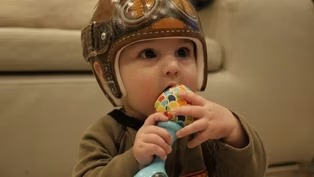
Kelli Sorg of Spring Hill decorates cranial bands, also known as orthotic helmets. Dance Theatre of Harlem celebrates 50 years with performances. The Menil Drawing Institute in Houston, Texas, features modern and contemporary works of art within this special medium. The Cass Tech Harp and Vocal Program in Detroit, Michigan, has been teaching students music for over 90 years.
Problems playing video? | Closed Captioning Feedback
Problems playing video? | Closed Captioning Feedback
WEDU Arts Plus is a local public television program presented by WEDU
Major funding for WEDU Arts Plus is provided through the generosity of Charles Rosenblum, The State of Florida and Division of Arts and Culture and the National Endowment for the Arts, and the Hillsborough County Board of County Commissioners.
WEDU Arts Plus
1104 | Episode
Season 11 Episode 4 | 26m 45sVideo has Closed Captions
Kelli Sorg of Spring Hill decorates cranial bands, also known as orthotic helmets. Dance Theatre of Harlem celebrates 50 years with performances. The Menil Drawing Institute in Houston, Texas, features modern and contemporary works of art within this special medium. The Cass Tech Harp and Vocal Program in Detroit, Michigan, has been teaching students music for over 90 years.
Problems playing video? | Closed Captioning Feedback
How to Watch WEDU Arts Plus
WEDU Arts Plus is available to stream on pbs.org and the free PBS App, available on iPhone, Apple TV, Android TV, Android smartphones, Amazon Fire TV, Amazon Fire Tablet, Roku, Samsung Smart TV, and Vizio.
Providing Support for PBS.org
Learn Moreabout PBS online sponsorship- [Male Announcer] This is a production of WEDU PBS, Tampa, St. Petersburg, Sarasota - [Female Announcer] Funding for WEDU Arts Plus is provided by the Community Foundation, Tampa Bay.
- [Gabe] In this edition of WEDU Arts Plus, a medical device that's downright adorable.
- [Jeetpaul] Kelli actually did a fantastic job sending us over proofs and ideas that she had on her Instagram page.
So we were able to sit one night, or actually two nights, and go through and pick different designs and pick different things that customized the helmet for what we liked, which was really fun for us.
- [Gabe] An innovative ballet company celebrates an important anniversary.
- We wanna make sure that we continue to do what Dance Theatre Harlem was always known for, which is being able to do all styles.
And do them all well.
- [Gabe] An institute of modern and contemporary drawing.
- And it's devoted to the acquisition, the study, the exhibition, conservation, and storage of drawing.
So it's very purposeful architecture.
- [Gabe] And a harp and vocal program for students.
- [Lydia] They learn to solve problems.
In real time.
They learn to work collaboratively in addition to being able to apply principles of math.
- It's all coming up next on WEDU Arts Plus.
(upbeat jazz music) Hello.
I'm Gabe Ortiz, and this is WEDU Arts Plus.
If you've ever seen a baby wearing one of those helmets to reshape their head, then you know that the medical device can be distracting.
But with creativity and a coat of paint, artist Kelli Sorg of Spring Hill shows us just how charming those helmets can be.
(soft guitar playing) - This cutie pie is our son Darwin.
He's six months old.
Right now, he likes chicken and rice, and music is his new big thing.
Good job bubby!
(grunts) You a rockstar, you're my rockstar.
When my wife and I found out that Darwin had to wear the helmet, it was actually a sense of relief.
We believed that maybe we were doing something wrong.
You know, as first time parents, we didn't know.
And then when we were able to talk to the physician, they were able to tell us that, you know, the flatness on his head was caused in utero and that actually gave us even more relief, saying that we didn't do anything wrong.
So we were actually quite happy and excited that there was something that we could do to help him out.
- The official term is cranial remolding orthosis.
A lot of people will call them star bands, or helmets, but realistically they're orthoses.
It's kinda like braces for your body.
And they're used for reshaping babies' heads.
Babies wear helmets for 23 hours a day.
It's one hour off for bathing and cleaning, and depending on the severity and the age of the child will determine how long it takes for the remolding to happen.
It could be between four and six months.
A lot of times it's faster, especially when they're compliant and wearing it full-time.
When they're not compliant, not so much.
(laughs) So I have cards of local artists, and basically I just say, here's an option.
If you want to have your helmet painted we have artists who are happy to paint it for you.
(upbeat guitar playing) - My name's Kelli Sorg, and I paint helmets for babies that need them for corrective issues with their heads.
And I enjoy bringing a little bit of sunshine to their helmet journeys.
I started painting helmets, I believe was September of 2016.
And I've painted over 70 helmets in that time.
I've always enjoyed art.
I knew for college, I wanted to pursue that.
So I took graphic design and fine arts.
I got a degree in both.
They really help me with the helmets because I can use my graphic design to make a digital proof for the parents to see ahead of time.
We can make changes to that easily while they're waiting for their helmet to be made.
And then once I pick up the helmet, I can use my fine arts skills to execute that and return it to them more quickly.
So to paint one of these helmets, non-toxic is my first priority.
When I first get it, it's got a very shiny coat on it, so I need to sand that off.
Before that to make sure I get every little spot, I take a crayon, non-toxic crayon, and I color over everything on the helmet.
When I am sanding it with a little hand sander, I can make sure I haven't missed a spot 'cause the paint will peel right off if I don't have it as a rougher surface.
Then I can start painting.
I return them within 24 hours.
So the child can get started wearing them as quickly as possible, since it is a medical device.
- We went with the fighter pilot and kind of designed it off of Top Gun.
Kelli actually did a fantastic job sending us over proofs and ideas that she had on her Instagram page.
So we were able to able to sit one night, or actually two nights, and go through and pick different designs and pick different things and customize the helmet for what we liked, which was really fun for us.
- Parents who are happy looking at the helmet are more likely to keep the helmet on appropriately.
Compliance is through the roof whenever they're enjoying what they're looking at on their child, because let's face it.
Babies are fine in the helmets, parents are not.
So if the parents are happy, everybody's happy.
- Being a new father and being a physician.
I understood that the treatment plan actually involved compliance.
Painting the helmet was a very simple solution for me to swallow the pill of having my child in the helmet for four months, (laughs) to be very honest with you.
(baby laughing) When we got the helmet back from Kelli, we were absolutely in love.
It looked even better than it did on the sketch-ups and the designs.
- Yeah, yeah!
- Strangers, now they don't even see the helmet.
They all believe it's part of his outfit or whatever he is doing.
They see right through the helmet.
The painting job worked.
It did exactly what it was supposed to do.
- I've always enjoyed using my art for children.
My son never had to wear a helmet, but as a mother, I can understand, and I have some empathy for parents who do have to go through that.
And I feel if there's something I can do to help make that a little easier and just a little more joyful for them, and that the people around them will be smiling at their child and seeing these really fun designs, that makes me happy.
- As a new parent, you wanna do everything that you possibly can for your child.
This was something that we saw from the very beginning and we did everything in our power to prevent the misshaped head.
We were awake until one, two o'clock in the morning, every 15 minutes, moving his head, turning his head.
For us, this gave us our lives back and it was a solution for his future.
Because if as new parents, we had an option of fixing something that could be fixed and we chose not to, it would be very difficult for me to be the dad that I want to be.
- I can't help them in a medical way, I can't help them, you know, every day on a personal level.
But I figure if I can use my talent to help in this way, that really, that really makes me happy.
- [Gabe] For more information, visit facebook.com/makeitsnappyart.
Dance Theatre of Harlem has been a force in the ballet world for the past 50 years.
In celebration of the big anniversary, the company presents performances that acknowledge their past, present, and future.
(intense drum music) - [Donald] My name is Donald Williams.
I'm a former principal dancer with Dance Theatre of Harlem.
As part of its 50th anniversary has brought back Geoffrey Holder's "Dougla", which is one of the signature pieces of Dance Theatre of Harlem from way back, it was originally choreographed in 1974.
(intense drum music) As a signature piece in the 90s he did a revamp and he used me as the central character, the principal dancer, to update it, and make it more relevant to the future, and now it's a timeless piece.
- You see what I'm saying?
Like that much, that much stuff.
- [Student] Yeah.
- So that's where you need to go.
- In this particular dance, a lot of the movements are very simple.
They're they'll just be arms, heads.
And then the most important part of this would be the eyes when you turn your head to the front and the expression that you give, what you're saying with your face as you make the movement, what you could bring to the steps.
You're bringing your own flavor, your own extra feeling to it, what you're saying in your eyes and your face and in your body as well.
That's something that you can't really pass on through a video.
You have to pass that on, you know, from person to person.
And so now I'm really proud to be able to pass this legacy on.
(melancholic strings music) Because the company's smaller now, we have to have supplements and we use local dancers, from the different places that we go to perform this particular ballet.
Here, we're gonna be using Peter London Ballet Company.
What I came here to do first is to begin to teach them before the company comes so that they know the work and then the company comes, and then we put it together and the magic happens.
I really appreciate the hard work that they've done.
(chanting, festive music) I spent a long career at Dance Theatre of Harlem.
I was a principal dancer there for 27 years.
What Dance Theatre of Harlem was about was trying to give opportunities to dancers of color, to perform in classical ballet.
That was the original thing because there was a thought that dancers of color couldn't do classical ballet.
(thoughtful drum music) Before we were trying to prove that dancers of color could do classical ballet.
Now that we know that that's a fact, and we can do it, now we're trying to do everything.
We wanna make sure that we continue to do what Dance Theatre of Harlem was always known for, which is being able to do all styles, and do them all well, and also provide opportunities for dancers of color to do classical ballet, to do contemporary.
It's all about access, opportunity, and excellence.
Just our presence makes it possible for students who are coming up to see, I can become a ballet dancer if I want to.
If they see people who are actually achieving it, then they can be it.
- [Gabe] To learn more, visit dancetheatreofharlem.org.
In Houston, Texas, the Menil Drawing Institute highlights modern and contemporary drawings and features a singular architectural design.
The institute invites viewers to observe, study, and contemplate an array of artistic works within this special medium.
(cheerful piano melody) - Drawings in many ways are a very personal way for a viewer to connect with an artist.
(playful instrumental music) But they're also an integral part of our experience as humans.
(playful instrumental music) Every culture has drawing as a part of it.
We all draw.
And this is a building that celebrates that.
The Menil Drawing Institute was founded at the end of 2007 to promote modern and contemporary drawing.
It has created many exhibitions, it has published catalogs that have traveled around the world.
And so now we inaugurate an actual physical space for that institute.
And it's devoted to the acquisition, the study, the exhibition, conservation, and storage of drawing.
So it's very purposeful architecture.
(playful instrumental music) - The drawing institute is an interesting building type both because of its focus on drawing and works on paper, but also its scale.
It's 30,000 square feet.
So it's really somewhere between a house and a museum in terms of its size.
- You know, when we studied the campus, we also noticed there's a kind of liturgical quality about the building types.
You know, certainly the Rothko Chapel and the Byzantine Chapel is a liturgical type.
The Flavin installation has this crypt-like quality.
You know, this whole idea of sacred and domestic kind of came together in this building.
(playful instrumental music) - We're sitting in a room that's got light sort of coming from every direction.
And I think that gives it a sense of time, the change in weather.
I mean, there's a kind of connection to the outside that's very different here than a more typical museum.
(playful instrumental music) Because it's a space for work and scholars in conservation, each one of those programs has a different light need.
So I think that's something that defines the Drawing Institute, is the qualities of light and atmosphere that are very calibrated but have a quite a wide range.
That's from the museum institutional condition to a domestic setting.
- Paper is very fragile and sensitive to light.
Our drawing curators will tell you that the room for the paper has to have a light level of like five foot candles or less.
So when you're outside in the Houston sun, it could be as high as 15,000 to 18,000 foot candles.
So I think this whole perception of having a courtyard that is partially indoors and partially outdoors, working in concert with the trees are ways to slowly help your eye adjust.
As you come in finally to the gallery that you don't feel like you're entering a dark room.
- So we inaugurate the building with an exhibition of drawings by Jasper Johns.
They're drawn entirely from the Menil's permanent collection, "Promised Gifts", and then seven loans from the artist himself.
He's one of the greatest artists of our time.
(playful instrumental music) Also on view is a wall drawing by Ronni Horn created this year, so as contemporary you can get, that is an eclectic group of aphorisms, which are silk screened onto a wall.
This is the first of the series of wall drawing commissions that we will have in this building.
And then the third work on view in our main space is a sculpture by Ruth Asawa.
And you might say, "Why, why have a sculpture in a building devoted to drawings?"
She used wire to create these amazing orbs that are suspended in space, and she always referred to that work as drawing in space.
So here you have an artist who pushes the typical definition of a drawing as an original work of art on a paper support in an entirely new way.
(playful instrumental music) We're pushing the definition of drawing because this is a building that will really explore what a drawing is and what its potential could be.
(playful instrumental music) - To find out more, visit menil.org/drawing-institute.
Visit the acclaimed Cass Tech Harp and Vocal Program, at Cass Technical High School in Detroit, Michigan.
The program has been teaching its students music and providing a space for them to express themselves for over 90 years.
(harp playing) - The words that come to mind when I hear the word harp are beautiful, difficult, and underappreciated.
- It's something that it that becomes a passion that you just don't want to release.
(harp playing) I began playing the harp in my ninth grade year at Cass Technical High School.
It's beautiful to look at, I think it was probably more the aesthetic (laughs) of the instrument than anything else.
So I said, "I'll try this."
(harp playing) Cass has the oldest established harp program in a public school, which began in 1925.
- We've been around for over 90 years, for starting with Velma Froude, Patricia Terry-Ross, and now currently Ms. Lydia Cleaver.
- [Lydia] Wanting to come back was the fulfillment of my desire to continue to be a part of the program and to see it go on after Patricia Terry-Ross retired.
And it was a great opportunity to be able to work with older students, and do more sophisticated things musically, and just come home, really.
(harp playing) - Harp Ensemble is the class where everybody plays the harp and then Harp and Vocal is, it's a combination of harp and choir at the same time.
(choir singing and harp playing) - And one.
- And three, and four, and one.
- I came into this class, and I thought it was really hard, like really, really hard, because I've never been in a music class.
I didn't know how to read notes, but it got better after a while.
- In Detroit, unfortunately, we have suffered significantly, in the fine arts area in our school system.
And so when students arrive in my classroom for the most part, they don't know anything about music.
So we start from the very beginning.
- Stretch.
Yep.
Stretch and slide down a little bit.
- [Lydia] It's a practical skill.
They learn to solve problems in real time.
They learn to work collaboratively.
In addition to being able to apply principles of math, they make connections to literature, through song.
- They say that the harp is the hardest instrument in the world.
So I feel like you can learn a lot of things from the harp that you can use in life, even if you're not gonna pursue music in college or in the future.
- I think it prepares me for everyday life and the way of not giving up on things, because it's really easy to give up on an instrument like the harp, 'cause it's hard.
It's teaching me to accept challenges and use it as a exercise to better myself as a person.
- Look.
'Cause that time, we didn't have any problem with what chord to play.
- [Lydia] When I see that students can learn how to figure something out, that is super exciting for me, because they have learned patience, how to break something down into parts that you can then put together again and create a whole, and then actually give life to it, to create an emotional aspect of it, and then share it with other people.
(choir singing and harp playing) - I have never seen come, with a harp before Harp and Vocal, which is very interesting.
Watching the harpists play as we sing.
It's another form of expression.
When we crescendo, they crescendo and they crescendo and it's very expressive and it's very essential in conveying the message and sharing the music with the audience.
(choir singing and harp playing) - I find music that is in our library typically that has worthiness that they can dig some meaning out of.
(choir singing) - Today, we're working on two songs, one called Steal Away, and then one called Going Home, which they're both essentially about having peace with yourself and being ready to go to heaven.
- It's a tribute to one of the many songs that slaves used to sing.
- [Lydia] Three and four.
Sing freedom for everybody.
(choir singing) - As a Black singer, it's really important to know like the history of the songs.
It really helps to convey the message to the audience, to have people relate to it.
- It means to me that we're doing something good, we're giving people something that maybe they didn't know they needed.
(choir singing) (harp playing) - I've heard Ms. Cleaver play the harp and it's inspired me to keep going with what I want to do.
And because she's so passionate about it, and her passion has driven her to be great that it inspires me to be great in what I want to do.
(harp playing) - It's incredible.
Like I always like I play and then I'm like, it's nothing compared to her.
Like she can play it right at that instinct.
And it's beautiful.
- It's actually very angelic to hear the sound of the harp especially the way she plays it with such passion.
It only encourages us to do, to sing the same way with a lot of passion.
(choir singing) - [Lydia] Much better.
So now... - I'm extremely proud of my students, I am extremely fortunate to work with young people who get what it means to be responsible and to grow.
And they do it through music.
(harp playing) - After I leave high school, I might go to college to play the harp.
And I want to find a way to incorporate harp into mainstream music, because you don't really see too many harpists in mainstream, So I wanna figure out a way to maybe make a new genre of music or something like that.
(harp playing) The experiences that I've had here at Cass Tech, have made me grateful for the things that I have, especially with the Harp program.
- We know that we'll have connections with people forever.
People that we know, if we need something we can call them up in 20 years from now and we'll know that we'll have support.
- The great thing about it is that everyone who's come through the program has seen the benefits of it and the beauty of it.
They can see, wow, this was really an important part of my life.
And so we have that support and it is one of the jewels of the district.
It's something that is unique and it belongs to Detroit public schools, community district.
(harp playing) - For more, visit harpandvocal.wixsite.com/harpandvocal.
And that wraps it up for this edition of WEDU Arts Plus.
For more arts and culture, visit wedu.org/artsplus.
Until next time, I'm Gabe Ortiz.
Thanks for watching.
(funky music) - [Female Announcer] Funding for WEDU Arts Plus is provided by the Community Foundation, Tampa Bay.
(closing music)
Video has Closed Captions
Clip: S11 Ep4 | 6m 37s | Kelli Sorg paints infant helmets deigned to help reshape their heads (6m 37s)
Providing Support for PBS.org
Learn Moreabout PBS online sponsorship

- Arts and Music
The Best of the Joy of Painting with Bob Ross
A pop icon, Bob Ross offers soothing words of wisdom as he paints captivating landscapes.













Support for PBS provided by:
WEDU Arts Plus is a local public television program presented by WEDU
Major funding for WEDU Arts Plus is provided through the generosity of Charles Rosenblum, The State of Florida and Division of Arts and Culture and the National Endowment for the Arts, and the Hillsborough County Board of County Commissioners.