WEDU Arts Plus
1106 | Episode
Season 11 Episode 6 | 26m 45sVideo has Closed Captions
St. Petersburg College, Ballet Edge Detroit, Chris Mercerhill, Carson City Mint
Stop motion animators share their love for this complicated craft. Ballet Edge Detroit presents classical technique with an edgy, modern twist. Artist Chris Mercerhill is rethinking the quilt making process with the addition of eye-catching photographs. The original coin press of the Carson City Mint from 1869 continues to mint uniquely designed coins at the Nevada State Museum.
Problems playing video? | Closed Captioning Feedback
Problems playing video? | Closed Captioning Feedback
WEDU Arts Plus is a local public television program presented by WEDU
Major funding for WEDU Arts Plus is provided through the generosity of Charles Rosenblum, The State of Florida and Division of Arts and Culture and the National Endowment for the Arts, and the Hillsborough County Board of County Commissioners.
WEDU Arts Plus
1106 | Episode
Season 11 Episode 6 | 26m 45sVideo has Closed Captions
Stop motion animators share their love for this complicated craft. Ballet Edge Detroit presents classical technique with an edgy, modern twist. Artist Chris Mercerhill is rethinking the quilt making process with the addition of eye-catching photographs. The original coin press of the Carson City Mint from 1869 continues to mint uniquely designed coins at the Nevada State Museum.
Problems playing video? | Closed Captioning Feedback
How to Watch WEDU Arts Plus
WEDU Arts Plus is available to stream on pbs.org and the free PBS App, available on iPhone, Apple TV, Android TV, Android smartphones, Amazon Fire TV, Amazon Fire Tablet, Roku, Samsung Smart TV, and Vizio.
Providing Support for PBS.org
Learn Moreabout PBS online sponsorship- [Male Narrator] This is a production of WEDU PBS, Tampa, St. Petersburg, Sarasota.
- [Female Narrator] Funding for WEDU Arts Plus is provided by the Community Foundation, Tampa Bay.
- [Gabe] In this addition of WEDU Arts Plus animators share their love for the art of stop motion.
- That's the beauty of it, for me, is just you're constantly learning, you're constantly getting to do and figure out new things, new ways of doing stuff, and seeing it all come together is really awesome.
- [Gabe] A ballet company with a modern edge.
- [Erica] Ballet dance just brings a different connection to people.
It's something that's expressive and people can come and just step away from all of what's going on in the world and just come and watch something entertaining and something fun.
- [Gabe] An artist who makes captivating photo quilts.
- [Chris] Traditional quilts they're made with fabric, and so often, you know, the story is, "This is my grandma's apron, and this is my aunt Myrtle's dress that she wore at a Sunday school."
And for me, I can capture memories through photographs.
- [Gabe] And the art of pressing coins.
- We have coins in our pocket, but do we really know the background and the history of how they're made and some of the details of what goes to make up a coin?
- It's all coming up next on WEDU Arts Plus.
(upbeat music) Hello, I'm Gabe Ortiz, and this is WEDU Arts Plus.
This first segment was produced by students at St. Petersburg College in partnership with WEDU.
Meet Jace Wertz, a stop motion animator from Hudson, Florida, as he explains his animation process.
Animators from around the world chime in with their own unique take on the art form.
♪ Save at the cave ♪ - Hocus cuackus.
(epic music) (duck quacking) (upbeat music) - I started doing stop motion when a friend of a family introduced me to the medium, we had a little VCR cam quarter, and we'd set up some of our toys and do a little toy animation, life got away from me, and I put it aside until I was about 27 years old, and then I started picking up a camera again.
I started doing video production, I would do short films, be live on set with actors, focus directly on knowing how to edit, how to set up a shot, how to light a scene.
I was diagnosed with fibromyalgia last year, it causes pain all over my body all the time, it restricts me from being able to venture out and be part of a group.
It's something that helped me transition into stop motion and move away from the live action.
You are the entirety of the crew.
So stop motion has really given me the ability to uplift myself.
Stop motion is very difficult process, but it's not something that you wanna run away from.
You don't have to study in a classroom, there is a plethora of information out there, any kind of forum base will be your best bet, you can search straight on Google for stop motion forums.
- That's the beauty of it, for me, is just you're constantly learning, you're constantly getting to do and figure out new things, new ways of doing stuff, and seeing it all come together is really awesome and beautiful.
- Creating a stop motion, there are many elements, first, materials.
There's so many that you can utilize, whether you wanna use felt, paints, foam board from the dollar store.
- I'm always hauling giant bags from the dollar store, like "I just spent a hundred dollars on craft supplies!"
I'm the reason that craft aisle is there.
I just love the dollar store.
I just like being, like, "I made this wizard out of a chicken nugget box and some sheets of felt, and some beads, and now he's real."
- Hi there, I'm a wizard, but I only know dumb spells about ducks.
- I used to really like playing with tiny things if it makes sense.
I remember making houses for bugs out of match boxes, and that kind of stuff.
(cheerful orchestral music) - What's your story?
Even not having a fully mapped out script is okay.
Having just words on paper is great because it helps you get direction the route you wanna go.
Once that script's finished storyboarding is the next step.
- I start with the story, then we create a script, and then I usually work with other artists, like for storyboarding, I create an animatic, I make a shot list, I divide it into sequences, and then I start just filming shot by shot.
- I didn't have storyboards, did a quick little breakdown of what I imagined would happen, and I got the go, ahead to go just with that.
- I feel like for me, my creative process is just to kind of just sit and let things come to me, and doodle at the same time.
- Once everything's laid out, then you can bring out the camera.
I recommend grabbing a phone, there's free software out there.
The fun begins there.
You would take a photo, move the camera a little bit, adjust your set, or your puppet, take a photo, move the camera, adjust your set and puppet, and so on and so forth until you finish out your scene.
Once puppets are animated, there's a process to remove the rigs, the rigs are gonna be the ball joint sockets or the metal armatures that are connected to the back, or the front, or the side of the puppets.
I use after effects to remove all of the rigs.
You just make a layer and another layer, and then you overlay the image of the puppet with the rig, and then you're able to just remove by highlighting around the rig, it will show the animation as it should look.
To remove all of the rigs I started in Photoshop, but the process, it takes much longer.
- I feel like people keep telling me that there's easy ways to do it in Adobe After Effects, but I'm just never satisfied with that, so I end up just photoshopping each individual frame myself.
- CGI has helped stop motion abundantly.
It's provided the ability to not have to have such a large elaborate set, utilize blue or green screens, and then be able to just build off of it.
- CGI, I think can complements any animation story, and you know, it's the future, and it's technology is always gonna be pushing further and further, until we reach like a singularity.
But then again, it doesn't because it's an art form, you know?
I specifically wanted to use textures that were very hard to mimic in CGI, so that somebody knows that it's a real thing, like clay, you can see my fingerprints, you know, you can see the imperfections in it, and you can feel like you can reach out and touch it.
- That's what where stop motion kind of shines for me, is like knowing that it's a real object, it's a real thing that's moving through space, and how cool it looks.
- Stop motion has those kind of childish curiosity, playfulness, you know, using whatever they have, and improvising with the stuff that we have.
- I love stop motion because it's frame by frame.
You have to build the sets, find a little space to do it, have a camera and some software, and just have fun with it.
Become a creator and find your passion, whatever you choose to do, you're capable of it.
Just have fun.
And you know, the sky's the limit, it's all about imagination.
- To see more of Jace's work visit youtube.com/c/jacewertz.
Founded in 2017, Ballet Edge Detroit is a dance company that presents classical technique with an edgy, modern twist.
Up next, hear from the company's founders and dancers, and learn more about their mission.
(light piano music) - Ballet is not just an activity or a hobby, it's a lifestyle.
(light piano music) I've always loved movement since I was a child, I was actually a more of a late bloomer when it came to ballet, I started around the time of 13 years old, but I loved it since.
Ballet is something that I have done my entire life.
It's just been this passion inside me, and I've always kind of wanted to get back to it, so a few years ago, I got back into ballet.
- When I first moved to Detroit, I felt like I really needed to find my passion and establish more of an identity for myself.
So I went back to taking dance classes and I realized how much I missed it.
And that's how I started meeting these wonderful dancers in class.
- Meeting Angel, really just the passion for ballet that we both had, was our instant connection, and we didn't really see any ballet companies in Detroit.
Most larger cities do have ballet companies, and we thought that this would be a great chance to really try to bring that ballet, that art, back to the city.
- And we decided to start working together after class, and learning choreography together, and performances started popping up for us.
So that's how Ballet Edge started.
- [Erica] Ballet dance just brings a different connection to people.
It's something that's expressive and people can come and just step away from all of what's going on in the world and just come and watch something entertaining, and something fun.
Our mission is to bring a bold and innovative twist to ballet, through using our trained classical technique, but putting more of a relatable, modern twist on it, so that all audience members can relate to our choreography.
- We're really trying to bring a new refreshing outlook on ballet to Detroit.
Our name is Ballet Edge Detroit so we try to be edgy and different, and, you know, we kind of try to break the mold of what people typically think of classical ballet that it's just tutus and classical music, we really try to bring something fun and unique, so that everyone will enjoy it.
- We're trying to attract all people to our performances, not just people who are really familiar with ballet.
So in order to attract all of Detroit, we need to have dancers that each audience member can relate to.
So, maybe an audience member will say, "Oh, I can relate to that mom, I can't believe she's dancing out there still, she's got kids, but she's still holding onto her passion."
- I think that it's very important, especially as women, and for those of us who are mothers, a lot of times we put ourselves, and our passions, and our dreams, and our what drives us, we put those on the back burner to be there for our family, so it's great to kind of reclaim some of that, and kind of remember who you are.
Everybody just comes from different walks of life, and everyone has their own little backstory before they come to Ballet Edge.
I'm a huge advocate for following your dreams, regardless of where you are, age, or stage in life.
- I think one of the things that makes us different and perhaps mature is that many of our dancers have done other things in their lives, such as work, or gone to college.
And those experiences make us very comfortable with who we are, and made us realize how much we love dance, and make us come back to dance.
So we are experiencing the best of both worlds.
- I think it's so cool to go to my job, and people are like, "Oh, what are you doing this weekend?"
And I'm like, "Oh, I've got a five hour ballet rehearsal."
And they're like, "Wow, that's so amazing!"
And it is amazing, but I think it's inspirational because now other people can see they can do that too, not only with dance, but whatever your thing is, you're never too old or too busy, the situation is never too chaotic for you to remember who you are.
- [Angel] This group of women is incredible, they show their personality, whatever the musicality, or the artistry calls for, whether it be sad, happy, serious, exciting, they can do it.
And you'll be able to see that in all of the pieces that we showcase.
- We're gonna be getting ready for our show, we've got some large group pieces, we've got some small group pieces, we're gonna be cleaning, cleaning, cleaning, we just finished learning all of the choreography, so now we make sure everyone's looking the same way, and everyone's arm is the same way.
So, it's gonna be kind of a wide range of things.
- Angel Lavery does all of choreographing.
She's really open to listening to everyone, and making sure that we all feel comfortable in the dance because, you know, that's how we're gonna be the best that we can be as if we're all comfortable with what we're doing.
- Angel is a great choreographer.
I think she has really interesting ideas when it comes to choosing music.
- I pick out the music first.
I listen to the music over, and over, and over again, and I see the choreography in my mind and that's how I choreograph.
We try to portray what the music is trying to tell.
So, for example, we do a piece called "Embrace", which is to Vivaldi's Winter, and that is more about friendship, and our relationship together as a company, we all get along and we truly embrace each other's presence.
We've done a piece to "Game of Thrones", and that's really to portray the theme of that wildly popular show, it's very serious, it's about battling and trying to be in power.
We have a piece currently to "Beethoven's Fur Elise."
And these are all songs that the majority of people will recognize.
And they get drawn in, they get hooked in, and they end up enjoying the pieces.
Failing is very challenging, it requires a lot of discipline.
We've all been training for 15 plus years.
We are all top professionals and we work really hard.
Ballet dancers have great stamina, they have great flexibility, they have the discipline to come to class, to stay in shape.
- And I think that the talent that's in Ballet Edge is just phenomenal.
It's unbelievable, honestly, to me to know that there are so many talented, like amazingly talented dancers that are right here in the city.
- Typically when people see a ballet company in Detroit, it's a ballet company that passes through Detroit and leaves.
And we are making ballet accessible to Detroit neighborhoods, we keep our pricing affordable for everybody to come to see us, we are homegrown, and we're proud to be Detroit.
- I'm so grateful for Ballet Edge.
I think that it's so great for so many different women to be able to come together in the name of ballet, and put together something so professional, and something so unique, and something so entertaining.
- Long term goals for Ballet Edge Detroit is really just to continue growing the ballet company, you know, we would love to have more dancers, and really be able to put on more shows.
- I think that the climb that Detroit is making right now, really all it's missing is in ballet.
So I'm really excited that Ballet Edge is right there growing with the city, and making the presence of ballet known in that growth.
(upbeat music) - Discover more at balletedgedetroit.com.
Up next, meet an artist who is rethinking the quilts making process and creating colorful, eye-catching quilts, made of photographs.
(light piano music) (sewing machine whirring) - I'm originally from Toronto, Canada.
I came to the United States to go to graduate school, met my wife there in South Carolina, we moved to Illinois, and then back to Ohio, cause it's closer to home.
So kind of a classic story, really.
I've always been interested in patterns, you know, shapes, squares, triangles.
So when I set out to make a photo quilt, a quilt made a photo sewn together, I start with an image.
So, this is an image of the North Market, so I'm gonna use this photo, and I'm gonna make its mirror image.
For the bottom half of the quilt, I'll cut these two inches off, and then the next layer I'll cut one to three quarters and a little bit off here, and then I march it down like this.
So by the end, by the top row, I'm using this, this is my foreign square, so the effect this creates is from the top to the bottom the source image shifts slightly and changes, and these lines, which are, you know, odd angles, really lend this dynamism, they intersect in really interesting ways that create diamond shapes, and points, and spikes.
(cheerful music) Traditional quotes they're made with fabric.
And so often, you know, the story is, "This is my grandma's apron, and this is my aunt Myrtle's dress that she wore at a Sunday school."
And for me, I can capture memories through photographs, I can identify patterns, or places, or things, and then use them in much the same way, make a quilt out of those, instead of out a fabric.
And so it's all about, you know, exploring the city, finding interesting viewpoints, finding things that reach out to me as a really dynamic image, and then I cut 'em up and sew them together and see what happens.
(sewing machine whirring) When I was in Illinois I started working on a pattern called Log Cabin, which is sort of a square with these strips all the way around that just repeat, and repeat, and repeat, which kind of gives the effect of a log cabin.
And I was in the land of Lincoln.
When I came to Ohio, a little over 10 years ago, you know, I was thinking and exploring, and I found this Ohio star pattern, and so the Ohio star pattern it's called a nine patch quilt.
There's a group of patterns called that because they're three squares by three squares, and so this one, four of the squares have triangles that sort of form an X, and so the thing I like about these is you get these, where these four triangles come together, you get these sort of kaleidoscopic diamondy spots, and then there's this pattern that sort of repeats, square, triangle, square, but if we put it next to another block it's square, triangle, square.
So right when you think you've discovered the pattern square, triangle, square, that's not a triangle, that's another square, and it's to my eye, it's complicated enough that you have to sort of look twice to really figure it out, and I don't always feel like, when I'm looking at it, that I've figured it out.
One thing I really try to do with my work is to create objects that you can appreciate both up close and from a distance.
So from a distance, it almost looks like a carpet, or wallpaper, or interesting shapes, and then you get up close and you go, "Hey, there's a person there.
They're walking down an aisle.
Is that the North Market?"
And you kinda look and go, "That's the North Market!"
(light piano music) I love fabric quilts, I make quilts, my wife and I make fabric quilts together.
But for me, there's something about photographs and sewing them together.
And I guess maybe it's the resolution, the clarity you can get with a photograph that really sets it apart from fabric.
I think my work is sort of about noticing the beauty around us, and, you know, sort of stopping, and pausing, and appreciating it in a way maybe we haven't before.
- You can find more of his work at chrismercerhill.com.
The Nevada State Museum is home to the original coin press of the Carson City Mint.
Built an 1869, Coin Press Number One continues to mint uniquely designed coins that are works of art.
(piano music) - The Nevada State Museum is located in Carson City.
The main building was originally the Carson City branch man.
This is the beautiful sandstone building you see facing Carson Street.
And so what you see today is a complex that has grown up to hold the many stories that are part of Nevada's history.
One of the most amazing artifacts in the State Museum is Coin Press Number One.
- Coin Press Number One, boy.
It is such a special part of this museum, continuation of the great history of the U.S. mint.
- Coin Press Number One was the first coin press in the Carson City Mint.
Coin Press Number One was also the only coin press for the first five years of the Mint's operation.
Eventually there were three presses here.
- When this coin press was brand new, it could do from 80 to a hundred silver dollars a minute and smaller denominational coins, that could do even more.
- Today we don't have the equipment that automated the activity.
So we mint each one by hand, we operate it where we make maybe one per minute.
(atmospheric music) The first step in minting the planchet is to put it into the collar.
So a planchet is another word for a coin blank, it's simply a piece of metal that's ready to be put into the coin press ready to be minted.
So I put it on the table of the coin press, and I slide it into the opening, and it drops into the collar, and I step back and push the two run buttons.
Now they make you use two hands, so the buttons are quite separated.
And that's purposeful so your hands are separated, so you don't end up leaving a finger in under the coin press and losing part of it.
So you have to use two hands to start the press, it's a six ton machine.
We operate Coin Press Number One at about 110 tons of pressure to make the half dollar size medallions.
So, coins or medallions are made from dies, the dies are what make the impression on the coins, we have a bottom die, which has the reverse image, a top die that has the obverse image, and then there's a collar which inside has reading, and those are those edges that you see on the edges of your quarters and half dollars, and dollars.
And so that's inside the collar, so when that wedge comes down and pushes those dies together, all of that happens in one action, so that complete coin is made in a second.
We've had the pleasure of working with Tom Rogers, a former sculptor and engraver for the United States Mint.
He's done several of the dies for us.
We work with people who actually used to work for the mint, so we're getting absolutely the most professional experience we can to make the dies for Coin Press Number One.
- When they're designing these, these are original works of really art.
That's what coin collectors are excited about is the designs and the quality of those, and that's where the sculpting comes in, and it works hand in hand.
- Really has history in action.
Here you are standing in the original mint building and you're working with the actual coin press, and it's still operating, the very first one that was here at the museum.
And we're minting silver blanks, silver planchets, just like they did back in the 1870s and 80s.
- There's many people out there, many collectors, they just focus on the Carson City medallions that have been done on historic Coin Press Number One.
- Museums are all about connections, connecting people with stories, so that they not only understand, but they feel a real link to the time.
And so Coin Press Number One is a perfect example of how that works.
- To learn more, go to carsonnvmuseum.org.
And that wraps it up for this edition of WEDU Arts Plus.
For more arts and culture visit wedu.org/artsplus.
Until next time, I'm Gabe Ortiz.
Thanks for watching.
(upbeat music) - [Female Narrator] Funding for WEDU Arts Plus is provided by the Community Foundation, Tampa Bay.
(atmospheric music)
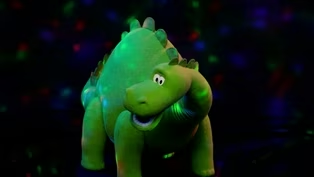
Video has Closed Captions
Clip: S11 Ep6 | 6m 43s | Learn the painstaking process of stop motion filmmaking. (6m 43s)
Providing Support for PBS.org
Learn Moreabout PBS online sponsorship

- Arts and Music
The Best of the Joy of Painting with Bob Ross
A pop icon, Bob Ross offers soothing words of wisdom as he paints captivating landscapes.













Support for PBS provided by:
WEDU Arts Plus is a local public television program presented by WEDU
Major funding for WEDU Arts Plus is provided through the generosity of Charles Rosenblum, The State of Florida and Division of Arts and Culture and the National Endowment for the Arts, and the Hillsborough County Board of County Commissioners.