WEDU Arts Plus
1108 | Episode
Season 11 Episode 8 | 27m 7sVideo has Closed Captions
Melvin Gómez, Fairgrounds, Heidi Wineland, Weedon Island Preserve
Fine art painter Melvin Gómez brings his experience from growing up in El Salvador to his works as a student at Ringling College of Art + Design. Get a behind-the-scenes look at Fairgrounds, a new interactive art space. Heidi Wineland creates whimsical creatures and miniature celebrities in her Lakeland home studio. Visit the vast expanse of Weedon Island Preserve.
Problems playing video? | Closed Captioning Feedback
Problems playing video? | Closed Captioning Feedback
WEDU Arts Plus is a local public television program presented by WEDU
Major funding for WEDU Arts Plus is provided through the generosity of Charles Rosenblum, The State of Florida and Division of Arts and Culture and the National Endowment for the Arts, and the Hillsborough County Board of County Commissioners.
WEDU Arts Plus
1108 | Episode
Season 11 Episode 8 | 27m 7sVideo has Closed Captions
Fine art painter Melvin Gómez brings his experience from growing up in El Salvador to his works as a student at Ringling College of Art + Design. Get a behind-the-scenes look at Fairgrounds, a new interactive art space. Heidi Wineland creates whimsical creatures and miniature celebrities in her Lakeland home studio. Visit the vast expanse of Weedon Island Preserve.
Problems playing video? | Closed Captioning Feedback
How to Watch WEDU Arts Plus
WEDU Arts Plus is available to stream on pbs.org and the free PBS App, available on iPhone, Apple TV, Android TV, Android smartphones, Amazon Fire TV, Amazon Fire Tablet, Roku, Samsung Smart TV, and Vizio.
Providing Support for PBS.org
Learn Moreabout PBS online sponsorship- [Announcer] This is a production of WEDU PBS, Tampa, St. Petersburg, Sarasota.
(bright music) - [Woman] Funding for WEDU "Arts Plus" is provided by the Community Foundation Tampa Bay.
(soft electronic music) - [Dalia] In this addition of WEDU "Arts Plus," featuring the diverse art and artists found across the Gulf Coast, a local art student uses his paintings to help encourage peace.
- [Melvin] I don't want to glorify violence.
At the same time, I want also the viewers to have their own interpretation when they confront my painting.
- [Dalia] Peak inside St. Petersburg's newest interactive art space.
- And what we really are is a stage to just show a lot of the wonderful art and the artists and creative things that are happening here in St. Pete.
- [Dalia] A Lakeland folk artist celebrates traditional crafts.
- They're strange.
They're small.
I make them because they make me happy.
- [Dalia] And looking back at ancient pottery of Weedon Island.
- Weedon Island is one of the most distinctive pottery types in certainly in Eastern North America.
- It's all coming up next on WEDU "Arts Plus."
(upbeat lively jazzy music) Hello, I'm Dalia Colon, and this is WEDU "Arts Plus."
Let's head to Ringling College of Art and Design in Sarasota to meet senior Melvin Gomez.
We visit his studio to to learn how he's using his talent to give back to his home country of El Salvador.
(soft melancholy South American music) - Since my childhood, I was supposed to be creative by making in my own toys with the material that I found in nature, including wood, clay, rock.
And since then, I have been really interested in art, and one of my neighbor, he's a painter, and I always look at him, his work.
And at some point, I asked him if he was willing to teach me because he don't teach, and he say, "Yes."
So I start having classes with him, with my neighbor, and that's how I start getting truly into painting and drawing.
And in 2014, I got the opportunity to study visual art in a international school in Norway, and I met Kimberly White, associate director, International Mission for Ringling.
And I knew about the fine art program, and I say, "I want to go there."
- As department head, I look at all the applications, and when Melvin arrived, he came from this school in Norway.
So I thought he would be Norwegian.
And then he showed up on campus, and obviously, he was not (laughs) Norwegian.
He's a really gifted painter.
He's expressive.
He's got great content that's there.
He's trying to deal with the human condition and bigger issues, but just in the general way of applying paint, I just love his surfaces and a sense of color and composition and form and brush marks.
(bright lively music) - He knows that his hand can make certain marks that no one else's can.
This kind of mark is more appropriate for the horse.
This kind of mark is more appropriate for the figure.
This kind of mark is more appropriate for the landscape or the light source and the clouds.
That ability to grasp that and to organize it and then to adjust it continuously is, I think, everyone who has worked around Melvin knows that his trajectory is like superstar level, and we're all glad to be part of it.
(laughs) I would say it's incredibly rare, and the level of sophistication goes into not just like great technical skills as far as rendering but seeing some of the compositions, you start to see right away, oh there's dynamics of interaction, social, political, and historic as well.
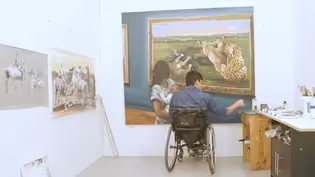
- There is really a strong composition to see a children shooting a horse, but I grew up in El Salvador around that social context with guns.
(soft piano music) I don't want to glorify violence.
At the same time, I want also the viewers to have their own interpretation when they confront my painting because, for instance, the painting in the back is a contrast life and death.
- You can talk about philosophy with Melvin.
You can talk about like political things.
You can talk about like really deep, intellectual associations of subject matter that oftentimes you never get to that point in the conversation with students.
- My art has some classical approach in my artistic process, but at the same time, I'm trying to pursue and find my own voice.
- He knows what he's doing, and we're just here to help along with technical advice, conceptual advice, maybe some references or historic context.
But the subject matter, the themes, what he's creating, inventing, and transferring to the surface, that's entirely his, and it's beautiful.
- That is my main inspiration, to express human condition, emotion, feelings, and desire, and I use my personal experience as an inspiration.
(soft melancholy piano music) In 2009, my life changed forever.
I was a victim of gang violence in my country.
I saw art.
In a way, it gave me hope and motivation to move forward in life.
I wake up happy to pursue my passion, and I'm happy to come to my studio because there is a painting waiting for me.
- There's been times where I've come in here.
There's been a Thursday class, and I come back in on Monday, and I'm like, "How did you even do all this work?
Did you sleep?"
- I'm gonna graduate in May next year.
My goal at the moment is to teach.
Also, I want to go back to my country and share what Ringling taught me.
I went back to my country after I finished my studies in Norway, and I opened an art school for children with the mission of breaking the cycle of gun violence and providing the tool to create art three years ago with my neighbor who taught me painting classes, and I told him like, "While I'm not here, you are in charge from the art school, and when I come back, I'll take full responsibility."
My main focus is to keep them busy and to spend their time positive.
- It'd be great for Melvin to stay here.
I think he'd be an incredible asset to the community and a great leader, and maybe he'll come back, but I think he could bring all those traits back to his home country and really build something special over there.
- It's truly important.
Painting to me, in some way, I would say saved my life because it truly gave me a new perspective in life, and I don't see myself doing something else.
(soft music) - Check out more of Melvin's artwork on Instagram.
Just search Melvin Gomez art.
St. Petersburg is an art lover's dream with its world-class museums, galleries, and murals, and one of the city's newest art spaces is taking things to the next level.
Let's head to the Warehouse District for a behind-the-scenes look at Fairgrounds St. Pete.
- Well, first of all, you're about to leave reality.
Walking through these doors is a whole nother dimension, but it's up to you what dimension that will be.
(pounding contemplative music) Hi, my name is John-Michael Hines, and I'm the experience manager for Fairgrounds St. Pete.
- So it's immersive art experience, which means it's an entire world created by a bunch of artists, mainly local artists, 64 of them, collaborating to create an entire world that we invite you in to come explore.
We're the anchor tenant of a larger cultural campus called The Factory, and The Factory is a six and a half acre big campus where there's many artist studios and creative companies, and we're one of the big anchor tenants of The Factory.
So our exhibition is about 15,000 square feet.
- Fairground St. Pete is a time ticketed experience.
So we are encouraging guests to reserve their time slot ahead of time.
Once you arrive, our guest experience guide will scan your ticket and give you a brief introduction about what you're about to experience, and from there, you will walk into the wonderful, weird, wacky world of Fairgrounds.
(upbeat guitar music) - What I think visitors don't realize yet is it's gonna be so different than their normal art exhibition.
They're gonna be walking in artwork everywhere.
From the ceiling to the walls to the floor, everything's gonna be art, and it's gonna be a totally immersive experience and a different magical place.
- Early on, we really wanted to make a very tangible digital playground.
COVID really forced us to think the differently and pivot, and so we started taking touchless sensors and creating our interpretation of what a button would be if you didn't touch a button.
So there are many aspects where you hold your hand over something and you get lighting and sound feedback, but you don't physically make contact with something.
So it was a way to make things of a bit safer.
We're also using things like foot pedals, little surprises that you can step on things and then something happens or activates sounds or lighting.
It's a lot of traditional theater and stage craft meets art meets storytelling, and so the difference is is that you don't just sit back as a passive audience member and watch things happen on a stage.
You are on the stage, and you are in the story.
- So Fairgrounds is to choose your own adventure type experience.
So there is a storyline underlying why certain things are where they are.
It's up to you to experience that and try to find out the storyline or just walk around and enjoy yourself.
So that's part of our loose narrative is we're going for the old school, retro Florida motel vibe.
So we do have 100% Fairgrounds branded motel room with some cool gadgets in there that you can play with or experiment with or just try to help find the storyline with, and then other rooms or nothing like a motel room 'cause they've been taken over by an artist, but they are still have a Florida theme to them or whatever kind of theme that you might think it is.
- So Fairgrounds St. Pete is a celebration of all weird, wacky, wonderful Florida.
And when we put out the open call to artists, we knew that what we wanted was for artists to celebrate the weird, wacky, wonderful world that we live in here in Florida.
- I feel like Fairgrounds gets me.
They know that I'm more than just an artist.
They know I love to collect seashells.
I like to just have a vibe, so that's what it is.
- Well, what stands out most to me is the Floridarama Room.
That's where we have our small tiny worlds that artists have created based on our loose narrative that we provided for them.
So they all brought their individuality and their ideas, and they were able to put in a little box.
- I do these customized train cars and like the G-scale model train cars, and I'll paint them and make them look like they're grungy or like they have graffiti all over the side of 'em.
But this time, I knew I was going to have this opportunity, so I didn't wanna just put a train in the box, so I made this entire almost a dream-like landscape with this train going into this water and has a speaker and lights in it so you can change the mood of it.
So more 3D, more interactive artwork, for sure.
- So for a Fairground St. Pete, I'm doing a large site-specific installation.
It's gonna be covering the whole ceiling.
It's gonna be something you can walk under and truly feel immersed in the artwork.
- I'm super excited to experience it myself as the artist, seeing it through everyone else's eyes.
I've heard the concept.
I have not seen it yet, but I know there's gonna be a mermaid room, and that's where my art will be in, and so I'm so excited to see it.
So you guys come out and see it.
(upbeat music) - So our tagline is art for all, play for all, joy for all.
So it's really about everyone coming to enjoy this weird, wacky, wonderful world that we've created with 64 artists.
- And what we really are is a stage to just a lot of the wonderful art and the artists and creative things that are happening here at St. Pete.
It's really just playful and fun, and there's a lot of humor and adventure, and I think it's a great place to just have fun with your family or on a date or just to go explore yourself as an artist and to see great works.
(soft music) - For ticket information, visit fairgrounds.art.
Throughout history, the majority of the world's creatives have worked at home as folk artists.
In this next segment, we'll meet modern day art teacher and folk artist Heidi Wineland in her Lakeland home where she's keeping traditions alive.
(upbeat percussive music) - My father was a painter and an advertising executive.
My mother was a professional seamstress and very much a folk artist and a needle worker herself, and so I grew up just with everything all around all the time that it was just free to use.
and I also had a really good arts program in the school system where I was.
And so now that I'm an art teacher in the public schools, I'm really geared towards making sure my students have as much experience with as many materials as possible.
I'm Heidi Wineland, and I am a folk artist.
I make rag baskets.
I make something called Knitagains, which are made, they're little creatures made from recycled sweaters, and they were made from knit fabrics, so they were knit, and now they are knit again.
I make a lot of jewelry.
I do some painting.
I do a lot of embroidery.
I'm very much into needle work, and I'm always experimenting, trying new things.
Years ago, I was doing craft fairs, and I've always had a lot of odds and ends and different things but really struggling to find the thing.
And there were a lot of people at that time who were knitting and felting, and that seemed really interesting, but I didn't wanna take the time to knit.
So I just went to the Goodwill and just bought the sweaters and felted those, and I was making bags and hats.
But then one day, I had a little scrap, and I didn't wanna waste it, and I just made it into a little oval and put eyes on it, and suddenly, there was my new friend.
And that took off.
As soon as I started selling those, I just couldn't keep 'em in stock.
Even though they all have the same basic shape and they all have these very simple circle eyes, they all have their own personalities, and people are really strangely drawn to them.
- I love seeing kids, adults, families, everyone sees her piece as they turn a corner and a smile just hits their face.
(upbeat dance music) - For 30 years, I've been working on a project I call the Academy Award Action Figures, which are miniature replicas of Oscar fashion.
I've always been interested in film history, but I'm also very interested in fashion and the cult of celebrity.
And then one night, I couldn't sleep, and I had this idea that I could make these dresses in miniature.
Now I'm not a doll person, didn't play with Barbies, didn't have any dolls.
The dolls are really just hangers for the clothes.
So I only do the Academy Awards because the Academy Awards is the highest pinnacle of celebrity.
What you wear to the Academy Awards.
that photograph is the photograph that's gonna be published over and over again.
It's the dress that people recognize the celebrity.
For me, it's both a critical commentary on the cult of celebrity, on how we make idols of movie stars and wanna emulate what they wear.
And at the same time, I actually am making idols (laughs) to celebrities, so this I don't sell.
This is just for me.
(upbeat guitar music) So the Knitagains and the Oscar dolls are really the two things I spend the most time on, and they seem very different, but they're both examples of they're strange.
They're small.
I make them 'cause they make me happy.
And I really pride myself on using scraps, leftover materials.
For instance, for the dolls, I never, other than that that first one that I tried, I never buy new dolls.
So if you look closely, a lot of them have chewed-on hands or some of them have stains on them.
It's just a matter of looking at something and seeing new life in it.
I've had the opportunity to have an actual away from home art studio before, and it's always seems so appealing, but then I think, "I would never go there."
I really like to work on my lap.
I like to work in small, comfortable spaces.
I like to watch television while I work, and I think that's a reflection of how folk art has always been made.
It's always been made while you're rocking the baby or while dinner is cooking.
- I think folk art is more relevant today than it's ever been because the world is so complex.
Folk art brings us back to something simple.
It's very simple.
It's very nostalgic.
It's something that we can process pretty easily and add beauty to our life.
(bright upbeat music) - As an artist and as a teacher, I am really invested in the idea that art is not just painting and drawing, and I've been teaching primarily adults for years, and I encounter people all the time who say, "Oh, you made that?
I wish I could be an artist."
And I said, "Well, of course you can."
It doesn't have to be oil painting on canvas.
It could be a doll, a basket, a quilt, and to come to realize that they're really doing this already, even if it's cooking or decorating, that there's something in us that wants to make our surroundings nicer, more comfortable, more visually appealing, and I want people, especially my students, to realize that's within their power.
(soft music) - See more at heidiwineland.com.
Weedon Island Preserve is an expansive natural area in Pinellas County that's rich with history.
Through the unique pottery found at Weedon Island, we can learn about the people who once lived there and the evolution of pottery over time.
(soft gentle music) - The Weedon Island preserve is a little over 3,000 acres.
There's hiking trails.
There's canoe and kayak trails.
There's the Weedon Island Cultural Natural History Center, which has a small museum and has the Weedon Island Canoe Display, Junior Archeology Camp for kids, and so there's a variety of activities out here that the public can participate in.
The Weedon Island pottery is probably, and this is the opinions of variety of people besides me, professional archeologists, probably some of the most well-made and distinctive pottery in the Southeastern United States.
It's very well made, very well decorated, and so from an artistic standpoint, they're artistically and aesthetically very pleasing.
Archeologically, they were found at Weedon Island, anyway, in the burial that was excavated by the Smithsonian back in the 1920s.
And they formed the basis for what's now called the Weedon Island culture, and that kind of pottery has been found all over Florida and the lower Southeast as far west as I think in Arkansas and into Georgia and Alabama.
- We all recognize Weedon Island pottery when we see it because it is so distinctive in terms of the the neatness of the application, the elaborateness of the designs.
It really stands out among other pottery traditions.
There are a lot of naturalistic elements that are represented in the pottery.
Some of them are purely abstract, but the ones that we can wrap our heads around a little bit better, there seem to be a lot of representations of animals, especially birds, not only in the form of some of these pots but also in some of the designs, not so much in this one, but there are incised and punctated designs that look like bird's wings or bird's heads or representations of the wind maybe from the flutter of birds' wings, and other animals are represented, too.
Not exclusively birds, but birds seem to be one of the more commonly represented.
And then some of 'em probably represent more cosmological themes, like the movement of the sun, the movement of the moon, the movement of stars, perhaps.
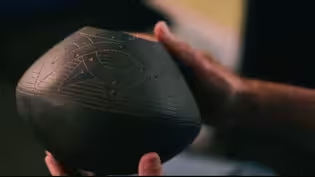
Weedon Island is one of the most distinctive pottery types in certainly in Eastern North America just because of the incised and punctated designs on pots like this, the unusual vessel forms.
We see certain elements of this pottery that show up elsewhere in different types and different places.
But Weedon Island was recognized like 100 years ago as a really distinctive type of pottery, even before they had the name Weedon Island.
- So pottery has evolved most recently in probably the past 50 years.
So there's different ways to make things outta clay.
The wheel's most commonly know, but people still do pinch pottery.
You just take a ball clay and pinch it with your hands, or people will make coils outta clay.
So they'll roll 'em out and stack 'em and build it.
So pottery is more than just a functional vessel that can you get across ideas.
It's something that it's easiest to get art into a home through something accessible that you use.
I think pottery is something that is important to St. Petersburg community.
Just through second Saturday events, we get probably like 100 to 200 people coming through every second Saturday to look at the the new shows we have up.
We showcase artists from around the country and around the world.
- One of the things that I think artists today could take from looking at Weedon Island pottery is just understanding that connection that people have with the natural world and drawing inspiration from that.
I think a lot of artists do that, but thinking about that from the perspective of Native Americans and the connection to landscapes and all the beings in the landscapes, I think, is something that artists could draw inspiration from.
(soft music) - To learn more, visit weedonislandpreserve.org.
And that wraps it up for this edition of WEDU "Arts Plus."
For more arts and culture, visit WEDU.org/artsplus.
Until next time, I'm Dalia Colon.
Thanks for watching.
(pounding dramatic music) - [Announcer] Funding for WEDU "Arts Plus" is provided by the Community Foundation Tampa Bay.
(soft electronic music) (sweeping moving music)

1108 | Local | Fairgrounds St Pete
Video has Closed Captions
Clip: S11 Ep8 | 6m 11s | Escape reality in an art and technology museum located in St Pete. (6m 11s)

Video has Closed Captions
Clip: S11 Ep8 | 6m 19s | Art teacher and folk artist Heidi Wineland creates whimsy creatures and mini ball gowns. (6m 19s)
Video has Closed Captions
Clip: S11 Ep8 | 6m 51s | Fine art painter Melvin Gómez brings his experience from El Salvador to his works. (6m 51s)
1108 | Local | Weedon Island Pottery
Video has Closed Captions
Clip: S11 Ep8 | 5m 27s | Through its unique pottery, we explore the history of Weedon Island Preserve in Pinellas. (5m 27s)
Providing Support for PBS.org
Learn Moreabout PBS online sponsorship

- Arts and Music
The Best of the Joy of Painting with Bob Ross
A pop icon, Bob Ross offers soothing words of wisdom as he paints captivating landscapes.













Support for PBS provided by:
WEDU Arts Plus is a local public television program presented by WEDU
Major funding for WEDU Arts Plus is provided through the generosity of Charles Rosenblum, The State of Florida and Division of Arts and Culture and the National Endowment for the Arts, and the Hillsborough County Board of County Commissioners.