
Episode 111
Season 1 Episode 111 | 25m 56sVideo has Closed Captions
Explore bird rehabilitation, visit Mediaverse Studios, and meet the Christofferson family.
Find out how Iowa Bird Rehabilitation is working to preserve and rebuild Iowa’s bird population, visit a creative space for filmmakers in Marengo, and learn how the Christoffersons prioritize love and advocacy in their family.
Problems playing video? | Closed Captioning Feedback
Problems playing video? | Closed Captioning Feedback
Iowa Life is a local public television program presented by Iowa PBS
Episode 111
Season 1 Episode 111 | 25m 56sVideo has Closed Captions
Find out how Iowa Bird Rehabilitation is working to preserve and rebuild Iowa’s bird population, visit a creative space for filmmakers in Marengo, and learn how the Christoffersons prioritize love and advocacy in their family.
Problems playing video? | Closed Captioning Feedback
How to Watch Iowa Life
Iowa Life is available to stream on pbs.org and the free PBS App, available on iPhone, Apple TV, Android TV, Android smartphones, Amazon Fire TV, Amazon Fire Tablet, Roku, Samsung Smart TV, and Vizio.
Providing Support for PBS.org
Learn Moreabout PBS online sponsorship♪♪ Coming up on this episode of Iowa Life -- See how this team of volunteers is rehabilitating wild birds.
It's kind of one of the first things we hear is, I've never been this close to a bird.
♪♪ Visit a Marengo barn that now serves as a creative space for filmmakers.
Mediaverse Studios is a film collaborative.
What we're trying to do here is encourage all of the filmmakers in the Midwest to make their dreams come true.
♪♪ And learn how the Christofferson family prioritizes love and advocacy.
We really switched at that time to a new trajectory of just loving every moment, loving every ounce of extra that everybody brings, and seeing the beauty in it.
♪♪ It's all coming up next on Iowa Life.
♪♪ Funding for Iowa Life is provided by the Gilchrist Foundation, founded by Jocelyn Gilchrist, furthering the philanthropic interests of the Gilchrist family in wildlife and conservation, the arts and public broadcasting and disaster relief.
Mark and Kay De Cook Charitable Foundation, proud to support programs that highlight the stories about the people and places of Iowa.
The Strickler Family, in loving memory of Lois Strickler, to support programs that highlight the importance of Iowa's natural resources on Iowa PBS.
And by -- the Lainie Grimm Fund for Inclusive Programming at the Iowa PBS Foundation.
♪♪ ♪♪ ♪♪ ♪♪ ♪♪ Every spring and fall, hundreds of millions of birds migrate through Iowa, though we often take them for granted.
♪♪ Jenni Boonjakuakul: I don't think people understand how important birds are to our survival.
Birds play a huge role in insect control, in rodent control, they also are pollinators and seed spreaders.
♪♪ Jenni Boonjakuakul: And if we lose our bird population, it's going to have a direct impact on humans as well.
♪♪ Jenni Boonjakuakul: Wild birds are in decline.
It's a pretty devastating number.
25% to 30% of wild birds have disappeared in the last 50 years.
One question I am starting to ask people is, can you imagine a world without birds?
And I think that we take for granted when we walk outside, we hear the birds, we see them, we don't really think about that because they're there and they're always there.
But I think if we get to a point where we start losing their population or they disappear completely, it's going to be pretty noticeable.
♪♪ Jenni Boonjakuakul: Probably very few people know that nestled in a yard in the Beaverdale area of Des Moines is one of the busiest wildlife centers in the state of Iowa.
(goose honking) ♪♪ Jenni Boonjakuakul: So, we do specialize in just wild birds, so we don't take in mammals.
But we do take in nearly 2,000 birds a year.
♪♪ Jenni Boonjakuakul: Our goal is to take them in, give them medical treatment, medical care, rehabilitate them, get them ready for release and then release them.
♪♪ Jenni Boonjakuakul: So, this is our pigeon aviary.
All of these pigeons have come in through rehabilitation cases.
So, a lot of them have come in just injured or baby pigeons.
A lot of times people find them downtown.
I think this one maybe here is missing a leg and he was a rehab case.
His leg had been twisted up in some string and then he was hanging from I think it was a Bankers Trust sign.
And animal control was able to get him down and then we were able to amputate his leg because it was pretty mangled, and now he does great.
He flies well.
He flies around with the other pigeons and then he comes back.
We don't mind having them here.
Some of them might be a little bit more friendly than others.
(laughs) ♪♪ Jenni Boonjakuakul: I first got involved in bird rehabilitation when I was a graduate student in California.
I was at UC-Davis studying microbiology and I found a baby crow and I didn't know what to do with it, so I called one of my professors and he said, bring in a can of cat food and I'll show you how to feed it.
♪♪ Jenni Boonjakuakul: I did everything wrong.
It's actually illegal to raise a federally protected bird, which a crow is, and he imprinted on me.
So, there was just a lot of things that were not done well.
But after that I decided if I want to rehabilitate birds, then I want to do it correctly.
(crow squawking) Jenni Boonjakuakul: In 2012, I got my own permit to rehabilitate wild birds and started keeping track of our numbers.
And that year I took in 170 birds and this last year we took in almost 2,000 birds.
It definitely was not anywhere I imagined myself when I was in grad school.
I loved science and I loved research, but once I started working with birds, something just blossomed and I'm not sure if I can even tell you what that is.
It's just that these guys are remarkable and they're beautiful.
And I think what I love about working with wildlife is that it's not a permanent thing.
I am trying to get this bird back out into the wild as soon as I can.
♪♪ Jenni Boonjakuakul: This little guy is a wing injury that he's recovering from.
Nighthawks get hit by cars a lot.
They hunt at dusk when the insects are most prevalent.
Some of them just came in as babies, but they weren't quite ready to go, they weren't strong enough to go in the fall.
So, we were trying to over winter them, but they are a tougher bird to rehab.
Jenni Boonjakuakul: It's a lot of fun.
It's diverse.
One reason I went into science is because I wanted a job where it changed all the time and that's kind of what rehabilitation is with wild birds too.
Our day-to-day is never the same.
(baby bird squeaking) Jenni Boonjakuakul: We work with a vet when we need to, so if we need to get x-rays or special medication, we have a vet that we can work with.
But a lot of the medical is done by me and just through my experience.
So, I can set legs, I can set wings, we can give medication if the bird has an infection.
Want to get up so you can eat better?
Jenni Boonjakuakul: So, this is Jujube, she is a turkey vulture and she is one of our education birds.
She is about two years old now.
She came to us when she was probably about four or five months old.
She had wing deformities, so her wings can't extend fully, they kind of have a bend in them.
And when she arrived, she also had really horrible feather damage, which indicated to me that somebody had kept her in a cage for a while.
Jenni Boonjakuakul: So, she can't fly, but she is going to be a great education ambassador for us.
It's a great way for people to see a bird up close and personal.
We get to talk about Jujube in particular as a turkey vulture being a scavenger.
Without turkey vultures, our roads would just be a mess.
So, they are kind of a cleanup crew.
Kristi Brede: Everybody who seems to meet her loves her and I think that turkey vultures get a really bad rap.
Jenni Boonjakuakul: People love being close up to birds.
It's kind of one of the first things we hear is, I've never been this close to a bird.
(goose honking) Jenni Boonjakuakul: We are not just taking in birds from the Metro area anymore, we're taking them in from all over the state.
So, we're definitely at a point where we need more space.
I think that Iowa is ready for a wildlife center specifically for birds and that's kind of our next goal is to build a facility that is permanent, that can handle the number of birds that we take in, and it can also handle the variety of birds that we take in.
♪♪ Jenni Boonjakuakul: It goes beyond just saving this one bird.
I think that we are one small place in Iowa and I believe in the ripple effect.
Letting nature take its course, maybe in some instances that's sometimes what we have to do.
But we have the knowledge and we have the experience and we have the know-how to help a bird with whatever it's going through, then why not?
And why not give it that second chance?
♪♪ ♪♪ ♪♪ Jacob Daniels: So, we are here at Mediaverse Studios and this is in Marengo, Iowa west of Iowa City.
♪♪ Jacob Daniels: Mediaverse Studios is a film collaborative.
What we're trying to do here is encourage all of the filmmakers in the Midwest to make their dreams come true.
So, we're sitting right now in six acres.
With any luck, we'll be able to turn this into an entire film compound.
We would like this place to just become a hub for all filmmakers in the Midwest, to be honest, something that can be inspiring and can be just immensely useful.
Everybody settled and action.
Brittany Benedict: Filmmaking in Iowa, if you're really out there alone, you don't know where to start, it definitely is a grind.
You just have to get a camera and you have to make things.
I didn't go to film school.
I didn't know that people were doing it here.
It definitely took meeting people who also have the same passion, specifically my partner Michael Huntington, to get me into it.
Michael Huntington: I started filmmaking probably when I was like ten, I really got into it.
My dad showed me movies and I fell in love with storytelling.
We had a handheld camera that I found in a closet and we just started making short films with that.
But when I started, I knew nothing.
And action.
Brittany Benedict: There are people doing all levels of it in Iowa.
It's huge, there's a ton of people here that love filmmaking and are passionate about it no matter what level they're at, if they're being paid professional or just grinding independently.
You're missing the point.
She's taking -- Jacob Daniels: So, I got into filmmaking during COVID.
I think that a lot of people found a creative outlet while they were stuck at home and mine just happened to be filmmaking.
So, I made a couple of short films with my partner at home and we had a great time doing it.
I found that I really love this craft.
And I got onto the Iowa Film Facebook page and just happened to break into a pocket of local filmmakers that happened to be Michael and Brittany.
Brittany Benedict: Three years ago, we were doing our third annual Christmas film.
♪♪ Brittany Benedict: And that's where we met Jake Daniels.
Michael Huntington: Our sound person dropped out for a short film that we were going to do and I was like, I know this guy.
I'll hit him up to do sound.
And he just kept coming back and we would do projects after projects.
And we were outside one night and I was talking about the filmmaking idea of, man I wish I had a studio.
And Jake was like, well, my parents have a place.
And I'm like, what?
And then he showed me photos and it was this massive facility and I was like, dude, this is crazy.
Jacob Daniels: So, I grew up in Ladora, probably like 10 minutes west of here.
And I went to Iowa Valley High School here at Marengo.
And this building is actually owned by my father.
He ran Iowa Valley Vet Clinic out of here and then it was Honey Creek Marketplace for a couple of years.
And then when COVID hit they had to shut down.
The use of this space is just very convenient and we're very grateful to my family for allowing us to rent it from them.
♪♪ Michael Huntington: I'll never forget that moment going through those gates, there was things there that you could see a future in.
♪♪ Jacob Daniels: Film Alley is a set of stalls that can turn into film sets.
You can control all of the lighting, you can control the set design and tailor it to whatever the film needs.
Kevin Shepherd: That's the biggest thing.
When people want to write stories that involve a hospital room, the changes of getting into a hospital room is minimal.
In a place like this, we can build one, as we've done.
And it has already been utilized in a short film.
So, just the ability to create what you want in your film as opposed to being limited to what you can obtain.
Jacob Daniels: Adjacent to that we have our podcast setup.
We have a dedicated editing room.
We have our own equipment and we are able to rent it out.
A movie theater and a wardrobe and prop department, all of that stuff.
And it has been a lot of work but it has been very successful so far.
Brittany Benedict: Coincidentally, we were filming in Marengo far before we even knew this building existed.
And I think what really drew us in is that it is a small community and we have found it to be great to film in.
Now that they know we're here, there is kind of more of an awareness and an acceptance of us filming out there.
And it has been a really great experience.
Jacob Daniels: We have a crew right now of 13 people.
We have auto mechanics, we have construction workers, we have graphic designers.
We're all filmmakers and so we all have ideas.
Michael Huntington: There's like 13 of us who all have the same passion, but the ultimate goal is for the community to get in here and use this space.
Jacob Daniels: One of my favorite memories here was we did the July 3rd parade here in Marengo and then we all pulled our float back in here after the sun went down.
They started shooting off fireworks and we all just kind of sat on the parade float and watched the fireworks.
And without filmmaking we would never even know each other.
That's what this is, this is building family.
It's more than just film.
It's more than just art and creativity.
It's family.
♪♪ ♪♪ ♪♪ Megan Christofferson: Matt and I have been married it will be 25 years this summer.
And we have 8 children.
Kat is the oldest at 22.
Gabe is 20.
Carsten is 17.
Bo is almost 16.
And Elle is 15.
Griffin is 14.
Mae is 12.
And Eve is 10.
♪♪ Megan: Did I get them all?
Matt Christofferson: You got them all.
You did much better than I would have done.
(laughs) Megan: We're kind of like a beehive.
While there's a lot going on, we generally buzz in the same direction.
Matt: Pretty much.
♪♪ Megan: We try to really focus on each other's strengths and rally around each other.
We say we put each other in the love jar.
So, focusing on the positive of each other.
That's perfect big boy.
♪♪ Megan: So, Carsten loves the family.
His hero is Gabe.
Gabe is his best friend.
♪♪ Gabe Christofferson: Did you enjoy bowling today, buddy?
Carsten Christofferson: Yes.
Gabe: You got a spare, didn't you, at the beginning?
Carsten: Yes.
♪♪ Good spare!
Carsten: We're brothers.
Gabe: We are brothers, yeah.
Carsten: I was born in 2006.
Gabe: You were born in 2006.
Carsten: How about you?
Gabe: Do you know when I was born?
Carsten: No.
Gabe: 2003.
Carsten: Oh.
Bo, Mae, Elle, Mae and Kat -- five of them born in China.
Gabe: Yeah, we have five siblings who are adopted.
Gabe: I think anybody who has younger siblings will relate to wanting to be there for them and do right by them and protect them.
♪♪ Megan: Carsten is now 17, so about 10 hours after he was born my hospital room fills full of doctors to tell us that they believe he has Down Syndrome.
I say Carsten rearranged my stars.
So, he changed everything.
And we really switched at that time to a new trajectory of just loving every moment, loving every ounce of extra that everybody brings and seeing the beauty in it.
And also started my journey in advocacy around children with special needs.
Carsten just wants to be included, involved.
He wants his opinions known.
He wants to be sure you know about him.
♪♪ Megan: He is just really good too at reading a room and knowing who needs him.
It's just kind of incredible how he picks up on those things.
Matt: And I think one of the nice things about Carsten too is he focuses on what he thinks is important.
All of the other things that sometimes we get caught up in and get worried about, he just lets those go.
♪♪ Megan: Over Christmas, Kat and Gabe were back from college.
We had them home for a whole month, so all eight little birdies were back in the nest and we did our annual gingerbread contest during that time.
♪♪ Griffin Christofferson: When Kat and I were doing the gingerbread house, I came up with ideas and she'd put them on the house.
That teamwork together made us win.
So, always remember to work as a team.
♪♪ Megan: So, Griffin is amazing.
When he was little, I would call his name and he wouldn't respond to his name.
And that kind of set the wheels in motion.
We got one diagnosis of mixed expressive receptive speech delays at that time.
But, when he was nine, we got the official diagnosis that he is on the Autism spectrum.
We were already plugged into the services that we needed to be plugged into.
I also think that places like ChildServe have really enabled our family to be the family we are because we're not having to hunt and peck for all of these different services.
It's all under one roof.
There's a bishop here, you can't take it.
Megan: We felt really lucky that we found Johnston Community Education and the chess club and he really enjoys going to that and being a part of the club.
Matt: He likes to win.
Megan: He does like to, a quiet win.
Matt: Griffin will bring the energy to the room.
It's just Griffin and it's fun.
He keeps you on your toes.
Megan: He's a fun kid.
Matt: He's a great kid.
Megan: I just, his sense of humor is hilarious.
He's very logical.
He's the keeper of an insane amount of knowledge.
♪♪ Griffin: What's your favorite part of your days?
Eve Christofferson: Usually like right then, right now.
Griffin: Yeah, right now, eating food with family.
Eve: Being around my family, yeah.
Mae Christofferson: I've learned to be more patient and be more inclusive with the others and to just be nice.
Griffin: Just because you're a little different doesn't mean that we're all not the same.
We're all the same.
Some of us are just a little different.
(Bo beatboxing) Megan: Bo came popping into our lives when he was six.
And I like to say that Bo is a luva, not a fighta.
♪♪ Megan: He and Carsten, while they share a diagnosis of Down Syndrome, are quite different on their personalities, very different personalities but very, very fun people to be around.
Matt: Carsten is a little more discerning on who he wants to spend his time with.
Bo wants to spend time with anybody that he can wrap his arms around.
Megan: He loves Sparkle Squad and cheering with the cheerleaders.
Megan: He loves beatboxing for us.
That's his primary joy in life.
Matt: Yeah, he's the showman.
(Bo beatboxing) Bo Christofferson: I love pie.
Elle Christofferson: You love pie.
Bo: I made tacos in school.
Elle: In school, yeah.
A few days ago, yeah.
They were a bit spicy.
Kat Christofferson: I think most importantly like as a family we are able to have fun as a family.
Family is also fun, family is love, I think that's what family should be.
Right Bo Bo?
We have fun?
Bo: Yeah, kitty.
Kat: Yeah, kitty.
He calls me kitty sometimes.
♪♪ Kat: I don't know, we just fit together really well.
Everybody has got their personalities and what they're good at and they just, they just use whatever they're good at and then help each other out.
Elle: It's like a little bit of everything.
We complement each other really well.
♪♪ Elle: Everyone brings everything to the table and everyone is just amazing and it just brings the whole family together.
No one is left out.
Everyone is here and important.
♪♪ Megan: I'm hoping that Matt and I have lived our lives and demonstrated to our kids the importance of being the voice for others and just create a better, brighter place for everyone to live.
♪♪ ♪♪ (cheering) (guitar playing) ♪♪ ♪♪ ♪♪ ♪♪ ♪♪ ♪♪ ♪♪ ♪♪ ♪♪ ♪♪ ♪♪ ♪♪ ♪♪ ♪♪ ♪♪ ♪♪ ♪♪ Ten ... Nine ...
Eight ...
Seven ... Six ... Five ... Four ... Three ... Two ... One!
(cheering & applause) ♪♪ ♪♪ ♪♪ Funding for Iowa Life is provided by the Gilchrist Foundation, founded by Jocelyn Gilchrist, furthering the philanthropic interests of the Gilchrist family in wildlife and conservation, the arts and public broadcasting and disaster relief.
Mark and Kay De Cook Charitable Foundation, proud to support programs that highlight the stories about the people and places of Iowa.
The Strickler Family, in loving memory of Lois Strickler, to support programs that highlight the importance of Iowa's natural resources on Iowa PBS.
And by -- the Lainie Grimm Fund for Inclusive Programming at the Iowa PBS Foundation.
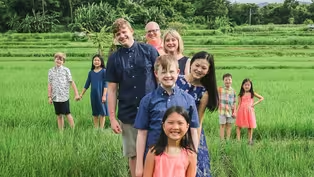
Video has Closed Captions
Clip: S1 Ep111 | 7m 58s | Learn how the Christofferson family prioritizes love and advocacy. (7m 58s)
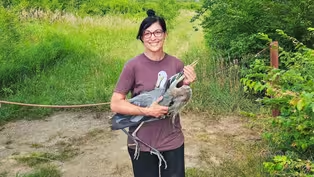
Video has Closed Captions
Clip: S1 Ep111 | 6m 43s | Learn about Jenni Boonjakuakul and her team of volunteers at Iowa Bird Rehabilitation. (6m 43s)
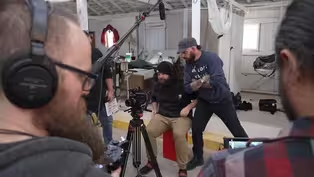
Video has Closed Captions
Clip: S1 Ep111 | 5m 9s | A creative space for artists and filmmakers needing room to bring their vision to life. (5m 9s)
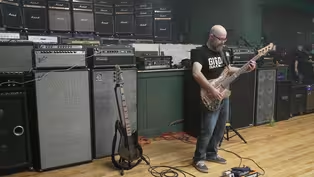
Video has Closed Captions
Clip: S1 Ep111 | 2m 44s | Jon Locker breaks a world record for the most guitar/bass amps connected at once. (2m 44s)
Providing Support for PBS.org
Learn Moreabout PBS online sponsorship













Support for PBS provided by:
Iowa Life is a local public television program presented by Iowa PBS