WEDU Arts Plus
1110 | Episode
Season 11 Episode 10 | 26m 46sVideo has Closed Captions
Erin A. Mitchell, Detroit Institute of Music Education, Chela Lujan, Reno Film Collective
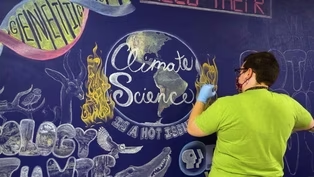
Eryn A. Mitchell is celebrating science with chalk drawings. The Detroit Institute of Music Education teaches students about the contemporary music industry to prepare them for a leading role in today's music world. Artist Chela Lujan practices the ancestral art of beadwork in La Junta, Colorado. The Reno Film Collective brings members together to improve their craft and tell stories through film.
Problems playing video? | Closed Captioning Feedback
Problems playing video? | Closed Captioning Feedback
WEDU Arts Plus is a local public television program presented by WEDU
Major funding for WEDU Arts Plus is provided through the generosity of Charles Rosenblum, The State of Florida and Division of Arts and Culture and the National Endowment for the Arts, and the Hillsborough County Board of County Commissioners.
WEDU Arts Plus
1110 | Episode
Season 11 Episode 10 | 26m 46sVideo has Closed Captions
Eryn A. Mitchell is celebrating science with chalk drawings. The Detroit Institute of Music Education teaches students about the contemporary music industry to prepare them for a leading role in today's music world. Artist Chela Lujan practices the ancestral art of beadwork in La Junta, Colorado. The Reno Film Collective brings members together to improve their craft and tell stories through film.
Problems playing video? | Closed Captioning Feedback
How to Watch WEDU Arts Plus
WEDU Arts Plus is available to stream on pbs.org and the free PBS App, available on iPhone, Apple TV, Android TV, Android smartphones, Amazon Fire TV, Amazon Fire Tablet, Roku, Samsung Smart TV, and Vizio.
Providing Support for PBS.org
Learn Moreabout PBS online sponsorship- [Announcer] This is a production of WEDU PBS, Tampa, St. Petersburg, Sarasota.
(gentle calm music) - [Announcer] Funding for "WEDU Arts Plus" is provided by the Community Foundation, Tampa Bay.
- [Gabe] In this edition of "WEDU Arts Plus", using chalk to celebrate science.
- [Eryn] I wanted to have like a rock pick in there somewhere, you know, that kinda thing.
You know, it's just like weird little things like that.
I love putting those into it, which is why the farther I get into this, the more crazy detailed it gets.
- [Gabe] A music institute unlike any other.
- We really wanted to help young modern musicians, entrepreneurs, and songwriters understand how the business of music works.
And that was really the motivation about setting up DIME.
- [Gabe] Drawing up on the ancient practice of beading.
- Ceremony and traditions and the culture of indigenous people, those things are just (sighing) really, really near and dear to my heart.
- [Gabe] And a collaborative film collective.
- [Bryant] You can't make a movie by yourself.
A lot of art, one person can create it, one person can write a poem, but it takes an army of people to create a short film.
- It's all coming up next on "WEDU Arts Plus".
(gentle jazzy music) Hello, I'm Gabe Ortiz, and this is "WEDU Arts Plus".
This first segment was produced by students at St. Petersburg College in partnership with WEDU.
St. Petersburg College recruited Eryn A. Mitchell earlier this year for a very specific purpose.
With a passion for art and science, Eryn livens the walls with her chalk drawings, seeking to inspire a new generation of artists and scientists with her work.
(gentle jazzy music) - My name is Eryn Mitchell.
They started me as a lab assistant back in 2018.
And I was here as a lab assistant until 2020 and the pandemic hit, and they hired me back in February, 2022.
Now I'm just drawing on the chalkboard wall for them.
I've worked with pastels before, and which is kind of similar to chalk, but not quite.
But otherwise they were just like, "We have this chalkboard wall, do you wanna work on it?"
Yeah, it just kinda chose me.
I've always been creative, been drawing pretty much since I could pick up a crayon.
That's what my family always tells me.
"Oh, you're in biology?
But you do so much art stuff."
I'm like, "Yeah, don't really get a big intersection there."
(laughing) Like a lot of people ask when I graduate, if I'm gonna do like textbook illustrations, medical illustration, that kind of thing.
Illustration's a crossover.
(gentle jazzy music) For the chalkboard out here, when I first started working on it in 2018, it was a lot of staring at blank paper.
I have this big blank chalkboard, and this list of puns that I've been given, natural science puns, "Marine biology has a porpoise".
You know, that kind of thing.
Like, "What can I do with that?"
"It's a blank page, you can do anything with it."
And I'm like, "I'm gonna stand here and stare at it for a while, 'cause I don't know what to do with this."
And then more recently the farther I've gotten into it, the more detailed I've gotten, the more I plan it out.
I'm like, "Okay, well the inspiration is gonna be based on what this is."
So like geology.
Okay, I want this thing to be in there.
(gentle jazzy music) I wanna have like a little tourmaline rock B. I think it's the L, is like a little tourmaline rock in there.
And then like the O's are geodes, and I wanted to have like a rock pick in there somewhere, and you know, that kind of thing, You know, it's just like weird little things like that.
I love putting those into it, which is why the farther I get into this, the more crazy detailed it gets.
- I have walked by this I don't know how many thousands of times, and it is just, it's a really cool piece of amazing artwork.
I study space, and that's your, kind of your ultimate goal, is to be able to touch space.
And this is kind of a way of making space into the world I live in much closer.
So it's a nice opportunity to see stuff you don't see every day.
You know, we don't see galaxies.
We don't see some of these animals every day.
I mean the artist has done an amazing job.
It definitely makes walking in every day to work, it's kind of inspiring to see, you know, the skill and ability of an artist to bring an object and idea to life, and that's what I've kind of enjoyed.
- And then as I go, as I've gone, I'm like, "Biology."
The department I'm in, it's the field that I'm studying.
I wanna get really crazy detailed with it.
And so I decided to do, each letter is a biome in biology.
Just the letters for biology, each letter took three to five hours.
I think either the V or the E in vie, in c'est la vie, took like five hours.
Yeah, most of them take like three to five hours.
So biology is all the terrestrial biomes.
(gentle acoustic music) And c'est la vie are all aquatic biomes.
La is like, just the sky.
And then it's surrounded by, just the ghosts of animals basically.
I'm so happy when I finally finish stuff.
I'm happy working on it, but I'm like really happy when I'm, like done with something.
I'm like, "Okay, so now I feel like I finished something."
Like it does make me happy to finish pieces of it.
So it's like, now I actually have a plan and I'm just like, "Okay, I'm working on this section today."
You know, that kind of thing.
Now I've gotten better at it.
So now I've taken a photo of it into Photoshop and just made it so that I have a rough sketch of what I wanna do, like already planned out.
So now I'm not just standing there for like an hour going, "What am I gonna do with this?"
So I took a couple of photos of the wall and just kinda patched them together, so that I had like, all the blank space.
So I just took these stitched photos into Photoshop and just started drawing over them.
So I have like layers of like, the different layers of everything that I just started throwing together.
So for like botany, I've just started planning a rough idea of what I wanna put in.
So like, some of these might change.
I can change any of these as I go, but roughly this is what I have an idea.
So this is really rough over here.
So like eventually I wanted to say entomology bugs me in that spot, but I'm not entirely sure what kind of bugs I want in there.
Well, we'll take care of the details when I get to it, but for now it's like, this is a rough.
And you can kinda see it with the climate change in the astronomy section now, 'cause that looks so much different from the fire and everything that I've got out here now.
The globe that I'm working on right now for climate change, that, I started that and took four hours, and then I had to erase it and then had to take another five hours to fix it, that kind of thing.
It depends on what you're looking at.
But no, I'd like to help people like realize that you can do both art and science.
I get a lot of comments that are just like, (gasping) "You can do this and science?"
I'm like, "Yeah, you can do art and science.
They're not, you know, exclusive things."
- Yeah, so every time I pass by the chalkboard drawing, I always admire it, 'cause I'm an artist myself, and I can see how much dedication and work goes into it.
So it's really cool to see someone so consistent and passionate about drawing on the chalkboard, and all sorts of different things, every subject matter or what have you.
So it's really cool to see, as a fellow artist.
There's an ever-evolving art form being created, and I think it's really cool to see something like that on our campus.
- I just took it in, and kinda roughed it out and everything.
And eventually I will actually get there and draw it.
(gentle acoustic music) So it's like, I like putting things on there that look kinda different, find inspiration there, and I just wanted to do something neat.
(laughing) (gentle acoustic music) - [Gabe] See more of her work at instagram.com/whogrooveson.
Detroit Institute of Music Education, also known as DIME, provides a unique music education that centers on the contemporary music industry.
The college prepares its students for a longstanding role in today's music world.
Find every song groove - When you walk the halls of DIME, you hear incredible music.
- You feel the music industry.
Ba da da da Ba da da da - Most places measure success in music by complication, so more complicated music is better than simple music.
But in the music industry it's the reverse.
Detroit has got the best musical bones of anywhere in the world, so the chance to build a college here was an amazing thing.
In 2001 in England, we built five colleges there so that young people had an academic path into the music industry that valued modern music at the same level as traditional music.
- We really wanted to help young modern musicians, entrepreneurs, and songwriters understand how the business of music works, and that was really the motivation about setting up DIME.
- DIME is different because it focuses on the contemporary music industry.
A lot of universities you'll study like one track, you'll do like a classical track or a jazz track.
DIME is more fit for students who wanna do, you know, pop music or anything along those lines of being in the contemporary music industry.
Much better, okay?
It's just amazing how like, when you really like get into it, like as far as your character, how much that helps the voice.
- What you get at DIME is the real deal.
What it's really like every day, and how you also have to have entrepreneurial skills to survive in today's industry.
- And we want young people to understand, it's not just about playing guitar in your bedroom or being the next Beyonce, there's everything in between.
There will be some singers who realize they're not as good as some of the other people in their class, and that's okay.
Think how you can find your path in the music industry.
And it doesn't mean that you will never sing again.
It just means that you might do something else as your primary source of income, and that will allow you to continue your singing passion.
- Okay good, very good.
Now, as we go, Do ti la just make sure we have a nice blended sound, all right?
Most of our faculty members, if not all, they're all practicing musicians.
And so we are all familiar with what it takes to like have a career, have year nine to five, and also pursue this dream.
- When I leave class, most of the times on the weekend, I'm going to the airport to catch a flight, to go do a one-off or a tour date with one of the artists that I work with.
So I'm able to bring that experience back to the classroom Monday morning, and that's one of the things that separates DIME and makes it unique.
- The degree that DIME students get is a bachelor of arts in commercial music performance or commercial songwriting, or music industry studies.
And the degrees are awarded through Metropolitan State University of Denver.
- If you're a performance major, you'll take a class that's called live performance workshop where you'll have to learn a different song each week.
In songwriting, they take classes like lyric writing, foundations of songwriting, writing for artists.
And then for music industry studies, some of their main classes are like domestic music market, international music market, politics of A&R, establishing an artist.
So just kind of like getting a feel for different aspects of being behind the scenes, and not being on stage.
- We want students in their first week when they enroll in the program to feel like they've already entered the music industry.
So it was really important to build a building that feels inspiring, that's full of music, that has vintage and new equipment everywhere that students can trial and test.
- [Eric] We don't have classrooms, we have studios.
So when we go in the studio, we're working, we're vibing, we're collaborating.
- We often describe DIME like a development deal.
So we say during your four years, come here and make all your mistakes.
Use DIME, the program, and your academic studies to figure out who you wanna be, so when you graduate, you're gonna get that job that you want.
(sticks drumming) - Yeah, come on.
There we go, uh.
Funky drama.
I try to be relentless at making sure I empower them to know that.
"You can make music, you can turn this music into a passion and make it a career."
- [Sarah] It's really important for us to open our doors to the city, and we wanted DIME to feel like anyone in the city is welcome in these four walls.
- [Kevin] We saw the basement here and, 'cause I'm from like deep jazz world, we've modeled this on Charlie Parker's club.
That kinda speakeasy, open door attitude, about there's music going on here, and anyone can walk in off the street.
- All our events are free, and if someone enjoys the show, we have a student scholarship fund.
They can put a couple of bucks in to say thank you.
Because we are the Detroit Institute of Music Education, we're taking that tagline all around the world with us.
So we have now just built a college in Denver.
It's called DIME Denver, but it's powered by the Detroit Institute of Music Education.
So we are trying to fly the flag for all Detroit performers within Detroit and also outside of Detroit, and tell the world what an incredibly talented city this is.
- [Kevin] And we've also got DIME online, which is in 23 countries right now.
- And that's also powered by Detroit.
- It's also powered by Detroit.
Oh oh oh oh - One of our mottoes is like, simple done well.
So being able to really take on a song, and communicate it to the point where it just feels like you're just having a good time, and you're really like touching the person with your music.
You have all of these tools in your tool bank, but you make it look effortless.
And so I think that that is one of the things that we try to get across here at DIME.
So you're here by my side - To learn more, visit dime-detroit.com.
Embracing her culture and heritage, artist Chela Lujan practices the art of beadwork.
Head to La Junta, Colorado, to see how she makes meaningful pieces of jewelry with beads.
- Southern Colorado and Northern New Mexico, it all has the same air of just that high desert, high plains, which I think my beadwork really draws from that energy.
We grew up on the Dine nation, the Navajo reservation, in Ganado, Arizona.
All of those traditions and cultural backgrounds really had an effect on me.
Ceremony and traditions and the culture of indigenous people, those things are just (sighing) really, really near and dear to my heart.
They really kinda shaped who I was growing up in that way.
My mother Charlotte, her grandmother was Jicarilla Apache.
Her name was Delavina Chicoon.
I don't know much about that lineage, unfortunately.
I really wish I did.
But back in those times, she didn't tell anybody that she was Apache.
So, there isn't a lot of those traditions that she might have had in her life passed on to my family.
My mother Charlotte was actually the one who taught me beadwork, and she was taught by a famous Dine, or Navajo artist.
I remember her teaching me the loom, the beaded loom, which, when I was about six years old, I was just a baby.
And I remember taking it to it really easily, but I didn't pick it up again until I was 23.
I remember seeing a hatband that somebody was wearing, and I knew that that's what I wanted to do.
And I knew that I had to teach myself how to do it, and so I did.
(laughing) The name of my business is Roadside Remedies.
You know, you go to these places and there's always vendors on the side of the road who are selling jewelry.
It started off on like, Etsy.
We found the name and I started getting the supplies, and my supplies at that time were cheap, for lack of a better word, you know, 'cause I didn't know the difference between this bead or this bead, and quality versus quantity, that sort of thing.
Finally opened up my own online store, which looks a lot better.
Thank God for Instagram and things like that.
And then I have gotten on board with really talented women, other women makers, people like Cate Havstad, who is making her own hats.
Suzy Cotcher, who, her hatband was the first hatband I saw that I wanted to do, and she was really supportive of my work.
This is a porcupine quill hatband.
So, you string up the porcupine quills first, and those are all hand dyed.
This is a Dine Tree of Life, the Navajo Tree of Life.
It's a corn stalk and birdies, and the basket and feathers, and it's all, it's all sacred symbols.
This is the Cheyenne brickstitch.
This one in particular was inspired by ceremony, by the four rounds of the ceremony.
So this is what I call, Midnight Water, and the line of blue represents the water.
And the shape, of course is the teepee, the womb, the ribs, the mother, and the gray is the smoke coming out of the fireplace.
I use a lot of hearts and a lot of triangles that I think represent fire, and like this teepee shape to represent the womb and mother earth, essentially.
Yeah, and the colors just you know, like a painter would pick out his palette or her palette, and I do the same thing with my beads.
To develop the relationship with threads and beads and patterns and colors, and they talk to me.
That's kinda how I feel.
(laughing) There's times when I think that I don't wanna teach somebody, but I know that people have helped me so much learn, that, and it isn't mine, it's not mine to hold.
It's not mine to own.
So it has to be passed on or it'll be lost.
My own lineage, my being a woman of color, and trying to find out my roots and what those are, I think really is what inspired me to continue the beadwork as my mother started it and passed it on to me.
And hopefully my daughter will do it too.
(laughing) I'm all for it, I can only imagine wanting to sit next to her and teach her how to do this and pass it down like my mother passed it down to me.
But I definitely, I'm a little slower now.
(laughing) - For more of Lujan's beaded creations, check out roadsideremedies.com.
For the Reno Film Collective, collaboration is essential.
Located in Reno, Nevada, members of this community film group work together to tell a story, improve their craft, and create a work of art.
- Camera.
- Rolling.
- [Crew] Scene four, bravo, take four.
(clapboard clacking) - Action.
(gentle ambient music) - [Bryant] Filmmaking is definitely art.
It's not just one art though.
It's many different types of art forms all coming together.
You can't make a movie by yourself.
A lot of art, one person can create it, like one person can write a poem.
But it takes an army of people to create a short film.
I know a lot of people look at the director and they think they're responsible for it.
They're responsible for wrangling all the other artists together to create one vision.
- Let's keep going.
- Reset.
- [Crew] If you're gonna converse conversion, converse and be productive, let's go.
- The Reno Film Collective is a group of local filmmakers, aspiring filmmakers, and even people that are just curious about film.
We come together and we help each other create our own stories, and help each other on each other's projects.
- It's a fun way to learn new skills, practice different positions that you're, may not be used to.
And we like to make movies.
It's for people who are passionate.
We like to present to them the skills, we like to present to them the opportunities, and different facets of movie making that maybe people aren't aware of.
- You like music?
- [Joe] The Reno Film Collective currently has 172 members, and it's not all active members.
Some of those people are people who have moved away, or are just taking a little break from film right now.
But it's people who have at one point expressed interest in film.
So 173 people have decided that they wanted to take the time out of their free time to come and work on a film, to help someone else create their vision.
- He wants us to call her.
- [Joe] We have it in our general consensus that a director is the number one boss.
They make or break an entire film set based off of their word alone.
But it's an entire team.
Not a single person has made a single we by themselves.
- It takes nothing to make a bad one, but it takes everything to make a good one.
To make a good one, it needs at least a good director, assistant director, producer to kind of have their back.
And then you're gonna need a lot of really good actors that are willing to give up their weekends to help you make a film, as well as someone who knows what to do with lighting and sound, because if you don't have those two things, you're dead in the water before you even start.
(upbeat mellow acoustic music) Film Something events are some of my favorite things to do every month.
It's a day where we invite filmmakers in Reno, people that are aspiring to be filmmakers, people that just are curious about it.
We bring them all together and we create a story together in about four hours.
- We meet up at a predetermined location, but before then, nothing else has been established.
Everyone brings everything that they possibly can.
So you bring in costumes, you bring in props, you bring in things that we can use to decorate sets with.
- [Bryant] Whoever shows up, that's your crew and the actors you can cast from.
- And based off of everything we have, based off the new people that we have, we say, "Okay cool, what can we make of this?"
It is so fun getting to see how much you can accomplish when you have no pre-production.
I don't recommend it for every set, but at least in our Film Something events, it's so great to see, "Okay, we're gonna have 16 shots.
We need to do them in three hours.
Normally this would take three days just to make sure we do them all properly, okay go."
So right now we are in the process where our teams have split up, depending on the chore that they need to accomplish.
We have our screenwriters who are fleshing out the script, making sure that we have an outline.
We have our group that's currently meeting about costumes and what we wanna do with makeup, with looks.
And then we have our tech people, like sound and cameras, who are currently working on that process.
So they know that everything is working fine, that we will not have any technical issues during this process.
- Okay, so we're gonna start now.
- [Bryant] Trying to write and then film a story in four hours is very difficult.
A lot of times you have to skip steps just to get to the end.
- Okay.
- So you're gonna wanna film that.
- We've got about 30 minutes left of filming.
We filmed two scenes so far, we've got two left.
Because we're so close on time we're gonna be prioritizing what scenes to shoot, get the most important ones shot, And then hopefully it'll still make sense without the last scenes.
- [Crew] Rolling.
- All right, scene three, apple, take three.
(clapboard clacking) - Before I knew about the RFC, it felt a little lonely as a filmmaker.
I had to do kind of everything.
So finally finding a group, I would not wanna lose that group of filmmakers.
It's nice having that support, 'cause if you're taking somebody who didn't think it was at all possible to make even just a small short that they had envisioned, and then telling them, "We'll help you, we'll help you do that," and seeing like the look on their face of just excited, and like a weight's been lifted.
Like they thought they had to do was all on their own, and now they have a support behind them that'll help them accomplish their goal.
- That's right.
- I didn't think film was up here.
I thought it's in Hollywood, it's in New York City.
And I'm like, "Oh, I have to move to one of those places if I ever wanna get a chance to do this."
And having this community here, it's like, "No, no, you can do it, you can do it here."
And you can do it in a playground where you feel safe, where you feel comfortable, and you kind of have your resources here, and that's the most exciting part.
It's, it's your home base, and you can use that as the biggest playground that you possibly have to follow your passion.
I think that's why it works here in Reno.
(crew laughing) (gentle acoustic music) - For more information, head to facebook.com/renofilmcollective.
and that wraps it up for this edition of "WEDU Arts Plus".
For more arts and culture, visit wedu.org/artsplus.
Until next time, I'm Gabe Ortiz, thanks for watching.
(energetic expectant music) - [Announcer] Funding for "WEDU Arts Plus" is provided by the Community Foundation, Tampa Bay.
(bright orchestral music)
Video has Closed Captions
Clip: S11 Ep10 | 7m 14s | Eryn Mitchell creates detailed chalk drawings that depict different fields of science. (7m 14s)
Providing Support for PBS.org
Learn Moreabout PBS online sponsorship

- Arts and Music
The Best of the Joy of Painting with Bob Ross
A pop icon, Bob Ross offers soothing words of wisdom as he paints captivating landscapes.











Support for PBS provided by:
WEDU Arts Plus is a local public television program presented by WEDU
Major funding for WEDU Arts Plus is provided through the generosity of Charles Rosenblum, The State of Florida and Division of Arts and Culture and the National Endowment for the Arts, and the Hillsborough County Board of County Commissioners.