WEDU Arts Plus
1113 | Episode
Season 11 Episode 13 | 26m 20sVideo has Closed Captions
High quality guitars, the sound of jazz, making artisan cocktails, and Bonsai
Produced by students at St. Petersburg College in partnership with WEDU, Donna LoPrenzi is a second-generation luthier from Clearwater who creates custom guitars for local musicians. Hear the soulful sounds of jazz musician Romel Sims. Learn how to make artisanal cocktails in Reno, Nevada. The Milwaukee Bonsai Society celebrates the tradition and artistry of growing Bonsai.
Problems playing video? | Closed Captioning Feedback
Problems playing video? | Closed Captioning Feedback
WEDU Arts Plus is a local public television program presented by WEDU
Major funding for WEDU Arts Plus is provided through the generosity of Charles Rosenblum, The State of Florida and Division of Arts and Culture and the National Endowment for the Arts, and the Hillsborough County Board of County Commissioners.
WEDU Arts Plus
1113 | Episode
Season 11 Episode 13 | 26m 20sVideo has Closed Captions
Produced by students at St. Petersburg College in partnership with WEDU, Donna LoPrenzi is a second-generation luthier from Clearwater who creates custom guitars for local musicians. Hear the soulful sounds of jazz musician Romel Sims. Learn how to make artisanal cocktails in Reno, Nevada. The Milwaukee Bonsai Society celebrates the tradition and artistry of growing Bonsai.
Problems playing video? | Closed Captioning Feedback
How to Watch WEDU Arts Plus
WEDU Arts Plus is available to stream on pbs.org and the free PBS App, available on iPhone, Apple TV, Android TV, Android smartphones, Amazon Fire TV, Amazon Fire Tablet, Roku, Samsung Smart TV, and Vizio.
Providing Support for PBS.org
Learn Moreabout PBS online sponsorship- [Narrator] This is a production of WEDU PBS Tampa, St. Petersburg, Sarasota.
- [Narrator] Funding for WEDU Arts Plus is provided by the Community Foundation Tampa Bay.
- In this edition of WEDU Arts Plus a father-daughter team construct high quality guitars.
- I knew I wanted to become a luthier and follow my father's footsteps when I was young and we would get in trouble and our punishments we had to go to the shop and work in the shop and I enjoyed it.
- The sound of jazz.
- Some people say, I'm battling with my horn and I realized over time that it is you, it's just an extension of you.
It's all art, it's all freedom and it's all self-expression.
- Making artisan cocktails.
- It's an art form at the end of the day.
It's the same thing of watching an artist do a painting, a chef making a beautiful dish, so now the cocktail world is completely like following those footsteps.
- And the Bonsai tradition.
- It's creating the image of a large tree you would find growing in nature in a pot that you can maintain in your own home.
- It's all coming up next on WEDU Arts Plus.
(upbeat music) Hello, I'm Gabe Ortiz and this is WEDU Arts Plus.
This first segment was produced by students at St. Petersburg College in partnership with WEDU.
Donna LoPrinzi is a second generation luthier who trained under her father, Augustino LoPrinzi a master guitar craftsman.
As she honed her craft, she implemented everyday designs and visuals into her style.
The father-daughter team continued to craft high quality instruments in their Clearwater shop.
(guitar music playing) - As far as constructing any instruments I was the first it started with me.
I have three children when I had to punish them for something they did wrong, they had to come to the workshop.
And I knew when Donna, when it was her turn to come to the shop she loved it.
- I knew I wanted to become a luthier and follow my father's footsteps when I was young and we would get in trouble and our punishments we had to go to the shop and work in the shop and I enjoyed it and so I knew I liked woodworking and that type of work.
It wasn't difficult at all to learn under my father he was a very good teacher very patient, never yelled at me, he always took his time and he made sure I learned.
The most important lesson my father taught me was always to do my best work and as long as I was doing good work that everything else would basically fall in place.
I think the biggest highlight of my crafting is when I have a finished product and I'm able to turn it over to a customer and to see their expression, and I can tell that they're really enjoying their instrument that I think is the biggest highlight.
- This guitar, it just feels excellent like, the way that it plays, it couldn't be any more perfect really as far as acoustic goes.
The action is, and that means basically the distance between the strings and the fretboard is perfect.
It doesn't affect the tone but it still feels very comfortable to play.
The intonation, which is basically saying that the open string is the same as you come up here, it's perfect.
Still get an A right there, and right there, right there and it just couldn't be any better really.
(chuckles) The tone of it, it just sounds beautiful.
I haven't heard a guitar that sounds this crisp in a long time.
I don't even think I've ever played one like this.
- My creative process, I get creative ideas from everything and anything.
I can look at a piece of furniture and think about, oh, that design is nice how can I implement it or even any architectural design I can look at something and say, how can I implement that into it 'cause that's a nice feature maybe I can somehow get it into my instruments.
In the end when you see the customer appreciates all that hard work it makes everything worthwhile.
The guitar that stands out the most to me that I've built was the very first guitar I've built completely on my own.
That instrument I built for my husband so that one probably stands out the most for me.
My creative process starts with the piece of wood.
When we find a piece of wood or a customer picks out a set that they wanna use for their instrument that's when the process would start and that's when the design aspect comes in.
We're gonna bend the bend the sides to whatever shape, body we're gonna be using.
And then we design the rosette a lot of times customers have input on what they would like so I'll design something that they're interested in.
And then it's the process of making all the parts for the instrument then we go to assembling the instrument and then there's sanding after everything you do.
It seems like no matter what process you're in, you gotta sand the wood before you cut the wood it's always something.
And once the instrument is assembled then we have to go into the finishing stage where we're applying the finish and based on what the customer wants will be the type of finish we use whether it's a satin finish or a high gloss finish.
- Beautiful man!
My first time playing one of these and I gotta tell you it plays great.
It looks like it's put together beautifully and it's so cool to be here in the actual place they make them.
It's so cool to meet Donna and man!
I'm gonna have to check these out more.
(chuckles) I didn't tune it at all it was perfectly in tune.
It's a really nice thing you show up to play guitar and you never played it before and it plays great.
I mean, that's one thing that, I'll pick up some acoustic guitars sometimes and they're difficult to play or they're set up so high, the action's so high and stuff like that but it's so nice to just pick it up and there you go.
- The biggest challenge I probably faced was early on because being a woman, this is a male dominated field.
And we did a lot of building for overseas even though the United States was a little better and more accepting of a woman in this field overseas they lagged behind this a little bit so that was probably the biggest challenge to be accepted over there.
(guitar music playing) I'm always willing to train female, male anybody that needs it.
How we can differ from the big main manufacturers is we can't really compete with them of course, volume-wise but the difference is that we have the ability because we're a small shop we can tap tone every instrument we make unlike a major manufacturer, they have to kinda find a happy medium.
All their tops have to be a certain thickness because they don't have the time to tap tone every single instrument like I'm able to do here because we're building one instrument and from start to finish the same person is building that instrument not going down an assembly line.
(guitar music playing) - For more information, visit augustinoloprinzi.com.
Travel to Cincinnati, Ohio to meet jazz musician, Romel Sims With a trumpet in hand he proudly plays for all to hear and tells a story through the notes he emits.
(jazz music playing) - Jazz is everyday life.
My earliest influence within jazz I would have to say, my grandmother.
In her basement she had this picture of the great Count Basie phenomenal jazz pianist ranger, just a master of the music.
And I'd always look at that picture ever since I was a boy and I'd be like man, who is that man you just see the silhouette and this light on him and him sitting at the piano.
And I always thought it was cool.
I didn't necessarily know at that time that that was jazz music or that he was affiliated with it but I felt a vibe from that picture and it meant a lot to me and I still have it till this day.
(jazz music playing) My primary is trumpet and I realized in my journey with this horn that she's very demanding in the sense that you have to respect her in the sense.
And some people say, I'm battling with my horn and I realized over time that it is you, it's just an extension of you.
It's all art, it's all freedom, and it's all self-expression.
(jazz music playing) And my journey at the Cincinnati conservatory Music as far as the jazz program there I'm very thankful for it because of these two main people, Craig Bailey and Dr. Scott Bell as far as my major as jazz trumpet performance and studying the music outside of just the notes 'cause it's much more than that.
A lot of people say that jazz this, jazz is that, and to me, it's your own interpretation of it to a certain extent.
I'm in this paradox because at one point it's like, I have my own voice already and there's also this sense of discovery.
I'm 21 years young and I know I don't have it all together but I'm willing to go through this journey called life and through my journey so far I realize I know a lot about nothing.
And I say that humbly because I feel like right when you think you've mastered something or that you know everything about it, life comes around the corner and it shows you hey, there's much more.
I come from great musicians, Buddy Bolden, Bunk Johnson, King Joe Oliver, Louis Armstrong, Ray Aldridge, Dizzy Gillespie, Clifford Brown, Miles Davis, Fats Navarro, Bran Marsalis, even to the Nicholas Payton and sad to that that we lost him.
One of my favorites Roy Hargrove.
I'm just being me when I make my music 'cause it's just genuinely me.
I'm very thankful for certain mentors in my life such as Erwin Stuckey, Craig Bailey, Will McKay, these men reaching out to me, Alda David saying that you could just be yourself.
I mean, not everyone's necessarily gonna like it, not everyone's gonna necessarily love it too but you're being genuinely you and when it comes to the music it's the same thing.
We all have emotions, we all have families, we got stuff that we're going through stuff that we don't tell people about, but we're going through something together.
I'm gonna lean on somebody's shoulder one day so you can lean on mine and that's how I got the connection to the melody of this ballad that I just recently wrote.
If you on love, you show love even through adversity even through people that don't show you the love that you necessarily would like 'cause it all comes back.
- Hear more at romelsims.com.
Up next, head to Reno, Nevada to find out about artisan cocktail making.
With seasonal ingredients and delightful garnishes, these cocktails become flavorful works of art.
(upbeat music) - Artisanal craft cocktail would be taking a classic cocktail and spinning it and putting your take on the cocktail, maybe doing something a little bit more creative and it is a complete culinary approach on all your ingredients.
(upbeat music) Everything is going to be very important from start to finish.
The cocktail needs to look beautiful and then the garnishes need to tie in completely as well.
So we do a lot of dehydrated garnishes for our program because of course they will always stay looking nice dehydrated roses might be one of them.
The garnish that we're doing for old fashioned is a dehydrated pineapple that we then dye with red beets to add a little bit of flare to it.
(upbeat music) - What really gets me jazzed about cocktails in general is just the fact that there's so much on the market and there's so many opportunity to try something different.
Since we're working with such seasonal ingredients we have to pay extra attention because every season, those ingredients change and so we have to change the drink to keep it consistent.
- I like to add a little bit of flare to the situation as well so we might smoke a cinnamon stick or some star anise and completely smoke the cocktail glass and then we'll pour the cocktail on top and you have this kind of like little bit of a show and at the same time though you're adding depth to the cocktail.
It's an art form at the end of the day it's the same thing of watching an artist do a painting, a chef making a beautiful dish, so now the cocktail world is completely following those footsteps.
- I even drink cocktails like I'm coursing out a meal.
You start light spirit, something maybe a little bit like a martini style drink and then work your way to a deeper, richer maybe a sherry based cocktail or that late night kinda nightcap.
- More and more bars are opening up doing craft cocktails and well thought cocktail lists and so on.
I think that it's very predominant in large cities and I think Reno is growing at such a fast pace and having lots of people that are well traveled moving here, and so there's a hunger for it.
I think more and more people are becoming more educated in fine drink and interesting spirits that they're coming to a fine place to get cocktails they want to learn something.
So they'll be either watching the bartender's technique or the bartender will be talking about the ingredients that they're putting in there.
- Citrus infusion, and earl gray, fresh lemon juice.
- And so you're dropping or giving a little bit of knowledge to the guests, which at the same time you're still also making a beautiful cocktail so it's just like a performance if you will.
We're always learning and always growing and our technique is gonna constantly be moving forward and upward and at the same time so will our cocktail program and I think that's the important thing is always striving for knowledge and growth.
- To find out more, visit deathandtaxesreno.com.
Bonsai is a Japanese art form that has been around for centuries.
Since the 1970s, the Milwaukee Bonsai Society has celebrated the tradition and artistry of Bonsai in Milwaukee, Wisconsin.
(upbeat music) - Bonsai means tree and tray so anytime you have a tree in a pot officially it's a bonsai where people say I have bonsai in my yard unless they are in pots that does not fit the definition.
- The Milwaukee Bonsai Society was started around 1970 in fact they're celebrating their 50th anniversary.
It's probably one of the bigger, more active clubs in the Midwest and none of this that you see here would be possible without their help.
The Milwaukee Bonsai Foundation is an organization that was set up to create, own and maintain a public bonsai collection here at Lynden Sculpture Garden in Milwaukee.
There are probably about 30#*32 trees in the collection but as far as I know it's the only public bonsai collection in the world that is in a dedicated art facility.
Bonsai is an art form, it's a very, very old art form.
It uses living trees as its media.
It's creating the image of a large tree you would find growing in nature in a pot that you can maintain in your own home.
The earliest recorded history we have of the art form is about 800 AD.
We think that the bonsai art itself started probably in China.
When the landlords would travel ground their property they would see a tree that they liked, had some character, they would dig it up and put it in a pot and put it in their garden.
In about 11, 1200 AD, the Chinese Buddhist priests were going to Japan and they took their bonsai with them and so that's where it got to start in Japan.
So after World War II when the GIs were there, they began to see the bonsai and that's when it started to become a worldwide hobby if you will.
You can use almost any tree for bonsai.
Anything that has a woody trunk can be used as a bonsai.
- What we like in bonsai, we like to have a tree that looks like a big old gnarly tree with character and as I get older I appreciate that more and more.
- The most common question is, is it real?
So they look at them and they say, how can that be real it's so small compared to the trees that you see out in nature.
That's a regular tree if you planted this in the ground it would become a large tree after some time.
They stay small because we keep them in pots and we trim the roots and trim the top and that keeps them small and that allows them to get a very large trunk while staying small.
- Part of the art form and part of the knowledge is figuring out how you can get that tree at the size you want it to look like an actual tree so when somebody sees it they say, oh yeah, that's a tree instead of that's a stump with a couple of leaves on it.
- You work with the tree.
You take what the tree gives you, and you look at the shape and you decide sort of what direction you'd like to go in.
The next thing you would do would be to remove any dead tree material there's dead leaves, dead branches, and you have to decide where in that mass is the art that you wanna bring out.
You would trim it and then you would wire it and you would wire it to whatever shape that you wanted in.
- We use some specialized tools as far as cutting goes, we use some concave cutters to help heal wounds faster.
The Japanese specific tools they're really made especially for minimizing the damage to the tree when you use them so that's what we prefer to use whenever we can.
- We use wire, as a training device we use wire like a doctor uses a cast.
We wrap it around a branch and we can move the branch and move it around a little bit, twist it, turn it, take it up and down, and as the branch grows, it puts on more wood and then it will hold that position when we take the wire off.
- And this is always the interesting part.
When you put the wire on and then you go to bend the branch and you hope that you don't hear a loud cracking sound which tells you that you made a big mistake somewhere.
But it is really quite surprising the extent to which a properly wired branch can be manipulated and moved.
- If I were to show this I would need to clean up a lot of the foliage.
You'd like to see definite layers in here and we have some of our bonsai artists who say that we would like to see this open so a bird can fly through it rather than just having it look like a big old shrub.
- What do I need to do to this tree now to get it to that vision at the end and that might be 3, 4, 5 years down the road.
So even the most seasoned bonsai artists and the most experienced have the same outlook it's this is what I want the tree to look like right now.
Next year, two years down the road, it may change.
- It's a living sculpture.
Bonsai is a living sculpture so it's never really done and you wanna maintain it, if you wanna keep the size the same then you have to prune it.
You will repot it every few years.
- Trees can only take so much work that you do on them at one time.
You can't pot a tree and trim a tree too much all at once otherwise the tree might not live.
It's not something that you're gonna finish in a day, this is a long term adventure.
- We make a cut today hoping that tomorrow it will do something and it will grow into the shape that we want it to grow into.
Bonsai artists are always working with the future.
- Discover more about the Bonsai Society at milwaukeebonsai.org.
And that wraps it up for this edition of WEDU Arts Plus.
For more arts and culture, visit wedu.org/artsplus.
Until next time I'm Gabe Ortiz.
Thanks for watching.
(upbeat music) - [Narrator] Funding for WEDU Arts Plus is provided by the Community Foundation Tampa Bay.
(upbeat music)
1113 | Local | LoPrenzi Guitars
Video has Closed Captions
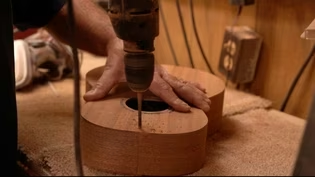
Clip: S11 Ep13 | 6m 55s | The LoPrinzi father-daughter team crafts beautiful guitars in their Clearwater shop. (6m 55s)
Providing Support for PBS.org
Learn Moreabout PBS online sponsorship

- Arts and Music
The Best of the Joy of Painting with Bob Ross
A pop icon, Bob Ross offers soothing words of wisdom as he paints captivating landscapes.













Support for PBS provided by:
WEDU Arts Plus is a local public television program presented by WEDU
Major funding for WEDU Arts Plus is provided through the generosity of Charles Rosenblum, The State of Florida and Division of Arts and Culture and the National Endowment for the Arts, and the Hillsborough County Board of County Commissioners.