WEDU Arts Plus
1116 | Episode
Season 11 Episode 16 | 26m 45sVideo has Closed Captions
Honesty through painting | New Mexico cuisine | Art magazine | Theater behind the scenes
A local artist seeks honesty and truth through his paintings | Bringing the tastes of New Mexico cuisine to life | Development of an independent art magazine | A behind the scenes look at a theatrical production
Problems playing video? | Closed Captioning Feedback
Problems playing video? | Closed Captioning Feedback
WEDU Arts Plus is a local public television program presented by WEDU
Major funding for WEDU Arts Plus is provided through the generosity of Charles Rosenblum, The State of Florida and Division of Arts and Culture and the National Endowment for the Arts, and the Hillsborough County Board of County Commissioners.
WEDU Arts Plus
1116 | Episode
Season 11 Episode 16 | 26m 45sVideo has Closed Captions
A local artist seeks honesty and truth through his paintings | Bringing the tastes of New Mexico cuisine to life | Development of an independent art magazine | A behind the scenes look at a theatrical production
Problems playing video? | Closed Captioning Feedback
How to Watch WEDU Arts Plus
WEDU Arts Plus is available to stream on pbs.org and the free PBS App, available on iPhone, Apple TV, Android TV, Android smartphones, Amazon Fire TV, Amazon Fire Tablet, Roku, Samsung Smart TV, and Vizio.
Providing Support for PBS.org
Learn Moreabout PBS online sponsorship- [Announcer] This is a production of WEDU PBS, Tampa, St. Petersburg, Sarasota.
- [Dalia Colon] Funding for WEDU Arts Plus is provided by the Community Foundation, Tampa Bay.
In this edition of WEDU Arts Plus, a local artist seeks honesty and truth through his paintings.
- If I can change the world in any way, it would be to help break down certain social constructs that I think are the detrimental to us as human beings.
- [Dalia Colon] Bringing the tastes of New Mexico cuisine to life.
- My whole thing is to be connected.
If it's through an individual relationship, either with a person or a food product, they're the same.
- [Dalia Colon] The development of an independent art magazine.
- We love seventies and eighties, the old school vibe, digital art, but mixed in with that analog feel.
We're, you know, influenced by film and punk and music.
- [Dalia Colon] And a behind the scenes look at a theatrical production.
- You do have to change the way you perform.
You have to be a performer at every angle.
That was something that took a little getting used to.
Like I've been in other shows, but I've never been in a show where I'm being watched from every single angle.
- It's all coming up next on WEDU Arts Plus.
(bright jazz music) Hello, I'm Dalia Colon and this is WEDU Arts Plus.
Dean Mitchell is a watercolor artist who grew up in the small town of Quincy, Florida during the sixties and seventies.
As a young African American, he faced many obstacles.
Inspired by his grandmother who raised him, Dean has become a voice for those who live in poverty and inequity.
- When I was a kid, I experienced racism very early on.
And it's an irony that I used to pray if I could do anything with my work, it would help us heal those wounds of racism and segregation.
A lot of these things have shaped my sensibility about what I do.
So a lot of it is not just because I think it's interesting in terms of light and this and that and shadow, which does interest me.
But the main overture of about the work is about poverty and the marginalization of people, and how those spaces affect our whole sense of self in a space.
That's been just a part of who I am.
This art thing, however you want to describe it is a huge part of my life.
And so, I want it to mean something.
If I can change the world in any way, it would be to help break down certain social constructs that I think are detrimental to us as human beings.
And there are plenty of them.
- My name is Matt Cutter.
I'm with Cutter & Cutter Fine Art in St. Augustine, Florida, and I'm also a painter.
We've got a good track record over 10 years of selling hundreds of paintings from Dean.
So, I think he's a very strong, worthy artist.
And I do think he stops people in their tracks, and it's very contemplative.
He's not grabbing you with the brightest color.
He's not grabbing you with bells and whistles.
He's grabbing you in a different way.
He's asking you to like, come in very slowly, examine what's going on, feel that nuance.
And that's what he brings to the table.
So if you're 30 feet away, you would say that's realism.
And it is, it conveys that emotion.
When you look really closely at how he's laid down the watercolor layers, there's a lot of abstraction.
There's a lot going on with the design.
What he does, he plays with this dark and light and everything, in my opinion, with Dean's work is keyed in on a strong design, that sets up everything for the painting.
(bright upbeat music) - Dean Mitchell is beyond that of a master.
If you had one where you say this is apprentice, and this is a master, well the apprentice learns how to do a this or a that.
And then once they're able to demonstrate that, then they say, oh, okay, now you're a master.
Dean Mitchell is an enigma.
Dean Mitchell was born to do what he does.
When I look at Dean Mitchell's work, I do see science.
I do see philosophy, I do see religion.
Because some of those pieces, like Rowena, when you see that particular piece, that is a religious piece.
That is an icon, that is an actual Mary that you say, oh my God, she speaks of humanity.
Where in the world would someone painting like a Andrew Wyeth and in some cases better than Andrew Wyeth come from?
And therein, I think, lies the spiritual quality.
Because if you look at Dean's background, Dean achieved not because of, but in spite of.
In spite of is when God takes place.
Therein lies the miracle.
- I was raised by my grandmother from 11 months old.
And so, I was sort of a highly active child.
And so I would often walk to town with her.
'Cause I grew up in the Panhandle of Florida in a little town called Quincy.
And I had no idea of the kind of wealth that was in Quincy, because we basically stayed in the black community.
A lot of us when we first got our first bikes, we would ride over in the area and we would see these huge mansions.
And so, I began to look at the wealth discrepancy.
And I said, how can somebody have a house that big?
Really didn't, you know, really understand it.
But I think through the years, as you become more educated, more socialized, you began to recognize how you fit into the social structure or social order of things.
And then when Martin Luther King started emerging on the scene and we would watch him on television.
So, a lot of these things have shaped my sensibility about what I do, because I do a lot of things.
A lot of the environments that I do are a window into poverty, and a window into that psychological space in which I emerged out of.
I had this teacher Tom Harris, who, there was four of us who were really interested in art.
And he introduced us to local art competitions.
And so we were often the only black people at these shows with Mr. Harris and his wife who were Caucasian.
- And I called it the crucible of competition, you know?
Which can be good or bad, because it puts pressure on kids.
He was even as focused then as he is now, but there was so many negatives.
A lot of it was the black, white thing.
He paints what he wants to paint, because it feels the need in here to make a visual statement about what's going on.
And that's the strength of Dean Mitchell's painting.
Half of his focus and intensity is based on this is, what I'm doing is extremely important.
And it's never been done before.
And whenever or however, whatever the recognition is, I have to do it my way.
Which to me is almost a definition of what art is and what art's supposed to be.
- I will be gone at some point.
But what I leave, will it really make the world better in some ways and make us examine our own human behavior toward one another?
- He didn't paint to sell.
Okay, that sounds ridiculous, because he had to make a living.
He painted because it's something he had to do.
It's something he had to say.
- He wants people to like examine this work on a deep level.
So I do think he's very important now.
And I think his work will be very important a hundred years from now.
- I think art has a way of mirroring back to us what we become.
And it also provides us history, in which we can reflect back on, to not keep repeating the same mistakes.
It's that kind of trouble in the world that feeds my passion to try to figure out how to derail some of the destructive behavior.
- Explore more at deanmitchellstudio.com.
Jonathan Perno is the executive chef at CAMPO, located at Los Poblano's Historic Inn and organic farm in New Mexico.
Perno uses fresh, seasonal ingredients that embrace local cuisine.
(birds squawking) (gentle instrumental music) - Rosales cuisine tastes like New Mexico.
I mean, it's the sky, it's the air, it's everything that encompasses this state and that river.
And this culture that resides here.
That's my main thing.
I mean I'm from here, so that's important to me.
I just believe in what I do.
And I believe in the nutrition that it provides.
I believe in knowing that if you eat seasonal, you're tend to be more healthy, because everything is at an optimal peak in nutrition and taste and everything.
(veggies tumbling) The story of the food starts from the people that produce it.
(veggies tumbling) (fire spitting) I'm just the guy that gets to play with it, to be honest with you.
And I get to carry that story on.
I get to enhance what they do.
So I'm like part of their story.
And then the people that really get the full story are the guest.
So I'm just a facet of the process of the story.
(knife slicing) And my whole thing is to be connected.
That's the whole thing, if it's through an individual relationship, either with a person or with a food product, they're the same.
They deserve the same attention and they deserve the same level of respect.
(doors opening) The challenge of local food is that you have to be ready to change.
We have to be willing to change as people.
It's gonna be nice for the mole.
Because if you can't change as an individual, it's gonna be really hard to change when you get a curve ball because your eggplants didn't manifest the way you wanted 'em to.
So what are you gonna do?
Are you gonna be upset?
No, you're gonna make adjustments.
Or if we have a huge bumper crop, what are we gonna do?
So all of a sudden the creative juices just start flowing and you're thinking I can do this, I can do this, I can do this, I can do this.
And you've got one thing and you're coming up with half a dozen, a dozen different things that you can start creating out of this one thing.
I do think it's important to hold onto traditional foods, because those are the things that make a space special, because you can't get it anywhere else.
But if you want the true essence of it, you can only get the green chili here.
You can only get the red chili here.
You can get it other places, but in different forms.
We started thinking about moles for this restaurant and for this menu quite a while ago, or I did.
And then it kind of just evolved.
And so we're running like two moles every six months.
So we'll have a vegetarian version and a meat version.
With the yellow mole, it was really about showcasing these vegetables that are in abundance right now.
(gentle instrumental music) So potatoes and onions and garlic and the eggplant and the ahi crystal peppers and the jujubes are gonna be on there and the pomegranates.
So this whole dish, this vegetarian mole was, the sauce was created to showcase these harvests.
So as we move into winter, all those vegetables that are on the dish now are gonna change, because the seasons have changed.
But the sauce will be the same.
So it's kind of like the mother that carries them, you know?
And some things will be stewed in the sauce.
And then some of those items will ornate the dish, so that you have some visual textures.
And maybe we'll create some height with it.
It evolves as the seasons evolve.
And that's what I like about the mole is they can adapt.
I think that the dishes pretty much evolve themselves.
I just have to make sure that I'm aware enough when to change them.
That's the hard part.
Because the way the seasons work, the way the harvest works, you just don't know from one year to the next, to the next, to the next, to the next.
And you have to have that flexibility about yourself, in this industry.
(bright upbeat music) The things I love about food, and what inspires me about it is always being surprised.
'Cause you just never know until you apply yourself.
Either, if you're a diner and experiencing something you've never had before, or if you're a cook and you're being presented something you've never worked with before and you have to work through it.
Those are the surprises, those are the things I look forward for, because they're always, there's always, it's always rewarding, no matter what.
I just invest myself into the product.
And I hope that when people order these dishes, that me and my team create, that they're as invested in eating it as we are prepping it and creating it.
That completes a cycle to me.
And to feed people well, I think that's huge, 'cause you're interacting with somebody that you don't even know.
And you're interacting with them on kind of an intimate level.
- Find out more at lospoblanos.com.
Birdy Magazine provides a platform for creative voices.
Based in Denver, Colorado, this arts and culture publication encourages expression and exploration.
It highlights an array of artists through the print medium.
- We had very humble beginnings, which we still do.
Me, Johnny, and Michael King, we met in Johnny's 600 square foot Capital Hill apartment.
And decided that there was something lacking within our community.
We just felt like there was this hole within the culture here in Denver.
- We felt that people still cared to have a palpable magazine to look at, to put on your coffee table, to enjoy it as something tactile.
We wanted to make living being creative, but also do something that contributes to the the world and helps make the culture better and more interesting.
- Why not kind of like not reinvent the wheel, but get a little bit more creative and see what you can do, just outside of a traditional format?
So we spearheaded it from there and launched the first magazine in January, 2014, with $2,000 and one month of content.
(upbeat techno music) Our sale is just birdy magazine.
If we could have like holographs coming out of birdy, we totally would do it, you know?
We love seventies and eighties, the old school vibe.
Digital art, but mixed in with that analog feel.
We're, you know, influenced by film and punk and music.
A lot of people would classify what we print as kind of a low brow art style, but we love contemporary art, abstract, poetry, comedy, and irreverence.
One of our baseline fundamental pillars of birdy is art as resistance.
You know, even if you're not able to go out there and march or you don't have money to give, making art in and of itself is the ultimate form of resistance in our opinion.
- Nonviolent.
- Yep.
- Artists are really brave people.
- We really do think that we need to respect art and the disenfranchised, the misfits of our community, the underrepresented that might not necessarily get into another publication.
We print what we want.
- When we started, we had no submissions and now it's just nonstop.
It's not just art, it's writers, it's comedians, it's filmmakers, you know, bands.
You know, we're able to represent a place for people that, you know, don't usually have a place to shine.
- Just, you know, a platform of diversity, inclusivity.
We're quite multi-generational, multi-background.
And that's really important.
Obviously we do have some language in our magazine, but it's an all ages publication.
There's nothing more exciting to me to print a little six year old's cartoon, because it is beautiful, it's art.
- Hopefully anybody can pick it up, appreciate it.
We fought to have good quality product.
So the cost of it, yeah, it's pretty penny to make it.
- Our model for advertising is quite different.
We actually don't call them advertisers.
They're friends and benefactors.
But, yeah, the large majority of our funding comes from those advertisers.
We design about 90% of our ads, so we're creating your own custom piece of art every single month.
- We are artists ourselves, so we want to approach it from a place where it's more content driven than ad driven.
Like we don't sell our back cover.
That's a piece of art.
Our centerfold is art.
If we don't do the way that is soulful and respects the art, then we're not interested.
- When you start a company, we're, you know, we probably make 2 cents an hour to, you know, really when all said and done.
We're sleeping a little bit more now.
And we have food and toilet paper and all that stuff.
But like, it really is, what we're doing for the community is very, it's quite philanthropic as well.
- Art is worth a lot, you know?
Like people don't value it like we feel that they should.
And when we began, you know the whole print is dead mentality was out there.
- And that was really scary and difficult and we got a lot of lashback at first, you know?
From different people, hey, you're never gonna be able to, you know, make this a thing.
But it's just perpetually growing.
- Revenge of the magazine.
- To see more, check out birdymagazine.com.
Go behind the scenes at the cirque du soleil show, Corteo.
Full of thrilling circus acts with a powerful story to match, learn more about the show and the group of performers that make it possible.
- And now we invite you into the world of Corteo.
- Corteo means cortege or procession.
Ir comes from Italian, because the show does star of a clown who is dreaming about his own funeral, but in a campy atmosphere.
We're gonna see his friends from all over the world and different circuses coming to see him, show all their amazing skills they have.
- It's the telling of his loves and triumphs and faults, all while the audience is being a part of it the whole time.
They get to sit and feel like they're on stage with him as he goes through these memories in his mind.
- Even though the main theme of this show is his own funeral, the show is a celebration of life.
(bright upbeat music) - Ladies and gentlemen, welcome to Cor - - It takes us about a 12 hour day to set the show up, from an empty floor to ready to go for the artist to arrive.
The first nine hours of that is us getting the set actually built, installed, and everything cabled.
And the last three hours for the lighting department and the sound department is checking everything in a dark room.
- They are going through each act of the show, every single moment of the show, they need to go through it and making sure that we have the lights in the right position and the right color as well.
So they are checking the lighting.
We have the rigging team also checking everything that we use to make our performers fly.
Not only the performers, but also fly apparatuses.
We have the automation team making sure that everything that moves on stage, on the floor, and the air, is also in place.
- [Jeffrey] The lights play a very key point in the safety reference for the artist.
They're used to seeing a beam at a certain angle and a certain part of the set lit up.
That's where they know where they're at in a roll or a tumble, and they can always stop right on the same spot, because they know the edge of the light is where it is.
But it's a subtle thing we can play to help them be safer.
- This show is very unique from any other cirque du soleil production, because of the way this stage is set up.
It's right in the middle of the arena and the audience is sitting on both sides of it.
This is why when you're watching the show, we see something extraordinary happening on the stage and the reaction of people on the other side of the stage, you have the feeling of the actors.
So, you know, how does it feel to be on stage and how do you see the reaction of people when they see something amazing happening in front of you.
(audience applauding) - You do have to change the way you perform.
You have to be a performer at every angle.
That was something that took a little getting used to.
Like I've been in other shows, but I've never been in a show where I'm being watched from every single angle.
There's moments where you feel like nobody's missing a trick.
And if you make a mistake or something, you feel right in the middle of everyone's eye line.
(planks thumping) - The creator of the show, Daniel Episipasca, he wanted the technicians to also have some visibility because they as important as our performance as well.
They're part of the show as well.
So by the end of the show, all the performers, they will look back to the center of the stage.
And all the technicians, they will run and cross into a high five with each other, from one side to the other.
It's a very small moment that they are being part of the show somehow, but it's beautiful to see that our director recognizes the hard work, not only from people on stage, but also offstage as well.
- We're here to set the mood and help subtly influence people into completely leaving the world they're in.
And remember they're not in an arena.
And feel like they've moved into wherever he is at any point, whether it's the warmth in the air or just a subtle little sound coming outta speaker behind them.
It's enough to just take them away to another world.
There is an amazing sound that comes out of almost every audience at some point during the show, which is just, you hear them collectively all gasp at the same time.
And it's the most spine tingling moment for somebody running the show, because you know you've made an impact.
- It's too much, I'm already dead.
- The only time our job titles matter is when the show's actually running.
- We have 52 performers from 18 different nationalities.
They come from the most different backgrounds.
We have musicians, we have singers, actors, dancers, people coming from gymnastics, circuses school.
So there's a very mixed group.
- We're about 110 people on the road together.
And when the show finishes at the end of the night, we eat in the same catering, we're living in the same venues.
We travel together on the same plane or bus.
- And seeing these people, from so many different places, working together and being able to put this beautiful piece of Corteo on stage every week.
This is definitely one of the best things that we could have.
- When the show is over, we are 110 family members.
We're there for each other, we support each other.
If you're having a bad day, somebody's gonna be there to support you.
And if you're having an amazing day, you've got this 109 troop behind you that wants to celebrate your accomplishments with you.
- Discover more at cirquedusoleil.com/corteo.
And that wraps it up for this edition of WEDU Arts Plus.
For more arts and culture, visit wedu.org/artsplus.
Until next time, I'm Dalia Colon.
Thanks for watching.
(rhythmic music) - [Announcer] Funding for WEDU Arts Plus is provided by the Community Foundation, Tampa Bay.
(resolving musical notes)
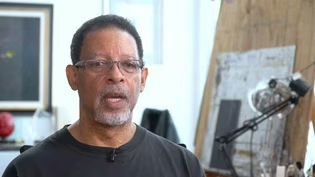
1116 | Local | Dean Mitchell's Watercolors
Video has Closed Captions
Clip: S11 Ep16 | 7m 8s | Watercolor artist Dean Mitchell, a voice for those who live in poverty and inequity. (7m 8s)
Providing Support for PBS.org
Learn Moreabout PBS online sponsorship

- Arts and Music
The Best of the Joy of Painting with Bob Ross
A pop icon, Bob Ross offers soothing words of wisdom as he paints captivating landscapes.












Support for PBS provided by:
WEDU Arts Plus is a local public television program presented by WEDU
Major funding for WEDU Arts Plus is provided through the generosity of Charles Rosenblum, The State of Florida and Division of Arts and Culture and the National Endowment for the Arts, and the Hillsborough County Board of County Commissioners.