WEDU Arts Plus
1118 | Episode
Season 11 Episode 18 | 26m 15sVideo has Closed Captions
Spreading Good Vibes | Archaeological Treasure | Graphic Designer | Airbrush Art
A local organization spreads good vibes, an architectural and archaeological treasure, a graphic designer calling the shots, and using an airbrush to create art.
Problems playing video? | Closed Captioning Feedback
Problems playing video? | Closed Captioning Feedback
WEDU Arts Plus is a local public television program presented by WEDU
Major funding for WEDU Arts Plus is provided through the generosity of Charles Rosenblum, The State of Florida and Division of Arts and Culture and the National Endowment for the Arts, and the Hillsborough County Board of County Commissioners.
WEDU Arts Plus
1118 | Episode
Season 11 Episode 18 | 26m 15sVideo has Closed Captions
A local organization spreads good vibes, an architectural and archaeological treasure, a graphic designer calling the shots, and using an airbrush to create art.
Problems playing video? | Closed Captioning Feedback
How to Watch WEDU Arts Plus
WEDU Arts Plus is available to stream on pbs.org and the free PBS App, available on iPhone, Apple TV, Android TV, Android smartphones, Amazon Fire TV, Amazon Fire Tablet, Roku, Samsung Smart TV, and Vizio.
Providing Support for PBS.org
Learn Moreabout PBS online sponsorship- [Narrator] This is a production of WEDU PBS - Tampa, St. Petersburg, Sarasota.
Funding for WEDU Arts Plus is provided by The Community Foundation Tampa Bay.
- [Dalia] In this edition of WEDU ArtsPlus, a local organization spreads good vibes.
- I love working with my special needs group because it's unfiltered joy.
- [Dalia] An architectural and archeological treasure.
- It's so beautifully constructed.
It almost is perfection and it looks like it's been here for hundreds of years.
- [Dalia] A graphic designer calling the shots.
- What I really wanted to bring with my company is a really clean aesthetic approach, just to really convey the story of what a client is looking for.
- [Dalia] And using an airbrush to create art.
- As you get older, you start to lose your vision and everything gets a little soft and fuzzy.
That's nature's Photoshop, a little airbrush look too.
- [Dalia] It's all coming up next on WEDU Arts Plus.
(upbeat jazz music playing) - Hello, I'm Dalia Colon and this is WEDU ArtsPlus.
We dare you to keep still during this first segment.
We're about to meet the team behind "Giving Tree Music ".
For more than 25 years, Giving Tree has been building community through drum circles that are interactive and just plain fun.
(music playing from drumming) - [Steve] Giving Tree Music uses drums as a vehicle to build community.
I started Giving Tree Music at the tail end of 1999.
(drums playing in background) I started out as a drum maker, so I used to make all of my own drums and we would travel around to different festivals and art shows, mostly renaissance festivals, and I would sell my drums.
In order to get people to buy those drums, I'd put them out for people to play, and hopefully they would fall in love with the drum and take it home.
And then I'd enjoyed actually making music with the people more than the haggling part, so I just decided I would do that instead.
Now I'm fortunate enough to be able to drum with anybody and everybody.
- [Paisley] They're one of the oldest instruments in the world.
Anybody can play it.
He had a gentleman playing the drums with his foot because he was immobile with his arms.
Anybody can do it.
You don't have to know how to play.
- [Steve] Mostly we work in the Tampa Bay area.
We drum at schools, we drum in hospitals, we drum in special needs groups.
We drum with corporate groups, we drum with seniors, we drum with youth detention centers, churches, mosques, temples, any group of people that you can bring together, any place where you bring humans, you can bring drums.
Everybody gets something to play.
Myself or one of our facilitators guides them through the experience and empowers them to realize that just a little bit of teamwork and a little bit of believing in yourself and you can create something much bigger than yourself.
(drums playing in background) This group that we are working with is the Shine Group.
It's a group of special needs adults.
They come together at this church.
They usually drum with me once, twice a year.
Here we go!
4, 3, 2, 1 - stop.
- [Chris] 4, 3, 2, 1.
A stop.
- [Debbie] Chris is 32.
He just loves people to death and he gives the best hugs on this Earth.
He always loves music, so any type of music.
And we actually bought him one of Steve's drums for Christmas.
His communication skill is very low, but drumming does just help him express himself more.
- [Steve] Let's go a little bit faster!
They're an amazing group of people and I love working with my special needs group because it's unfiltered joy.
- [Meghan] Well, the first thing I say, if somebody insists that they don't have rhythm is that if you didn't, you would be dead .
Without rhythm, there's no life.
Rhythm is how our heart beats.
Rhythm is how we walk.
It's how we brush our teeth.
Sharing rhythm with other people is as easy as just creating a phrase and repeating it rhythmically.
And then you can drum that.
- [Steve] I'll play it first.
You play it back.
(drumming noises) I make a lot of the drums myself.
We do drum making workshops.
I bring the shell into the kids and the kids will sand it, they will paint it, they'll attach that goat skin head to the top of the drum using some traditional methods, and they'll get it real tight and make it sound good.
And if we're lucky, we'll get to have a drum circle with the group of kids that just made a group of drums.
And it's this full circle experience that I think is pretty amazing.
When I do some of my corporate trainings, especially, I do a lot of teacher trainings, the principal will set something up and one of my favorite things to happen is when a group of teachers comes into the room and you can hear their eyes rolling as they walk in, they, they think that this is, "What the heck are we gonna do?"
You know, "what's this hippie stuff?"
The ones who roll their eyes the hardest and look like they think it's gonna be the dumbest thing ever are almost 100% the ones that end up in the dance floor first.
Every time.
Drum circles are about that transition.
You find that inner child, you find that inner goofball and you end up letting it out.
And that's where, that's where that joy lives.
(crowd cheering, music playing) - [Paul] If you hit a drum, it will give you happiness back.
Before I ever touch the Jam Bay, I was a drum set player.
And so I was really excited when the idea came up by Steven and myself to incorporate that part of what I do into Giving Tree.
- [Audio Recording] I know you asking today, how long will it take?
- [Paul] Stand up Speak Up is my program that I do where I play the drum set to the words of Dr. Martin Luther King Jr. Because I've been black for 30 years, and when Dr. King's words stop being relevant, I'll stop playing the drums to him.
That's the first reason.
The second reason is Dr. King is funky.
- [Audio Recording] Keeping Watch above his own.
How long?
Not long.
Cause the Moral Universe is long, but it been towards us.
- [Paul] There's one speech that he does that is a colloquially referred to as "the how long, not long speech".
And it's just got rhythm and rhythm and rhythm.
It's like he knew that I was gonna play the drums to it later.
(drumming noises playing) - [Meghan] If you're drumming with only one other person, there's a lot of communication that happens there.
But when you're drumming with a whole group of people, whether or not you know them, there's just, there's a magic that I can't define.
(drumming playing) - [Steve] When you hear say a hundred people playing music together, all stop together the silence is louder than 100 drums, every time.
- [Paisley] There are two people that you have to impress in the world and one is your five year old self and one is your 85 year old self.
And working for Giving Tree and doing the drum circles with all these people I'm fulfilling both of those.
My five year old is happy that I get to be a kid and play drums with people all over the place.
And my 85 year old is going, Good job, that's pretty cool.
(drums playing, crowd cheering) - To learn more, visit GivingTreeMusic.com.
- [Dalia] In Colorado Springs there's a remarkable English tutor style castle called Glen Eyrie.
Built in the early 1870s, the estate is rich with history, architectural splendor and archeological discovery.
- It's this rugged place at the foot of the Rocky Mountains with an English style castle right in the heart of it.
It's a little shocking the first time you come to the grounds.
- It's so beautifully constructed.
It almost is perfection, and it looks like it's been here for hundreds of years.
(violin tune playing in background) - I think the way that you come into Glen Eyrie on this winding road up a canyon, and there at the back, this castle is situated looking like it's always been here.
- [Matt] The thing that makes Glen Eyrie's canyons so powerful is, you know, it's part of the same geology as Garden of the Gods.
- [Anna] The garden of the Gods landscape consists, of course, large, famous Red Rock formations.
- [Michael] They're different colors of sandstones and conglomerates and granite that were actually uplifted during the mountain building process of Pikes Peak.
So as the mountain built, sandstones got tilted vertically.
- You don't really see the sandstone spires until you get here.
The canyon opens up to you as you arrive at the castle and continues on.
- It's a beautiful place and it draws many, many people and always has.
- [Narrator] One person enraptured by the views was General William Jackson Palmer, who came to the region on a railroad surveying trip in 1869.
After marrying his wife, Queen, they returned to the area and soon began construction on their dream home.
- John Blair, the landscape architect, saw an Eagles nest eyrie on the side of a beautiful rock here and gave the name Glen Eyrie to this space.
- The carriage house at Glen Eyrie was built in 1871.
It was the first building built on the property, and William and his new wife, Queen, lived in the upper stories while they were waiting for their main house to be built.
The original Glen Eyrie was a gothic style house, and it was built in the form of a Latin cross, and it had about 27 rooms.
It was built on the banks of Camp Creek that flows from the mountains down the Glen Eyrie Valley.
- [Narrator] Years of expansions and renovations created the estate we know today.
After Palmer's death, Glen Eyrie was eventually purchased by The Navigators - an International Ministry - becoming a conference center.
The region has long been affected by natural disasters, including fires and floods.
While surveying a site for flood mitigation work, the city of Colorado Spring's lead archeologist and a cordova, stumbles upon something left behind - the site of Palmer's trash dump.
This is where one man's trash became a treasure for local historians.
- [Anna] Context is everything in archeology.
And I started thinking of, you know, what am I close to?
Who was living in this area at the time?
- An archeology dig of this nature is actually very rare.
- To find more about Palmer over 100 years after he's gone?!
- It's once in a lifetime.
- You can't tell a lot about one particular family in a public dump because lots of families are putting their trash in those places.
The really unique thing about this site is that everything that's out there we know came from this estate, which it was apparently a really rare thing in archeology.
- There are a number of artifacts that we actually recovered were about 65,000.
We have looked at every one of those artifacts.
We have recovered and identified probably at least 50 different types of ceramics, buttons, forks, knives, cooking utensils, cups, stemware, liquor bottles, pipes, flower pots, lots of different animal bones, wooden furniture pieces.
Just identified a tree cleat, which was really interesting, a cleat that you attached to the toe so you could climb the trees.
There's also industrial items, so fire hose.
We also have bottles that went into early fire extinguishers.
Photographic equipment, so we have dark room elements.
There's a lot of medicinal things too, as well as medicine bottles, medicine jars, vials for homeopathic type of medicines.
- A lot of people ask why we care about trash, why it matters.
But trash can tell you a whole lot about households and people.
It can speak sometimes even to ethnicity, socioeconomic status, gender.
It can answer so many questions that will talk about the daily lives of these people - to what they ate, what they wore, what they read.
- It's unedited, and that's where it's power lies because it's literally the raw material of their lives out here at Glen Eyrie.
- [Anna] For example, we now know that Palmer really liked Worcestershire sauce.
- Apparently there are many, many, Worcestershire bottles.
- We're seeing very few items in the scheme of thousands that we have looked at that are domestically produced.
Most everything that we're finding is being imported, and I think that's another evidence of his wealth.
- I've got some mineral water from Budapest, even though he had some mineral water right next door in Manitou Springs.
As far as historic archeology goes, it's probably one of the most significant fines that that we've had definitely in Colorado Springs, in the Pikes Peak region.
Archeology is important in that it connects us to the past.
I think that helps people to form connections with those places.
And I think if you're connected with those places, you take care of them more as well.
- Having an English tutor castle in the Colorado Hillside helps remind us how people have continued to reshape Colorado over time in their own vision.
This place remains as a symbol of those dreams, visions, and ideas of that founding generation of Colorado settlement.
- [Narrator] Interested in visiting Glen Eyrie?
Go to GlenEyrie.org to learn more.
- [Dalia] Meet Ashley Armitage, a graphic designer based in Saratoga Springs, New York.
From there, she runs her own studio and develops standout design pieces for variety of clients.
- [Ashley] What really brings a logo together?
What brings the entire identity together?
What does the client really want when they tell me their story?
(light techno music playing) My name is Ashley Armitage.
I am the CEO of Ashley A Designs.
I do a whole variety of graphic design needs from basic brochures to newsletters, and above all, I love to really dive into an entire branding study.
That's my bread and butter.
(techno music playing in background) What I really believe in is good clean graphic design.
You see graphic design so populated and there's so much going on where what I really wanted to bring with my company is a really clean aesthetic approach.
Just to really convey the story of what a client is looking for, if it may be a restaurant, if it may be a resort.
I start to really, I sketch out my ideas and really bring all, all these ideas to the table to them, and very unique ones, not just one idea and then turned into one or two or three, just variations, but distinct differences so that the client can really see what their identity could look like potentially.
From that process, I work with my clients and they usually pick and choose and say, Hmm, I like this direction, I like that direction.
And then from there we pick out from the colors, make sure the tight faces are solid, also that they're legible.
You gotta realize too, with an identity that this identity is not just a logo.
This is your identity that's going to be applied to everything.
Oh, I wonder, that'd be so much fun.
If I can replicate those three right there.
I have to say it all started..
I gotta say, back in high school.
I got the kinda creative bug from one of my art teachers named Miss Sally Way from Shenanhoah.
Shout out to Shenanhoah High School.
And she introduced me to this idea, this concept that, you know, art doesn't always have to be, you know, drawing a portrait landscape or.. And I just said to myself - Well, I can actually design my work in these programs called the Adobe products like Illustrator, Photoshop and InDesign.
And I really wanna explore like, okay, where is this gonna go from here if I really wanna take this as a career?
(techno music playing) I went to RIT, Rochester Institute of Technology, then I found myself going to Maryland for a time, and then I actually worked for a company called Chesapeake Bay Candle, and I designed all of their candle products.
I was actually chosen to do a line in Target.
I did their pure and natural line.
I went to Fisher Price, I did a ton of packaging there and applied my skillset in an in-house setting.
And then later on I said to myself, You know what?
I really wanna branch in and do my own thing.
I will honestly say that get the experience first.
Go into in-house, go to corporate, go to the public and private sector and get your hands dirty first.
Really see the process.
And then later on as you're seeing yourself do a little better and say, Hmm, I can consistently get some, you know, constant money flow into my business or even to yourself, that you feel like you can establish yourself.
Then you know, then I say, go freelance.
Owning your own free, you know, freelance business, you have to set up those timelines for yourself.
It's not a boss looking over you.
You have to keep on track because if you miss out, you may miss out that next client.
You know, everyone always tells me their like, Why are you here?
Why are you in upstate New York?
And I have to say, the amount of talent that's here in Upstate is incredible.
And it's so huge between going to the Adirondacks to Albany where you are going to find some sort of creativity or arts festival or something in this area.
And I am very honored to be a part of that, especially with applying my work to be in, in the real world.
My passion with design, that is what keeps me going every day.
I know that I can push myself and have it be the best that it can possibly be.
(upbeat music playing) - [Narrator] See more at Ashleyadesigns.com - [Dalia] Whether he's depicting pop culture, icons, landscapes, or angels.
The tool of choice for artist John Schmitz is the airbrush.
Since he was 14 years old, he's been using this technique to create his works.
(upbeat music playing) - [John] The artistic mediums I work in are acrylic paints with airbrush, and I sharpen my paintings with the paint brush.
The way the airbrush works is it's powered by a compressor and you put your paint into the device, the airbrush, and it's powered by air through the hose, and it's all coming off the tip of a needle.
So the paint is atomized or pushed through the needle along to the campus.
It's a very nice medium.
And the advantage to using an airbrush over a traditional price would be that you get seamless blends, you can get blends, nice gradients and skin tones, skies, clouds.
You get that soft nature look, that's in nature.
As you get older, you start to lose your vision and everything gets a little soft and fuzzy.
That's nature's Photoshop.
A little airbrush look too.
I would say my artwork is definitely Americana because it's pop culture.
It's now and then, it's people you know, or people you've seen or maybe even places you know.
The types of clients I've had have been Elvis Presley Enterprises.
I've did 36 Kenny Rogers murals that were in all of his restaurants.
I've done a lot of movie theaters and a lot of amusement parks.
A lot of really big, large scale mural work, mainly with the airbrush.
That's another reason why I use it too, is because it covers a lot more ground than you could with the paint brush, depending on the size of job you're working on.
I like to paint landscapes too with the airbrush because that can get the sky to look like the sky.
Not that anybody who, you don't have to use an airbrush to make it that way.
It just happens to be my medium.
Some of the paintings I have that have so many angels is probably because they were, they were commissioned by an angel, which is my wife.
She's the one who loves the angels.
So anything with an angel on it, it's like the bur old pictures I do and this things like that.
She's the one who really likes that.
I've been airbrushing since I was 14, and when I first started airbrushing, I was really in love with it because everything was so seamless.
It was like, how did they get that, that smooth look on there.
And in the early days that I was using it, I was seeing a lot of album covers, mostly album covers, movie posters, anything that looked good.
There was, you could paint neon chrome, a lot of that.
So I chose to try to follow that and still to this day like to airbrush whatever I can.
But in today's world, not many people airbrush as much as they used to, especially in illustration and advertising and art, because the computer is more efficient.
So airbrush seems like it's a little old hat now.
Not as many people do it, but the car industry still does a lot of it.
I mean, here in Reno we have the hot August nights.
You see beautiful artwork done.
A lot of it with an airbrush on cars.
So that's an industry that hasn't let go of it.
Some people look at me and they say, You still doing that?
You know, it's like, why are you still doing that?
So I just, I'm, you know, I have a paint stained life and that's part of it.
When I do a painting I've gotten to in recent years where I don't finish the painting always, I, I like to leave my hand in.
And so you can tell it was made with a hand because I used to show my work to people and they say, "You're a good photographer."
And I said, "These aren't photographs.
They're paintings.
They look closer and then you can see."
So my favorite thing to do is, is to mix it up where you can tell somebody drew it.
You can tell somebody painted it.
It's not photo realistic.
You let the paint do the work for you.
It's like you, you let things happen.
You're not, you don't have a plan, you don't have a plan.
You start to push paint around.
It starts to look right, you know when leave it alone.
Because I learned something very early in life - It takes two people to do a great painting and that's one person to do it and the other to tell 'em when to stop.
Because you can romance the stone forever.
You gotta know when to quit.
- [Dalia] And that wraps it up for this edition of WEDU Arts Plus.
For more arts and culture, visit WEDU.org/artsPlus.
Until next time, I'm Delia Colon.
Thanks for watching.
(concluding music) Funding for WEDU Arts Plus is provided by the Community Foundation, Tampa Bay.
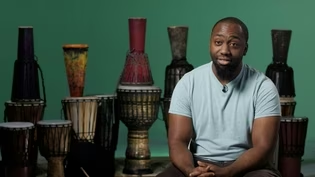
1118 | Local | Giving Tree Music
Video has Closed Captions
Clip: S11 Ep18 | 6m 55s | Giving Tree Music builds community and brings joy through drum circles. (6m 55s)
Providing Support for PBS.org
Learn Moreabout PBS online sponsorship














Support for PBS provided by:
WEDU Arts Plus is a local public television program presented by WEDU
Major funding for WEDU Arts Plus is provided through the generosity of Charles Rosenblum, The State of Florida and Division of Arts and Culture and the National Endowment for the Arts, and the Hillsborough County Board of County Commissioners.