WEDU Arts Plus
1119 | Episode
Season 11 Episode 19 | 27m 1sVideo has Closed Captions
Tampa artists armor up | Shoes from the past | Sand mandala | Chamber music
An exhibition in Tampa celebrates the work of two visionaries: graffiti artist Ales Bask Hostomsky and legendary comic book creator Bob Layton. A shoe company in Reno, Nevada, creates historically accurate footwear. Tibetan monks construct a sand mandala in Milwaukee, Wisconsin. The Chamber Music Society of Detroit has been delighting audiences for over 75 years.
Problems playing video? | Closed Captioning Feedback
Problems playing video? | Closed Captioning Feedback
WEDU Arts Plus is a local public television program presented by WEDU
Major funding for WEDU Arts Plus is provided through the generosity of Charles Rosenblum, The State of Florida and Division of Arts and Culture and the National Endowment for the Arts, and the Hillsborough County Board of County Commissioners.
WEDU Arts Plus
1119 | Episode
Season 11 Episode 19 | 27m 1sVideo has Closed Captions
An exhibition in Tampa celebrates the work of two visionaries: graffiti artist Ales Bask Hostomsky and legendary comic book creator Bob Layton. A shoe company in Reno, Nevada, creates historically accurate footwear. Tibetan monks construct a sand mandala in Milwaukee, Wisconsin. The Chamber Music Society of Detroit has been delighting audiences for over 75 years.
Problems playing video? | Closed Captioning Feedback
How to Watch WEDU Arts Plus
WEDU Arts Plus is available to stream on pbs.org and the free PBS App, available on iPhone, Apple TV, Android TV, Android smartphones, Amazon Fire TV, Amazon Fire Tablet, Roku, Samsung Smart TV, and Vizio.
Providing Support for PBS.org
Learn Moreabout PBS online sponsorship- [Announcer] This is a production of WEDU PBS, Tampa, St. Petersburg, Sarasota.
- [Dalia] Funding for "WEDU Arts Plus" is provided by the Community Foundation Tampa Bay.
In this edition of "WEDU Arts Plus," two visionary Tampa artists armor up for an epic collaboration.
- But I'm also learning that this is the project.
It's to collaborate with Bob Layton.
- [Dalia] Recreating shoes of the past.
- When you get a design just right, it is amazing because it's beautiful, and it's exactly the right thing at that moment.
- [Dalia] The sand mandala tradition.
- [Narrator] The Tibetan monks of the Drepung Loseling Monastery prepare the sand that will become an intricately crafted mandala of ancient spiritual symbols and geometric patterns.
- [Dalia] And a renowned chamber music society.
- When you play here, you're always received warmly, and you know, you can feel that from the stage even the minute that you walk on.
- It's all coming up next on "WEDU Arts Plus."
(upbeat music) Hello, I'm Dalia Colon, and this is "WEDU Arts Plus."
Two art forms collide at the Scarfone/Hartley Gallery in Tampa.
Prolific graffiti artist Ales Bask Hostomsky and legendary comic book creator, artist, and writer Bob Layton team up for the gallery exhibition of an iconic superhero.
- I've written and drawn about every comic book character imaginable in my 45 years in the business.
It'd be easier for you to try to find what characters I haven't done.
Most of all, I'm known for the reinvention of Iron Man.
(triumphant music) So when I heard that Marvel was going to kick off their entire cinematic universe with my version of that character, it was one of the most gratifying experiences of my life.
In 2007, I was asked by Marvel Studios to come out and do the narrative for the DVDs.
It occurred to me while I was out there that I had climbed every mountain, that I'd done everything in comics.
Suddenly the whole cinematic world opened up to me, and that just seemed like such an adventure and a chance to watch my characters breathe and talk and move.
So I moved to Hollywood, and I learned the language and the customs of Hollywood.
After about eight or nine years in Hollywood, I decided to move back to Florida.
I really wanted to try to work outside the system, and at the same time I realized I was missing my grandchildren's childhood, and they lived here in Riverview, so I wanted some time with them.
So I started my own production company.
After I moved back here, I met Tyler Martinolich, the Tampa Bay film commissioner.
Tyler kind of recruited me to help bring more attention and interest financially to making films and television in Florida.
I've always contended that Florida is a wonderful place to film because of, one, you have an amazing amount of talent here, you think of what comes out of Ringling College, of variety of topography here.
We worked together to promote film in Florida, lobby the State House in Tallahassee.
I said, "The one thing I have learned in all my years in traveling around the world is everybody has a Marvel fan in their family."
And so I said, "I'm gonna take a lot of free posters."
Earlier this summer, Tyler came to me and said that he had approached Mayor Jane Castor about having an Iron Man Day and to celebrate what I've done and what I brought here to the city and to the state.
So Mayor Jane Castor proclaimed August 4th Bob Layton Day.
So I was just amazed at how this whole thing snowballed into this huge event with radio shows and television shows and signings and screenings of the movie.
And when Commissioner Ken Hagan gave me this actual proclamation.
Ken, thank you so much.
(audience cheering and applauding) It was like very, very touching.
So Tyler asked me to come up to his office one day and to bring some of my artwork that we could display at the Scarfone Gallery, and when I got up there, I found out what his master plan was.
- Tyler reached out to me and said he had a pretty special project that he wanted me to collaborate on or get my input, and that's all he said.
- Another local artist who had worked and had a connection with Iron Man was Bask, who lives in St. Pete.
- We're sitting at the table and introduced to the group, but I'm also learning that this is the project.
It's to collaborate with Bob Layton.
- Bask did all the graphics, the paintings in "Iron Man 3."
So we are actually Iron brothers.
- 2012, I get a phone call, and he was like, "Hey, Robert Downey Jr. wants your art in 'Iron Man 3.'"
So immediately I was like (gasps).
- We began collaborating on some ideas for paintings that he could do based on my work.
Bask and I had similar backgrounds and similar problems that we had to deal with.
I grew up in the Midwest, and it was a difficult childhood because my mother had to raise five of us alone.
I learned to read on comics.
I bugged my sister Sue to teach me how to read.
I could tell what was happening in the stories 'cause the pictures connected one panel to another, but I didn't know what they were saying, and I was so curious.
- Growing up in the Czech Republic, it's, you know, we lived in, under communist oppression, and it was it was pretty stifling.
I'm always the outcast, and I've always looked towards art to kind of help me through a lot of those moments.
- I found that comic books were an incredible escape for me.
- Started looking towards like art like as a go-to form of joy and therapy and everything, distraction, whatever it might be.
I didn't have that many friends growing up, so it was just kind of something that it's like created my own worlds, my own places where I can go, sources of entertainment, essentially.
- Thank goodness for Spider-Man and the Fantastic Four and all these other characters that kind of kept me going.
- When I was drawing violent comic books or doing graffiti, none of that made sense to my parents, but they were like, "We're gonna go all in and encourage him."
(bright music) - Eventually when I got into comics, I started my career at DC, and there I met David Michelinie, who was my writing partner.
I convinced him to jump ship and go back to Marvel, and they offered us three books that were in danger of cancellation, and that's how they tried out new talent.
We basically did a complete overhaul of the premise of "Iron Man," and at that particular time, the Betty Ford clinic had just opened up, and the people were talking openly about drug and alcoholism for the first time.
We wanted to give Tony an internal struggle.
- "Demon in a Bottle," there is this real-world grounded element of it, and yeah, it's like, it's about a guy who is dressed up in a metal costume, and he's a billionaire and all this.
Despite him having everything in the world that he wants, he still has this, this albatross around his neck that he just, is weighing him down and having him self-destruct from the inside.
- And it occurred to us that this would be an interesting villain for Tony to have to struggle with.
- Anybody who's ever had a vice that they were struggling with or something internal, it's like the battle of self versus self is always the hardest.
- I was struggling with alcoholism myself, you know, 40-something years later, it was a cry for help.
- Going through my own struggles with various things, various substances or drinking or partying too much.
As an adult, I got to truly appreciate how profound that was.
- You know, "Demon in a Bottle" was Robert Downey's, one of the reasons why he signed up to do "Iron Man."
- [Bask] Sometimes the message or what the artist is putting out there, things or thoughts or images that reflect a point in time in his life that he wants some, he needs somebody to connect with that.
(patrons chattering) - In order for a story to really resonate, the story has to come, the conflict has to come from within the characters themselves.
- [Bask] It's truly something that I connected with personally.
- I saw a new way to kind of interpret the old Iron Man through Bask's imagination.
I don't know how you could the turn my little commercial art drawings into fine art.
That's amazing!
- No, no, no.
- Jocelyn, the curator, brought all this together because she figured out a way to bring comic books and fine art together in gallery in one showing.
It was an amazing experience.
It's something that I'm gonna remember always, you know?
It was taking something old out a new door.
(calm music) - You can see more of their work at boblayton.com and on Instagram at KnownAsBask.
Based in Reno, Nevada, American Duchess is a company that creates historically accurate shoes.
From the 1700s to the 1940s, a multitude of past styles and designs come to life in the modern day.
(lively chamber music) - American Duchess is a small company that makes new old shoes.
We take a really old design, something you see in a painting or in a museum, and we make it work for modern wear and comfort expectations, everything from the 18th century, 19th century and 1920s, '30s, and '40s as well.
American Duchess started as my personal blog on historic costuming.
I liked to make things, I'd make those things for myself and wear them to an event, a picnic, or a dance.
It's just what I did for fun, and I thought, "I'll blog about my experiences so that other people who have no idea how to make a wig or how to do this dress can learn from my mistakes."
And it's always been about sharing my mistakes and learning that way.
You don't wanna put all this time and effort and sometimes a lot of money into your beautiful dress and then have no shoes to wear with it because it crushes the illusion.
- When you're creating these gowns, they are art pieces, and if you don't have the right shoes, it just kills it.
And when you take those photos of yourself or someone's taking photos of you and you look at those later, you wanna be able to say, "I look like I walked out of a portrait."
- You're not gonna achieve that with tennis shoes under your dress.
Believe me, I've seen it.
(whimsical music) Historic shoes are not like shoes today.
They have strange closures.
They have specific toe shapes or lack of toe boxes.
You know, they're very, very different.
So nobody was really making that kind of thing, and I thought, "Well, okay maybe I'll have a go and make some shoes."
Not by hand, we couldn't make enough of them to make a living doing that.
So I found a manufacturer, and we developed a prototype.
I put it on the internet and did a pre-order, did a crowdfunding campaign, and it funded overnight.
Like, overnight we had enough money to do the production run, and it was like, "Oh my God."
I woke up in the morning like, "Oh, oh, this is a thing.
Okay, I'm gonna do this.
This is what I'm gonna do."
Our first design was Georgiana, named after the Duchess of Devonshire.
It was made out of dyeable satin.
It was our first go.
People were excited about it.
I was excited about it, and it worked.
We just kept producing like the next one, the next one, the next one.
(bright music) A typical 18th century shoe, the most characteristic hallmark that you might see on those are latchets with buckles.
So this is the way that 18th century shoes closed.
You have these two straps.
You put one strap through here.
You stick the prongs through the other one.
You can make them as tight as you want, so you can keep tightening them, and it makes your shoes look very pretty.
Historical accuracy is very, very, very important.
- So the basic process starts with looking at original shoes, whether through photographs.
- [Lauren] It's brainstorming, so we just kind of all get together and go, "What sounds cool?
What have we not made before?
What are the trends in the community?"
A lot of it is research, looking at old magazine ads, catalogs, original shoes, and then our collections.
- I've gone to a number of different museums and studied things hands-on so that way I have an understanding of how they're constructed and what goes into the internals of them and things of that nature.
All of that research gets done gradually as we find inspirations.
Say we need a boot for this time period, and we go and find lots of different examples and pick what ones really speak to us, what we think would translate well to a modern design.
And from there, we do a lot of sketches, a lot of ideations, and then actually come up with the formal line drawing, and we put little tiny details of the sole should be this many millimeters, this eyelet should be this many millimeters wide, all the little tiny details in there.
So that way the first sample that we get back is as close as we can get to right.
- There is nobody who knows about historic shoes and how to make them better than Nicole Rudolph.
- When I was at Colonial Williamsburg, I ended up learning how to do women's shoemaking in the proper 18th century style, all by hand, no machines, all hand stitched and assembled.
- We're based here in Reno, and this is where we do all of the design.
All the marketing and advertising happens here as well.
We also pack, ship, and do logistics out of here.
So there's a great big warehouse attached to this little tiny office.
We do everything except the actual manufacture of our footwear.
95% of the world's shoes are made in Huizhou.
It is in South China.
There are billions of people in Huizhou, and it's a city that is built for shoe production, factories, components markets, leather producers, just everything you need.
So that's where we also manufacture our shoes.
The people that we work with there are amazing.
We produce fantastic shoes in China because I get on a plane, and I go over there, and I make sure our quality processes are in place and that our materials are good and that our relationship with our manufacturer is good.
(whimsical music) - They really are unto themselves a sculptural, interesting piece of artwork, and they should stand on their own before you even put them on your feet.
And then to add that in, to add the whole costume and to add the clothes, the dresses, everything, it just ends up completing the whole thing.
- There are so many people in the world that are into historic costuming, or they're movie costumers or stage costumers.
That's a whole market I never even thought about when we started.
I was just making shoes for people like me.
It's about helping other members of the costuming community be their best selves in the 18th century or the 19th century to make their most beautiful dress and impression or character.
We wanna create a fun environment to help people have a good time playing dress-up.
(bright music) (calm music) - To see more designs, head to americanduchess.com.
In this segment, we travel to Milwaukee, Wisconsin, to witness a sacred artistic tradition.
For a week, Tibetan monks ceremoniously construct and dismantle a sand mandala in city hall.
(monks vocalizing) (bells ringing) (drums beating) (singing bowls reverberating) - [Narrator] With ceremony and reverence, the Tibetan monks of the Drepung Loseling Monastery prepare the sand that will become an intricately crafted mandala of ancient spiritual symbols and geometric patterns.
(bells ringing) (drums beating) Created over three days, the mandala's design promotes peace and healing.
(calm music) (monks vocalizing) (mysterious music) (calm music) Just as important as its creation, the ritual of destroying the sand mandala is a reminder of the impermanence of life and the blessings to those that have experienced its beauty.
(calm music) (singing bowls reverberating) (bright music) - To learn more about mandala sand painting, head to mysticalartsoftibet.org/mandalasandpainting.
Next, we visit the Chamber Music Society of Detroit.
For over 75 years, this chamber music society has invited audiences to experience an array of compositions performed by acclaimed musicians and ensembles.
(lively chamber music) - Chamber music is this magical art form.
Chamber music is music-making, and by extension, I think also music-listening.
The Chamber Music Society of Detroit is a presenter of chamber music, but more than that, we're an audience that loves chamber music.
- What we bring to Detroit is concerts of great chamber music, you know, year after year, bringing in all of these world-renowned artists and chamber ensembles for people to enjoy.
And you know, I think it's a great contribution to the community, and we have a loyal core audience that has been coming to our series for decades.
- This is not high society.
It's just, it's a group of friends.
That society came together from the central European immigrants who settled in the middle of Detroit, led originally by Karl Haas.
They came to a way of listening to music together that fed their own sort of musical souls beautifully, but it also, it fed back to the musicians.
And then when Tiny Konikow, the second president, took over, he developed very close relationships with the top ensembles of the day.
And then our third president, Lois Beznos, came along, and she really professionalized the organization.
And I'm determined that my stamp as fourth president is gonna be blowing the doors wide open and sharing that as broadly as possible, but without changing that nature of really loving the music for its own sake.
In chamber music, there is no conductor.
One person will do it one way, and then spontaneously the next person will do it slightly different, maybe a little more, maybe a little less.
The third person will follow that lead, and the fourth person may complete it by dropping off entirely or by saying, "No, we'll do it this way."
And that kind of interpretive spontaneous innovation, if you will, even though the notes are prescribed, but the way you play them is not, especially in the minute details.
(lively chamber music) Then there is this interpretive evolution that the audience gets to see in real time, and that's one of the things that makes chamber music especially magical when it's live.
(dramatic chamber music) - There's a chemistry that happens with the players on stage.
In the case of the Montrose Trio, we've worked together for a long time.
My colleagues Martin and Clive also played together in the Tokyo String Quartet for a long, very long time.
So we have an innate understanding of how to listen to each other and play music with each other and connect and converse on all the great things that happen, and I think for the audience, they feel like they become part of the conversation.
- [Steve] When you come and hear a performance even like the one tonight, the Mendelssohn's C minor trio, you have an opportunity not just to hear it and experience it but in a sense to master it, master the listening of it.
(dramatic chamber music) Here in Detroit, we know that we have extremely dedicated music lovers.
- The audience is wonderfully warm and receptive and I would say knowledgeable and cultured.
So when you play here, you're always received warmly, and you know, you can feel that from the stage, even the minute that you walk on.
- To me, that is a great advert for Detroit, the quality of the audience and the vision of the of the leaders here and the fact that it's been around for 75 years and has flourished for so for so long.
(lively chamber music) - We are dealing with incredible masterworks of repertoire.
In this program, to celebrate the Chamber Music Society of Detroit, we're playing a huge trio by Felix Mendelssohn, big romantic work, and another very big romantic work, the trio by Tchaikovsky.
It's the only significant chamber music work that Tchaikovsky wrote, and it happens to be the work that was played on the second half of the very first concert of the Chamber Music Society of Detroit 75 years ago.
So we thought, "We have to play that piece to celebrate this."
(lively chamber music) It's a huge honor for me personally and for the Montrose Trio as a group to be playing this opening concert for the 75th anniversary season.
(lively chamber music) - It's just a huge milestone, 75 years, and how we're celebrating it, so with a stellar lineup of, you know, artists and programs, with the launch of two new series, which is a pretty major undertaking in Grosse Pointe and in Canton.
(lively chamber music) - Live performance is more than just the person on the stage.
It's a two-way street, and the kind of interaction that's modeled in that relationship and has been for 75 years is absolutely magical, but it's very, very special at the Chamber of Music Society of Detroit.
(dramatic chamber music) (audience applauding) (calm music) - Head to chambermusicdetroit.org to hear more.
And that wraps it up for this edition of "WEDU Arts Plus."
For more arts and culture, visit wedu.org/artsplus.
Until next time, I'm Dalia Colon, thanks for watching.
(energetic music) (calm music) Funding for "WEDU Arts Plus" is provided by the Community Foundation Tampa Bay.
(wondrous music)
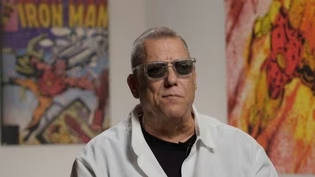
1119 | Local | Marvel Collaboration
Video has Closed Captions
Clip: S11 Ep19 | 7m 57s | Two Tampa artists armor up for an epic collaboration around the Marvel Cinematic Universe. (7m 57s)
Providing Support for PBS.org
Learn Moreabout PBS online sponsorship

- Arts and Music
The Best of the Joy of Painting with Bob Ross
A pop icon, Bob Ross offers soothing words of wisdom as he paints captivating landscapes.











Support for PBS provided by:
WEDU Arts Plus is a local public television program presented by WEDU
Major funding for WEDU Arts Plus is provided through the generosity of Charles Rosenblum, The State of Florida and Division of Arts and Culture and the National Endowment for the Arts, and the Hillsborough County Board of County Commissioners.