
Episode 112: Ray LaHood, Annazette Collins, and More
4/2/2021 | 26m 46sVideo has Closed Captions
Discussion on Ray LaHood, Annazette Collins, race for Governor, and more.
Host Bruce Rushton (IL Times) and guests Dave McKinney (WBEZ) and Jerry Nowicki (Capitol News IL) discuss a criminal investigation involving Ray LaHood and how that is effecting his position as chair of the ALPLM board of trustees. Plus the indictment of former State Senator Annazette Collins, race for governor 2022, and the Supreme Court considering Deerfield's assault
Problems playing video? | Closed Captioning Feedback
Problems playing video? | Closed Captioning Feedback
CapitolView is a local public television program presented by WSIU
CapitolView is a production of WSIU Public Broadcasting.
Episode 112: Ray LaHood, Annazette Collins, and More
4/2/2021 | 26m 46sVideo has Closed Captions
Host Bruce Rushton (IL Times) and guests Dave McKinney (WBEZ) and Jerry Nowicki (Capitol News IL) discuss a criminal investigation involving Ray LaHood and how that is effecting his position as chair of the ALPLM board of trustees. Plus the indictment of former State Senator Annazette Collins, race for governor 2022, and the Supreme Court considering Deerfield's assault
Problems playing video? | Closed Captioning Feedback
How to Watch CapitolView
CapitolView is available to stream on pbs.org and the free PBS App, available on iPhone, Apple TV, Android TV, Android smartphones, Amazon Fire TV, Amazon Fire Tablet, Roku, Samsung Smart TV, and Vizio.
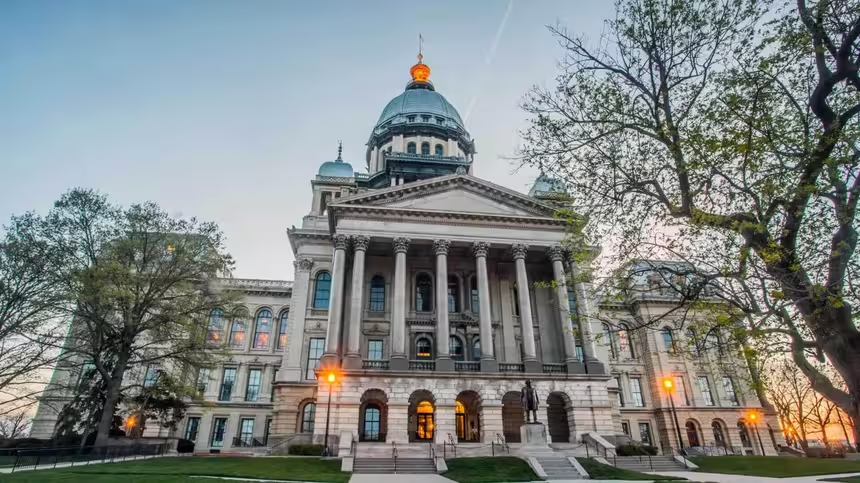
CapitolView
CapitolView is a weekly discussion of politics and government inside the Capitol, and around the state, with the Statehouse press corps. CapitolView is a production of WSIU Public Broadcasting.Providing Support for PBS.org
Learn Moreabout PBS online sponsorship(uplifting music) - Welcome to "Capitol View," the weekly program where we talk about state politics and government and how it just might affect you.
Joining me this week on "Capitol View" is Dave McKinney, reporter extraordinary with WBEZ radio in Chicago.
Welcome, Dave.
- Bruce, how are you?
- Just terrific.
Also Jerry Nowicki, bureau chief for "Capitol News Illinois" here in Springfield.
Welcome, Jerry.
- Thanks, Bruce.
- It is April Fool's Day as we tape, and so happy April Fool's Day to everybody.
And just this just in, within the last 24 hours Ray LaHood is in some issues on having been all connected with some nefarious conduct real or alleged.
Dave, give us the background and what does it mean?
- Well, this came out of Washington DC.
The Department of Justice announced late in the day on a Wednesday that they had settled a criminal investigation into Ray LaHood dealing with a loan he had gotten in 2012, I believe, from a Nigerian-Lebanese billionaire who was on the no-fly list.
This all arose from when LaHood was transportation secretary under former President Obama.
LaHood had a speaking engagement in California and he shortly after that met this billionaire and became acquaintances, and a couple of years later in '11 or '12, LaHood was suffering some financial difficulties, had something going on at his home in terms of, you know, some kind of home improvement that needed to be made, and he put out the word that he needed some money and help.
And this billionaire then wrote him a check for $50,000.
They considered it a loan, and where LaHood got himself into trouble is that he didn't disclose this income on federal ethics statements as he should have.
And to compound problems, when the fed started sniffing around on this, they interviewed LaHood and he initially told them he knew nothing about the money.
And so LaHood probably is lucky that he didn't face criminal charges here.
This is an agreement where he... they settled the case against him.
He had to repay the $50,000 to the billionaire, and he had to pay a $40,000 fine to the federal government.
So a real surprise, I think, to a lot of people who looked at LaHood, who... a Republican in democratic Illinois.
He had a good reputation for the most part, regarded as a bipartisan and you know was appointed by governor Pritzker not that long ago to be chairman of the Abraham Lincoln Presidential Library and Museum board.
So he has friends on both sides of the aisle.
- Yeah, I mean, a huge surprise because LaHood had always been viewed, I think you're absolutely right, as one of those squeaky clean folks that could work both sides of the aisle and everybody respected.
And now, I mean, this puts, not to bring Aaron Schock's name into this, but let's bring Aaron Schock's name into this, both from the same area of Illinois, both downstate and both stained I think pretty severely here.
What does a Congressman make?
I mean, I'm not sure...
I haven't had an opportunity to look this up, but he was broke?
I mean, how does that happen?
- Well, Bruce, see he wasn't in Congress at this point in time.
He was the transportation secretary and, you know, I don't know what the salary is, but it's, you know, it's a six-figure salary for serving- - He's 75 years old now.
Go ahead.
- Yeah.
And, you know, I think what this does as well, I mean, it creates some questions for Governor Pritzker.
What does he do with LaHood as chairman of this board?
Did the governor know about the investigation when the appointment occurred?
You know, does it affect LaHood's status now as chairman?
And then the other part of it, I think is, you know, we're kind of in that beauty pageant phase of the 20/22 election cycle and LaHood's son, Darren, the congressmen from Peoria is is on some people's shortlist as a potential gubernatorial nominee.
So, you know, it creates questions also for Congressman LaHood about his father.
- Sure.
I think you're right.
Let's dive a little bit into the ALPLM the Presidential Library Museum board.
Dave, you broke the story a few years ago, nine years ago, I think, if my memory serves, or almost a decade ago about the hat, and whether the infamous stovepipe hat is genuine or not.
Now, and I will take credit for this, yours truly reported on the most recent ALPLM board meeting where the board of the public institution chaired by LaHood has put all the private foundation in charge, essentially, of efforts to determine whether the hat is real.
And furthermore, the experts that are going to be retained are going to be required to sign non-disclosure agreements.
I'm presuming this is something just maybe a side venture here, as opposed to the straight thing, but what do you do if you're Pritzker and you do have...
This has come up and, and it didn't come up during Obama's tenure either, and this stuff was going on.
How does something like just fester for as long as it did?
Jerry, any questions?
Or any ideas, I'm sorry.
- Yeah.
I mean, it'd be hard for...
It's going to be a difficult decision for the governor whatever he's going to have to do with this.
It's hard to prognosticate or whatever, but it's a stain on what appeared to be at the time a pretty safe and a pretty politically savvy hire for that position when they'd gone through some stuff.
I think a previous director went the... Was it a copy of the Gettysburg Address to Glenn Beck.
So he brought in Ray LaHood thinking it would be a pretty... pretty good hire in that position, and now you're in this scandal.
So it's hard to tell how the governor is going to proceed.
But then one of the other things I was thinking about Ray LaHood is how prominently he played a role in the effort to pass the gas tax hike and the infrastructure bill on the governor's first year.
So he's been a pretty present and visible figure in working with Pritzker.
So it's a little bit of a black eye in that regard.
- [Bruce] How much do the oil slicks spread to his son, if at all, do you think?
- That's going to be up to the voters, I suppose.
He's in a pretty safe district.
I don't know if, if he's going to be primaried in any regard in terms of Congress, but who knows about other other aspirations he has.
- This is not the only issue involving potential corruption in the state of Illinois this week that's come up.
Dave, former Senator Collins, tell us about that.
- Yeah, that came out of the us attorney's office in Chicago on Thursday on Wednesday, excuse me.
Former state senator and former state representative, Annazette Collins, who represented part of Chicago's West side and part of the North side, she wound up being indicted in a five count indictment on tax evasion charges and for under-reporting income.
You know, what makes her case interesting?
I mean, it's a... on the surface, at least, you know, when you read the indictment, it's a pretty mundane looking set of circumstances where somebody is accused of just under-reporting income and not filing taxes, but beneath it, I think there is an interesting play going on here because she is a former lobbyist, long-time lobbyist, five years, I think, for ComEd.
ComEd, we know, has had its own problems where a year ago this summer they entered into a deferred prosecution agreement with the US attorney in Chicago and agreed to pay a $200 million fine for participating in a long running bribery scheme in Springfield that was aimed at influencing former House Speaker, Michael Madigan.
And they, you know, Madigan of course is no... you know, he's no longer on the scene here, but the federal government's interest in him continues, but they haven't been able to close the loop and bring charges against the former speaker.
And so I think, you know, in this case, there's a question of can Collins be any help in that pursuit?
Now, her lawyer told us at WBEZ on Wednesday evening that he believes this is completely about the government's pursuit of Madigan and that they would like to see her flip and cooperate.
So, you know, that one is still out there, but it's, you know, she becomes the latest in a series of state legislators, or former state legislators, who have wound up being criminally charged here in the last couple of years.
It's quite, you know, the state legislature, I think, now has eclipsed the Chicago city council as the, you know, the place where the corrupt go to live, you know.
- Is that per capita or on a percentage basis?
- That's a very good question.
You know, we're waiting on the census data like always.
(men chuckle) - Well, you know, it's laughable on one level but really it's not.
I mean, you know, the feds, I think this probably does, it's a good sign that Madigan still has a lot of stuff stuck to his shoe and he doesn't have, perhaps, the resources he might've had.
I mean, he could still... Actually, I take that back.
His campaign fund can still pay for legal expenses related to this.
So it doesn't seem like this is going to disappear.
At least it's hard for me to judge whether this is a light at the end of the tunnel or just the longer tunnel.
Is there any way to know?
- Well, I don't know, but I mean, you know, it's also interesting to note that the US attorney within the past, I might be wrong a little bit in my timing, but it's been roughly in the past month or so, they've, on similar charges, indicted former state representative, Edward Acevedo.
He was a member of Madigan's leadership team for a long time, and there seems to be a sense that you know, that that Acevedo could be of some use in the pursuit of Madigan as well.
So, I mean, it's the... the circle is tightening around Madigan but again, the key thing right now is that the feds have not charged him.
And, you know, there have been plenty of investigations that don't reach their top target, but we don't know yet.
You know, we're not at that point with this investigation, it's still very active.
- Let's jump into the realm of politics, pure politics here for a second, and that being the race for governor.
Governor Pritzker has recently given his campaign committee a whole bunch of money, $35 million, without announcing he is going to run.
Just $35 billion doesn't mean you're going to run for election or does it?
What do you think, Jerry?
If you paid $35 million, is that a good sign that the governor's going to be on the ballot in 2022?
- It seems to point that way.
He, of course, said that's not what he's thinking about amid the pandemic.
He said that to basically to all the reporters in the state who have had a one-on-one with him.
Couple days after, I think it was, that he made that $35 million payment, but... You know, he's putting all that money in.
It seems like it's an investment in something.
And it would pretty much be an investment in itself, so... - Is it an investment in credibility because when somebody tells me I'm looking for...
I don't have anything to think about politics right now and then they give themselves $35 million, do you trust it as much as you're used to?
What do you think, Dave?
Well, I mean, traditionally, when you see big money like that going in at this stage of an election cycle, it's purpose is really to sort of clear the field.
And I don't think that there's any kind of serious danger of Pritzker being primaried from anyone within the democratic party.
But I do think that this has meant as a signal to potential Republican candidates out there that, you know, if they want to take him on in 2022, that they're going to have to find a way to outspend a billionaire.
And, you know, we've seen in in his gubernatorial election, I mean, he spent, you know, over...
I mean, I think it was close to a $100 million, all self financed, so he has that capability.
And there really aren't any Republicans right now who have shown interest in the 2022 race who have those deep pockets.
And so I think that that's what this is.
It's a real clear message sent to the Republican field out there that, you know, "Yeah, I haven't announced, but get ready."
And, you know, "You're gonna lose on the TV airwaves when it comes to advertising, if you don't, you know, if you think you can outspend me.
Well, two questions, let's ask Bruce Rauner how much money makes a difference when you've done a lousy job.
And not the governor Pritzker has done a lousy job, but Bruce Rauner was roundly seen as a failed governor both by folks within his own party and, obviously, from the loyal opposition.
And so he had tons of money.
If you ain't got no message, if you screwed up, how far does that take you.
You know, the other question is, at least to me, is, you know, if you have given this kind of money, and you haven't announced, and you're trying to clear the slate of Republicans, I'm not...
I mean, part of this is having to do with caps, I think and not blowing caps.
But what do you think, Jerry, I mean are... Has the campaign season defacto already begun?
- I think in some regards we're always in a campaign season, but I think when it comes to the election, the governance is going to be judged on his pandemic response.
Like it, or hate it, you know, that's going to be the question for a lot of people, as it was in a large regard in the 2020 presidential election.
A lot of people don't like that businesses have been sort of forced into closure in many situations, especially bars and restaurants.
Some people think he's had a successful effort in sort of dealing with the pandemic and suppressing disease spreads, so I think that's going to be the question when it comes to the next election.
- No, but if the lecture is held today.
I mean, 2022 is obviously a couple of years back away from us.
The pandemic of 1918 didn't really resonate in the next presidential election.
It just kind of disappeared and everybody forgot about it so... Not that this is really going to be forgotten about, but on the one hand, you know, you can say, I think that the governor is most folks, I think, support him.
If you're looking at the polls, he's gotten a lot of support for, I think, his efforts in dealing with the pandemic.
Also, he can point to maybe a few economic gains despite all of this.
I mean, for one thing, Moody's has recently upgraded state bonds.
I mean, they're now from negative, we're not at junk bond status to treading water, which is stable.
What other issues, you know, aside from pandemic, might come into play as we head down into the next gubernatorial election?
- Well, we'll both jump at once here.
(men laugh) You know, I mean- - It's the deep end of the pool.
(Bruce laughs) - Yeah, exactly.
You know, on the pandemic...
I mean, another point, before we move on, I mean, you know, there's is a consortium of universities, Harvard, Northwestern, a couple of others, that have been tracking state governors and their approval ratings and their dealings with the pandemic since it began.
And Pritzker's numbers, like everyone's numbers, were really through the roof at the beginning of this, people were very supportive.
But since then, I mean, as of, I think, late February, that was the last data I looked at, his numbers had fallen by 20% below a majority on his handling of the pandemic.
And so I think that that reflects a general sense of fatigue that people have, maybe not so much with him, but with just the... "When is this thing ever going to end," kind of thing.
And so I think, you know, he has that kind of fatigue factor going into this race that, you know, that there are glimmers of hope, but we still don't have it under control.
The good thing for him though, is that you look at around the country and there are governors who had similarly high approval ratings a year ago who are absolutely in the tank now.
I mean, Gavin Newsom in California is an example.
I mean, he's the subject of a recall movement, because of his handling of the pandemic in California- - [Bruce] And the French laundry law, but go ahead, yeah.
- Absolutely.
And then the other issue of course is in New York and Governor Cuomo there.
I mean, of course, everything now is focused on the sexual harassment cases that keep coming out of the woodwork against him.
But remember his problems began with, you know, basically phony death data involving nursing homes that the state of New York was circulating under his watch.
And so Pritzker has avoided those kinds of pitfalls that politicians can sometimes fall into.
And so I think that, you know, he's got that, that advantage that there have been no major catastrophes.
You could call 36 deaths that have veterans home to COVID a disaster, but, you know, again... And Republicans are trying to make that an issue, but that was pretty much going to any nursing home in the state of Illinois and you would find horrible, horrible circumstances like that.
- I mean, I think it's pretty clear, Pritzker's no Cuomo in terms of what he's facing right now.
I think at least folks don't think see him as nefarious or inept in the sense that some folks thought of former Governor Quinn or corrupt as folks thought of Blagojevich.
It does seem very much in play, but that Republicans are eager to challenge him, and we, just this week, got a new challenger, Gary Rabine.
What do we know about this guy?
He's announced, "I'm going to run for governor as a Republican and I'm a businessman and he won't avow or disavow, or say much about what he thinks about our former president, Mr. Trump.
This is the second or third?
We got Paul Schimpf, we've got him.
How many more can we expect to jump into the fray or in coming weeks?
- Yeah, there's Darren Bailey, of course, - [Bruce] How could I forget?
My bad.
- Rabine, I think, has an asphalt company and I think his slogan was, "Paving the way to stay," so you're already seeing some of the themes from previous Republican candidates, which is of course, high taxes in Illinois, the apparent outmigration of Illinoisans, and that's sort of what he emphasized in his little introduction event in the suburbs.
So I think that's the type of theme you're going to see and I think we will see in many more challengers.
It's probably going to be a pretty wide GOP field.
I don't know if there's going to be a runaway candidate, but we'll just have to wait and see who else expresses interests and what other themes may develop in the election.
- Right now, I agree with you, Jerry.
It seems to be a fairly generic GOP theme.
Low taxes, slight fight, big government.
I presume the corruption card will be played at some point in time.
That's par for the course.
Darren Bailey seems to have more fire, for lack of a better word.
I mean, he's glommed onto an issue, in a way, that being COVID response and he's gonna sink or swim with it.
Any sense...
I mean, right now, there's been no candidate on the GOP side that I'm aware of that has said, "Donald Trump is bad, I disavowed him."
Am I wrong?
- I mean, Paul Schimpf has probably taken on the most moderate tone of any of them so far.
And, you know, we're still waiting to hear, as we mentioned earlier in the show, about what Congressman LaHood's intentions are.
Congressman Rodney Davis is another name that gets mentioned.
And both, you know, Davis and LaHood would have sort of mainstream Republican backing and there might be some momentum behind candidates like that.
You know guys like that are both... they're naturally downstaters.
In the past, when downstaters have won statewide office like that, they've also been able to consolidate support in the suburbs.
And right now Democrats seem to kind of control the collar counties.
And I think what, you know, what you may be seeing at play here, I mean, you know, what was interesting out of the Rabine press conference was that, you know, he was asked specifically about whether he agreed with Donald Trump's assertion that the election was stolen and he wouldn't shoot that down.
And so he kind of kept open the idea of what, you know, has been refuted everywhere, right?
That the election was... That there was something illegitimate about it.
And so, you know, there is an appetite, particularly, downstate for Donald Trump.
I mean, he in the general election, he picked up 2.4 million votes in Illinois, and that's a considerable number of people who, you know... they are die hard people.
If they're motivated to get out to the polls, if he can capitalize on a group like that, it's a very important thing, especially in a primary.
But the thing to remember is in a general election, the Democrat, Joe Biden, got a million more votes.
And so, you know, you may see some kind of splintering of the Trump's support among people like him and Darren Bailey, especially, if they both stay in it.
You know?
So I think it's the impact of Trump and the election in the Illinois gubernatorial election, I think, as a final outcome is going to be minimal.
- I mean, perhaps, a circular firing squad.
We've seen it before.
We'll know more later.
Speaking of guns, Deerfield, they passed a ban on assault rifles in 2018, I believe.
It's now before the State Supreme Court, which is agreed to take this case to determine whether it's a valid ban or not.
This seems, in lieu... or excuse me, in light of the tragedies that have hit us lately.
Could Illinois, again, find itself on the forefront of gun rights and second amendment issues as we did with the McDonald case about a decade ago where the right to possess a handgun was upheld in the city of Chicago?
- Yeah, so the Deerfield case is sort of a narrow reading of the Floyd act.
I think there was a period in 2013 in which municipalities were allowed to take further action against assault rifles, and Deerfield took some action, but it wasn't a complete ban.
So the gun rights groups are challenging whether, within the parameters of the law, they were allowed to amend that action in 2018 to make it a complete ban.
So it's a sort of marrow thing, not quite.
So if a municipality had enacted in 2013, they're not going to have this ability to ban the weapons, from my understanding of the lawsuit, but there are other bills circulating in the general assembly.
I think Ram Villivalam has one, a senator, that would take further action on guns.
- Well, unfortunately we're out of time and sobering things and interesting things to think about.
As always, thank you both for joining us and we'll see you again next week on "Capitol View".
(uplifting music) (graphic's sound effect)

- News and Public Affairs

Top journalists deliver compelling original analysis of the hour's headlines.

- News and Public Affairs

FRONTLINE is investigative journalism that questions, explains and changes our world.












Support for PBS provided by:
CapitolView is a local public television program presented by WSIU
CapitolView is a production of WSIU Public Broadcasting.