
Episode 112
Season 1 Episode 112 | 27m 46sVideo has Closed Captions
Explore breakdancing, a 1968 plane crash and community revitalization through the arts.
Learn more about breakdancing from DSM Breakerz, watch three Tjernagel siblings recall the day an airplane crashed into their Story City farmhouse, and meet Gabriella Torres, an abstract artist and creative placemaker in Clinton.
Problems playing video? | Closed Captioning Feedback
Problems playing video? | Closed Captioning Feedback
Iowa Life is a local public television program presented by Iowa PBS
Episode 112
Season 1 Episode 112 | 27m 46sVideo has Closed Captions
Learn more about breakdancing from DSM Breakerz, watch three Tjernagel siblings recall the day an airplane crashed into their Story City farmhouse, and meet Gabriella Torres, an abstract artist and creative placemaker in Clinton.
Problems playing video? | Closed Captioning Feedback
How to Watch Iowa Life
Iowa Life is available to stream on pbs.org and the free PBS App, available on iPhone, Apple TV, Android TV, Android smartphones, Amazon Fire TV, Amazon Fire Tablet, Roku, Samsung Smart TV, and Vizio.
Providing Support for PBS.org
Learn Moreabout PBS online sponsorship♪♪ Coming up on this episode of Iowa Life -- Learn more about the artistry and athleticism of breaking from DSM Breakerz.
It's more than just being physically fit.
Breaking comes with the culture and there's experiences along with that.
♪♪ Visit with the Tjernagel family as they recall the aftermath of a 1968 plane crash.
This isn't just the Tjernagel story, this is a Story City story, and that has stuck with me -- ♪♪ I just kind of want to do something really drippy.
♪♪ And meet Gabriella Torres, an artist who is working to make Clinton a destination for the arts.
There's also nothing special about me or what I do.
Anyone can do it and I just hope more people will because our towns are worth saving, our towns are worth fighting for.
It's all coming up next on Iowa Life.
♪♪ Funding for Iowa Life is provided by the Gilchrist Foundation, founded by Jocelyn Gilchrist, furthering the philanthropic interests of the Gilchrist family in wildlife and conservation, the arts and public broadcasting and disaster relief.
Mark and Kay De Cook Charitable Foundation, proud to support programs that highlight the stories about the people and places of Iowa.
The Strickler Family, in loving memory of Lois Strickler, to support programs that highlight the importance of Iowa's natural resources on Iowa PBS.
And by -- the Lainie Grimm Fund for Inclusive Programming at the Iowa PBS Foundation.
♪♪ ♪♪ ♪♪ ♪♪ ♪♪ The first rule of breaking -- don't call it breakdancing.
♪♪ Breaking is a form of dance that is known for having stylized footwork and acrobatic moves and is one of the four pillars of hip hop.
♪♪ The sport originated in the 1970s at a neighborhood party in the Bronx in New York City as hip hop was coming to life.
The dancers, known as B-Boys and B-Girls, would dance at parties, clubs and in parks and eventually became mainstream in the 1980s.
The sport has come a long way in 50 years and will make its Olympic debut at the 2024 Paris games.
♪♪ We want the same recognition as like snowboarders and skateboarders.
We want that type of recognition too.
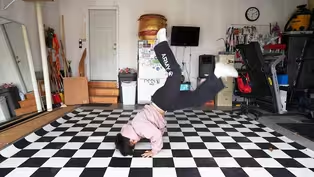
♪♪ Tami Swartwood: Welcome to my garage.
This is where Des Moines Breakerz, which we're now DSM Breakerz, first came about.
♪♪ DSM Breakerz is a non-profit that aims to offer a safe environment for people to practice the art of breaking through classes, performances or competitions.
♪♪ Tami Swartwood: It's more than just being physically fit.
Breaking comes with a culture and there's experiences along with that.
The new athletes now are artists.
♪♪ Like gymnastics, breaking is a judged sport, except there's no rigid point system.
Instead, B-Boys and B-Girls are scored on their creativity, personality and technique.
♪♪ B-Boy Homie Sky is one of the young talents working to raise the profile of the sport.
♪♪ He placed 9th in the teen division at the Breaking for Gold Tour in 2022, just shy of qualifying for the national team.
♪♪ Now, Sky is focused on passing his knowledge and skills to the next generation of breakers.
♪♪ Skyler Fongdaro: In breaking there's four fundamental categories.
One is top rocks, the first one.
It's the way you introduce yourself.
Cross, crossing your body, back, cross, back, cross.
And then your second element of your set is footwork.
And footwork is kind of just more floor oriented.
You're kind of instead of just on your feet you're mostly using other parts of your body as well.
One, two, three, four, five, six.
Number three, power moves.
Power moves are the more acrobatic moves and the more aerialesque type of moves.
They're kind of flashy.
And then four would be freezes.
Freezes are kind of like punctuation.
Skyler Fongdaro: Creativity and expression goes a long way, especially everybody is their own person, and I think being an individual you should have some uniqueness to yourself.
And so, my uniqueness is I find breaking as a really expressive outlet.
♪♪ Long before there were organized competitions, B-Boys and B-Girls performed in cyphers, which refers to the circle that breakers enter into to take turns dancing.
♪♪ Skyler Fongdaro: The music is really, really loud.
You can feel it in your chest, like the bass is just boom, boom, boom.
And you're kind of just in the zone.
You're just like looking around, you're seeing people younger than you, older than you, same age as you and you guys all just kind of come together and under one roof you share yourself, you share the love and you share the floor.
♪♪ Skyler Fongdaro: I think my biggest inspiration is just the Des Moines area full of all the breakers because we're just a small city, but we're trying to make it big.
♪♪ Tami Swartwood: So, when you think hip hop, you don't think Iowa.
So, when we're out traveling to these places, we're making them know that we are more than just farmland here in Iowa and that we have a culture here that we embrace it and we're teaching it to that next generation.
We have made a name in the last two years and that we are on the map and we're staying on the map.
♪♪ All right, let's give it up for this next generation!
♪♪ ♪♪ ♪♪ The Tjernagel family's story of survival begins in the 1850s when they emigrated from Norway and settled here on a place they called Follinglo Farm.
Over the decades, they built a life here, raising short-horn cattle, crops and generations of children.
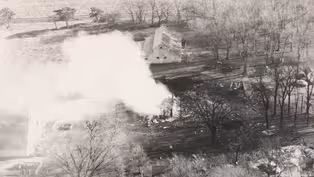
On December 9, 1968, Peter and Marie Tjernagel and their family were just about to enjoy their evening meal, when tragedy struck.
♪♪ Sigrid Tjernagel Hanson: Mom had just come out from the bathroom into the kitchen and Mike was getting dad up.
Mike Tjernagel: Dad had rheumatoid arthritis and so I was getting him ready.
It sounded like a jet and I think I mentioned to him, boy that one is low.
Ingeborg Tjernagel Schey: Just this incredibly loud sound.
We had sonic booms over the farm, so we were kind of familiar with that.
But this just wouldn't stop, it wouldn't stop, it just kept getting louder and louder and then kaboom!
(explosion) Sigrid Tjernagel Hanson: Then I went over the table, landed at mom's feet and when I got up that whole wall was gone.
There wasn't a stove, an oven, anything.
And then the upstairs came down.
So, we started running.
♪♪ The explosion sent burning wreckage onto the farmhouse engulfing it in flames.
Miraculously, all seven family members who were home that night escaped.
♪♪ Sigrid Tjernagel Hanson: I kept turning around because I just couldn't believe, I just couldn't believe it, and it just kept getting bigger and bigger and bigger and we were driving away from it, so it should have been getting smaller.
And it just blew my mind until we were on the way to Story City, I was convinced that it was the oven the blew up.
And Mary Ellen said, she just reached over and said, no, it was an airplane.
♪♪ 25 minutes earlier, an Iowa Air National Guard F-89 Scorpion left Des Moines.
The pilot was Captain John Rooks of Eldora and the radar operator was Lieutenant Larry Thomas of Ogden.
They were on a training mission with three other Iowa Air Guard planes.
Terry Greenfield: I worked in personnel full-time.
I saw the two guys.
They'd always come in together.
Night flying usually started around five or six o'clock and lasted for about 90 minutes.
The F-89J Scorpion, it was one of the first jets in the Air Force.
We called it the lead sled because it took the whole runway to get off the ground.
So, they were out doing a little bit of dogfighting type of thing.
The crew got kind of behind on the rest of the other two airplanes and the bigger plane they were protecting and they got kind of lost and they were up pretty high and they somehow became inverted.
And the yard lights looked like stars.
They didn't believe they were instruments.
They thought they could see where the sky was.
So, they were pulling back on the joystick to go higher, but they were actually going lower, and they were kicking in the afterburners to go faster to get more lift and they were actually going faster into the ground.
♪♪ Sigrid Tjernagel Hanson: I believe with all my heart that he tried to steer it as far from a populated area.
And I don't know if that's true or not.
Maybe he just couldn't do anything.
But in my mind, he did all that he humanly could.
Mike Tjernagel: And they basically should be heroes because they were training to defend this country.
♪♪ The loss was heavy for the pilot's families.
But somehow, the Tjernagel's escaped with only minor injuries.
♪♪ Ingeborg Tjernagel Schey: That was a big moment for all of us was like, yeah, it's all gone, everything.
Mike Tjernagel: That's a terrible thing when you finally realize the only thing you have is on your body and then not everything was mine.
Sigrid Tjernagel Hanson: By the next night, we were in a house, and that house had -- Mike Tjernagel: It was totally furnished.
Sigrid Tjernagel Hanson: -- beds.
Mike Tjernagel: Totally furnished.
Beds were made.
Everything -- the cupboards were full.
Sigrid Tjernagel Hanson: There were Kleenex boxes, there was toilet paper, there were toothbrushes, and this was before email and texting.
This is word of mouth.
Everybody did what they could, they came together.
Ingeborg Tjernagel Schey: And then the Christmas tree.
Sigrid Tjernagel Hanson: When we moved in that Tuesday night, there was this Christmas tree with the boxes of decorations underneath it so that we could decorate it.
They thought we would enjoy doing that.
Ingeborg Tjernagel Schey: That was so sweet, so thoughtful.
Sigrid Tjernagel Hanson: And that was very thoughtful.
♪♪ The support of the Story City community would fortify the Tjernagel family in the trying days to come.
Just a few weeks after the crash, Pete Tjernagel passed away, and the responsibility for rebuilding fell to Marie.
She would need to go to school, find a job, and begin what would turn into a four-year process of requesting compensation for the damages to their property, their farm equipment and the loss of the entire 1968 crop.
♪♪ Mike Tjernagel: The insurance company was willing to settle, but she was advised not to, let's see what the Air Force -- Ingeborg Tjernagel Schey: And then throughout all of this time, she has to list everything that was in the house that we lost, everything.
Sigrid Tjernagel Hanson: The purchase, when we purchased it, the purchase price, and the value.
State and federal government squabbled over who would take responsibility.
Marie Tjernagel: The frustration and the suspension and the, oh, you name it, it has been so hard not knowing.
You can't make plans.
You don't know if the money is coming.
You don't like to borrow because the interest rates are so high, when you don't have any idea when the money will be coming in.
Ingeborg Tjernagel Schey: So, she was kind of stuck between two great big bureaucracies and nobody was listening to her.
They were ignoring the plight of two families in Iowa.
Dean Borg: This is all that remains of the Clarence McCarville farm home east of Cresco.
An Air Force F-102 crashed into it this morning.
The incident at the Tjernagel farm was the second crash in Iowa that year.
Six months earlier, a Wisconsin Air National Guard plane went down near Cresco.
That pilot safely ejected.
But his plane destroyed the home of Clarence and Emma McCarville.
Years later, the McCarville's were still living in a chicken coop.
Numerous newspaper articles detailed the family's situation, drawing attention to the problem.
Senator Harold Hughes proposed legislation for the relief of the Tjernagel family.
The people of Story City came through again when a sociology class started a petition and collected 14,000 signatures.
And, when President Nixon came to Iowa to dedicate Lake Rathbun, Governor Bob Ray spoke to him about both families' claims.
David Oman: Ray, finally in a fit of pique, said I'm not going to take this anymore.
And as Commander in Chief of the Iowa Guard, signed a document that grounded the Guard.
They couldn't fly a plane, they couldn't fly a chopper, they couldn't move a truck, they couldn't drive a Jeep.
He just, you're done.
♪♪ Iowa Governor Robert Ray said he was fed up with all the delays, which he said was a bad case of government buck passing.
He ordered all methods of transportation of the state's Air and Army National Guard units grounded.
The order put nearly 1,700 vehicles out of business.
But the daring move worked, and less than 24 hours later the Air Force dropped their opposition to the claim.
Governor Robert Ray: It was drastic action and I intended it to be because if that's what it takes to get the federal government to realize they have a responsibility to people in this country, then I was willing to do that.
Afterall, they're there to protect our people, not destroy them.
♪♪ Sigrid Tjernagel Hanson: This isn't just the Tjernagel story, this is a Story City story.
Mike Tjernagel: That's true.
Ingeborg Tjernagel Schey: It's an Iowa story.
It's a small-town story.
It's a story of hope -- Sigrid Tjernagel Hanson: It's a story of a woman who never wanted to tell that story.
The story inspired Sigrid's daughter Jenn and her husband Marcus to produce a podcast chronicling the tragedy.
It's called Follinglo.
Jenn Hanson-dePaula: I had known of the story my whole life but I didn't know the details.
And so, just getting to hear these perspectives and the individual stories, it just brought up a whole new level of respect for my mom, my aunt, my grandmother, everyone.
Ingeborg Tjernagel Schey: The worst can happen, but it doesn't have to ruin your life forever.
Sigrid Tjernagel Hanson: We were all placed exactly where we needed to be.
And the worst didn't happen to us.
The worst happened to the pilot's family and the navigator's family.
We didn't lose a brother, a husband, a father.
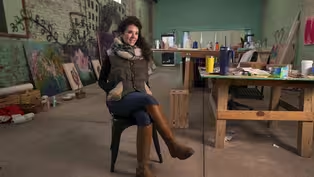
♪♪ ♪♪ ♪♪ Gabi Torres: I love so much about this town.
I love the people, I love the landscape, I love the opportunities that are here.
It's known for the lumber barons that came and had their mills here.
And one of the factoids you learn as a kid growing up is like, oh yeah, at one point in time it had the most millionaires per capita in the United States or something, maybe for like a year or two, but still.
And I think now we're known for our riverfront.
♪♪ Gabi Torres: I think that we're known for our Eagle Point Park area as well.
And hopefully we're going to be known for having a really incredible arts and culture scene here.
♪♪ Gabi Torres: I am a first-generation Latina here in Clinton, Iowa.
So, my mom is from Argentina.
My dad was from Mexico.
And they met actually in Boston.
My dad came over to America to finish off his medical training and my mom was here to learn English and eventually life brought them here to Clinton, Iowa.
I just feel so tied and connected to a place that embraced my family and made them feel like they could make this home and call it home and feel like there was nowhere else they'd rather be.
Gabi Torres: I've always just been, I guess, what someone would call a creative person.
I want to do something really drippy.
Gabi Torres: I didn't really start art as I do it now until a lot later in my life.
Well, hot dog!
Gabi Torres: My dad was just like, you know, he was really the one who gave me the courage to really believe in myself and take the next step.
I am so stoked.
I might have just -- I might have a new series.
Gabi Torres: I was working as a marketing and development director for our local YWCA at the time and he was like, you know, anyone can do that job, but not everyone can be an artist, and you should just spread your wings and just see what happens.
He really gave me his blessing.
That really was a turning point in my life.
♪♪ The red, the blue, skip over one, the red and then the other red, and that big one there.
That was from a show called Wild.
Gabi Torres: You know, this was the guy who was like, you go to school, you become a lawyer, and you follow this path and then by the end of his life, right before he really got sick with Alzheimer's he was just like, life is too short and you have to live your dreams.
I just felt really compelled to try to use art as a vehicle for doing something positive and impactful.
And if I could make a difference, I should, because that's what my dad would have wanted.
And I think that's really what he meant when he wanted me to be a full-time artist, to do it not just for me, but for other, for the betterment if I could for our town, a place that he adored.
Gabi Torres: So, this past year has been amazing.
It has just been full of projects.
♪♪ Grow Clinton is just beyond excited to celebrate Gabibird Art Studio and the second annual reception opening of The Grove.
Gabi Torres: So, The Grove really came out of a desire to create public art that would be accessible to everyone and would be very immersive.
So, that's where I came up with the concept of creating an art forest and that you could walk through the installation and get as close to the art as you wanted, you could touch it if you wanted to, and that it would be an outdoor experience so that way it would be free.
So, that's The Grove.
Gabi Torres: I look at empty buildings and empty lots and I don't see ugliness, I just see possibility.
To me, that is the best blank canvas.
It's like, how do I create beauty in a place that most people consider ugly or an eye sore?
How do you change that?
My big love and passion project is the Paint It Back Art Festival that Chris and I do together, Chris Shannon, and we're creating this really incredible vibrancy in a part of town that really was needing that.
(train whistle) Gabi Torres: You are here in Clinton, Iowa at what we refer to as the Toyota building.
(train whistle) Gabi Torres: This building has sort of just been sitting vacant for many years, at least a decade.
And so, I had the idea, along with my partner, we had an idea that we would try to, if it was going to be sitting here, we could activate the space through public art and through murals.
And essentially the idea was this, over one week in August we would invite artists, both local and national artists, to come and spend a week painting, wrapping the building in murals.
Each artist is able to pick their concept and theme.
There were no limitations.
The only real rule we had was that it was family friendly and there was something for everyone.
But basically, this is just a big celebration of this building and the revitalization of it.
♪♪ Gabi Torres: And I have to tell you, since we've been working here it has been crazy.
The number of cars that drive by has increased.
I've even had a local business, the business owner drove by to just say, this is awesome and thank you because since you have been doing this, my sales have increased.
This is why it matters.
It creates a sense of place.
It gives us an identity and I think can be sort of an anchor point for the Lyons District and help us move towards creating an arts and cultural district here to attract visitors and sort of just get more people to come and visit our community.
♪♪ ♪♪ Gabi Torres: Wildness, literally that just came out of a desire to do a more intensive collaboration with Clinton County Conservation, and also to try to implement an artist residency.
So, not only am I creating pieces of art using natural materials from their park areas, they also were kind enough to give me a cabin as a studio, which is really awesome.
♪♪ Gabi Torres: So, this idea, I was really interested in figuring out a way to make art that was less damaging to the environment.
I love working with acrylic and spray paint, but it's also really toxic and terrible.
Ooh, we're going to have to wipe down that wall.
Gabi Torres: It really just stemmed from a desire to be able to know how to make pigments and things and to make art that was maybe a little bit more environmentally mindful.
I'm not looking for perfection in any way because it's not about that.
♪♪ Gabi Torres: I think maybe each piece tells a little story and I might not even know what the story is.
That actually looks really cool.
I'm pleased with that.
♪♪ Gabi Torres: My purpose and overall goal is to use art as a way to create change and to make a positive impact on where I live and my community and the people who share this awesome place with me.
♪♪ Gabi Torres: It has always been about my town and how I can try to make a difference with my town.
So, all of those projects are very much tied to place in some sense.
So, The Grove was this park that we transformed into an outdoor art gallery and made a little art forest there.
Paint It Back obviously transformed a building.
♪♪ Gabi Torres: And Wildness is about our park areas that we have here and then hopefully -- obviously the connective thread in addition to that is these are places that we hope people will come and see.
♪♪ Gabi Torres: Art can be the game changer for a lot of places.
If you make something really interesting and beautiful or just creative and unique, people will come to visit it.
I just really hope that other people can feel inspired and feel empowered to do things and to just take those risks.
This story can be anybody's story, really it can.
I've had a lot of resources and I have been very lucky.
And there's also nothing special about me or what I do.
Anyone can do it and I just hope more people will because our towns are worth saving, our towns are worth fighting for, our towns are worth investing in and there's so much opportunity in places like this.
♪♪ ♪♪ ♪♪ ♪♪ ♪♪ Funding for Iowa Life is provided by the Gilchrist Foundation, founded by Jocelyn Gilchrist, furthering the philanthropic interests of the Gilchrist family in wildlife and conservation, the arts and public broadcasting and disaster relief.
Mark and Kay De Cook Charitable Foundation, proud to support programs that highlight the stories about the people and places of Iowa.
The Strickler Family, in loving memory of Lois Strickler, to support programs that highlight the importance of Iowa's natural resources on Iowa PBS.
And by -- the Lainie Grimm Fund for Inclusive Programming at the Iowa PBS Foundation.
Video has Closed Captions
Clip: S1 Ep112 | 5m 6s | Learn about breakdancing from a Des Moines breaking organization. (5m 6s)
Video has Closed Captions
Clip: S1 Ep112 | 9m 27s | Meet Gabi Torres, an abstract painter who’s working to make Clinton an arts destination. (9m 27s)
Video has Closed Captions
Clip: S1 Ep112 | 9m 48s | A National Guard airplane crashed into the Tjernagel family farmhouse on December 9, 1968. (9m 48s)
Providing Support for PBS.org
Learn Moreabout PBS online sponsorship












Support for PBS provided by:
Iowa Life is a local public television program presented by Iowa PBS