
Episode 113
Season 1 Episode 113 | 26m 45sVideo has Closed Captions
Explore a culinary competition, a luthier, equine-assisted therapy, and piano restoration.
Visit a statewide culinary competition for high school students, meet classically trained guitar builder Mike Marcovis, learn about equine-assisted therapy at Jester Park, and meet Chuck Behm who restores pianos at his Boone home.
Problems playing video? | Closed Captioning Feedback
Problems playing video? | Closed Captioning Feedback
Iowa Life is a local public television program presented by Iowa PBS
Episode 113
Season 1 Episode 113 | 26m 45sVideo has Closed Captions
Visit a statewide culinary competition for high school students, meet classically trained guitar builder Mike Marcovis, learn about equine-assisted therapy at Jester Park, and meet Chuck Behm who restores pianos at his Boone home.
Problems playing video? | Closed Captioning Feedback
How to Watch Iowa Life
Iowa Life is available to stream on pbs.org and the free PBS App, available on iPhone, Apple TV, Android TV, Android smartphones, Amazon Fire TV, Amazon Fire Tablet, Roku, Samsung Smart TV, and Vizio.
Providing Support for PBS.org
Learn Moreabout PBS online sponsorship♪♪ Coming up on this episode of Iowa Life -- More than 150 Iowa students show off their culinary skills.
I know chefs my age that would screw some of these dishes up.
Meet a classically-trained guitar builder.
Nobody needs a $5,000 guitar, there's no need for that, it's a want.
You can buy a bullet Strat from Squier for less than $300 that can play fine, but it's not the same as a custom-made instrument.
Learn how equine-assisted therapy helps military veterans.
The horses don't judge you, they're just happy to see you.
And meet a retired English teacher who restores pianos.
I like working with my hands.
I like working on mechanical things.
So, it really suits me.
It's all coming up next on Iowa Life.
♪♪ Funding for Iowa Life is provided by the Gilchrist Foundation, founded by Jocelyn Gilchrist, furthering the philanthropic interests of the Gilchrist family in wildlife and conservation, the arts and public broadcasting and disaster relief.
Mark and Kay De Cook Charitable Foundation, proud to support programs that highlight the stories about the people and places of Iowa.
The Strickler Family, in loving memory of Lois Strickler, to support programs that highlight the importance of Iowa's natural resources on Iowa PBS.
And by -- the Lainie Grimm Fund for Inclusive Programming at the Iowa PBS Foundation.
♪♪ ♪♪ ♪♪ ♪♪ ♪♪ It takes talent, teamwork, endurance and self-discipline to earn a place in a high school championship.
At the same time Iowa girl's basketball players are fighting for the state title, the culinary students are right across the street engaged in a battle of their own using many of the same skills.
♪♪ Good morning!
Welcome to the 2024 Iowa ProStart Invitational.
♪♪ Jessica Dunker: This is the culinary championships for Iowa high schools as well as the restaurant management championship.
♪♪ ProStart is a two-year food service curriculum for high school students.
31 teams from across the state are competing today and winners will represent Iowa in a national competition in Washington, D.C.
The day begins with the culinary teams.
Jessica Dunker: And that is a very Top Chef model.
They were judged the moment they walked in the door.
Their coolers were inspected, the way they load things into trays were inspected.
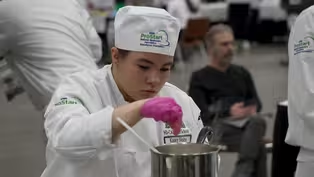
They have four students, two tables, two burners and 60 minutes to do a three-course presentation.
♪♪ The pressure is on for the students from Hampton-Dumont-Cal.
Their team has won this competition for the past two years.
And this year we chose an Iowa theme for our meal and it is seen throughout all of our dishes.
♪♪ Jaxson Rew: My name is Jaxson and I'm on the culinary team for Hampton-Dumont-Cal.
♪♪ Jaxson Rew: My biggest thing is am I forgetting something?
Kasey Nolte: I was really nervous.
I've never done this before and we've practiced many, many times, so I just had to keep my routine, just try to keep calm as I was doing it.
♪♪ Kasey Nolte: I was the starter.
I did all the starter myself.
It was a cheesy corn polenta with Brussel sprouts and pancetta and it had a Dijon maple mustard sauce.
We decided to put real corn in it and it tasted so good, so it was so good.
For maybe two months now we just practiced every single day, all day if we didn't have school we'd come in, just repeating recipes over and over again so we could get it right.
Leslie Osborn: Jaxson is one of our students that did one of the knife skills and he was working really hard on how to figure out how to speed up the process because that cuts into your hour of cook time.
♪♪ Jaxson Rew: I made all of the sides for the entree, so I made our green beans, the mushroom sauce and the potatoes and then I plated the entree.
Everything went well except when I was cooking the mushroom sauce it kind of spilled over the side onto the tablecloth.
But, it's okay.
Jessica Dunker: We have no trouble finding judges for this event.
It's folks that are specialists in sanitation, it's educators, it's professional chefs, it's restaurant owners, it's hospitality professionals.
Aaron Holt: I mean, mainly it's seasoning, that is my biggest thing.
Are things salted appropriately?
I also love the use of color.
I know chefs my age that would screw some of these dishes up.
So, to see a perfectly cooked lamb rack, a rack of lamb, really cool.
Maria Keys: A few schools really stood out for pushing and doing a bunch of stuff that were pretty bold like panna cotta in very short amounts of time.
♪♪ (applause & cheering) Jessica Dunker: What's interesting about the program is that there aren't class categories like sports.
So, sometimes the smallest schools are the schools that win.
And so, it's one of the few competitions where a Hampton-Dumont, who is one of the schools that we have today, is competing with Central Campus here in Des Moines or Davenport Central.
The second half of the day is the management competition.
♪♪ Jessica Dunker: You can be a great chef, but you can't run a great restaurant unless you have a great business person too.
And all of the students that choose to be in the management competition have created restaurant concepts.
They have looked at floor plan, concept, marketing, they've covered staffing, menu pricing.
Rylee Keehn: Our concept is a vegetarian food trailer who focuses on eliminating food waste and donating back to our community.
Zoe Erdman: I used to be terrified of speaking in front of large crowds and having a voice for myself.
But through watching and just gaining knowledge about the culinary industry and management and hospitality aspect has really opened my eyes and made me more comfortable with talking in front of people.
Rylee Keehn: We had some of the judges laughing so I'm going to take that as a positive.
(laughter) ♪♪ Jessica Dunker: And what we've really seen is that this program can give those students the opportunity to represent their school maybe for the first time on a team.
Leslie Osborn: Every change that I've asked them to make, every tweak that we have thought about and talked through has been group decisions, that collaboration, those communication skills, the critical thinking and thinking on your feet.
We had a dessert that didn't set the same way that it has 157,000 other times and she pivoted and she crushed it.
♪♪ Leslie Osborn: Being down here alongside state basketball at the same time, you know, you might think that this isn't the big deal, but I will tell you that we were livestreaming for students to watch back home, so knowing that this is going on around us and knowing that our community puts us on that similar sort of level that they're just so proud and it gives us that feeling of pride as well.
And our first-place culinary competition team going on to represent Iowa in the national ProStart Invitational, for what, third year in a row?
(cheering) Jessica Dunker: My favorite moment is when we announce the winners because always there are tears and they are tears of joy.
These students have poured their hearts and souls into these menus, they have poured their hearts and souls into those restaurant concepts, and when they realize that they are Iowa's champion and that this is their opportunity to represent our state on a bigger stage, they are overwhelmed with joy, as are we.
♪♪ ♪♪ ♪♪ I feel like doing stuff by hand the old way is, it's a different skill set when you have literally one person doing every aspect of the build.
♪♪ It's everything, it's functional art.
♪♪ Every piece of wood that is removed, even if with a power tool, it is done by hand, controlled by hand, carved by hand, anything is an option.
♪♪ For some people, these guitars are their babies.
People really attach themselves to their instruments, whether they're expensive or not, it's a sentimental thing.
♪♪ But also, guitars are cool, there's that.
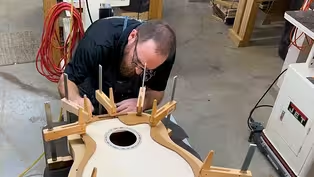
♪♪ So right now, I'm just taking the meat off the braces.
This is trying to maximize how much the top vibrates, which pushes more air, which makes it have more sustain or more treble or bass depending on where you're carving the braces.
The idea is you want to hear -- you want to hear as much resonance as possible.
Mike Marcovis: I got my first guitar in fifth grade, took lessons for a year at Ye Olde Guitar Shoppe on an acoustic and then quit because I didn't get an electric.
Once I got the electric guitar though it really kicked in.
That's what sparked the interest again I guess you could say.
And the guitar building came from I had kind of done everything in the art field in high school -- did ceramics, did jewelry, photography and there was a local builder named Dave Plummer here in town that I heard about through a guitar shop or something and I went and visited him and he's the one that told me about the school I went to in Phoenix called the Roberto-Venn School of Luthiery.
Once I found out about that it was a quick decision what I was doing after high school.
And that was fall of 2001, so I've really been building ever since then.
♪♪ Mike Marcovis: So, a luthier is a person that builds stringed instruments.
So, it could be violins, could be cellos, could be guitars, harps, really anything.
Nowadays a lot of the guitar building, the big companies you're working at a factory, so you maybe specialize in one task versus the entire process.
Like acoustic guitars?
Yeah, I build acoustic guitars, I build electric guitars, I work on all that stuff.
Mike Marcovis: What I think is cool about at least my job is the guys that can't get what they want somewhere can come to me and say, this type of wood, this type of size, you basically can pick whatever you want because it's all, it's one person taking raw materials and creating an instrument out of it versus somebody doing this step, somebody doing this step, a robot doing this step.
It's old school but I definitely think that there's value in that.
♪♪ Eli Clark: It's dangerous.
♪♪ Eli Clark: There's a certain caliber of guitars that once you put it in your lap and you're like oh, okay.
♪♪ Eli Clark: My way of explaining it is, the higher up in the price you go, the playing field kind of levels and it's all really, really good and it's kind of a do you want the keys to the Corvette or do you want the keys to the Camry?
♪♪ Mike Marcovis: I have made 38 guitars.
I've built basses, I've built ukuleles, I've built guitars, you know, someone might order something really wild and we'll have 17 horns on it and a bunch of lights and you never know, but it would be a fun project.
It's the same thing I say to everybody about this is nobody needs a $5,000 guitar, there's no need for that, it's a want.
You can by a bullet Strat from Squier for less than $300 that can play fine, but it's not the same as a custom-made instrument.
And it's kind of cool to look back and think about being that kid like, man I'll never own one of these, or how could you ever afford something like this, and then sometimes it just works out.
♪♪ Jordan Jensen: I actually own two Marcovis instruments.
I have this bass.
I also have the guitar that's right here.
♪♪ Jordan Jensen: I really like the body style that he puts into it.
It's familiar and traditional, but it is unique.
And then just the quality of the woods that he uses for the built, just the flame at the top, the back of the neck, the body.
One little thing, I really love the handwritten serial number on the back of the headstock.
I'm not sure why.
He's got a great eye for everything that is going to look together in terms of how the hardware is going to go with the finish and the woods themselves and how it's going to pop.
♪♪ Mike Marcovis: You just meet a whole lot of different people and it's anything from teenage girls to 80-year-old men that play guitar and need something fixed or want it tweaked to their liking.
It's not just one type of person that does this, you get to meet all sorts of people.
♪♪ Mike Marcovis: If you really can find something that you're passionate about and that you enjoy on a personal level, not just a work level, it doesn't feel like work.
I feel lucky that I have found that and that it has worked.
There was no guarantee.
It's not been easy, but it's definitely fulfilling.
♪♪ ♪♪ ♪♪ Gene Garrett: Horses are different.
They're just, I don't think sometimes people would think that a person could connect with a horse.
Maybe they've never been around horses.
♪♪ Mike McGehee: Seek out the horses.
They'll take care of you.
They're beautiful creatures and they just understand and they'll nudge up to you and just give you a little love nudge and that's a wonderful thing.
But horses, they help people.
Eric Moorman: The horses don't judge you, they don't have any predispositions about anything about you, they're just happy to see you, they just have that connection.
♪♪ Eric Moorman: 2016 the VA contacted the Polk County Conservation Board because they own Jester Park Equestrian Center, to see if they could develop a PTSD, a horse program for therapy to help their patients.
So, since 2016 they've had 300 veterans go through the horse programs out here.
I'm a retired Des Moines Police Officer.
I've been a horse trainer for 40 years, Marine Corp veteran six years, combat, Gulf War.
I have PTSD myself.
So, I'm also working towards getting a first responder program up here that's going to mirror the veterans' program for law enforcement, fire and paramedics.
The Wednesday night co-ed class and the driving classes are open to any veteran, no VA attachment, and they're free to any veteran that wants to come out here.
The Monday morning classes are VA only with the VA therapists.
Most of the veterans that come out here have little to no horse experience.
And so, they're always a little nervous at first and then they kind of hook up to one horse and that's pretty much the horse they're going to be with for the next eight weeks.
So, that's how they form a bond.
You ready for it?
Mike McGehee: Being a Marine combat veteran, I was in the first Gulf War.
My unit punched into Kuwait two days before the ground war started.
We're already fighting two days before the world even knew what was going on.
And we saw a lot, we did a lot and there was some deaths.
I've had a couple of buddies already take their lives.
Five years ago, I suffered a hemorrhagic stroke.
I had a near-death experience.
I crossed over and I came back.
And I was moved into my girlfriend's small ranch and she had horses and I just loved being around them.
It's self-reflection where you might not understand yourself and the horses might understand you better than yourself.
It's a heart-to-heart, it's getting to understand the animal and the body language and just feeling better about yourself.
Let's go to the box over here.
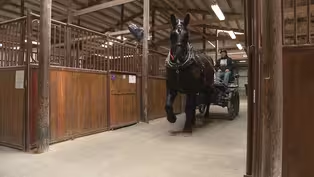
Eric Moorman: Curtis, our driving instructor, he has to be on the cart with them.
It's just like a learner's permit, you're learning how to drive a draft horse, a 2,200-pound animal.
They're very well-trained, but you still want to make sure that you're safe.
Curtis Kentner: After I went through school, I started with the Budweiser Clydesdales and I traveled with them for six years.
And then after that I came here to Iowa here at Jester Park.
The comfort level is something that we really try to help them gain is some confidence around the bigger horses.
If we need to go down a size to one of our ponies we can, but I usually like picking out one horse that is really suitable for that veteran so that way they get to really form a bond with that horse and work off each other's skills.
♪♪ Curtis Kentner: I think the horses play a critical role with the veterans by they can connect on a deeper level than just a human.
So, I can usually tell if the veteran is having a good day or a bad day based on how the horse is reacting.
♪♪ Gene Garrett: I don't know what it is with me but I like it.
And that horse, one day I was talking to my therapist, she was up here, and I knew that I had upset him just because he could tell in the tone of my voice of something I was talking about, and I just went up there and I put my arm up around his neck and I was there petting him, and of course he's such a big fella, he just kind of wrapped his whole head and neck around me like he was giving me a hug.
And it was just, you could feel it.
♪♪ Gene Garrett: I messed up my back really bad, I crushed two vertebrae and I struggle with pain a lot.
It kind of takes your mind instead of being somewhere where you're kind of low and in pain and it's frustrating and this gives me a chance to do something else and to focus on something else and to find out that not everything is bad.
♪♪ Eric Moorman: The whole thing is, is to get stronger, to have a better outlook on life.
You might learn something about yourself.
So, it makes them think of something they might not have thought before.
Gene Garrett: Don't be afraid to try something new.
You might like it.
♪♪ ♪♪ Most days, Chuck Behm can be found in his workshop restoring old pianos.
Check Behm: So, on a typical day I'm doing my refinishing in the morning.
I'm 74 but I'm not ready to be full retirement mode.
I have no intention just to sit around and watch soap operas.
Apply the finish.
Check.
Chuck Behm: I like working with my hands.
I like working on mechanical things.
So, it really suits me.
In 1972, I got my first teaching job in Festus, Missouri working at the St. Pius X High School for $6,000 a year.
So, I knew I needed a part-time job and my dad had just gone into tuning the year before.
He was a band director in Mason City.
And he encouraged me to look into piano tuning and I bought my first set of tools in '72 and I started tuning in Missouri.
I did one or two a month and then it just built up from there.
So, with this piano it's 52,928.
52,000, 1902, so it's been around.
Chuck Behm: You take a piano that hasn't been really worked on since it left the factory in 1900 or 1910 and you're tearing it completely apart and when you get done it's more or less like it rolled off the factory floor and it's just a real satisfying feeling.
If you're restoring a piano top to bottom, you're refinishing the case, you're putting in new what are called pins and strings and hammers and keys and replacing all sorts of things.
So, it's a little something different every day.
But none of it is high stress and I don't keep track of my time intensely because when I come out here it's just a job that I enjoy doing.
In 2015, Chuck decided to take on a new project, building an outdoor piano that the community could enjoy.
♪♪ Chuck Behm: I had been reading about pianos that were put outside and after a week or so something would happen, primarily they get rained on, and they'd be ruined.
I was in the Piano Technician Guild and I approached my guild chapter with the idea of taking a piano and modifying it.
And we spent three Saturdays doing everything we could and we made a piano that was outside here in Boone, it was actually moved from location to location for three summers by the city.
The city was very good about it.
And people really loved it.
And then finally it got to the point where it just couldn't be used anymore.
So, I built a second outdoor piano and I did this one on my own and it's quite a bit more elaborate.
♪♪ Chuck Behm: So, this is a piano that I built to withstand the rains that we get here in the summer.
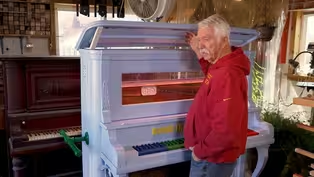
And it's unique in that it's not just a single piano, but it's a piano inside of a piano.
It's a small console piano or Wurlitzer that's inside the case of a 1903 upright.
♪♪ This time around, Chuck decided he wanted the piano to be truly weatherproof, which meant the keys couldn't be made out of wood.
Through trial and error, Chuck experimented making keys out of liquid plastic and aluminum before settling on using a 3D printer.
Chuck Behm: And so, this is what we ended up with right here.
They come apart in three parts.
So, I'm going to prop this lid up.
And the lid, by the way, is made out of PVC lumber to prevent it having a veneer surface that is going to peel away when it gets wet.
What makes this work is that when it gets rained on, instead of accumulating underneath the keys as it would if it was an ordinary piano, the water is going to pour right off.
(water pouring) Don't try that at home.
♪♪ ♪♪ Chuck Behm: Boone doesn't have a whole lot of tourist attractions.
We have the train, of course.
We have the racetracks.
But I think this is something that people can say well, we have a really cool outdoor piano.
It just gives the community something that sets it apart a little bit.
♪♪ We're in downtown Boone in front of the book shop here and she has graciously consented to having the piano out front for a time.
And this is right on Story Street, the main street through town, so a lot of foot traffic along here.
♪♪ Susan Schafer: It brings smiles.
When we had it the first time around you could just see people smile when they hear the music or when they actually got to play the piano.
I think it's a great thing for Boone.
It's a nice, positive piece for downtown Boone.
♪♪ ♪♪ ♪♪ (applause) ♪♪ ♪♪ ♪♪ ♪♪ Funding for Iowa Life is provided by the Gilchrist Foundation, founded by Jocelyn Gilchrist, furthering the philanthropic interests of the Gilchrist family in wildlife and conservation, the arts and public broadcasting and disaster relief.
Mark and Kay De Cook Charitable Foundation, proud to support programs that highlight the stories about the people and places of Iowa.
The Strickler Family, in loving memory of Lois Strickler, to support programs that highlight the importance of Iowa's natural resources on Iowa PBS.
And by -- the Lainie Grimm Fund for Inclusive Programming at the Iowa PBS Foundation.
Video has Closed Captions
Clip: S1 Ep113 | 5m 34s | Equine-assisted therapy can help veterans and service members find a path toward healing. (5m 34s)
Video has Closed Captions
Clip: S1 Ep113 | 6m 28s | Over 150 students show off their culinary, management and cake decorating skills. (6m 28s)
Video has Closed Captions
Clip: S1 Ep113 | 5m 56s | Mike Marcovis creates world class electric and acoustic guitars in his Urbandale home. (5m 56s)
Video has Closed Captions
Clip: S1 Ep113 | 5m 34s | Chuck Behm is a retired English teacher who restores pianos out of his home in Boone. (5m 34s)
Providing Support for PBS.org
Learn Moreabout PBS online sponsorship













Support for PBS provided by:
Iowa Life is a local public television program presented by Iowa PBS