
Episode 113: New Hospitalizations, Redistricting, and More
4/9/2021 | 26m 46sVideo has Closed Captions
A rise in new Covid-19 hospitalizations, redistricting maps, and more.
Host Hannah Meisil (NPR Illinois) and guests Charlie Wheeler (Prof. Emeritus, UIS) and Raymon Troncoso (Capitol News IL) discuss the rise in new Covid-19 hospitalizations, vaccinations, and redistricting maps.
Problems playing video? | Closed Captioning Feedback
Problems playing video? | Closed Captioning Feedback
CapitolView is a local public television program presented by WSIU
CapitolView is a production of WSIU Public Broadcasting.
Episode 113: New Hospitalizations, Redistricting, and More
4/9/2021 | 26m 46sVideo has Closed Captions
Host Hannah Meisil (NPR Illinois) and guests Charlie Wheeler (Prof. Emeritus, UIS) and Raymon Troncoso (Capitol News IL) discuss the rise in new Covid-19 hospitalizations, vaccinations, and redistricting maps.
Problems playing video? | Closed Captioning Feedback
How to Watch CapitolView
CapitolView is available to stream on pbs.org and the free PBS App, available on iPhone, Apple TV, Android TV, Android smartphones, Amazon Fire TV, Amazon Fire Tablet, Roku, Samsung Smart TV, and Vizio.
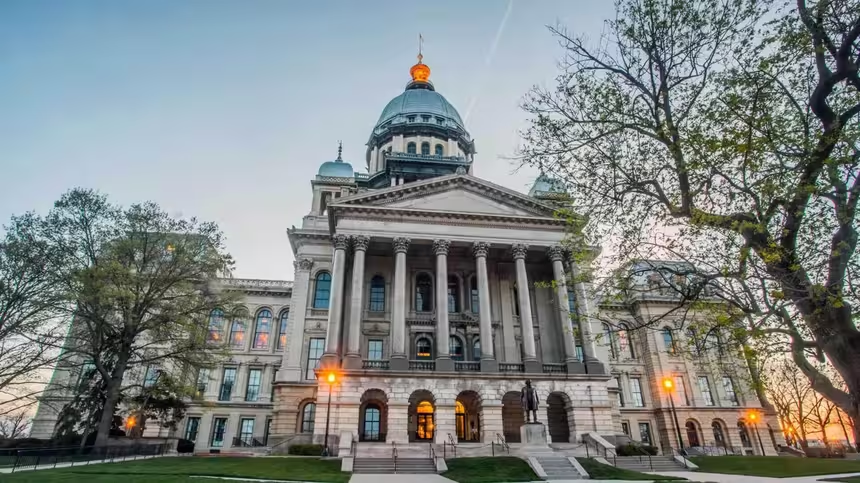
CapitolView
CapitolView is a weekly discussion of politics and government inside the Capitol, and around the state, with the Statehouse press corps. CapitolView is a production of WSIU Public Broadcasting.Providing Support for PBS.org
Learn Moreabout PBS online sponsorship(upbeat music) - Welcome to Capitol View, where we discuss the latest in state government and politics.
I'm Hannah Meisel with NPR, Illinois.
Joining us this week is Charlie Wheeler, Director of Meredith of the Public Affairs Reporting Program at the University of Illinois Springfield.
Thanks for being here, Charlie.
- Always good to be here.
- And also here is Raymon Troncoso, a reporter for Capitol News, Illinois.
Glad you're here, Raymon.
- Thanks for having me.
- Get down to it.
Well, we had a brief window of, you know, everything was going great with our COVID metrics.
They were heading in the right direction which is downward and vaccinations were heading in the right direction, which is upward.
But, you know, lately we have not been doing so well.
Hospitalizations in particular, new hospitalizations and people hospitalized with COVID in the longterm have been climbing upward.
And that's what prevented Illinois last week from entering the so-called bridge phase that the governor had really just announced, you know a couple of weeks prior and, you know by halting the expansion of capacity limits, you know they're hoping that that will buy us more time to vaccinate more people.
And you know, win the war over the virus that way but you know, Raymon, what does it say that, we're two steps forward and one step back?
What does that mean for, you know I guess Illinois going forward this spring and summer and you know, our long-term plans with trying to reopen our economy?
- It definitely puts a delay in those plans to reopen as you said, it keeps us from going to the bridge phase because it requires that metrics for two quarantine cycles meaning 28 days, be trending downward.
while that's not happening in terms of infections and hospitalizations, in terms of deaths, we've seen that despite the increases in hospitalizations deaths are still low.
And that has to almost do entirely with the fact that our vaccination program has been going pretty smoothly.
We have over 70% of people 65 and over, having received at least one dose.
And that can be pointing to as a big reason while hospitalizations are the highest they've been since mid February, that's, they're still less than half of what they were during that same time period.
- Sure, and we're approaching 20%.
And by the time this program airs I'm sure we'll have already gotten there.
20% of the entire population of Illinois, being fully vaccinated.
And on Monday, every single vaccination site outside of the city of Chicago will be serving folks 16 and over, which is you know, great, but also, you know, there are issues in terms of, you know, vaccination in Chicago.
It's just, it's a very clear disparity when you know, Downstate you can get a vaccine appointment, no problem.
And it's still, you know, this hunger games that we were seeing back in February, up in Chicago.
So Charlie, what does that say to you about the management and the decision to make Chicago a separate vaccine distribution program than the rest of Illinois?
- Well, I think that was a decision that was made by the federal government way back when the vaccination program was first launched.
Chicago gets its own number of vaccines apart from the state of Illinois.
And I think what has happened, is that as you said, the majority of people my age or younger, 10 years younger than me, have already had at least one shot.
I'm fortunate, I've had both of them.
But what that meant was the focus on the older folks meant that younger people weren't eligible.
And so we see this spike in cases and we see the number of positive cases, the number of hospitalization rising, but we don't see the fatalities, because what we're seeing now is people who weren't eligible to be vaccinated, younger people, particularly people in their late teens, twenties are leading the charge in most areas in Chicago in Cook County, parts of Downstate.
They have not been able to be vaccinated.
So there's still contracting the illness but it doesn't affect them by large as seriously as it might someone my age.
And so it's the younger cohorts who're getting it, but their ultimate risk is not as great.
And now it's complicated by the fact that we have these variants, these mutations of the virus some of which are a lot more contagious than the initial one.
And so it's kind of a race between the virus and the vaccines.
Now the vaccinations are going to continue to grow up.
Everybody 16 or older is going to be eligible come Monday.
And a week from Monday, everybody in Chicago will be eligible.
And so there's going to be a big drive to get as many people vaccinated as possible.
And when that happens, I think we'll be able to finally, if you will turn the corner on this stuff and see all the rates go down.
The infections, hospitalizations and of course the fatalities.
But in the meantime, it was in fact the doctors are saying even after most people were vaccinated, you still have to wear a mask.
You still have to observe social distance.
You still have to wash your hands, because the fact that I'm vaccinated means that I'm pretty, well-protected.
There's only maybe one chance in 20 that I'll catch it if I'm exposed.
What's unclear though, is whether if I'm exposed to it, I can be a carrier unknowingly and spread it to someone else.
Which is why I intend to keep wearing a mask for the foreseeable future.
- Sure and the governor had said that even when we do re reach this phase five, which is you know, basically normalcy, we won't have capacity limits on anything anywhere, and it will be, you know, kind of back up to businesses.
Whether they wanna, you know keep enforcing capacity limits or if businesses are stuck, stay fully remote, if you, you know, if they like the work from home arrangement.
But the governor says that even when we do reach that phase, his mask mandate will still be in effect.
And he has punted kind of to the CDC to tell us when it will be safe to take off those masks.
But no, I've rather enjoyed not having a cold or flu in a year.
You know, Raymon, I guess because Illinois has kind of this surplus, at least for now until all counties open up, vaccination to everyone 16 over, the governor could potentially give some of our vaccines to Chicago, but that's, you know kind of politically perilous.
There's always been this narrative of, you know Chicago versus everyone else.
And, you know, do you see that happening?
That the governor would, you know give any extra vaccinations to Chicago?
- I'm not sure because I'm not sure if it's really a problem of supplying more than it's a problem of the capacity to actually give those vaccines out, to stick them into people.
So that seems more like a personnel infrastructure issue, than a pure supply issue.
It's not like they're running out of vaccines.
In fact, you can go on the COVID tracking website and see how many vaccines have actually expired throughout the state.
So I don't really think it's going to be an issue of you know, Chicago needs more vaccines rather it needs more vaccine capacity.
One bright spot here is that we're actually kind of doing better than the metrics suggest.
Because you know, that 20% mark that you talked about, that's for all people in Illinois.
But the only people that we're trying to vaccinate are 16 and over.
And when you consider that, that population that's 16 and over, is closer to around 10 million, so with 2.5 million vaccinations having gone out at least one shot, we're closer to 25% of everyone being vaccinated.
So we're pretty close to getting to that metric where things can almost presume normalcy.
We'll probably see that within a few months, you know if the vaccinations hold against new variants.
- I think there's another thing to remember is that, although Chicago has distributed its own vaccines, that doesn't mean that if I live in Chicago, I can't go somewhere else to get one.
As a matter of fact, there were reports of people going to Gary, Indiana, people on the Southeast side of Chicago.
'Cause Indiana has a clinic there it's open to anybody.
Or people can go into some of the neighboring communities.
I know people from Chicago come down here to Springfield, to the State Fairgrounds, where there's a vaccination center and they don't care where you from they'll take anybody.
So the opportunities are there.
The difficulty is, for particularly disadvantaged neighborhoods in Chicago and the city has done a good job of targeting those areas, they don't have the ability to travel.
They don't have the mobility that people would say in a more affluent area.
And it's interesting 'cause in Chicago, the numbers of the spikes after Lightfoot, Mayor Lightfoot, and the health people concentrated on getting vaccines into what you would say the poor neighborhoods on the South and West side.
The spikes have occurred in some of the more affluent areas, for example, Lincoln Park or the up NorthWest side of the city, that tend to be better off economically and less diverse than the folks that were targeted on the West side and the South side.
So we're moving forward and I'm hopeful that the day will come when, just about everybody who wants one will I be able to have one.
And also I believe isn't it Pfizer who's asked the FDA to approve its vaccine for children as young as 12?
- That's correct.
- And when that comes, as Raymon said we have this huge cohort of kids that was not vaccinated and kids can spread out just as well as adults can.
- So, yeah, I mean, within the city of Chicago, I've seen in the last week or so, this program where CTA buses are you know, filled with vaccines and going and targeted to those neighborhoods.
But I was looking at, statewide COVID stats this week and really it's counties in North-Central Illinois that have the absolute highest positivity rates right now.
Peoria County, Tazewell County, and Stark County, all around the Peoria area.
They're hitting 10% and above in their positivity rates.
So hopefully those are trends that can be reversed in the next coming weeks, month or so, brighter days ahead.
But you know, we still have to forge on.
- Yeah, I'm pretty sure.
I think the governor this week also said he was sending out rural vaccination teams into some of those counties, including Tazewell, Fulton, Woodford counties that are right around Peoria.
- That's right, yes.
I'd like to move on to redistricting.
It's another huge, huge thing.
That's going to dominate a lot of conversation, a lot of Illinois political conversation this year, We are what?
Three or four weeks into these hearings.
Most of them are being done on zoom but there are a few that have gone into different communities throughout the state, talking about where the lines should be, which communities feel as if they've not been represented and need a bigger voice in terms of these legislative maps.
And I just, I think it's so interesting that the good government kind of activists groups like Common Cause, and you know groups like that are kind of siding with Republicans here who say, "Well, we we already spent so much money pushing this message that you should fill out the census, you know hiring folks to go out into communities."
And, you know trying to bridge a trust gap there to say, the census matters but then Democrats want to go ahead and use this American Community survey data, which is a couple years old.
They'll say it's fairly accurate, to go ahead with map-making.
So Raymon catch us up.
What is going on?
And, you know do you think Democrats are ready to budge?
- Well, I'm not sure that right to budge.
'Cause that does mean giving up kind of the legislative advantage, right?
Democrats are in control of both houses of government.
And they're also in charge of governorship.
When you have that much leverage, it doesn't make really make a lot of sense politically to give that up in a way that might disadvantage you when it comes time to, you know create these districts and possibly split up, you know the legislature and an even more advantageous way, come the next election cycle.
- Raymon it occurs to me and this is maybe a cynical viewpoint, the reason the Republicans are so gung ho on inclusivity and transparency, and let's wait for the real numbers, although there's some question about how good the numbers are going to be after the Trump administration, tried to fudge them, in my mind it's because the Republicans realize that if they can stall this long enough that it goes to the commission, under the constitution and there's a deadlock and there's a ninth member drawn who is likely to be either a Republican or a Democrat, that gives them a 50/50 chance of gerrymandering the districts in their favor.
So again, this is cynical, but based on history and based on what's occurred in the past, I don't look at the Republicans as being kind of, you know, the Knights on white horses trying to make sure this is an open and transparent process.
And I think the reality is, the districts that the Democrats will draw, are going to focused I believe on preserving districts, with people of color.
Particularly Latinos whose numbers, according to the unofficial survey, as Hannah said from a couple of years ago, whose numbers have risen dramatically.
There'll be an effort I'm sure to try and create at least one, if not more districts which have a majority, or at least a solid voting block of Asian Americans.
And that's going to be the main driver for the Democrats.
Now, the fact that Latinos, people of color, tend to favor Democrats, that's just a fact of life that it reflects what the Republican party has become, particularly on the national level.
So I would say I'm not going to be all that worried if Democrats draw a map that it's going to be disadvantageous for minorities, that's going to be disadvantageous for whatever.
And it probably it'll cost seats in rural Illinois, and downstate Illinois, 'cause that's where the population loss is.
- Sure and you know, Illinois stands to lose one, if not two congressional seats.
And, you know, from the prognostication I've seen so far from actually national experts, Rodney Davis who has represented, kind of the Central District of Illinois for almost a decade now, might stand to be kind of redistricted out of that seat and have his district kind of drawn away from him.
- What's likely to happen is Rodney is going to wind up in a district with a couple other incumbent Republican Congressmen.
And it'll be a, what would you say?
A fight to the death in the Republican Primary.
- Which will also be interesting because it'll be, you know a broad view of the Republican fight at large, on the national stage and we'll see it here at home.
But, you know, we should also remind viewers that in the Illinois constitution, we don't have a mandate to use census data, but we do have this kind of, some would say artificial deadline.
Democrats this year are taking it very seriously.
Having the legislature approved maps by June 30th.
And if that doesn't happen, it gets kicked to this bipartisan commission.
And if that commission can't agree on maps, then a name is basically taken out of a replica stovepipe hat, because land of Lincoln and, you know, that gives one or the other party kind of an advantage of chance.
And that's since the constitution has been, in place in 1970, that has happened four out of the last five decades.
And in 1990 was the only time that Republicans won that advantage of chance.
They redistricted to their favor.
And, you know, it worked for a couple of years, but Democrats did eventually, especially in the house gain back that partisan advantage.
- Well, that particular redistricting in 1991, worked for a decade for the Republicans in the Senate.
They controlled the Senate for 10 years.
But Michael Madigan the then House Speaker, managed to thwart the Republican map four out of five elections.
So the Republicans held the majority in the Illinois house, only one, two year period, 95 to 97.
- And Raymon we are talking a lot about process, but you know, it's like Charlie was mentioning earlier, we really have had, you know a lot of growth in the state's Latino population.
And compared to say, the black caucus, the Latino caucus is, you know, smaller proportionate to the actual Latino population in Illinois.
And there are other groups, Asian Americans you know, writ large, not just in Illinois but they are a group that has been kind of ignored politically for decades.
And they also want a seat at the table and that, South Asians, people of Indian descent, there are just a lot of groups that they want a seat at the table finally.
And so what are you hearing at these commissions or are you not hearing much because not a lot of people are, you know, getting to show up in the middle of the day on a random zoom call.
- Yeah I'm not really hearing much in terms of these commissions regarding that.
One thing you have to realize is that proportionally, a lot of those population groups get placed into areas in the big city in Chicago, where there is still a larger black population.
So it makes it really hard to kind of chop up those districts to provide good minority representation for Asian Americans, for Hispanics, without trying to draw some pretty interesting districts to get those areas.
We have a couple like that, but even the Latino caucus for the state legislature, for the general assembly, you don't actually have to be a Latino.
You just need to have a lot of Latinos in your district to qualify for that caucus.
Not so obviously for the black caucus, because you know you don't need such strict definitions when there's so many people part of that constituency that you represent.
- I want to move on with just five minutes remaining.
The governor has been a lot of places in the state in the last couple of weeks, while legislators take their traditional two week spring break.
Although like we mentioned, there's been a lot of zoom calls.
But he is touting this $7 billion grant, this federal, from the Federal American Rescue Plan, the Stimulus Bill that will go directly to Illinois schools.
And along with that this P-20 council, has put out these recommendations of how to spend that money for schools to, you know, not just like get back to normal, but also to address this learning loss.
So Raymon, where are schools being encouraged to spend that money?
And, you know, do you think that consumer concerns about learning loss are overblown?
- I wouldn't say they're overblown.
We know from studies that especially in Chicago and in disadvantaged communities that don't really have great broadband infrastructure, that there's a lot of students that just didn't show up to their online classes, whether that be because, you know they literally did not have access, or access they did have was too limited to really engage with the content of their classrooms.
This happens not just in Chicago but also downstate in Southern Illinois where if you didn't have in-person classes, and you had to go online the broadband infrastructure downstate is not that good.
That's why the governor is trying to spend, you know $20 million to improve that or $200 million to improve that.
So it is a very big issue and it's not just, you know catching students up who lost an entire year of learning.
It's, you know, shoring up the infrastructure that was lacking in the first place.
- Sure and you know, broadband has been a huge issue for a long time.
And, you know Governor Pritzker is trying to, administration is trying to address this, Governor Rauner's administration before him has, you know, tried to address it.
Lots of people have made advances or at least made it a campaign issue, but it is difficult.
And you know, that kind of segues to this other big broad infrastructure package that President Joe Biden's administration is pushing.
Charlie it's a $2 trillion idea.
Of course it's still early stages but what kinds of things, this is would be on top of the, you know, $45 billion infrastructure plan the state passed two years ago.
So what kinds of things do you think Illinois could stand to benefit from this package?
- Obviously the first thing would be roads and bridges.
We have, I forget how many thousands of miles of substandard highways on the state system, and local systems.
We have any number of deficient bridges.
Not that they're going to fall down, but that they're not properly designed.
They have to be, there have to be weight limits put on some of them.
So that'll be an obvious area.
Plus improving rail facilities, improving mass transit in the Chicago area.
I know in the Chicago area, there's talk of extending the Red Line, the Main North-South line of the CTA, all the way down to almost the city limits on the South side of the city, you know also be muddy in there I'm sure for water and sewer projects.
The state released I don't know how many millions of dollars of projects just a week or so ago, going to communities around the state to upgrade sewage treatment plants, upgrade water facilities, those kinds of things.
And they're not really, what would you say?
Real splashy stuff.
I guess water projects would be, until you're driving along you hit a huge pothole on some state highway and you blow a tire, as has happened to me a couple of years ago.
Then you realize we really got to take care of this.
So I think that Illinois will get a good share of it.
The question is, and I guess the big hangup with the federal program is, that the president wants to pay for it by rolling back some of the tax cuts for business that were given out during the Trump administration.
Republicans probably aren't going to go along with that.
So it looks like it's likely to be a Democrat only program.
- Yeah, that's right.
You know, Republicans are pushing back hard against this idea of, you know raising corporate taxes again, you know, in the middle of pandemic, but we will see what happens there.
I also do want to mention thought it was very interesting Tammy Duckworth, our US Senator, you know mentioned using the money as huge upgrades to our mass, network of lead water pipes.
Illinois has the most share of lead water pipes in the entire United States, which I learned recently The Tribune did a big investigation.
I'd encourage everyone to check it out but we are almost out of time.
I'd like to thank my guests, Charlie Wheeler, Raymon Troncoso.
Thank you so much for joining me this week, and we'll see you next time on Capitol View.
(upbeat music)

- News and Public Affairs

Top journalists deliver compelling original analysis of the hour's headlines.

- News and Public Affairs

FRONTLINE is investigative journalism that questions, explains and changes our world.












Support for PBS provided by:
CapitolView is a local public television program presented by WSIU
CapitolView is a production of WSIU Public Broadcasting.