
Episode 116: Bipartisanship and Redistricting
4/30/2021 | 26m 46sVideo has Closed Captions
Bruce Rushton & guests Dave Dahl & Amanda Vinicky discuss bipartisanship and redistricting
Host Bruce Rushton (IL Times) and guests Dave Dahl (WTAX) and Amanda Vinicky (WTTW) discuss bipartisanship and redistricting.
Problems playing video? | Closed Captioning Feedback
Problems playing video? | Closed Captioning Feedback
CapitolView is a local public television program presented by WSIU
CapitolView is a production of WSIU Public Broadcasting.
Episode 116: Bipartisanship and Redistricting
4/30/2021 | 26m 46sVideo has Closed Captions
Host Bruce Rushton (IL Times) and guests Dave Dahl (WTAX) and Amanda Vinicky (WTTW) discuss bipartisanship and redistricting.
Problems playing video? | Closed Captioning Feedback
How to Watch CapitolView
CapitolView is available to stream on pbs.org and the free PBS App, available on iPhone, Apple TV, Android TV, Android smartphones, Amazon Fire TV, Amazon Fire Tablet, Roku, Samsung Smart TV, and Vizio.
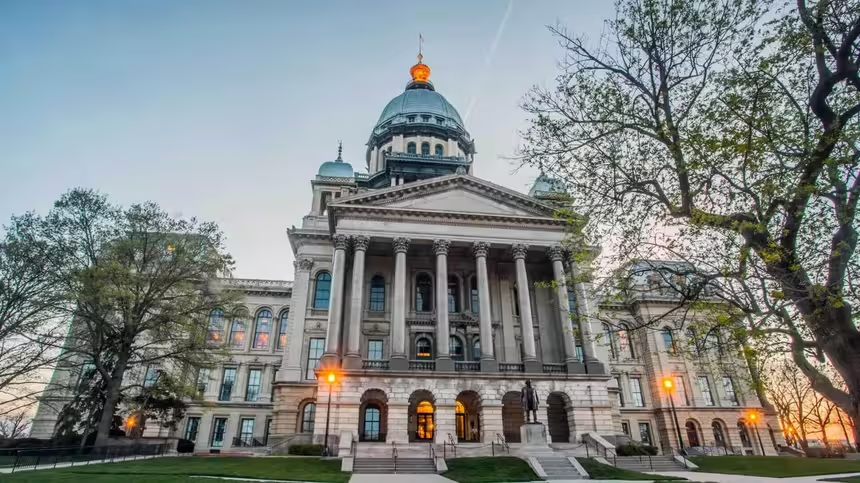
CapitolView
CapitolView is a weekly discussion of politics and government inside the Capitol, and around the state, with the Statehouse press corps. CapitolView is a production of WSIU Public Broadcasting.Providing Support for PBS.org
Learn Moreabout PBS online sponsorship(dramatic music) - Welcome to Capitol View, the weekly program where we talk about state government and politics, and how it might just affect you.
Joining me this week on Capitol View is Amanda Vinicky, of WTTW Television in Chicago.
Welcome Amanda.
- Thanks so much.
- Also through the miracle of Zoom is Dave Dahl, a state law and state house reporter for WTX Radio in central Illinois.
Welcome, Dave.
- Bruce, that hair salon of yours is gonna be open any day now, I assure you.
(laughing) - Well, I'll take a recommendation from you as to where I should go.
Let's talk, let's jump in the deep end of the pool, as we always do, or try to, and talk about the issue, do yours, which now is I think two things kind of intertwined.
Bipartisanship and redistricting.
Redistricting is coming to the fore as a result of census numbers coming out showing that Illinois has lost population.
Not as much as was feared or was predicted.
We're only going to lose, only, one Congress person.
How much of a surprise is this, and can we trust these census numbers?
I mean, this is a unique census that was done in mid pandemic.
Are there, I mean, is there anything out there in terms of, 'cause I kind of scratched my head.
Is it the same count as we've had in past years?
Can we trust the numbers?
Let's start with that.
Is that on anybody's radar at this point in time, that this is kind of screwy this time around?
- I think an interesting, I'm sorry.
- No, You go ahead, Dave.
- I think it's an interesting question, Bruce, and of course we've go the, you know, the state level numbers and the congressional apportionment numbers, but we don't have the local numbers, the granular numbers, the street by street numbers.
So a lot of it is yet to come.
To answer your question, I don't think we lost as many people as we thought, and I think losing one seat is just about what we thought.
To me, the real question is who is, whose seat is going to be gone?
What Congress person is going to say, you know what?
I think it's time for me to hang it up anyway, and go out into their own power.
So there's a lot yet to be seen.
- I think there's,-- - [Bruce] Go ahead, I'm sorry.
- There's the political question of what losing one seat in Congress, because there had been some thought Illinois might lose two, but that was always kind of an outlier.
So it's good for Illinois in terms of, you know, just sort of political power representation that that did not come to fruition.
But I think, so there's there's that political fight of, you know, gerrymandering, redistricting, power plays, which of the five Republican Congresspeople are going to have a district really drawn, so that they don't have any sort of real chance of heading back to Washington.
There's that, but then there is also, I think there are questions, Bruce, very much about trusting the census numbers.
And that is particularly because places, including Chicago, but there are certainly pockets throughout the rest of Illinois that have large populations of undocumented immigrants, or immigrants in general who might not have felt comfortable sharing that information with the government due to some policies by the Trump administration.
Of course, this was a census during the pandemic.
Then it was a truncated enumeration process.
So there are a lot of questions, and of course every state battled with the pandemic, but certain States were, in terms of if you want to count up as much as possible, more disadvantaged by that lack of trust due to who makes up the population.
Although frankly Illinois did pretty darn well in terms of getting out, the census version of getting out the vote.
Turnout was decently high.
So I think there's that.
And then I will just finally add, that kind of connects these two, is the question because of the delays this is now the political fight.
Republicans are saying, hey, wait a second.
What data are you going to use to draw this map and get it done by the end of session, by May 31st, by June 30th when there's a constitutional deadline that would sort of switch up who gets to draw the map, that would take away power from the Democrats who have it now, all of that ability.
And so that's another fight, because due to all of the things we've just talked about, the census numbers aren't going to become until after those deadlines.
Two States, including the (inaudible).
- Yeah-- - I would point out too that Illinois is now number six.
Pennsylvania has passed us, so we're the sixth most populous state now.
- Well, and what does that mean in terms of, of course, while the state didn't perhaps lose as many populations as they think Governor Pritzker in question, in response to questions, including from you, Dave, the other day, called them, you know, carnival barkers who have been saying, oh, woe is me.
Everybody's leaving the state.
Still, Illinois was one of only three States to go down in population.
So that is still bad for Illinois when you of course want to have both representation in Congress, but also as many taxpayers as possible, jobs, businesses, property, taxpayers, the works.
(inaudible chatting) - I mean, for the carnival barker aspect, let's be clear here.
The folks who were the naysayers, who says that, who said we're going to lose two seats, there's an Exodus that we haven't seen since biblical times from the state of Illinois, these were based on census number projections.
They didn't pull these out of the blue.
They pulled them from the US census Bureau that was dramatically wrong in terms of its, apparently in terms of its estimates and projections as to what the current census would show.
So let's make that clear.
I mean, it could have, maybe perhaps there's, it happens in Monopoly, maybe there's been a bank error in our favor.
So who knows, but if you're a Republican, you're playing musical chairs here, I think, maybe in central Illinois.
Would you rather be a Tim Butler, or excuse me, we'll get to him in a second.
- Yeah!
(laughing) - Would be rather be Darin LaHood or Rodney Davis.
I'm sorry, go ahead.
- Well, Congressman Davis will tell you, as he has for years and years, he was elected to a seat drawn for a Democrat.
The seat the Democrats drew for Democrats.
It's a strange district, strangely shaped.
It's got a lot of college towns in it, got a lot of rural in it.
So, you know, he's benefited all the way around.
Now that said, when asked about running for Governor, he said, my first choice is you go back to Congress, and, you know, we'll look at the map.
I think if there's an unfavorable map someone might not run.
And, you know, I don't think you can cut out LaHood's problems either, 'cause he took the loan from that, you know, shady foreign national-- (inaudible overlapping chatting) - It was Ray LaHood who took the loan.
It wasn't Darin LaHood.
- No, Darin got a campaign contribution, I should say.
Not a loan.
I stand corrected, a campaign contribution.
So he's going to have to answer for that.
He's going to be asked about his dad.
I assure you, the next time he comes around here he will be, and fair or not, he probably might want to do some soul searching.
I mean, I'm just kind of pulling that one out of thin air, but between the map and that kind of a problem.
Kinzinger, what's his future?
So, you know, and then you've got, you know, the other two might be in a map situation.
The other two Republicans being Larry Miller and Mike Bost.
So there are a lot of factors here.
You know, people might want to go up or out, what have you.
- If you're the Democrat, do you want Davis running for Governor?
I mean, because he's threatened-- - I think the Democrats are going to be in good shape because the Republicans so far have failed to stand up anybody statewide, and give them money, and get votes for them.
And I'm not, as good as Rodney Davis is at campaigning and winning elections, I don't think he's proven statewide, and we'll have to see if statewide there are enough people who are sour on Pritzker that, you know, they're gonna go for a Republican.
So.
- I mean, I think either way Dave is right.
That Republicans truly have a challenge right now, because it's all about the money.
Guess who's got more of it than any of us could possibly ever dream of?
Jay Pritzker-- - Bruce Rauner.
- Also him, also him.
But I'm not sure he would fare all that well, at least in Illinois, even if evidently, Bruce, I'm sorry if I'm explaining your lead here, but there was an article in a Dartmouth alumni magazine in which he talked about not closing the door on running for office again.
Not sure that he would do so in the State of Illinois.
- Yeah, he does-- - But the Republicans in Illinois have failed to come up with candidates who are appealing statewide.
Candidates who can, you know, get the votes.
So if they do that, you know, there's time to make it a competitive race.
Good for them!
I'd like to see that just for a more interesting story.
- Well, I mean, you had Judy Baar Topinka on the daily, you know, the late Judy Baar Topinka.
She was a Democrat that got statewide office.
You had Mr. Brady, the former treasurer.
That didn't go so well-- - Rutherford.
- Thank you.
Again, I stand corrected.
Rutherford, my bad.
But yeah-- - And Bruce Rauner!
I mean, he did win statewide-- - He did win statewide office.
- That's content.
He won.
- You can pull an elephant out of the hat once in a while I guess.
- I just think the dynamics are a bit changed in Illinois.
Again, we talk about population, and so that's part of it.
It's also still a lot of a Donald Trump legacy that has perhaps turned some people very much off to the GOP, and then brought others very much to the party, except they were already there in the first place.
So the calculations just calculate is just a bit different.
And also, of course now J.B Pritzker has a record.
He didn't before.
He was virtually a blank slate.
- Now listen, the two of your brought up folks.
Rutherford, and Topinka, and Rauner.
By the time we get to election day in 2022, you're talking about eight years ago, 12 years ago.
That's an awful lot of time ago.
- And that's a fair point, you know.
Let's talk about bipartisanship for a second here.
As we're taping now, we're less than 24 hours past Joe Biden's, of our President's announcement of some pretty significant spending plans for domestic spending.
I'm not sure that it's a new deal, all our FDR, but it's a pretty major shift in terms of federal policy, and I'm wondering how that might affect stuff here in Illinois.
I.E, but for, I mean, if Biden's plan proves unpopular, what happens to the Republicans, you know, prospects here for such things as the governorship, another statewide office, and may be able even to pick up a few seats in the general assembly.
I mean, is this this link, because folks, you always, you know, there's a natural inclination to link the local and the state with the federal.
Any guesses on how that might play out?
- I think it's still a bit probably early to tell, given that, as you said, we just heard this really expansive plan given by the President.
We don't know how that is going to fare, particularly really in the US Senate, and therefore what consequences that could have in Illinois, and particularly tax implications.
That's something that, like, everybody's ears perks, right?
Because the policies themselves, like, sure, we want to put more money into bridges!
You would think in Illinois, something like, that there's been a debate on the President's infrastructure plan, where Republicans in Congress say, hey, no, we just want classic infrastructure.
Not things like, oh, wait, broadband, which really helps rural areas represented in Illinois by Republicans.
So I think that's difficult to make those ties at this juncture, but you're not wrong, of course, to tie what happens at the federal level to what happens at the state level.
Again, as I think we really saw exemplified by President Trump.
- We promised everybody we'd talk about Tim Butler, so let's do it.
He became, the World Frisbee Association called last week.
They want their calendar back that Mr. Butler threw across the house floor late last week in frustration because he can't get his bills across.
That sort of thing worked for Mike Bost, I'm not sure whether it's going to work for Tim Butler, but how realistic is it to talk about bipartisanship in the sort of two party democracy that we have?
It's happening on the federal level, it's happening on the state level here, and we'll get to Pritzker in a second, because he had promised, hey, I am going to reject any map, any redistricting map that's not bipartisan.
And he's shifted a bit his position from what he said while a candidate.
This flinging, it seems to me to be a bit dramatic?
- Well.
I find it hard to imagine a valid reason for the Democrats not to call a bill that applies to one community.
You know, what's the rationale there?
And they said it was under review, but it's about Capitol township in the Springfield area either collapsing into the County, or collapsing into the city.
It shouldn't be a matter of, you know, statewide controversy or consternation among the Democrats.
And certainly I'd welcome an explanation from them as to why they snuffed out his bill.
With regard to the display of throwing things, you know, if that's the only time it happens.
Well, maybe it's interesting.
I mean, it's like using a curse word.
If you do it all the time, loses its effectiveness.
But if you do it, you know, a well-placed time, or a singularly place time, maybe it will be more effective.
You know, if you were here for Mike Bost, if you're here for Bill Black, you're really kind of been there, done that, seen that.
And it's the house, which is pretty raucous to begin with.
(inaudible overlapped talking) - Oh, I'm sorry.
Dave is frequently I know in the chambers.
And I mean, my guess, first of all, that was an impressive throw.
I don't care what party you're from.
That was, paper is hard to throw, and I'm guessing, Dave, that you could like maybe hear it swish as that calendar flew?
But-- - The clubs are calling.
(laughs quickly) - Yeah, I mean, you're not kidding.
The Frisbee association should be recruiting representative Butler.
But I do think that, he says that this was raw and earnest frustration.
That it wasn't theatrics.
I would say I tend to believe him in that, because again, that throw was mighty, and I don't know how you could work that sort of thing up.
And I think part of this is these are very long days in the general assembly, that week was.
There is that frustration.
You have legislators who very much care about what they are presenting.
And so that's just raw, and it's gotta be.
Well, it is not new.
I mean, Republicans, as we've been talking about, haven't had much success statewide, also in super minorities in both chambers.
That has to get old.
That has to be frustrating.
See the victor goes the spoils, but still, and I do think it also brought a lot of attention, as Dave said, because it really kind of happened once.
This isn't a common thing that it got a lot of attention, because there are a lot of eyes on the house.
And what leadership looks like under a speaker, Emanuel Chris Welch, and what an Illinois house does and is without a Illinois house speaker, Michael Madigan.
- Yeah, I think, you know, for all the hope of a new day, a lot of pages of the Madigan playbook are lying around.
- Yeah, yeah.
And it should be noted before we move on that Mr. Butler does live across the street from Lincoln Park, which features the area's only Frisbee golf course.
And so he perhaps got some amount of training in before he flung his fling, or vice versa.
Speaking of bipartisanship, the Governor as a candidate said, hey, I'm going to take this redistricting seriously.
Remind us what he said then and what he's saying now, in terms of vetoing a redistricting map, and a bipartisan commission, because the way that it seems to be shaping up is, nah, this is kind of our job, because for the victors go the spoils.
What kind of a corner to the Governor paint himself into, if any?
- So this goes back, I think, most pointedly to a survey by Capitol Fax at the time that he was a candidate, when Pritzker by the way didn't have to answer it this way.
Other candidates did not.
But he said that, the question was something to the effect of will you reject any map that is drawn by the legislative leaders or their representatives.
In essence, what we have now.
And the governor at the time said, yes, and talked about a couple of means of instead giving the power of drawing districts for the general assembly and for Congress over to an independent commission.
And lo and behold, that's not happening.
In response to questions, including again from Dave, the Governor indicated, no, we need a constitutional amendment for that.
Which, by the way, he did not put any energy into making happen.
So if this was something that he really believed had to happen or cared about, in addition to the failed, by the way, graduated income tax constitutional amendment, there could have been another one.
But we didn't see that regardless.
There are other means to perhaps come up with a legislative panel.
He's not backing that either.
And really this comes down to the victor goes the spoils.
And the Democrats, they want those spoils.
This matters.
It has contributed to the reason that they have these super majorities, and he wants to ensure that, members of the general assembly want to ensure that.
And I think the calculus by J.B Pritzker is that any sort of backlash that he's getting now, any, you know, bad headlines from the media, that those will long be forgotten, because a map is confusing.
Voters don't particularly care.
So he'll take a short-term hit for the long-term gain of getting a map that is favorable to his party.
- Well, it was pointed out to him by, well, modesty forbids me, that Chicago's Chinatown is divided into four districts, and you still have the congressional district that, you know, is shaped like a claw.
It's almost not contiguous at all.
And for the governor to say with a straight face the current map begun leaning toward fairness.
I mean, he'll say almost anything if that's how it's going to be.
- If this was Frisbee golf, do we give the Governor a Mulligan?
- I don't think Frisbee gets to the bottom of the stairs, Bruce.
(laughing) - I mean, redistricting, it's stuff that the folks like us talk about and think about, and it's hugely important, but it's not something that the average person, generally average, quote on quote, not everybody's average, but, you know, it's not something that's upper most in a lot of folks' mind.
Lots of folks that are observers of government rightly point out how important it is, but nothing ever seems to get done about it.
You know, kind of like the weather.
Everybody complains but nobody does anything about it-- - You know, speaking of the maps, they carved out a big chunk of Peoria for Bustos, and not Darin LaHood.
And so what happens, and LaHood people like it when I point out that neither LaHood's Peoria office, nor his Springfield office, are in his district.
- Yeah.
I mean, especially, I do think there's complications there, and I kind of, before we maybe perhaps move on, it is worth pointing out that I think a lot of this is what has led to polarization in Illinois, and in the federal government.
You draw districts so that it is favorable to a member of, two to one party.
And so it's one of those things where you think about, okay, all right, this is great because we get the power, we win the seats.
But, and part, one of the reasons that Democrats say, hey we're not going to go to this, is because other States aren't doing so.
And kind of circling back to the census numbers, while Illinois lost a blue state, there very much are, States that are classically red gained representation in Congress.
So that is going to presumably give the GOP on the national level more power.
And again, if they're drawing their districts that way, that is what leads to people who are on the, you're not going to have a moderate, have an easy time in any of these districts.
And that's what, again, has led to the polarization of very conservative Republicans, and particularly progressive liberal Democrats.
- It's almost baked in divisiveness on some level.
Let's move on to our favorite former Governor, Bruce Rauner.
As, again, we said we'd talk a little bit about him, and we won't talk much because we're nearly out of time.
He did give an interview to his alumni magazine.
And he said the hardest thing about being Governor, the worst part about the whole thing was dealing with people like us!
It was the media that was the problem!
And I guess I read that, and I didn't feel ashamed.
Should I have been?
Did the media give Rauner a fair shake?
- All I know is I've been in contact with him a number of times since he left office.
And he claims that his wife won't let him do an on the record interview with me.
- Really?
- Yeah.
You know, I do think that if you are, it has to be difficult.
One of the many reasons I don't want to run for public office is I don't want to expose my life to the to the press really.
I mean, that has to be-- - [Bruce] And you're making more money now, but go ahead.
- Yeah.
(laughs quickly) But I also think that, yeah, I mean, in a way Rauner did have, I think, a lot of attention on him.
He was new.
He was the only Republican.
There were big stories, there were big battles.
I'm not going to say that he got an unfair shake, because I think that generally journalists do a very good job in doing their research, vetting him and his policies.
And there were certainly opponents who were quite vocal.
I will say that I don't think that Governor Pritzker has gotten it quite as rough, and perhaps it is for maybe a multitude of reasons.
Be it because it is a pandemic, being it because, frankly, where I'm here in Chicago, I think there's been less attention on state government during the Pritzker era than there was during the Rauner era.
So I will say that there might be a little bit of he had more attention than most.
- I think Bruce Rauner as Governor was an abrasive guy.
- Also that!
He-- - If he want to see tough treatment, if he wants to see tough, unfair treatment from the press, I mean, one of his kids got into big trouble a number of years ago, and that was reported in every Chicago magazine.
And, you know, we could delve into that and, you know, what's fair compared to that.
Nothing, that kind of stuff was not going on here.
So, you know, I reject that argument that we were unfair, and I wish them well.
- No, as do I.
As do we all, it think.
You know, I do think that the honeymoon, there's always a honeymoon, right?
The honeymoon with Rauner didn't last long, but, you know, you can't necessarily blame, and not just with the media, but everybody.
But, you know, sometimes the spouse doesn't behave as well as perhaps a spouse-- - Well, because it was his actions and his leadership that instigated a lot of that.
- Absolutely.
Well, with that said, we're running out of time now, and so we'll have to bid everybody adieu.
And so thanks for joining us, and we'll see you next week on Capital View.
(dramatic music)

- News and Public Affairs

Top journalists deliver compelling original analysis of the hour's headlines.

- News and Public Affairs

FRONTLINE is investigative journalism that questions, explains and changes our world.












Support for PBS provided by:
CapitolView is a local public television program presented by WSIU
CapitolView is a production of WSIU Public Broadcasting.