
Episode 117: LaSalle Veterans Home, ComEd, and more.
5/7/2021 | 26m 46sVideo has Closed Captions
Discussion on LaSalle Veterans Home, ComEd and politicians, & Ethics Reform in New Energy.
Host Hannah Meisel (NPR Illinois) and guests Charlie Wheeler (UIS) and Raymon Troncoso (Capitol News Illinois) discuss the LaSalle Veterans Home COVID outbreak, additional developments in the federal case surrounding ComEd and politicians - including former House Speaker Michael Madigan, and ethics reform in new energy legislation.
Problems playing video? | Closed Captioning Feedback
Problems playing video? | Closed Captioning Feedback
CapitolView is a local public television program presented by WSIU
CapitolView is a production of WSIU Public Broadcasting.
Episode 117: LaSalle Veterans Home, ComEd, and more.
5/7/2021 | 26m 46sVideo has Closed Captions
Host Hannah Meisel (NPR Illinois) and guests Charlie Wheeler (UIS) and Raymon Troncoso (Capitol News Illinois) discuss the LaSalle Veterans Home COVID outbreak, additional developments in the federal case surrounding ComEd and politicians - including former House Speaker Michael Madigan, and ethics reform in new energy legislation.
Problems playing video? | Closed Captioning Feedback
How to Watch CapitolView
CapitolView is available to stream on pbs.org and the free PBS App, available on iPhone, Apple TV, Android TV, Android smartphones, Amazon Fire TV, Amazon Fire Tablet, Roku, Samsung Smart TV, and Vizio.
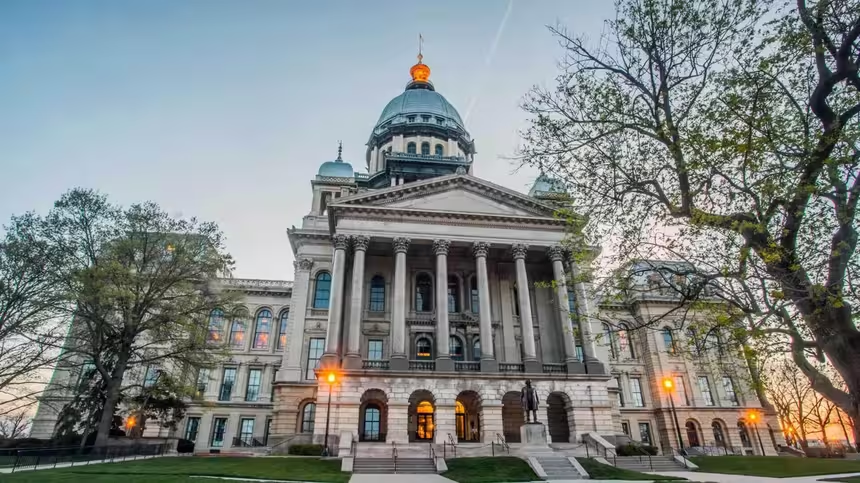
CapitolView
CapitolView is a weekly discussion of politics and government inside the Capitol, and around the state, with the Statehouse press corps. CapitolView is a production of WSIU Public Broadcasting.Providing Support for PBS.org
Learn Moreabout PBS online sponsorship(inspiring music) - Welcome to Capitol View, where we discuss the latest in state government and politics.
I'm Hannah Meisel with NPR Illinois.
Joining us this week is Charlie Wheeler, director emeritus of the Public Affairs Reporting Program at the University of Illinois - Springfield.
Thanks for being here, Charlie.
- You're welcome.
It's always a pleasure to be with you guys.
- And also here is Raymon Troncoso of Capitol News Illinois.
Glad you're here, Raymon.
- Thanks for having me.
- Since the show was last filmed, we have all seen a pretty damning report about what what happened at the state run veterans home in LaSalle, where a COVID outbreak killed 36 residents, that's more than a quarter of the homes population, in fall.
The report blamed the lack of preparedness, lax COVID protocols and general failures to communicate at all levels, both within the home and at the Illinois Department of Veterans Affairs.
Governor Pritzker ordered an investigation a few weeks in the outbreak, but five months later, the blame is pointing back to him and his hires 'cause at the end of the day, it's his administration.
And in fact, when he was asked about it a few hours after the report came out, Pritzker essentially said he regretted hiring former state representative Linda Chapa LaVia as state VA director.
Charlie, in the many years that you've spent watching state government and the many government screw ups that you've witnessed is this among the worst?
- I would say it is.
And there's a certain, I guess I don't know if irony's the right word, but when he ran for governor against then Governor Bruce Rauner, Governor Pritzker raised the issue of what happened at the Quincy Veterans Home with legionnaires' disease starting what was it, I think in 2015 where there were a number of deaths and he hammered Rauner for that.
And I guess in a way the issue has come full circle because now he's wearing the jacket for what happened at Lasalle.
And while we focus on LaSalle, there were also outbreaks at other veterans homes of the coronavirus, including at Quincy and at Manteno and I believe down in Anna too.
But one of the differences I see is that when everything came out about what happened under Rauner, there was an attempt by the administration to cover it up.
Now, I don't think Pritzger tried to cover this up.
As a matter of fact, as you said, he really took responsibility for it.
One of the things he said about Chapa LaVia, who he said at the time she was hired, he thought she would be a good choice because she had headed up a house committee that investigated what went on in Quincy.
And then he said that if he knew then what he knows now he would not have hired her because apparently as an administrator she was just a total flop and there were other key positions at the home that were left open.
There was a lack of communication.
It was just totally dropping the ball all the way around - Right, the report indicated that she was kind of an absentee director.
You know, of course, most directors of big state agencies, they're not involved in the day-to-day minutia of what's going on.
They're not supposed to micromanage.
They're supposed to see the big picture.
This seemed to be more than that.
Her chief of staff, Tony Kolbeck, was left to basically do her job, do his own job, and then do the job of the vacant, as you said, Charlie, senior homes administrator, which would have overseen these four homes.
And in that way, of course, things dropped off his plate when he's doing three jobs.
And the same kind of thing happened at the home.
The infection control nurse was similarly doing two or three jobs at once and things started to fall off the plate.
So Raymon, House Republicans especially have said that there is possibly a case for criminal negligence and is asking for more hearings and is asking the Attorney General Kwame Raoul to open an investigation and also the LaSalle County prosecutor to possibly call a grand jury.
So what, I mean we're not gonna hear the end of this, and frankly, nor should we.
This is not something to be swept under the rug.
36 people died, people who have served this country and were supposed to be guaranteed a safe place to live out the rest of their days.
But Raymon, what kinds of political blow back are we already seeing here?
- Well, you know, the issue is being used as a cudgel against Governor Pritzker very much in the same way that it was used against then Governor Bruce Rauner for what happened at Quincy with Legionnaires' disease.
In terms of criminal negligence, as you mentioned, house minority leader Jim Durkin and the rest of the GOP are asking for there to be a criminal investigation by Attorney General Kwame Raoul into what happened at Lasalle.
The thing is is that there was a criminal investigation at Quincy for Legionnaires' disease.
It lasted over two years and it concluded while Attorney General Kwame Raoul was in office.
And he decided that there wasn't a case.
Even though that over 20 people died in that instance and there was an attempted cover up as Charlie noted, it was still determined that there wasn't any sort of criminal liability.
So I'm not sure when it comes to what happened at LaSalle, even though there was a form of negligence, as we've seen in this report, they didn't have proper infection prevention techniques, they didn't have proper training.
It was understaffed.
There wasn't the proper oversight that there needed to be.
Best practices set by the state were being followed such as using the wrong kind of soap for killing coronavirus, people who were actually positive with coronavirus still showing up to work.
All these different violations occurred.
But I'm not sure if, given we have the precedent, of what happened at Quincy, that there's a case for criminal negligence for LaSalle.
- Sure.
And well, I guess we'll see.
I mean the first step would be attorney general Kwame Raoul actually opening an investigation.
But there is still a path for these families to seek damages in the civil route through the Illinois State Court of Claims.
In fact, after the Quincy debacle, the general assembly raised the cap on the maximum collections to two million dollars.
And so we have already seen one family of a LaSalle veteran who was killed by COVID sue the state and I'm hearing from the lawyers that there were at least a dozen more families.
And that sort of thing, that keeps this in the news and it keeps it alive and relevant to people.
So, Charlie, I mean let's go back to when that cap was raised if you remember a few years ago.
There are some people that said that was a mistake, that two million dollars was too high for a state that's kind of, we don't obviously have the best track record for our finances.
I mean, who's to say?
Is two million dollars too high a cap to seek damages from the state with the court of claims?
Knowing though that it's very possible that it would end in a settlement.
- Yeah, I think the thing is you don't necessarily get two million.
You can't get more than two million.
And that is a determination that would be made by the Court of Claims.
Now the Court of Claims is different than a normal court.
It's provided in instances where the state is at fault because you really can't sue the state in a regular court of law.
Typically the Court of Claims would handle things like the snowplow driver ran into my car and there's a lot that comes from the Department of Corrections, shakedowns, somebody stole my radio, that kind of stuff.
And I believe, if I'm not mistaken, there's already been more than two dozen suits filed dealing with what occurred at Lasalle.
And to go back to what Raymon said in terms of the investigations, I don't know if you'd be able to get a conviction in a court of law without showing it with some criminal intent.
The statute, as Raymon suggested, deals with negligence.
And could you argue that the people were negligent?
Yeah, I suppose you could.
One of the things that got me was that the report said in the months before the outbreak, no cases had been reported at the home, but there was a lack of planning, lack of training, communication between the agency, home administrators and staff.
Despite the fact that COVID was spreading, particularly in congregate settings.
And I would go back, as you said before, the director of an agency doesn't deal with the minutiae, but on an issue like this, you would think the director would say, "Holy cow, look what's going on.
I'm in charge of these facilities and they're all elderly people and they're congregate settings, man I better get on the ball and make sure that my underlings know what to do.
And apparently that didn't happen.
Now there's already a couple of investigations that are being started, if I'm not mistaken.
Senator Tom Cullerton, who is the head of the Senate Veterans Affairs Committee in the Senate, he's gonna be calling hearings pretty soon.
He was very critical about the report.
In the house state representative Stephanie Kifowit of Oswego, who's a Marine Corps veteran herself, she's the chair of the House Veteran Affairs Committee.
She's gonna hold hearings on the report and put together a comprehensive legislation package to be introduced if not yet this spring, 'cause there's not much time, then maybe next year.
One of the things that she wants to do that I thought was interesting is to put into law a minimum qualifications for the agency's director.
In other words, someone who has a background in this kind of work, as opposed to someone who was a lawmaker and happened to sit on a committee that investigated failure in another area.
I think if that requirement were in place, Chapa LaVia would not have been named the director.
- Right, that's a good point.
The report says that there was no one in those high levels of responsibility that had medical experience, that had nursing home experience.
The new acting director of the Department of Veterans Affairs, who Pritzker brought on board I think about a month ago, his name is Terry Prince and he ran the veterans homes in Ohio.
So he did a little bit of a media tour last week ahead of the report coming out and he assured everyone that many of the changes that were recommended in the report had already been made at the home before the report came out.
But Raymon, I thought it was interesting that earlier this week, US senators, Dick Durbin and Tammy Duckworth, who of course is herself a veteran, they wrote a letter to the US Department of Veterans Affairs and they said, "Okay, we've seen assurances that things have changed in the home but we're just asking the US VA to go in and make sure.
So Raymon, I mean, people say that there are changes made.
We've seen this before.
We've seen this movie before, as the governor likes to say.
How can we be sure that changes are really on their way?
Like what kind of accountability do you think that we as reporters and we as the public are gonna be able to really see?
- Well, I believe when this problem initially occurred, it was an audit from the United States Department of Veterans that kind of uncovered just how bad the problem was and how faulty the policies that were put in place at the state level were for dealing with this sort of thing.
I think it's probably prudent of our US senators to reach out to the federal government to make sure there's that oversight, to confirm, as you said, that these changes have really been put into place because after all, as we saw, not necessarily under Pritzker, but under Governor Rauner, when the outbreak, the Legionnaires outbreak happened at Quincy, there was an attempted coverup.
So it's probably necessary that we have some sort of oversight not at the state level that confirms these changes have been put into place.
And to your question, what can the public do?
What can us as journalists do?
Is to confirm that those policies are actually there.
It's to ask, maybe file some foil requests about what has been put into place, what are the necessary policies, not just for COVID, but for any sort of infectious diseases that tends to populate nursing homes.
- Yeah I think one of the things that Kifowit is also pushing, and I believe it's been approved in the house already and is now before the Senate is legislation that would create an independent veterans accountability unit to receive complaints and recommendations from veterans, including residents in state homes, and for that matter anyone else, and refer problems to the inspector general.
So that would be another avenue to get information about what's going on and get it out in public where some pressure can be brought to basically remedy the situation.
- That's right.
Well he's been gone since January, or February, however you want to count it, when then representative Mike Madigan stepped down officially from the legislature, but of course former long time house speaker Madigan still kind of haunts the Capitol building.
He of course, has not been charged of any wrongdoing, but five former lobbyists and executives for ComEd and its parent company Exelon, have been charged in a year's long bribery scheme where Madigan has been identified by the feds as public official A.
One of those charged was his close confidant Mike McLean.
And this week during a status hearing, his attorney let slip or kind of telegraphed I feel like that the feds are seeking a superseding indictment, which may, among other things, indict more people involved in the bribery scheme.
The Tribune then reported that a few former lawmakers have appeared in front of a grand jury seeking more information about scheme in just the last week.
Charlie, what do you make of this?
Are people making the right assumption to leap to "Oh my God, maybe Mike Madigan will be charged or is it way too premature?"
- I've always been one in dealing with those kinds of proceedings is to wait until the US attorney actually says here's what the situation is.
And I'm reminded of, when would it have been?
It would've been back in 2006 when the then US attorney asked then attorney general Lisa Madigan to stop investigating the hiring practices of Rod Blagojevich.
They talked about endemic fraud in the hiring practices.
So everyone thought Blagojevich is gonna be in trouble because of the way they rigged the hiring rules to reward cronies.
And lo and behold, when Blagojevich is indicted, it has nothing at all to do with hiring, it's all with him shaking down people for money.
So that was just another reminder to me don't try and guess what the attorney general is going to do.
A superseding indictment, as you mentioned, can be we're adding more people or it can be we're bringing more charges against the folks who are already charged.
And the US attorney in the case wouldn't say anything further.
I believe her comment was, "I'm not at liberty to discuss this."
And so Judge Harry Leinenweber set an August 3rd date for everybody to come back.
And maybe that's when we'll find out whether or not Madigan will go from being public official A to I guess defendant number five, or six, depending on how you count.
- Yeah, we should mention, one of the four that were charged in November have pled not guilty, but from one of the ComEd officials had already pled guilty back in September.
Anyway, Raymon, this happens, it's May, we have just a few more weeks left until the end of legislative session.
And one of the major major issues that lawmakers are discussing is this big energy omnibus package that, the groups all share who have put forward competing plans.
They all say that they want to get Illinois on the path to being 100% renewable energies by 2050 to combat climate change.
But they do it in competing ways.
And I think one of the, the group that I'm paying most attention to, is the union-backed group, who is basically asking on behalf of Exelon for the state to provide more subsidies to Exelon so that it would not close the two nuclear plants that it has threatened to close.
And we've also again seen this movie before.
In 2016, Exelon demanded the state provide more subsidies so that it wouldn't have to close two other nuclear plants.
So does this, Raymon, do you think that this new revelation might poison the water or well or cause people to be a little bit too afraid to go forward?
Or do you think that it's everyone's already laid their cards on the table and everyone's made such a deal of this that something has to go forward by the end of session?
- I think it's really hard to speculate what's going to occur because again there's so many players and we haven't even really gotten into the federal government and all of this.
As we know, we've had massive stimulus money coming in from the federal government, which can be used for a wide variety of issues.
It doesn't necessarily have to be used for COVID.
And on top of that, we have a multi-trillion dollar infrastructure plan that may also be coming down the pipe from the federal government.
So knowing that that could be on the horizon, it might change the calculus of what the governor's comfortable with and what the legislature's comfortable with in terms of funding for infrastructure and energy.
I think everyone's kind of laying their cards on the table, but there's other hidden players out there that we don't even have seen what they're gonna play yet.
So it's really hard to speculate what kind of negotiations are going backdoor or what the governor may have heard at the federal level or what he's expecting at the federal level that could change the calculus of all of this.
- That's a good point.
And you know, it is possible that this kind of thing might be pushed off until veto session in October, November.
Of course, people wouldn't necessarily be happy about that, but we don't know when we're gonna see the big infrastructure plan that the Biden administration is pushing past, and then let alone they have to promulgate rules for what the states can specifically do with it and then how much Illinois would see of that money.
But that's a good point.
But Charlie, a major element of the energy legislation, the governor has said it, most of the groups who are pushing their competing plans have said it, that they want ethics reform to be at the center of this legislation.
So to prevent situations like the feds saying last summer, oh by the way for the last nine, 10 yrs there's been this big bribery scheme going on from ComEd and Exelon targeting Speaker Madigan.
So, I mean what kinds of ethics legislation or ethics measures have we seen the folks who are negotiating this package say that they want in there?
- Well I think for starters, one of the things that they'll want to do is make it clearer if you're a lobbyist, you have to register as a lobbyist.
The reason I say that is because according to the scheme as reported by the US attorney, one of the ways ComEd tried to influence Madigan was to hire people in his operation as consultants to other people who were lobbyists.
And they would actually go out and lobby, but because they were consultants, the way the rules are structured now, they didn't have to register.
I think that'll be one of the changes that you'll see.
I think another thing that's likely to happen is there's gonna be some kind of a cooling off period between when you leave office as the legislator and when you can begin to lobby.
There will probably also be regulations dealing with the ability of elected officials to lobby other branches of government or other levels of government.
So if I'm a legislator, I can't lobby city hall, that kind of stuff.
And I think if I'm not mistaken, there may be some urgency to getting something done.
I think I read somewhere that ComEd wants to know what's gonna happen to their nuclear plants sooner rather than later because apparently within a matter of a month or so, they have to decide whether they're gonna order more nuclear fuel for those plants.
And they're saying, if we don't get some subsidy, we're gonna shut the plants down.
And so we're not gonna go ahead and order the fuel in the hopes that we might get the subsidy and then wind up with this fuel with nothing to do for it.
I think there's also some credits for renewable resources that are going to expire, I believe at the end of this fiscal year.
So I would guess the urgency is to get something done and I believe that the moving parts will kind of come together.
There'll be compromises made, ComEd's not gonna get everything they ask for in terms of money and subsidy, but they'll get something.
- Sure.
- [Charlie] And I think we'll see something before the session ends.
- I mean they could always come back and do a trailer bill, or what's called a trailer bill, in veto session if they feel like what they passed is incomplete.
And like Raymon said, we do probably want to see what that federal infrastructure package looks like, but, it'll be very interesting to see how radically lawmakers want to change how these big public utilities operate in Springfield because they have been such a huge force in the lawmaking process for so, so long.
But we are pretty much out of time.
I want to thank our guests, Charlie Wheeler, Raymon Tronscoso.
Thank you for watching Capitol View and see us again next time.
(dramatic music)

- News and Public Affairs

Top journalists deliver compelling original analysis of the hour's headlines.

- News and Public Affairs

FRONTLINE is investigative journalism that questions, explains and changes our world.












Support for PBS provided by:
CapitolView is a local public television program presented by WSIU
CapitolView is a production of WSIU Public Broadcasting.