
Episode 119: Redistricting, Big Energy, and LaSalle
5/21/2021 | 26m 46sVideo has Closed Captions
Discussion on redistricting, big energy, and the latest on LaSalle veterans home.
Host Hannah Meisel (NPR Illinois) and guests Sarah Mansur (Capitol News Illinois) and Dave McKinney (WBEZ) talk about redistricting, negotiations over big energy policies, and the latest on the LaSalle Veterans home.
Problems playing video? | Closed Captioning Feedback
Problems playing video? | Closed Captioning Feedback
CapitolView is a local public television program presented by WSIU
CapitolView is a production of WSIU Public Broadcasting.
Episode 119: Redistricting, Big Energy, and LaSalle
5/21/2021 | 26m 46sVideo has Closed Captions
Host Hannah Meisel (NPR Illinois) and guests Sarah Mansur (Capitol News Illinois) and Dave McKinney (WBEZ) talk about redistricting, negotiations over big energy policies, and the latest on the LaSalle Veterans home.
Problems playing video? | Closed Captioning Feedback
How to Watch CapitolView
CapitolView is available to stream on pbs.org and the free PBS App, available on iPhone, Apple TV, Android TV, Android smartphones, Amazon Fire TV, Amazon Fire Tablet, Roku, Samsung Smart TV, and Vizio.
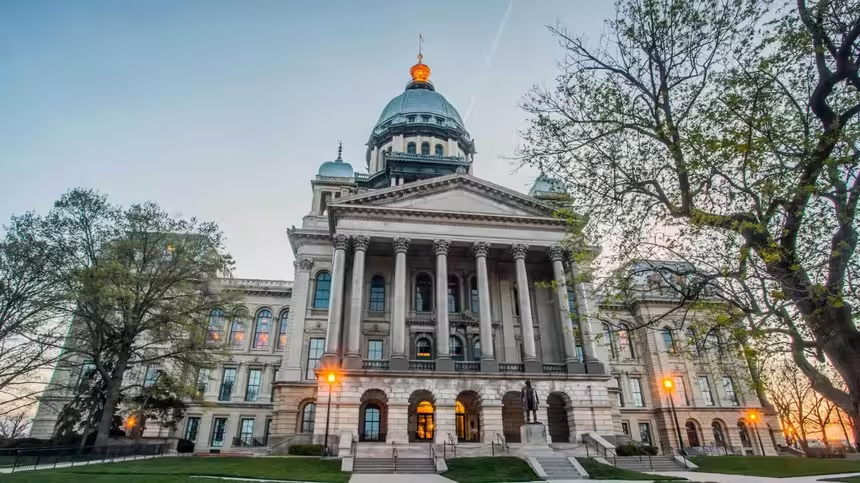
CapitolView
CapitolView is a weekly discussion of politics and government inside the Capitol, and around the state, with the Statehouse press corps. CapitolView is a production of WSIU Public Broadcasting.Providing Support for PBS.org
Learn Moreabout PBS online sponsorship(dramatic music) - Welcome to Capitol View, where we discuss the latest in state government and politics.
I'm Hannah Meisel with NPR, Illinois.
Joining us this week is David McKinney, government and politics reporter for Chicago public radio station, WBEZ.
Thanks for being here, Dave.
- Thanks for having me.
- And also here is Sarah Mansur, statehouse reporter for Capitol News Illinois.
Glad you're here, Sarah.
Let's get down to it.
So yeah, here we sit.
As we are filming, we are a little bit more than 10 days out of what's supposed to be the final day of lawmakers spring session here in Springfield.
And of course, it is a once in a decade remap gear meaning that the lawmakers are supposed to draw new legislative districts.
And this has long been a fraught process but it just feels here in 2021, there are just so many more factors that are making the process difficult and politically uneasy.
And so let's remind viewers that because of the pandemic, the decennial census numbers that are usually delivered to states in April probably won't be coming until August, September in that format that most people use.
So that is difficult.
And of course, the longstanding political divisions in the states make it hard.
Republicans have long accused Democrats who, for the most part have had map-making abilities except for one decade in the last 50 years of this state constitution and in this process of gaming the system and choosing their own voters.
So Dave with only a week or so left here, where do we stand?
And what arguments for the so-called fair maps no longer kind of hold water at this point?
- Yeah, I mean, I think that there's a pretty, we're very close to seeing what the legislative maps look like and these are important because they basically are ensuring communities of color and rural communities.
It just lays out who's gonna be representing them.
I mean, you have some situations around the state where neighborhoods or communities might be divided right along the middle of town or along one of the streets and you've got just confusion and under-representation.
So it's an important decision or important function of government that unfolds.
I mean, there are tons of political ramifications of this.
I mean, in the last go around, Democrats as you mentioned, control the process of redistricting as a way for the party doing the drawing to have placed some political mischief on their opponents.
I mean, they crammed four house Republicans into one house district the last go round.
And so you can expect that kind of stuff to happen.
The congressional map is very important.
We don't know for sure when that's gonna come out if it's gonna be before the end of May or if they will wait until the actual census numbers come in.
There's ramifications from the congressional map on who controls Congress, because right now, it's 13 to five Democrat versus Republican ratio in our congressional delegation.
And I think that there is some effort to try to diminish the number of Republicans representing Illinois and Congress down to as low as three, potentially, and increasing the number of Democrats.
So, by possibly one.
So, I mean, you could see a swing of three seats in the Democrats' favor in Illinois, which could help Nancy Pelosi in a long-shot effort to hold the house.
And then one last thing before I stop here.
I mean that the Supreme Court and the appellate courts are also in need of redistricting.
And that hasn't happened in a long time but it's a really important political process because when Justice Kilbride lost his retention effort last November, that really, really put the democratic majority, which is a four to three majority on the court in serious question.
I mean, the Democrats still control the court but the Democrats are gonna have to find some way to retain that district, which runs through Peoria and the Quad Cities and Joliet.
And they're also gonna have to figure out a way to pick up the district that is now in Northern Illinois.
That includes to page Kane Kendall and all the way over to Galena.
That's a Republican seat right now.
If Republicans can pick off that seat and take control of the court, suddenly these democratic super majorities in the legislature don't matter as much anymore.
So it's a really important process and we're down to the wire.
- And the Supreme Court districts as I understand, have not actually been touched for decades on like the legislative congressional maps.
And the Supreme court has played a pivotal role, I mean, it always does, but just so many big decisions.
If we go back to 2013 when the general assembly passed a Pension Reform Law that labor rallied against and fought really hard and then they took it to the courts and then they Illinois Supreme Court.
Now this was a unanimous decision, but they said, no, I'm sorry, it's unconstitutional.
And basically you're on the hook for hundreds of billions of dollars in pension liabilities.
Now, a more pressured decision, which I think was the one that perhaps set the events in motion to take off that for recalling things to go after that Kilbride seat is actually the 2016 decision ironically, or maybe not so ironically, where the court was split.
And they said, no, citizens cannot bring this proposal for an independent redistricting commission.
And if Republicans are successful on this long game gambit to get conservative in there and flip the influence of the court, that could be very interesting.
But Sarah, speaking of independent redistricting, all spring, we've been talking about how good government groups and the Republicans are United because they feel like they've long wanted the redistricting power to be out of lawmakers, but specifically Democrats' hands.
The governor, as viewers might remember, back in 2018 when he was running, he said, "Yes, I will veto maps that are drawn by lawmakers or their staff."
And furthermore, he went further than most other candidates.
And he said, in fact, even in the absence of a constitutional amendment, we should have some sort of independent redistricting committee.
He's gone back on his word kind of ham-handedly in the last few weeks.
But Sarah, those arguments have kind of played themselves out now.
I think what a lot of people are looking toward is a possible lawsuit over the actual data that lawmakers are using to draw their maps.
So catch us up on that.
- Yeah.
So like you were saying before, because of the pandemic, the numbers that are used or traditionally used to draw the maps, the census numbers are gonna be delayed.
And the constitution sets deadlines for redistricting.
So if a map is not drawn and approved by the governor by June 30th, then it goes to a legislative redistricting commission which is split four Democrats, four Republicans and then a ninth person is randomly drawn out of a hat.
And that person if it's a Republican, brand really will be decided.
So obviously, the Democrats are trying to get a map drawn before it goes to a random name pulled out of a hat and the Republicans are trying to make sure that they have the opportunity to have their name randomly drawn out or their party's representative drawn out of a hat.
So obviously, they don't have census data that's usually used so they're relying on the American Community Survey data which is less precise and doesn't have the same level of detail that the US Census data has.
And so Republicans are crying fall about that.
They're saying that it's unfair to use data that's not the best data that's out there and that the Democrats should wait for that data to come out but then there's that deadline tension.
And so, yeah, we'll have to see if they're gonna be able to have a map before June 30th, which, I mean, I think they're trying really hard to do.
- And that's not just about where lines drawn.
It's about people, it's about demographics and it's about specifically minority groups being able to be represented by people who look like them.
And there's been a lot of changes in Illinois' demographics in the last 10 years.
And people groups move to different places.
We have seen the suburbs change a whole lot in the last decade, especially.
And people want, they're entitled to representation.
And so it's about groups being able to strike a balance but it's not always easy.
And especially when it comes to, if you remember back to 2018, when we had this so-called blue wave of Democrats especially in the suburbs winning seats that they maybe weren't supposed to win, that even the Democrats who drew the maps 10 years ago didn't really have any aspirations of winning necessarily.
But if they won by smaller margins, they might be on the bubble especially if they are younger legislators.
And so it'll be very interesting to see what happens there but there's so much to get to.
Dave, I wanna go back to you to talk about where things stand on big energy negotiations.
Yes, it's about big conversations about political power and influence but also it's about at the end of the day, what shows up on your electricity bill because of decisions that are made here in the Capitol.
Dave, up in Northern Illinois the state is split into two regions.
Northern Illinois has a lot of nuclear power from this company called Exelon in Downstate Illinois.
A lot of electricity is generated by Ameren or they're the way that electricity gets to most people's homes.
We have different kinds of electricity generating capabilities down here.
But Exelon have been the big power player for years and years.
And they've threatened to shut their two nuclear plants.
And it's been reported this week that they're threatening to shut their two more all while they are under the federal microscope, which I just think is so interesting that they still feel as if they have the power.
So Dave, catch us up on where things are now because it's not just about Exelon.
It's about renewables and it's about the future of Illinois and trying to get to 100% renewable energy to fight climate change by 2050.
- You pretty well laid it out there.
I mean, I think the start of this is that Exelon, as far back as last year, had threatened to close nuclear plants in Dresden and Byron.
There are two plants there that are in North Central Illinois.
Close to Chicago, actually.
And these plants are really important to the communities they provide.
That they reside in.
I mean about 1,500 workers combined, all union labor pretty much work at those two plants.
And as you mentioned, there was a new threat, I think that was put on the table by Exelon this week that would potentially extend that closure to Braidwood and to LaSalle to more nuclear plants that are in Northern Illinois.
These nuclear plants statewide are important because they provide, as we're trying to reduce our carbon footprint, nuclear energy is considered to be cleaner energy than than coal or natural gas.
And so it's important the governor wants to keep these things open.
And if you recall the governor had talked about, he had a study done that justified about $350 million over 10 years in rate payer subsidies to help with these two plants, Dresden and Byron.
And I'm told that that the Exelon, they've tried to push that number up to somewhere around a half a billion dollars over 10 years.
And it would have a big hit on roughly four million Illinois rate payers, basically.
I mean, the turf for Exelon and ComEd extends almost all the way down to Bloomington, not quite, a little North of Bloomington and it's Rockford and then all the way over to Galena in Chicago, of course.
So big issue, big economic issue.
And of course, the part of this that I think is difficult for the power companies is the ethics piece of this.
The deferred prosecution agreement that involved an Exelon subsidiary, Commonwealth Edison, that laid out this corrupt lobbying effort that went on for about a decade as they were trying to pass bills, just like this one.
And so I think there's a real effort to try to get some ethics stuff over the goal line as well.
I don't know if we're gonna wind up getting a final package share between now and the end of the month.
There certainly is a push to do that but you've got lots of players, the governor to legislative leaders and the power companies.
And I don't think that they're really close to an agreement yet.
- I mean, they might need a cooling off period but again, Exelon's threats, they're pretty imminent until I guess we'll see if they are more bark than bite.
If it were to continue in the summer.
Sarah, just real quick, the other elements of this energy fight are that renewable energies.
So that have been subsidized by the state, especially since 2016 in the last big energy negotiation we had.
Especially solar credits for these solar projects, which they have committed to hiring a lot, committed to hiring a diverse workforce.
They've run out of money.
That pot has run dry for five months or so now.
And it's a classic kind of Illinois situation where businesses say, well, the state made these promises, but they're leaving us high and dry and so much for economic opportunity here.
I mean, in that context, what would be lost if a deal isn't reached fairly soon?
- Yeah, I think that's a really good point.
I'm probably not as informed about this as Dave but I think that what would be lost is the trying to make that shift and trying to give some of these communities that rely on fossil fuels like a new alternative.
- And folks who have been in the clean energy space and just people who care about the environment in general, which honestly should be most people.
They say, well, Illinois has repeatedly laid out goals for more than a decade for getting to cleaner energy but we have repeatedly falling short on those foals.
So it'll be interesting to see what kind of enforcement mechanisms there might be in a final package.
But we also have this massive scandal that has been given new life at the end of session here.
Timing is just impeccable, always in Springfield.
With this huge invest inspector general investigation into the 36 veteran deaths at the LaSalle Veterans' Home in November and December for a massive COVID outbreak spread among the facility, totally uncontrolled.
Since last time this program was filmed, there've been more revelations.
The governor's office now claims that is total ignorance of what was happening at the veterans home and at the department of veterans affairs which oversees the facility.
And Dave, I thought was very interesting to watch Deputy Governor Sol Flores lay out this situation where she said, basically she was duped by the governors picked who had that agency.
So catch us up there.
- Yeah, I mean, they really kind of threw the former IDVA Director Linda Chapa LaVia under the bus.
She was their second choice to head that agency.
And of course, there are four state run veterans homes in Illinois.
The largest is Quincy, but the one in Manteno or excuse me, at LaSalle where this happened, it's a real political problem for the governor.
And I think the Republicans are trying to equate what happened at LaSalle with the legionnaires' outbreaks that killed 13 veterans at the Quincy Home that really transformed or helped impact the last governor's race.
I mean, the governor's people would tell you that there's a big difference though, between Quincy and between LaSalle.
And that is that, you could look at just about any nursing home in the State of Illinois during the pandemic and just find deaths on this scale.
I think there are nursing homes across the state that have had more people die.
Not not a lot of them, but there have been some.
And Chapa LaVia was put in charge of that agency.
She's a former house member from Aurora, house Democrat.
And she'd helped oversee the Legionnaires' hearings with Quincy while she was in the house.
But this report that came out pretty much had her, it talked about her abdicating her oversight of that agency to the chief of staff of the Department of Veteran affairs.
He had no background in long-term care, which is what these veterans homes are all about.
And so, it was just really a lot of malfeasance in that agency that runs those homes.
And it begs the question about, should the state really be running these homes if we keep having these kinds of tragedies unfold in facilities that are supposed to be top-notch?
So it's gonna be an issue that Republicans try to exploit if Pritzker seats reelection for sure.
- And it's important to note too.
I mean, I say 36 veteran residents died.
That's more than a quarter of the homeless population.
It was a massive outbreak.
And Sarah, you've been doing a lot of reporting on this and you've been looking into why the home even got its license renewed and the perhaps lack of oversight by the state.
So what have you found there?
- Yeah, I think to add to what Dave said, it's such a tragedy and it's so heartbreaking because after the really important work that Dave and his colleagues at BEZ did to reveal what was happening at Quincy, there was an independent report done.
And then there was an Auditor General's report done into specifically Quincy.
And there were recommendations made at that time back in 2019 before the pandemic, that IDBA and the administration create uniform infection control policies.
And the person that would have been responsible for doing that at LaSalle, the senior home administrator, that position wasn't filled.
And so that has been the response from IDBA that that is why those recommendations were not implemented in 2019 because that person was not there.
And they have said that they couldn't find a qualified person to fill that position.
So it really raises the question of why these deficiencies, these really like glaring deficiencies not following the most basic protocol, changing gloves, between patients, wiping things down between each patient, why that wasn't detected at an earlier site visit?
Why it wasn't documented and why they had their license renewed?
I think those questions are still not answered.
And hopefully, I can come back and give you a better answer.
- And like Dave said, Republicans are seeking to compare this with the tragedy that happened at Quincy that clearly, the state did not necessarily pay closest attention to the suggested changes or bothered to make them.
And no one of course wants to be used as a political pond but inevitably, this will come up in the governor's race.
Like Dave said, if and when the governor decides to announce his campaign for reelection.
Because of course, the governor used the Quincy situation against former Governor Bruce Rauner at that time.
But we are out of times, I wanna thank our guests today, Dave McKinney, Sarah Mansur.
Thank you for watching Capitol View.
Please tune in again next time.
(dramatic music)

- News and Public Affairs

Top journalists deliver compelling original analysis of the hour's headlines.

- News and Public Affairs

FRONTLINE is investigative journalism that questions, explains and changes our world.












Support for PBS provided by:
CapitolView is a local public television program presented by WSIU
CapitolView is a production of WSIU Public Broadcasting.