
Episode 121: Energy Package, The Budget, and More.
6/4/2021 | 26m 46sVideo has Closed Captions
Discussion on energy package, the budget, ethics bill, and redistricting.
Host Hannah Meisel (NPR Illinois) and guests Jerry Nowicki (Capitol News Illinois) and Amanda Vinicky (WTTW) talk about a massive energy package still to be voted on, the budget, ethics bill, and redistricting.
Problems playing video? | Closed Captioning Feedback
Problems playing video? | Closed Captioning Feedback
CapitolView is a local public television program presented by WSIU
CapitolView is a production of WSIU Public Broadcasting.
Episode 121: Energy Package, The Budget, and More.
6/4/2021 | 26m 46sVideo has Closed Captions
Host Hannah Meisel (NPR Illinois) and guests Jerry Nowicki (Capitol News Illinois) and Amanda Vinicky (WTTW) talk about a massive energy package still to be voted on, the budget, ethics bill, and redistricting.
Problems playing video? | Closed Captioning Feedback
How to Watch CapitolView
CapitolView is available to stream on pbs.org and the free PBS App, available on iPhone, Apple TV, Android TV, Android smartphones, Amazon Fire TV, Amazon Fire Tablet, Roku, Samsung Smart TV, and Vizio.
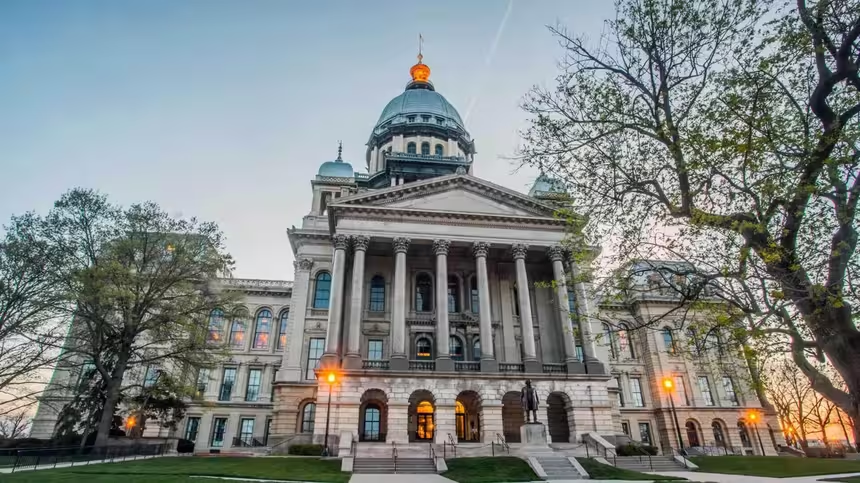
CapitolView
CapitolView is a weekly discussion of politics and government inside the Capitol, and around the state, with the Statehouse press corps. CapitolView is a production of WSIU Public Broadcasting.Providing Support for PBS.org
Learn Moreabout PBS online sponsorship(upbeat music) - Welcome to "Capitol View," where we discuss the latest in state, government and politics.
I'm Hannah Meisel with NPR, Illinois.
Joining us this week is Amanda Vinicky of Chicago public television station, WTTW.
Thanks for being here, Amanda.
- Thanks for having me.
- And also here is Jerry Nowicki of Capitol News, Illinois.
Glad you're here, Jerry.
- Glad to be here.
- Definitely sounds like it.
We are all very sleep deprived after a marathon end, but not quite end of lawmakers spring legislative session in Springfield.
You know, the reason that we say it's not quite ended is because lawmakers are due back to Springfield at some point in the next couple of weeks to vote on this massive energy package that did not get done and had several blow ups and near misses in the last few days.
And what's at stake here is environmental groups for years have wanted to get Illinois on track to a 100% clean energy future by year 2050, 2045 was also being developed but that's kind of an impossible goal with the technology that we have right now if we don't use nuclear energy as a bridge to that.
And Illinois' the most nuclearized state in the entire nation, half of our energy, especially in the Northern part of Illinois, I know that doesn't necessarily jive with the reality of folks in central and Southern Illinois, but it's all still very important, very related.
And lawmakers did not get this done because deal making between the governor's office and nuclear giant Exelon went to the 11th hour and with Exelon asking for far more in subsidies to keep three of their nuclear plants going than the governor's office thought was in the realm of possibility or reality.
And then also we have this 11th-hour blow up over what to do with coal fire power plants specifically the ones that are either owned by municipalities, that includes one in Springfield, City, Water, Light, and Power, and some in Southern Illinois but also massive co-op up down in the Metro east that actually powers a lot of cities and towns throughout Illinois.
They bought into this prairie state generation years ago with bonds.
And so if the state says, "Sorry, you have to close coal fire power plants by 2035, because this prairie state is supposedly the biggest polluter in Illinois and one of the biggest polluters in the entire nation," the cities and towns that bought into it would be upside down on those bonds.
So, it's very, very, very complicated.
I hope viewers are still with us, but Amanda, let's go to you.
I thought it was very interesting that of all things to hold us up, it wasn't the big subsidy to Exelon deal but it was this other thing.
So, walk us through what this means.
People are still very much on pins and needles.
I hear positivity and then negativity from those who are negotiating this deal.
What does it mean that we've been held up on this and what happens next?
- So, a couple of things, I think you're right that everybody thought that Exelon was really going to be the holdup for a couple of reasons.
First being that, of course it's Exelon and that, of course is the parent company of Commonwealth Edison which we see all over the deferred prosecution agreement and the prosecuting paper, prosecuting court documents against some of Madigan's inner circle.
And that's directly tied to the precursor in energy legislation that is called the future energy jobs act, which which was supposed to be the path toward renewables but needs fixing.
So yet another reason why this legislation was brought to the forefront.
So, everybody thought that that would be there because the specter of corruption in dealing with this company that according to that deferred prosecution agreement really made millions of dollars off of Illinoisans through this law, that was again, the precursor to the current package.
Yet, the fact that that wasn't it, and let's be clear, I mean, that was tough to negotiate.
And I think another reason why that is something people are paying a lot of attention to is because as you noted, Hannah, a lot of this is so complicated.
What isn't complicated is getting an electric bill and seeing a line on it that basically says subsidy and knowing through our reporting in such that is going to be because of legislators.
They passed that increase on the electric bill.
As of course, nobody ever wants to pay that extra money to utility but they especially don't wanna be doing it coming out of a pandemic when a lot of people are really still hurting.
So, where do things go from here, as you noted, I think negotiations are continuing is both, however, the fact that they waited until the 11th hour.
A lot of stiff things, we saw this, right?
The reason that we're all sleep deprived just because so much was saved until the very end of the general assembly as is typical, but sometimes that doesn't pan out.
Generally, that pushes everybody to an agreement because you've gotta get it done.
In this case, no, waited too late, something popped up, couldn't make it happen.
And so now not only do you have to reach a deal, people would back out of the current one and it's tough to get all the legislators back in Springfield folks' plan on May 31st being and people are on vacation.
So, you're really going to have to work that roll call.
This is something, however, we talk a lot about or I mention because I think it's very instructive in terms of what does and doesn't get done in Illinois that Democrats hold super majorities.
This is not something that is going to necessarily be partisan.
You're going to see a mixed roll call.
And so when there is a deal, it's going to be a tough one for legislators to potentially vote for, because again of that Exelon component that we've been talking about, but it's doable, I think.
- Yeah, and like Amanda said, we've so, so much toward the very end.
I mean yes, in a certain sense, it is typical for the legislatures, at least as long as I've been around to see things pop at the very last day.
I mean, it's kind of remarkable that Democrats introduced budget language finally at 1:30 in the morning on Monday, Memorial Day and then the budget was passed within the matter of 24 hours with, I think a couple of amendments there too.
What else?
Ethics bill, we had been waiting on that for months, a year, however you wanna put it but I think that was introduced, what Jerry, mid-morning?
What else?
- Can we take a second?
I mean, the irony there, right?
That's something that, while we have gotten some negative feedback on the ethics bill from some of the better government reformer groups on the actual, what is, and frankly more, what isn't contained within that ethics bill, I was struck by the irony that it is an ethics bill that was given very little chance to see public sunshine.
- Oh yeah, 100%.
But it was remarkable that even Republicans who have been banging this hammer and specifically, I wanna say Republicans in the Illinois Senate have been banging this drum for months and months and months, they went out and they publicly said, "Oh, well this is a win, despite everything.
Despite the process, despite, you know..." I go back and Jerry, I don't know if you were sitting with me last winter, pre-COVID, in all of those weekly ethics meetings, there was this whole ethics and lobbying commission set up so we can get good ideas for how to improve Illinois ethics laws.
I have no idea how much of that testimony actually made it through into these bills or if law makers just wrote it and said, "Well, this is doable because of political rallies."
I mean the ethics thing, Jerry, is this an ethics bill that is workable and is actually gonna make meaningful change, do we think?
- I don't know, that remains to be seen.
So, the thing that I haven't really gotten out of it is, a lot of this is sort of the impetus for it was guys like Louis Arroyo who lobbied the city of Chicago and I'm not 100% clear that with the Chicago carve out in this ethics bill, maybe more about it or got a better answer from some of the lawmakers than I did, but the Democrats tell me this is gonna prevent someone from Luis Arroyo from being able to lobby the city of Chicago.
but then you have either Jim Durkin say, "Louis Arroyo would have been able to do what he did."
So, Luis Arroyo, of course, he had lobbied the city of Chicago on behalf of these sweepstakes machines, ended up being indicted, was one of the many indictments.
So, I'm not 100% sure operationally how that Chicago carve-out would work.
I think the extent of it is that if you lobby any other municipality, you'll have to register with the Secretary of State, but is it, maybe it could clear this up for me, Hannah?
- I've asked folks and they're still trying to analyze it and say, "They'll get back to me."
It is a little convoluted, and usually you can- - To my point, right?
This is an ethics bill that didn't have zeros at it.
The fact that we have been asking and ethics experts don't have definitive answers I think proves that that's perhaps not the most transparent way of doing business, right?
- Right, and so, and for the process part of this, I always say, when I hear people say, "Oh, that's just Illinois," I compare it to a person who goes out and says, "Oh, I drive drunk every day, it should be fine, I have to be back to the car after these five tequilas."
- You know, I thought one of the things that there is some agreement on is that the economic disclosure form which for years had literally just been, what?
I think a two-page piece of paper and usually when you look them up, people say, "Just like through all the categories N/A, not applicable and then that's it."
So, the statement of economic disclosure, excuse me, is a lot more thorough than it used to be.
So, that's possibly a win, but other things, there's really mixed, I'd say mixed feedback especially because advanced fundraisers in Sangamon County, which, of course where Springfield is, where the legislature is on Mondays and Fridays during session weeks.
And the argument there is that, "Oh, someone's gonna hand you a check before a vote," but if you're gonna change your vote for a check in the first place, that's not gonna change the venue.
And honestly it ends up hurting local restaurants who have come to depend on hosting these fundraisers over many decades and- - Sorry, did they make that statewide, Hannah?
For fundraiser ban statewide?
- [Hannah] Did they?
- I think so, I think it is state wide, but nonetheless, where does that really hurt?
Hannah, to your point of Springfield, just given that tradition.
In terms of economics, I think.
- Right, so, Jerry, the budget, $42-billion budget.
It was one of those "Deux Ex Machina" kind of things.
We remember flash back six months, or no like seven months ago, I think was election day.
And that is the day that voters rejected Governor J. Pritzker's graduated income tax constitutional amendment.
This is his signature campaign promise and he said it would bring in, at the rates that were passed into law, had this gone through $3.5 billion extra annually.
And then the next day, we all remember, the governor came out and he shamed folks who didn't vote for it and shamed the people who, the business interests, the Republicans who spent a lot of money trying to defeat it and he said, "This is gonna be a very painful budget as a result," but doesn't seem like there's a lot of pain in this budget.
- Yeah, so, I think it was John O'Connor from the AP who asked him, "Where's the pain?
Or is the flat spending pain?"
And he said, "We wish we could have done more for more people but we were able to do what we did in this budget thanks to the unexpected revenue performance."
I think a lot of that is attributable to that the state could tax the extra unemployment income that the federal government had signed into law through their stimulus packages.
But, they did end up putting the extra 350 million towards schools, that evidence-based funding model calls for each year.
So, I think the American rescue plan, the plan signed by Joe Biden allowed a little bit more sort of flexibility in what they're spending on.
They couldn't use that revenue to displace other spending but there were many factors that made this year may be a blip on the radar, and we'll see structurally how that deficit looks moving forward.
I don't know that this year is, I know that this year is not a normal year, I just don't know how it'll look into the future.
- And Amanda, the governor had, since his budget address in February been saying, "Well, we need to cut nearly a billion dollars in so-called corporate income tax loopholes."
And then toward the final weeks of session, he's called it a couple of times, just flat out corporate welfare.
Of course, folks on the other side said this is business incentives.
Businesses have been fleeing from the state for years and years and to cut this at a time when the economy is trying to recover, that is supremely unfair.
So, why'd we end up there?
- So, I think actually something that really struck home to me was during the Florida debate where you had Senator Chapin Rose going through some of these tax breaks, tax incentives, whatever you wanna turn them because noting that they're so arcane that beyond calling them by those two-word descriptors, it's really difficult for your average person to understand what it means.
And he was saying, this is why they're important.
And that's a message that perhaps didn't really get home.
What you ended up having happen was one of the things that I think people do really understand a lot about, and there was heavy lobbying on is the governor had wanted to reduce the tax credit given to owners to invest in kids.
That is the around-our-area program that sends low-income individuals to private schools on scholarships through those donations.
So, that stayed in there.
A couple of the other tax breaks went away but a couple were brought in.
This is something that I think is particularly interesting about it is, certainly, Hannah, as you noted through hinging the governor, hinging his work and really amping it up (indistinct) I think proactively partisan in some of his remarks, sort of defending the budget saying it's balanced, it's Republicans who wanted to (indistinct) low and behold, he's got an election on the horizon.
And some of these tax breaks were ones that he had previously celebrated through an agreement with the GOP on the Capitol bill.
So, there's a lot there.
In short, it's a mixed bag.
Something that the administration will point out is it's going to be, their argument is this saves Illinois money, not just this year, but down the road, really hard to figure out, does it save money or if you agree with the process, is it going to cost the state money through a lack of jobs?
That's something that we can't easily measure.
- Right, the other thing that he touched to saying toward the end is that some of these tax loopholes are actually a result of the Trump tax cut bill of 2017.
And of course, that always is, like you mentioned, he's got an election coming up though he has not formally announced yet but anytime he can harken back to the Trump era, I think is probably good for him and his base.
But Jerry, I wanna move on to maps.
I think since this program was last filmed, the Democrats were able to ramp through their version of maps and I think also a new version of their maps had surfaced, I believe Thursday evening, 24 hours before they'd be passed.
So, Jerry always a very, very, very hyper partisan process, very personal process too when we bring in questions of community identity but also lawmakers own political whole fades.
So, Republicans obviously slam the process as being the furthest thing from transparent.
Democrats can claim, "Oh, well we had 50 community meetings."
Where do we land there?
- Well, I think one of the illustrative back and forths regarding the maps debate took place when representative Curtis Tarver was on the floor introducing the judicial maps and Rep Tim Butler from here in Springfield was questioning him and says, "What's on this map?"
Curtis Tarver says, "I don't know, I didn't draw them.
I don't know who drew them.
I don't know how the language got to be in the bill, yada, yada, yada."
So, they're hiding behind their consultants, whatever.
Some consultant drew this, I don't know who it was.
There was EDS, I think is the company that they said helped them.
Senate President Harmon finally admitted that EDS was a company that was used.
But when I've said that EDS was the company that helped draw the maps, their office of course sent me a correction, "No, they didn't draw the map, they were just a consultant."
So, I said, "Oh good, I'll delete the tweet once you tell me who did draw them," still nothing.
It's a completely opaque process.
We all know it was going to be a partisan process.
Democrats are going to try to protect their seeds, we all knew that coming in.
But a little more honesty, a little more transparency is entirely necessary for this process.
If you're going to do it, at least say, "I think they finally did.
In the final floor debate were trying to protect this level of diversity.
We're trying to protect the things we've accomplished."
Fine, say that all along and say who's drawing this map and who you're paying to do it.
- Yeah, Jerry, that was pretty interesting to finally, because of course there are court cases coming, they're being drafted up right now, so, the Democrats have to be extremely careful about what they said in the lead up, but after they pass these resolutions that contain their legislative intent, it's very difficult to explain.
But they finally, as you said, in the house, at least they let loose and they, it was all about identity.
And it was pretty interesting to finally hear people and Republicans too, all about identity and just everyone finally let loose.
And it is, like I said, the most partisan thing that they could possibly do is drawing these maps, Amanda?
- Yeah, you know, I think something that really struck home to me, you're right, it became about political identity and causes really.
And the defense by Democrats that they're doing this for the greater good because they want to push their agenda and that was one of the defenses.
But the other one is, Jerry noted was the diversity, that particularly, you do see very much on the Democrat side of the aisle and something that in this first, post-Mike Madigan session the first black speaker of the Illinois house said, "This is our strength, the diversity."
And we don't see a lot of that on the Republican side of the aisle, at least when it comes to the racial background or the racial makeup of the GOP in Springfield.
But while Democrats were celebrating that, many of the organizations, the community groups that really had fought for community representation so these districts would have at least a 50% makeup of Latinos, Muslims, blacks so that these populations would be protected and being able to choose a representative of choice, they're really unhappy and one of those lawsuits, a lot of speculation is will come from MALDEF, that's the Mexican American Legal Defense Education Defense Fund.
So, it was something that Democrats are saying, "Hey, we've got this.
This is what these maps were designed to do.
And the community organizations were saying, "Hey, wait, hold up, no, you didn't."
- Right, and no one never likes to be spoken for if it's not quite the same thing.
It's doubly complicated when you have, especially in the process, this decade, Latino lawmakers were put in charge and black lawmakers were made their deputies on these district commissions.
And so it's really interesting to see the back and forth between the community advocates of color and their counterparts on, the folks who are in charge.
And they're arguing about the same things, but the law makers say, "Sorry, you're wrong, we're right."
And they say, "We're the community group."
It's very interesting, very complicated a parse.
But at the end of the day, either the governor will veto the maps, which is very unlikely despite his campaign promises that he would veto maps that were drawn by legislators or political staff or the courts will step in and then they'll end up drawing the maps, or at the end of the day, when the final census data comes out, the legislature will come back in and rejigger them.
But for now, we are almost out of time here.
I would like to thank our guests, Amanda Vinicky, Jerry Nowicki.
My name is Hannah Meisel.
Thank you so much for joining us on this week of "Capitol View."
(upbeat music) (playful music)

- News and Public Affairs

Top journalists deliver compelling original analysis of the hour's headlines.

- News and Public Affairs

FRONTLINE is investigative journalism that questions, explains and changes our world.












Support for PBS provided by:
CapitolView is a local public television program presented by WSIU
CapitolView is a production of WSIU Public Broadcasting.