
Episode 122: Energy Legislation & Redistricting Maps
6/11/2021 | 26m 51sVideo has Closed Captions
Discussion on energy legislation & redistricting maps.
Host Hannah Meisel (NPR Illinois) and guests Peter Hancock (Capitol News Illinois) and Kent Redfield (UIS) discuss the latest on energy legislation and the redistricting maps.
Problems playing video? | Closed Captioning Feedback
Problems playing video? | Closed Captioning Feedback
CapitolView is a local public television program presented by WSIU
CapitolView is a production of WSIU Public Broadcasting.
Episode 122: Energy Legislation & Redistricting Maps
6/11/2021 | 26m 51sVideo has Closed Captions
Host Hannah Meisel (NPR Illinois) and guests Peter Hancock (Capitol News Illinois) and Kent Redfield (UIS) discuss the latest on energy legislation and the redistricting maps.
Problems playing video? | Closed Captioning Feedback
How to Watch CapitolView
CapitolView is available to stream on pbs.org and the free PBS App, available on iPhone, Apple TV, Android TV, Android smartphones, Amazon Fire TV, Amazon Fire Tablet, Roku, Samsung Smart TV, and Vizio.
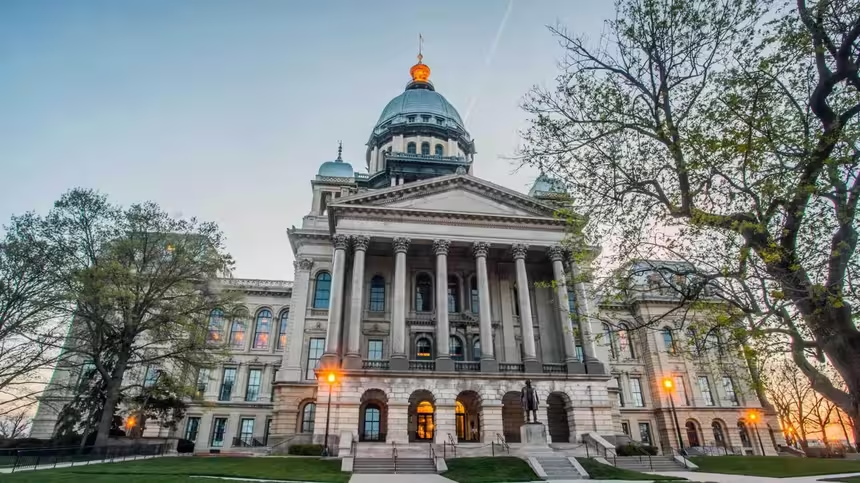
CapitolView
CapitolView is a weekly discussion of politics and government inside the Capitol, and around the state, with the Statehouse press corps. CapitolView is a production of WSIU Public Broadcasting.Providing Support for PBS.org
Learn Moreabout PBS online sponsorship(upbeat music) - Welcome to "Capitol View," where we discuss the latest in state government and politics.
I'm Hannah Meisel with NPR Illinois.
Joining us this week is Kent Redfield, professor emeritus of political science at the University of Illinois, Springfield.
Thanks for being here, Kent.
- Good to be here.
- And also here is Peter Hancock, of Capitol News Illinois.
Glad you're here, Peter.
- Nice to be here, Hannah.
- Well, lawmakers are heading back to Springfield for a couple of days next week.
You know, it seems like we all just left Springfield because we did.
You know, there at the end we had kind of a blow up over this major piece of energy legislation that has a lot of components.
We discussed it in depth last week on the show.
But you know, lawmakers also had a lot of other things that kind of left undone by one chamber or the other.
You know, some close observers might say, it's because of lack of communication between the chambers, personality conflicts, fundamental differences between the democratic caucuses.
I dunno, kind of priorities or centrism in the Senate democratic chamber at least.
Very interesting stuff.
But Peter I'm gonna go you first, this massive energy deal where for months, for years really, it's been worked out that we have to re-up our clean energy goals because we have fallen massively short as a state repeatedly on these goals.
But also Exelon, the nuclear giant that powers 50% of Illinois.
And yes, it is a lot of (indistinct) there in Illinois, but it's all intertwined.
You know, they had been searching for a big nuclear subsidy to bail out their unprofitable nukes before they closed them, which they have threatened to do repeatedly for last year and a half.
But at the end there, we all saw it.
We got stuck instead on coal-fired power plants, especially municipally owned coal-fired power plants, which they heat a lot of, they electrify a lot of the central and Southern part of the state.
So Peter, where are we at there?
Does it look like there's a deal on the horizon?
Because I'm hearing different things from folks who are negotiating that bill.
- Well, what we've been told is that a deal has been struck.
But days later we're sitting here and we still have not seen the details of them.
I've seen some very rough sketches of what's in it.
The idea is to get to 100% carbon free electricity in Illinois by 2045, which is about five years earlier than the governor originally said.
They want to phase out coal fired power plants by 2035.
And of course, they're gonna be the subsidies for the nuclear power plants that are unprofitable.
At least two, possibly as many as four later down the line.
And then there's also this jobs component, where they want to be able to train the workers who are gonna be displaced by the shutdown of coal fired power plants and some coal mining jobs, get them trained and find employment in the clean energy sector.
So yeah, a lot of moving parts, we still haven't seen the details.
We don't know how much of a subsidy is gonna be going to the nuclear plants.
What impact this is going to have on rates overall.
We do know there are some municipalities, including right here in Springfield, which has a very large coal fired power plant run by City Water Light Power or CWLP.
And the city of Springfield is very concerned that they may have to shut that plant down under this proposal, before they're finished paying off the bonds that they issued in order to upgrade it.
There's a similar situation in the Metro East area.
I believe it's called Prairie State Power.
So there's some municipalities that are very concerned about this.
But as I said, as we're sitting here taping this right now, we haven't seen all of the details.
- That's right.
It's still, as I'm sitting here, I'm getting more updates from folks who I know are close to negotiations.
And you know, the governor has already said explicitly and the house speaker Chris Welch and the Senate president, almost as explicitly that they're not going to let anything pass through their chamber.
They're not gonna stand for anything that carves out, that exempts the early closure of those coal-fired power plants in 2035.
But as you said, 2035 is 15 years earlier than that Prairie State Energy Campus was scheduled to close.
And they made deals long ago, more than 10 years ago because they only just opened in 2012.
With municipalities, 60 plus municipalities and energy co-ops throughout the state, and more in other states that said, "We will supply your energy through 2050.
And if you help us finance it through selling bonds."
And like you said, even if the state is able to work out some sort of deal to help those municipalities with the price of energy after the foreclosure of Prairie State, there's still been nothing sad about if there's any chance of hope.
Any chance of helping those municipalities with the bonding issue.
So Kent, I mean, how big of a deal is the.
If it were to happen that the plants would be closed, all close by 2035 and there's outstanding bond debt on these municipalities balance sheets, how big of a deal is that for an individual town or city?
- It's gonna depend from city to city.
And you have to separate out the cost of energy versus what kind of financial obligation they've taken on in terms of bonding.
Coal fired plants are looking at the need for upgrades to meet environmental standards.
And so the situation in Springfield is, it's not clear that it's gonna be cost-effective to run any of their plants all the way out to 2035.
Because you can buy right now, you can get energy much cheaper on the open market than it costs you to produce it.
So, that's one piece of it.
But the other piece is, you don't want to be paying on buildings or facilities that no longer exist.
I mean, at one point we refinanced the debt on the McCormick Place building that had burned down about 10 years previously and had been replaced by the current McCormick Place buildings.
So these are the problems you can get into trying to do long range planning.
And so I think there probably will have to be some relief.
Because this is pretty broad in terms of you know, I mean it affects a lot of people, but it also affects a lot of areas of the state with a lot of members who represent chunks of this.
And so I think it's gonna be, the state will take a hit further down the road to kind of ameliorate this.
But it is the uncertainty of making long-term commitments in the current energy environment.
There's really no, unless you just quit planning altogether, you have to take certain risks.
So, you know, but this is 2035.
I mean, the general assembly would pass the end of the world if it had a 10 year or 20 year implementation date on it, an effective date on it.
So we are long time to sort this out, but it's gonna hurt credit to individual municipalities if they get caught in terms of this.
So it's a big deal, but I think it's pretty clear the leadership is gonna put it on the books.
Now you can always go back and amend stuff, but I suspect it'll come out that way.
- Yeah, you make a good point that 2035 is still 14 years away.
And there could be other help by then.
But you also make a good point, but a lot of the energy price, a lot of the deals that were made years ago to finance this Prairie State Energy Campus with those 60 plus municipalities and co-ops, they were based on energy prices that were, shall we say rosy for coal.
And technology is really advanced a lot in the years that have passed.
And the price of renewable energy has come down quite a lot.
Obviously, environmentalists are not necessarily, they live in reality and they know for the most part that it's not gonna be an easy road to clean energy without making sure that nuclear is still the bridge to get us there.
And in the meantime, also, our energy grid is set up such that coal fired power plants are still gonna be a reality for a little while longer, at least.
I mean, it's just, it's very interesting though to hear that at least from the people in the room that I've been talking to, they thought that there was a deal on these coal fired power plants.
They thought there was a deal for several aspects.
Like I mentioned, helping municipalities with the price of energy later.
And then like Peter mentioned, transitioning those folks to different jobs later.
But I thought it was interesting that at a press conference last Friday morning, first of all, the folks who've been able to kind of construct a media strategy around this so quickly, seeing that they had an opening here.
A guy from a Prairie based steam pipe fitter union, he said, "Listen, even if our folks are transitioned to jobs in the clean energy space later on, it's not the same as having a career at a coal-fired power plant."
You know, the job is you'll help construct a wind farm, a solar farm, but then that will be it.
And so for the unions who are involved here, because unions are of course heavily involved in preserving nuclear power, but also they're heavily involved in the coal fired power plant space.
You know, they are still quite powerful.
They're still, they still have the power to hold things up.
So Peter, do you think that there's any way that the unions who are fighting for the not 2035 to extend the closing date all the way to 2050 for these coal-fired power plants, is there any way to appease them?
- You know, I don't know.
And I don't know that there's a whole lot.
There are certain forces at work here that unions just are not gonna be able to stop.
Renewable energy is where the global economy is going.
You know, nuclear energy and fossil fuel energy are both very labor-intensive, renewable energy isn't.
You put up a solar array, the sun shines on it, it makes electricity.
You put up a wind farm, the wind blows, it makes electricity.
And so I think organized labor in that sector, is gonna have to start doing some long range planning, because those jobs just aren't going to be around anymore.
And so I'm not sure what to do about it.
I think there is gonna be a lot of construction opportunities with not only wind farms, but rooftop solar installations, even on an industrial scale, like rooftop solar on a Walmart or a shopping mall or something like that.
So I don't think those construction jobs are gonna disappear anytime soon.
They're not as temporary as they're being made out to be.
But generally, the power industry is changing and it's not just in Illinois, it's not just in the United States, it's happening throughout the world, because we have to confront global warming.
So I think that's where we're at.
And the people who are still in those industries are gonna have to start making some long range plans.
- One thing I do want to mention before we move on is that, yes, you are correct that these jobs in the renewable energy space are you know, they're not going anywhere.
However, some of the funding for a (indistinct), is a little too detailed for the show, of solar projects already dried up back in December.
And people are hoping for that more money to be included in the overall deal and so that's also on the line.
But I want to move on from energy talks and talk about maps.
Here we are again, after we filmed the show last Thursday, governor J.B. Pritzker assigned the new legislative and judicial maps that Democrats approved at end of session.
And then of course, the Republican leaders, they as expected, they filed the first wave of litigation against the maps.
So, kent, obviously as expected, the governor signed the maps and as expected Republicans filed suit.
Obviously, they're not gonna be the only ones to file a suit.
But where do we go from here?
- Well, this is the initial suit is in federal court.
And this is essentially, it is partially a data issue, but it's mostly a process issue.
You know, the constitution has a process in a timeline.
And or if you don't meet that, you get to this redistricting commission with four Democrats and four Republicans.
The legislature (indistinct) met the process and the deadline.
You know, it says, you pass a map, it's gotta be compact, contiguous, substantially equal.
You have to do it before the 30th of June.
And at that point, then you're arguing about the legitimacy of that map.
What the Republicans want to do, is essentially get back to the process that if you don't have a map pass by the 30th of June, you get into redistricting commission and then ultimately you may be drawing a name out of a hat.
So it's interesting that we're in federal court rather than state court.
Arguing about and in fact ask asking the federal court to essentially compel Illinois to follow the redistricting commission language in the state constitution, under the argument that somehow the legislature didn't meet the deadline and the process requirements of the state constitution.
So, I don't know that they're in the right place in terms of where they want to file suit.
I think this court has been very literate, district Illinois state Supreme court has been very literate about reading the plain language of the state constitution.
So, but this is just the first volley.
After we decide what we're arguing about, whether we're going back to a different process or we're arguing about the Democrats map, then we'll get, if we agree, yes, that's the map, then we're into suit to federal and state court about the content.
The problem with the Republican suit is that they're arguing that it's bad data, but they have no way of proving that it's bad data until they get the census data.
So they're making an argument that somehow this is illegitimate data in the abstract without having any clear reference point, which would clearly be the census data.
But the state constitution never mentions using the census data in order to draw a map.
So I don't know that this is going anywhere, but I also don't think it's gonna.
We're not gonna know exactly what the boundaries are for quite a while, until all of the litigation in state and federal court is done.
- Yeah, no that's a good point that Republicans really, they say they want this appointed by partisan panel, but that then gives Democrats more credence to their theory or their argument that really what Republicans want is that 50, 50 chance to control the process.
And that they've just glommed on to the arguments of community advocacy groups because it's convenient for them.
You know, they would argue otherwise.
But, Peter, like we said there is gonna be more litigation over this.
You know, there's gonna a be litigation that will focus exclusively on the federal and state voting rights acts later, which this was not.
But you know, the suing over the ACS data in general, that is a novel argument.
Have you heard from sources that suing over that data might be a little bit more successful than your typical remap lawsuit?
- Well, I think we're all in kind of uncharted territory here.
The Illinois constitution was written because they anticipated that lawmakers might not be able to agree on maps for a long time.
And so they put these deadlines in here.
No one ever anticipated that the census bureau wouldn't be able to deliver the numbers on time.
And the other interesting thing I think about the Republican's lawsuit is that, it was filed in federal court in Chicago.
And they're arguing this on federal constitutional grounds, specifically the equal protection clause of the 14th amendment.
There it says, states have to give all of their citizens equal protection of the laws.
And that is in federal courts.
And there's jurisprudence on this going back much farther than 1970, when the Illinois constitution was written.
The U.S Supreme court and federal courts have said that districts have to be as equal as practicable, they will allow up to 10% variation between the smallest district and the largest district.
But sometimes they will even strike down maps that have less variation than that, if they think that the maps were drawn in an arbitrary or discriminatory manner.
And that is what the Republicans are arguing.
They're saying it was arbitrary, it was discriminatory.
In part because they argue that the American Community Survey undercounts certain populations.
It's only distributed in English and Spanish, so there are a lot of other language minority groups out there that don't participate in it.
And it's based on survey data that has a margin of sampling error.
So you can't really guarantee that the district populations are within the allowable margins.
So it's gonna be interesting to see whether or not, first of all, whether or not the federal courts will take this before it's been litigated in state courts.
And what kind of standard they're going to apply to it.
There are other states that have constitutions that don't specifically mandate the use of census data.
But if you have census data out there, that is presumed to be the most accurate count of people.
It's why we do the census.
One of the many reasons why we do the census.
So this could really go either way.
- The interesting thing though is on the remedy, they want the remedy to be not to say, legislature draw a new map when you have the census data.
They want the remedy is to move it out of the legislative process and into this unique constitutional requirement in the state constitution, which is designed only to kick in if the legislative process doesn't work.
It's hard to argue legislative process didn't work in terms of what the constitution requires.
So the court could accept their argument, but they could also say, the remedy is you know, we're not gonna put this in a redistricting commission.
We're gonna either have our own master, which is like their alternative, or we could kick it back to the legislature.
And you're right.
I mean, this is uncharted territory, and this is stayed tuned in terms of how this ends up.
- I think one of the interesting things is that Democrats are now accusing Republicans of trying to hijack the process for their own political advantage.
It was pretty clear that the Democrats ran this thing through during the session, using survey data so that they could draw maps to their own political advantage.
So a little bit of the pot calling the kettle black there.
- Shocking.
- Shocking.
(group laughs) - We only have a couple of minutes left, but I'm glad that you brought up the fact that American Community Survey data only goes out in English and Spanish.
Because one of the things I've been tracking over the last several years is, Asian-American communities have been pretty eager for the results of the 2020 census, because that was a group that, I mean, still is poised to gain a lot more political power after both parties kind of ignored that group writ large for many years.
But you know.
And so you see groups like Asian Americans Advancing Justice Chicago, as one of the kind of loud voices against the Democrats ramming through these maps.
And then also as we know, neither the census nor ACS obviously, acknowledges middle Eastern Americans as their own people group.
And so they're also classified as white.
But they would like to someday elect people who look like them, from their own racial, ethnic, religious backgrounds too.
But, sadly we are out of time for this episode of "Capitol View".
I'd like to thank my guests, Kent Redfield, Peter Hancock.
My name is Hannah Meisel.
Thanks for watching and we'll catch you again next time.
(upbeat music)

- News and Public Affairs

Top journalists deliver compelling original analysis of the hour's headlines.

- News and Public Affairs

FRONTLINE is investigative journalism that questions, explains and changes our world.












Support for PBS provided by:
CapitolView is a local public television program presented by WSIU
CapitolView is a production of WSIU Public Broadcasting.