
Episode 124: Illinois Credit Score, New Leadership, and More
6/25/2021 | 26m 46sVideo has Closed Captions
Discussion on Illinois Credit Score, New Leadership, and Pending Energy Bill
Host Hannah Meisel (NPR Illinois) and guests Dave McKinney (WBEZ) and Dave Dahl (WTAX) discuss Fitch Ratings giving Illinois a positive credit score, what kind of new leadership does the Democratic Party of Illinois want after Michael Madigan, and the pending energy bill.
Problems playing video? | Closed Captioning Feedback
Problems playing video? | Closed Captioning Feedback
CapitolView is a local public television program presented by WSIU
CapitolView is a production of WSIU Public Broadcasting.
Episode 124: Illinois Credit Score, New Leadership, and More
6/25/2021 | 26m 46sVideo has Closed Captions
Host Hannah Meisel (NPR Illinois) and guests Dave McKinney (WBEZ) and Dave Dahl (WTAX) discuss Fitch Ratings giving Illinois a positive credit score, what kind of new leadership does the Democratic Party of Illinois want after Michael Madigan, and the pending energy bill.
Problems playing video? | Closed Captioning Feedback
How to Watch CapitolView
CapitolView is available to stream on pbs.org and the free PBS App, available on iPhone, Apple TV, Android TV, Android smartphones, Amazon Fire TV, Amazon Fire Tablet, Roku, Samsung Smart TV, and Vizio.
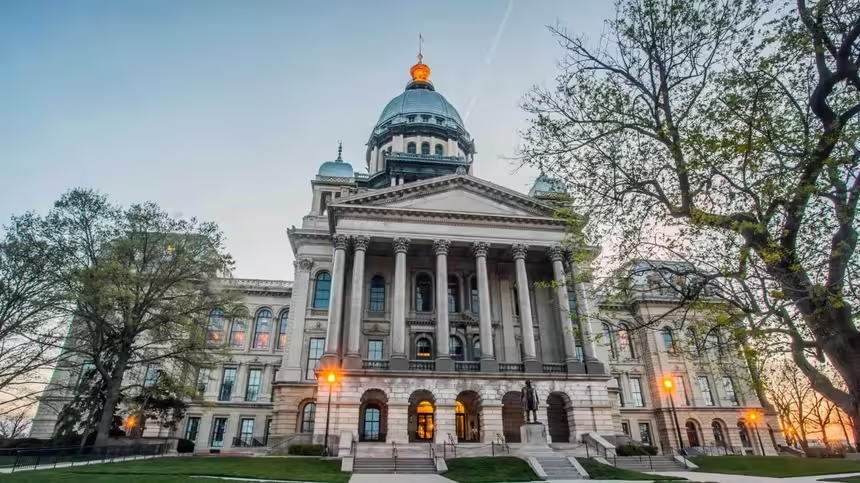
CapitolView
CapitolView is a weekly discussion of politics and government inside the Capitol, and around the state, with the Statehouse press corps. CapitolView is a production of WSIU Public Broadcasting.Providing Support for PBS.org
Learn Moreabout PBS online sponsorship(enchanted instrumental music) - Welcome to Capitol View Where we discuss the latest in state government and politics.
I'm Hannah Meisel with NPR Illinois.
Joining us this week is Dave McKinney of Chicago Public Radio Station WBEZ.
Thanks for being here, Dave.
And also here is Dave Dahl of radio station WTAX in Springfield.
Glad you're here, Dave.
- You're no Bruce Rushton.
Hello, Dave here.
- Double Dave's today.
All right guys, well, it's been a few weeks since session ended And the Wall Street ratings agencies are starting to take notice of our state budget.
And actually yesterday on Wednesday Fitch Ratings agency changed our credit outlook to positive from a negative, which is, it's not a ratings upgrade, but it is something.
It's in their analysis, they said, it's it reflects the state's preservation of fiscal resilience and sustained economic recovery since it started the pandemic.
And also suggest further improvements in the state's operating performance and structural balance in the near and medium term.
Could even support a change in our credit outlook to pre pandemic rating or higher, which again, if we recall four years ago, when we were, we were not quite out of the budget impasse.
That's when our ratings took tumble after tumble to near junk bond status.
And we'd been basically there for four years.
And the last time Illinois actually had a credit upgrade was I believe 2002.
I was 11, Governor George Ryan was still in office.
This is before mass early retirement program, which was one of those early harbingers that made our pension, some people want to call it a crisis worse.
So Dave, you and your colleague, Tony Arnold earlier this month published a story about how maybe, just maybe, our fiscal house is getting itself in order.
And it's kind of wild that it took a pandemic and we should say a lot of federal help to help us a lot.
But what is, what are financial analysts saying?
And what might be to come for Illinois?
- Well, I mean, you pretty well summed it up what was in the report there, Hannah.
I mean, I think for the Pritzker administration this is obviously a dose of great news for them.
I mean, it didn't take long for that report to land before, pretty much every Democrat in power in state government was issuing a press release proclaiming that fiscal stability had arrived in Springfield.
I mean, this is an important moment for sure because as you point out, it wasn't that long ago that that the State of Illinois went two years without having a budget.
And that was all driven by Bruce Rauner's interest in trying to leverage other issues to try to get those passed.
So he held up the budget.
This is a big deal.
The tax collections are up.
The income tax, the sales tax, two biggest drivers in state government.
The federal COVID relief helps.
Although a lot of that money still is Pritzker is still waiting to get that money.
But Fitch took note of the fact that our bill backlog has dropped dramatically.
We're down around $3 billion and change.
Which compared to four years ago, at 16 billion you can see that's improvement.
And then the other part that they cited in the report was the idea that we're paying off these federal pandemic loans ahead of schedule.
So all things combined, that's why they're saying that we could be headed for no longer being a notch above of junk status.
- Yeah, and Dave Dahl, I mean, that 30 day bill repayment schedule that we're now finally back on, Illinois has for years struggled with that, it predated the budget impasse.
Illinois (indistinct) the reputation of being kind of a deadbeat on its bills.
I think there was a kind of recurring column at the time that was named something like Deadbeat Illinois or something like that.
Having a reputation for that really, it played into not just politics, but also played into how other states and frankly, the Wall Street entities these credit region agencies' sorrow state.
So, do you think that actually having a upgrade like the governor has wives?
I mean, it was only a couple (indistinct) to his tenure a couple of years ago when he went out to New York and he met with some of these rating agencies and he said, listen, we were due for an upgrade.
We're gonna get our house in order.
Do you think that it'll actually make a difference when it comes to how people will, especially Republicans who for years have ran on campaigns of Democrats have ruined our state?
- I think you're right.
And I think the one question would be can you and I keep it up?
And we'll see if there's some other financial calamity on the other hand, through the pandemic this is all been able to happen.
A naysayer, if you will.
Or if I were a naysayer, I'd say, no, I'm not a naysayer, I'm realistic.
Some would say that a lot of federal money is coming into Illinois, which isn't gonna come in every year.
On the other hand, if Illinois can keep up, what it's doing.
That'll give the governor a great thing to run on and take the pressure away from the pandemic stuff and the mitigations.
I mean, in California, they're trying to recall the governor over the very same thing, and it could well, happen here.
And in fact, I asked that one of the remote news conferences where they were trying to impeach the governor of Ohio if that was already here and the governor didn't take it seriously.
He said, who asked that question?
But I think it's valid.
I think a lot of folks are upset about how he's handled the pandemic and the Republicans, I think they're gonna try to make hay out of that.
As well as the graduated income tax that thing's not gonna go away.
If I may Republican campaigner.
I think the Republican primary is gonna be pretty interesting to watch for a number of reasons.
And that's not really the question you asked but I think it is gonna be something that the governor is gonna call a win and you know the comptroller has already done so.
So yeah, I think in short, yes.
- Now, that's you bring up two good points that I'd like to touch.
I mean, California, that governor being recalled, I can't remember what the latest is in that but I know they have several candidates that's attracted.
Just in general, the governor's pandemic handling, I think people's memories will be dulled, especially, since we have done a lot of economic recovery.
But the folks who were most in pain were calling the unemployment office day after day after day.
And folks who unfortunately had to maybe close their businesses, they're not gonna have the short memory that maybe the rest of us had that came through COVID economically unscathed.
- I think the grainy, black and white video is already in the can.
- Always, always, but your other point about the graduated income tax, Dave McKinney, the governor campaign on that for basically the entire time he was running for governor, back to spring of 2017.
This was his signature issue.
He couldn't get it across the finish line voters kind of overwhelmingly rejected it.
But the fact that the governor, the day after that failed on election day, the governor comes out and he says, There will be cuts and it will be painful.
And then seven months later passed a budget that is basically level set.
And folks are pretty happy about, thanks to a lot of that federal money and our quick economic recovery.
He and other Democrats still say that there is a need for this graduated income tax to address our long running structural deficit.
Do you think that this argument, that argument gets weakened with every day that folks like him celebrate Fitch and other credit rating agencies saying, you know what?
Illinois might be on some better fiscal footing?
- Well, I mean, I think the thing to remember is that not only in Illinois, but across the country, I mean, any economy runs in boom and bust periods.
And it's clear that right now, we're in the boom phase.
And what I'm a little wary of here is that there's, is this just gonna be like a financial sugar high?
That's the question.
And I think the people who support the graduated income tax would tell you that long-term, that would introduce some stability to it.
I mean, one point not to forget an all of this, Hannah is that as optimistic as people are right now and the bond rating agencies seem to be about the State of Illinois, Illinois' finances at the moment.
The big elephant in the room of course is the state's unfunded pension liabilities.
And there are lots of people around the state who, mainly critics of the governor who would tell you that, well, you can't really celebrate when that problem still has not been addressed.
And there's not really a good way to address the problem short of changing the constitution.
But that's just for people to understand.
I mean, you're talking about $140 billion in commitments that the state has to current and future state retirees.
And so far, there's not a way to pay for that.
and as time goes on that whole continues to get deeper and deeper and deeper.
And there's not a real solution to that, as I say, short of changing the state constitution.
And there's no real appetite or push at the moment by anybody to do that.
- Yeah, I would remind those Republicans that are lining up on the ballot to keep that in mind because you got to get something through the Supreme Court, which Pat Quinn tried.
You got to get something onto the constitution.
There's really no way around it.
So on one hand, yes, it's important.
On the other hand, just say, well, the governor should have done something or the legislature should have done something.
There's no way to do it.
You've got to wait for it to almost resolve itself unless you can find a fix that either is constitutional or get everybody on board a constitutional amendment.
So in one way, it's a huge problem.
In another way, it's kind of a red herring or a diversionary shiny thing that the opposition party in this case, the Republicans can throw out the governor.
What are you gonna do?
- I mean, the thing that's to forget too is that the idea that, given the state's track record in its annual operating budget and how it's just constantly the story of cuts and these bookkeeping magic tricks that happen, whether they're called pension holidays or shifting from one fund to another.
I mean, for at least one year there was a respite from that.
and that is significant given our history and not really being able to balance the books in Illinois But you're right.
I mean, there are big broad financial problems that the state of Illinois has that they need to get solved at some point.
- I think I've been talking about these things for awhile.
I think Illinois needs to really try to overhaul the way it does taxes.
And this is something that wouldn't necessarily need a constitutional amendment, but go for gas tax.
Cars are more and more electric, using less gas.
I don't have an electric car, but the car I drive supposedly it gets 40 miles to the gallon.
This isn't 1970s anymore where you got leaded gas and low gas mileage, and you don't have to worry about that stuff.
So that's something that we'll look at.
Other states have a mix of services that are subject to sales tax.
We don't have that.
So I'm not saying sort the rich or hit big guys or prop up the little guys, I'm just saying as a matter of revenue, the whole system, the whole structure is outdated.
And I think that's a quicker way to firming up the fiscal footing or whatever you call it, than some of the other stuff that people are talking about, maybe I'll run on that.
Maybe I'll start my own party.
Like Willie Wilson, I have the Dave Dahl Party, - Or the Sam McCann's of the world.
Although, we saw what happened to him.
We'll I guess we'll see later.
I was thinking about that the other day.
Anyway, News Well, we've been recording via Federal Election Commission had met at Thursday morning, as whether Congresswoman Robin Kelly could remain basically the chair of the Democratic Party of Illinois.
After of course, Mike Madigan resigned his seat in the house.
And in short order then resigned from chair of the DPI back in February.
There was a little race to become the next head of this organization.
And as a sitting Congresswoman, basically the issue is that Robin Kelly can't really raise what's called soft money running for state legislative races.
And so she's been kind of holding off on doing big moves there.
But the FEC was supposed to have made a decision on that but instead they fronted to the next meeting.
But I would like even more than the technicalities of that, I would like to discuss, like, what would it mean if just the overall change from the decades in which Mike Madigan was in charge of the party, and kind of used it as (indistinct) Kind of a piggy bank mostly for house Democratic races instead of an overall strategy for the whole Democratic Party up and down the ballot.
So, Dave McKinney, what kind of change do you feel like Democrats in Illinois are hungry for under new leadership?
- Well, like you mentioned the question there, I mean, I think the state party pretty much was an instrument for Madigan to kind of buttress the campaigns of house Democrats and nobody else.
And he used some of the fundraising capabilities that the state party had to to help get discounts on postage for direct mail for the house Democrats.
And so there was a real, there was a strategy behind or a method to the madness, I guess you could say, but really what a state party chairman should be.
I mean, if you look at what the national model is, you have you have somebody who really is sort of a figurehead person and mainly a cheerleader, and cheerleader slash bulldog.
Somebody who can take an issue and go out and beat the drum publicly and kind of help rouse public opinion one way or the other.
And of course in Madigan, who was very loathed to come out and be accessible to people to say much out in the open, about anything, he didn't do any of that.
And so I think in Robin Kelly, that was sort of the hope that you would have this fresh face that might be able to kind of help shape and mold a party going into this new century that like, it's a very different look.
Now, I don't know that if you went around the State of Illinois and asked who the state party chairman is now or at any point in the last 20 years anybody could tell you who that is.
So it's a ceremonial position.
I mean, there are some reasons that they are capable and helping campaigns financially.
This issue that we're dealing with now, that the federal election commission has in its lap is important for Robin Kelly when the vote was going on, pitting her against Michelle Harris.
But Chicago Alderman, that governor Pritzker supported for party chairman.
I remember at one point that the former Senate president, John Cullerton raised this very issue that you're gonna be handicapped if you can't raise money for state races.
And it he raised the point, but it didn't really, it didn't really affect the vote.
She had the votes sewn up.
And that was that.
But I think you, you do have a party chairman here who has one hand tied behind her back if she can't raise money for these state races.
It's an important thing.
- And Dave Dahl, one of the Madigan in terms of fundraising, he was known as a prolific fundraiser but he was also, (indistinct) one, two trick pony.
his, the major donors for DPI consistently, trial lawyers and organized labor.
And organized labor in that way became just the powerful behemoths that he is now whereas another state's organized labor, either...
I dunno, handicap themselves or were handicapped by these right to work laws that, especially red states have passed in the last decade or so.
But Dave, I mean we are seeing, are we seeing organized labor give its kind of like our last gasps.
We see fights in the Energy Bill, but would you say that organized labor is afraid of being weakened or are they as strong as ever?
- I think they'll tell you their numbers are as good as ever.
I don't know if they are but I think they like everybody else is still feeling their way around.
It's a different world, and you know the old ways don't work anymore.
They're not gonna be used.
And what are the new ways going to be?
I think people are still trying to plot that on the spectrum.
I wouldn't discount organized labor, but it is just like the name of it, dumb spinoff TV show, a different world.
- Dahl, that is true.
We don't have a ton of time left but I did want to get onto Energy Bill.
Obviously it was discussed last week after lawmakers came and went from Springfield without any deal getting done.
But Dave McKinney, I just let's go over some of the last key notes that those who are, Senate president, Don Harmon, especially tried it outlined for us last week.
it was these coal fired power plants.
And now he said, (indistinct) actually now it's the natural gas fired power plants.
And then there's also this issue over prevailing wage.
So Dave McKinney, do you feel like these are the things that are actually holding up the bill or do you think that there's something larger, maybe there's just actually not an appetite to get this done this summer?
- It doesn't feel like there's an appetite to get it done this summer because I was struck at the end of session that there was a press conference that the house speaker Chris Welch had with some of the house Democrats talking about what had been accomplished and Robin Gable who's a house member who has been involved in some of these negotiations on energy, basically kind of said, I'm not really feeling a whole lot of pressure here.
And that to me was a signal that they're not being intimidated by Exelon's threats to close two power plants which I think they probably will, that process has already kind of begun.
and September is a real key date to watch there, when one of those two plants, when that process really will hit the ground.
I mean, there's issues we talk about.
They're important to the constituencies.
The environmentalist supports one, the energy plants that the fossil burning energy plants to be shut down earlier.
The organized labor they're at the opposite end of that tug of war they're there.
They don't wanna risk the union jobs in those facilities.
And then this prevailing wage issue is a thing where basically as I heard it, one person told me it was basically kind of a situation where every major green energy project that would launch under this plan from wind turbines, all the way down to solar panels on your rooftop would have to have this prevailing wage attached to it.
And I think th there were some bulking by business, it's like, well, wait a minute where do we draw the line here?
And so you have three Democrats running Springfield right now, the governor and the two democratic legislative leaders.
And clearly if they were on the same page, this would be done and they're not.
And what you have is really I think kind of Don Harman, the Senate president who has, the governor has portrayed him as someone who would be coming into these meetings and coming in sort of at the last moment with new ideas.
And that is always kind of a de-stabilizing process during talks.
None of us know, none of us are in that room, obviously when these talks are happening to know what that personality issue is there.
But then you also have Chris Welch, the new house speaker who hasn't really kind of played a passive role in all of this.
And so I don't think, until we see puffs of white smoke that all three of these people are on the same page, there's no movement.
- Yeah, and you also have organized labor.
There was a change in leadership at the AFL-CIO a of years ago.
Mike Kerrigan retired from being the head of that organization.
Tim Drea became the leader.
And the AFL-CIO is kind of like the de facto leader of all organized labor in Illinois from certain perspectives.
And so there's change in leadership there.
And you're right.
I mean, like Dave said earlier, folks are still familiar each other out, even though yeah, they've been in these positions for a while now, but we were in a pandemic.
I don't know if anyone forgot.
So being in the same room was impossible for awhile and you just, things don't come across the same on Zoom or email or whatever.
But Dave, these issues, especially with the coal-fired power plants in Springfield and down in Marissa, we talked about it for several weeks on the show, in (indistinct) on regular jobs.
But do you feel like regular people in Springfield are getting any of the flavor of this kind of fight that they argue that stability (indistinct).
Do you feel like residents are getting any of that?
- Which Dave?
- You, Dave Dahl.
- I think if my job is in the balance, I get it.
I think people think that TWLP is important here.
One thing I'm worried about, or I would be worried about, it's been somewhere all these bells are talking about eventually, seem to benefit big guy a lot more than little guys.
Exelon is gonna walk away happier than a pig and catnip or something like that.
And we'll be doing the best we can.
- All right, well, that is about all the time we have for this week's edition of Capitol View.
I want to thank my guests, Dave McKinney, Dave Dahl, Dope Dave's, I'm Hannah Meisel.
Please tune in again next week.
We'll see you then.
(enchanted upbeat music)

- News and Public Affairs

Top journalists deliver compelling original analysis of the hour's headlines.

- News and Public Affairs

FRONTLINE is investigative journalism that questions, explains and changes our world.











Support for PBS provided by:
CapitolView is a local public television program presented by WSIU
CapitolView is a production of WSIU Public Broadcasting.