
Episode 125: Illinois' Credit Upgrade, IDES, and More
7/2/2021 | 26m 46sVideo has Closed Captions
Discussion on Illinois' Credit Upgrade, College Athletes, Employment Fraud, and More...
Host Hannah Meisel (NPR Illinois) and guests Sarah Mansur (Freelance Reporter) and John O'Connor (Associated Press) discuss Illinois' credit upgrade, a bill that allows college athletes to profit from their name, image, and likeness, an investigation into IDES and COVID related employment fraud and an investigation into inmate deaths.
Problems playing video? | Closed Captioning Feedback
Problems playing video? | Closed Captioning Feedback
CapitolView is a local public television program presented by WSIU
CapitolView is a production of WSIU Public Broadcasting.
Episode 125: Illinois' Credit Upgrade, IDES, and More
7/2/2021 | 26m 46sVideo has Closed Captions
Host Hannah Meisel (NPR Illinois) and guests Sarah Mansur (Freelance Reporter) and John O'Connor (Associated Press) discuss Illinois' credit upgrade, a bill that allows college athletes to profit from their name, image, and likeness, an investigation into IDES and COVID related employment fraud and an investigation into inmate deaths.
Problems playing video? | Closed Captioning Feedback
How to Watch CapitolView
CapitolView is available to stream on pbs.org and the free PBS App, available on iPhone, Apple TV, Android TV, Android smartphones, Amazon Fire TV, Amazon Fire Tablet, Roku, Samsung Smart TV, and Vizio.
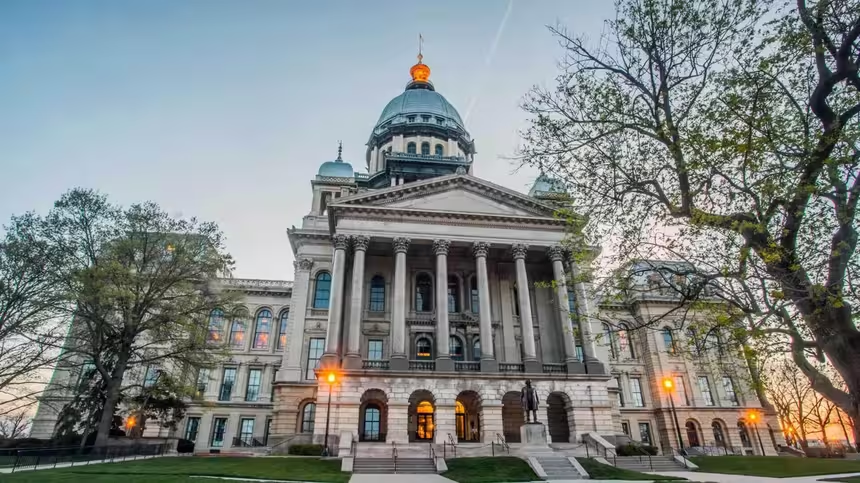
CapitolView
CapitolView is a weekly discussion of politics and government inside the Capitol, and around the state, with the Statehouse press corps. CapitolView is a production of WSIU Public Broadcasting.Providing Support for PBS.org
Learn Moreabout PBS online sponsorship(upbeat music music) - Welcome to Capitol View, where we discuss the latest in state, government and politics.
I'm Hannah Meisel with NPR Illinois.
Joining us this week is John O'Connor of the Associated Press.
Thanks for being here, John.
- Thank you, my pleasure.
- And also here is Freelance Reporter, Sarah Mansur.
Thanks for being here, Sarah.
- Thanks for having me.
- Well, another eventful week around the 4th of July holiday.
Illinois got its first credit rating upgrade in two decades from Moody's Investors Service.
It's not as if we have suddenly jumped to being totally credit worthy.
There's a map that shows where we are in relation to other states.
We're still the state with the worst bond rating across all three of those major Wall Street credit rating agencies.
But it's still, still an awe to be able to turn around the trajectory, to be able to turn around the narrative that Illinois' finances are going down the drain, that we're a lost cause.
That's a cause for celebration for some, and certainly the Democrats who are in charge of state government.
Sarah, I'll start with you, what did Moody say about why they determined Illinois should get a credit rating upgrade from one notch above junk status to just two?
- Yeah, so in the statement that Moody's made, they said that their decision was in part due to the state repaying last year's emergency borrowing and keeping the state's bill backlog in check.
But the statement from Moody's also noted the longterm structural debt.
So it did seem like a tempered upgrade that acknowledged that there were still problems and issues with the state's finances, but that like you said, it's moving in a positive direction, that the state has a balanced budget for the first time.
They have the past couple of years, but it's again, a balanced budget.
And so, it's a positive, but it's still, like you said, there's still a lot to work on (laughs).
- Yeah, I mean, we have those looming financial pressures.
It's not just the massive, I think $44 billion of unfunded pension liabilities that we still have, but it's also increases in education funding that we need to make statutorily.
It's a lot of things.
But yeah, that pension, folks wanna call it a crisis.
Other folks say it's not a crisis that we've known what we're dealing with, but either way, the way that our pension payments are designed, we're not gonna be out of it till 2045 if that.
I think there are many actuaries who say, "Oh, well, I'm not sure that Illinois is dealing with reality here."
But John you've been around for a while.
You've seen the history of credit rating downgrades starting with the George Ryan years, the Blagojevich years, for sure.
And I think we were all around for the budget impasse and the massive credit rating downgrades that brought us to here just teetering above junk territory under former governor Bruce Rauner.
But John, when did this begin?
Some say we never recovered fully from the recession that we had after 9/11, what's your take on that?
- Well, in terms of credit ratings, the bond rating houses credit ratings, I don't think anybody paid much attention to them until they started going down and going down steeply.
When we got to the one step above junk status that became sexy for the media to latch onto and to explain.
It's very difficult to explain to taxpayers what these things represent.
But when you say junk bond, people get an idea that we're not in very good territory.
Now, as you pointed out Hannah in your story where the rubber meets the road with these things when the state goes to borrow money, when he sells bonds on the open market to borrow money for long-term infrastructure, bricks and mortar type projects, essentially general obligation bonds that are backed by a general revenue.
And when the credit rating is low, Illinois, as you pointed out is going to pay a higher interest rate.
We're a bad credit rating.
If I'm in debt and I go to buy a house, I'm gonna pay a higher interest rate than somebody else who is more financially stable.
But the irony here is that as the state has continued to borrow money, we see news releases from Democratic administration saying, "We got great to interest rates.
They still trust us."
And the reality is the Illinois is not going to go bankrupt.
So even though its credit rating is one step above junk, there's always a way to pay off debt.
If things get really bad and that's to raise taxes and that's the reality of the thing, Illinois cannot default on debt like that, but it became weaponized during the Rauner years, particularly when Bruce Rauner the Republican from 2015 to 2019 and the Democrats who ran the legislature couldn't agree on a budget.
And they went three years without an annual spending plan.
And that does not look good in the bonding houses.
So that's where it really started coming to the interest of people outside of Springfield, the money counters, if you will, the experts.
And so as you said, Hannah, it's a good thing.
Obviously it's better to be in better financial shape than to be in junk status, but the way the Democrats celebrated it, as you said, we still have monstrous pension debt.
And we have a change of a definition here.
For example, Governor Pritzker, the Democrat describes the backlog of bills is what three billion now.
And he says, we're now up to date.
We don't have a backlog anymore.
We're paying them on time.
And $3 billion is still a lot of money.
It's not as much as 17 billion, which is how bad it got it at one point.
But as you rightly pointed out, Hannah, we're not out of the woods.
- No, and a couple of things you said there, states pretty they can't go bankrupt.
We saw in 2013, the city of Detroit went bankrupt, and that was a very rare municipal bankruptcy.
Puerto Rico, a U.S. territory is not in great shape.
And so there's been discussions about Puerto Rico declaring bankruptcy, but states, I'm pretty sure it's settled a law that states can't go bankrupt.
And you're right, we still have all of these levers available to us, whether there's political will to raise income taxes, whether there's political will to expand the sales tax to services, which has been discussed for many years.
That's another question.
In 2013 also the legislature passed a pension overhaul law that was supposed to free the state from a lot of pension debt, and unanimously the Illinois Supreme Court said, "Nope, that pension protection clause in the state's constitution is pretty darn ironclad.
And you can't do anything about that."
But Sarah, we saw definitely self-congratulatory statements from Democrats saying, "Well, we are the party of fiscal responsibility.
We are saving the state.
You don't have to ruin lives."
I think that was a quote I'm paraphrasing from Senate President, Don Harmon, who often tussled with Bruce Rauner back in the day.
You don't have to ruin lives to get the state's fiscal house back in order.
So I thought it was very interesting that they put out those statements.
But also, you know, on the other hand, those who have for years been banging the drum that Illinois is not worth saving, they had very little to say, and in some of their little peeps, like, "Oh, we shouldn't trust what credit rating agencies say anyway, it doesn't matter."
It's human nature to use something to that in a way that's convenient to you.
But yeah, Sarah, what'd you see with that?
- I do think that the Democrat's celebrations was premature exaggerated because obviously the state should be passing balanced budgets and paying back their bill backlog and funding their pensions at the rate that they should annually.
So, I mean, these are things and being improved just like a notch above junk status should not be a cause for celebration, I guess.
But yeah, I think that the Republican's arguments, they actually, I think, would argue that we should declare bankruptcy as a state.
I think that's probably what they would say that that would be the fiscally responsible thing to do though, we should declare bankruptcy.
But yeah, I think it's expected that they would try to downplay this positive news that the governor's administration put out.
And I think that the Democrats too are trying to cling onto the narrative that this is a new day, that like state government is different now under JB Pritzker and Chris Welch.
And this is just another example of that, that the state's finances are changing to a positive outlook, but there's still a lot of negative there that they have to improve upon, so.
- If I may, Hannah.
- [Hannah] Oh, yeah, please.
- As Sarah pointed out to the statement from Moody's noted that some of the pandemic relief had been paid back early, I think the state borrowed 2.5 billion and still owed a billion and a half, which it was due, coming due in December of 2023.
So it had some time to pay that back.
The Democrat leaders agreed to pay that off early.
And in a conversation with Governor Pritzker, I said that that shows, I have to say that especially for Democrats, it shows a great deal of restraint, because if you've got that money now, Democrats who were in charge of everything the governorship, the house and the Senate, and they're the ones making the budget, the temptation would be, well, let's use that money now.
We don't have to pay this debt for a few more years.
That's how we got into the pension minutes, quite frankly, is that we'll put off paying the three billion we owe this year because it's not due for a long, long time.
So I will say that in the Democrats favor that they showed restraint there that they paid, paid down debt first, rather than adding it, it would have been very easy to add it to the budget and say, look how great we are in pumping up the budget.
- Sure, but can I also point out that Illinois was the only state to have to take advantage of that federal reserve borrowing program that was made available last spring in the depths of COVID.
And so that shows a lot about where Illinois is at as a state.
But I do wanna move on.
Sarah this week, the governor signed a piece of legislation that's been brewing for about two years, that would allow college athletes to finally profit from their name, image and likeness, sign endorsement deals, hire agents.
This is a movement that's been talked about for, I don't know, a decade or so maybe a little bit more.
It started with some lawsuits from former college athletes and in 2019, California implemented the first of it's kind law.
And then now Illinois is the 20th state to do this.
So what does it mean?
What did the sponsors want out of this legislation in terms of fairness to players, but also making Illinois a leader even though Illinois is like a state planning a state, they still, we always want to tout how Illinois is doing things different better?
- Yeah, so like you said, this is been an issue for years that college athletes are almost treated like indentured servants.
They're not being paid for their work.
So this law, even though it doesn't allow athletes to be compensated by the school for their performance, they are allowed to make money off of their image and likeness from sponsors like you said, like Nike or Adidas, but if it also limits, I think, if the school is partnering with Nike, then the athlete can't get money from Adidas, but still it's definitely a step in the right direction.
- But they can sign on with a local restaurant or car dealership.
- Right and exactly.
Or at the event, one of the woman's basketball player, Ava Rubin was talking about how she wants to partner with a American Diabetes Association.
That's a personal thing for her so it does like open up these opportunities to not just work with businesses or corporations, but these like public, like a medical group or something like that.
So that is, I think it's a positive thing.
Cam Buckner who's a member of the House of Representatives in Illinois was a college athlete.
So was speaker Chris Welch.
So it's a personal thing for them.
And it's still not obviously going... it's not giving athletes, I think, or college athletes, maybe what some people think that they're entitled to, but it's a step in the right direction, I think.
- Sure, and I thought it was really like you pointed out Chris Welsh, speaker of the house, he played baseball at Northwestern, and he didn't say it at the signing ceremony the other day.
But when he first introduced the bill, because he was the one who introed it in 2019, I feel like he talked about how, even though he was from Southwest suburbs, getting to Northwestern, which is just in Evanston, it was difficult.
He did not grow up in a wealthy family.
And just being able to get to those two locations, it was difficult for him.
He didn't have a lot of money and you hear a lot, you hear anecdotes about not just Illinois, but college athletes across the country, having to pick up second jobs, having to sometimes go to food banks all well, the universities profit off of their athletic abilities.
But John, what I thought was interesting thinking back on how this played out in the last two years was if you remember when Chris Welch introduced that legislation, house minority leader, Jim Durkin was very against it, but he and a lot of Republicans ended up voting for it.
So this was one of those few like major pieces of legislation that ended up being bipartisan.
Do you think that that signals that not everything in Springfield is as partisan as folks want to, I don't know, make it seem like it is?
- I doubt it (laughs).
Things are always gonna be partisan.
And at least, well, let me say this you're right in that there are times when publicly it appears that things are much more bi-partisan.
These people get along very well behind the scenes, but they represent different points of view Republicans and Democrats.
And there are conservative Republicans.
There are moderate Republicans, there are conservative Democrats.
And this one, I think was a matter of common sense.
As Sarah said, these athletes are often treated.
and we're not talking the elite division, one scholarship football or basketball player, he is not suffering.
But as representative Buckner told me, as you said, the woman's softball player may be able to, she's not gonna play pro so she can... she's a big star in her hometown and can sign up with the local car dealer.
And it's a step in the right direction.
As Sarah said, it doesn't give athletes everything they want.
James Michener, who is famous novelist, wrote a book in the mid '70s called "Sports in America," where he advocated for paying college athletes.
This idea that the amateur athlete is this innocent wide-eyed person from the planes is long over.
And these universities make oodles of money on sports.
And this is just an opportunity for players to get some of that.
- Sure, and we've got about five minutes left, and I did want to touch on a couple of things and group them together.
Some investigations from some outlets this week that put Governor J.
B. Pritzker's administration in the hot seat yet again.
From the Tribune, there was an investigation about what could the Department of Employment Security have done to prevent this tidal wave of COVID related unemployment fraud?
Let me read a little bit from the piece.
Right on this.
"Records obtained by the Tribune show the flood of fraud happened after IDES failed to follow federal recommendations to adopt free fraud fighting tools that were made available in 2019.
Only recently the agency began using these tools.
A separate process to help identify problematic claims also didn't become fully functional until February, nearly a year into the pandemic."
And also the administration has declined over and over to identify a solid number of unemployment, fraudulent payments that have gone out to these fraudsters.
And then there was a couple other stories, WBEZ published a story this a couple of weeks ago, and the follow up this week about prisoner deaths.
And it wasn't during the Pritzker administration, but in the final months of the Rauner administration, there were workers at a state run mental health facility downstate that were indicted for abusing residents there.
And so Sarah governors, as we like to say in Springfield governor's own.
So what do you think this means specifically the unemployment fraud?
'Cause that's probably the thing that the governor had the most control over because it was made available in 2019 and he failed to do it.
What do you think this is gonna mean for the Pritzker administration going forward?
- Yeah, I think the unemployment story is so interesting because it was such a widespread problem.
I remember even the Attorney General Kwame Raoul talked about being targeted by fraud during the pandemic.
And there are just so many issues, like you said, we don't know how much money was lost to fraud.
There were people who were given overpayments, who like needed to pay that back.
And then of course there are Republicans that are complaining that the IDES offices are still closed.
And that's something that the governor is also having to respond to.
They may have opened recently.
I actually realized, I don't know if they have, but back during session they were closed.
So yes, I do think that these are things that the administration will have to answer for.
They seem like pretty significant lapses or oversights that his administration probably should have known that there were tools available to try and stop this and that they didn't.
And so I definitely think, he will try and talk around it, but it's something he will need to respond to.
- We will probably talk more about this in future shows, but I wanna point out this was on top of the horrific veteran deaths at the Quincy Veterans Home where 36 died from a COVID outbreak.
And so, heading into an election year, we have a lot, but John, just about a minute here.
So please be as brief as you can, but you've seen a lot of elections.
You've seen a lot of governors come into elections with a lot of baggage.
How do you think this will play as we go into an election year?
- I think one of the bigger issues for Governor Pritzker may be the prison issue.
WBEZ revealed that there have been several inmates allegedly beaten.
And what I found interesting in that story is that the local state's attorney said he has tried to investigate several of those incidents and has always been told, "We can't release that because of security."
Long before Governor Pritzker came along, the Corrections Department hid a lot of information behind this idea that we are trying to remain secure.
This could be a story that does have some legs and could cause the governor problems.
- Sure, all right.
Well, that's all we have time for on this week's edition of Capital View.
Thank you for joining us.
I'd like to thank my guests, Sarah and John O'Connor.
Please join us again next time.
(upbeat music)

- News and Public Affairs

Top journalists deliver compelling original analysis of the hour's headlines.

- News and Public Affairs

FRONTLINE is investigative journalism that questions, explains and changes our world.












Support for PBS provided by:
CapitolView is a local public television program presented by WSIU
CapitolView is a production of WSIU Public Broadcasting.