Home is Here
Kahuna Ikaika and Diamond Head Theatre
Season 2 Episode 8 | 28m 45sVideo has Closed Captions
Kahuna Ikaika and Diamond Head Theatre
Diamond Head Theatre, a century-old hub for live productions, just unveiled its modern facility, replacing the worn Fort Ruger Theatre—with PBS Hawai‘i capturing the moment. Then, Ikaika Dombrigues, a man who has reached the status of kahuna or high priest, takes us through his spiritual journey and how he’s using his knowledge to protect and perpetuate traditional Hawaiian healing techniques.
Problems playing video? | Closed Captioning Feedback
Problems playing video? | Closed Captioning Feedback
Home is Here is a local public television program presented by PBS Hawai'i
Home is Here
Kahuna Ikaika and Diamond Head Theatre
Season 2 Episode 8 | 28m 45sVideo has Closed Captions
Diamond Head Theatre, a century-old hub for live productions, just unveiled its modern facility, replacing the worn Fort Ruger Theatre—with PBS Hawai‘i capturing the moment. Then, Ikaika Dombrigues, a man who has reached the status of kahuna or high priest, takes us through his spiritual journey and how he’s using his knowledge to protect and perpetuate traditional Hawaiian healing techniques.
Problems playing video? | Closed Captioning Feedback
How to Watch Home is Here
Home is Here is available to stream on pbs.org and the free PBS App, available on iPhone, Apple TV, Android TV, Android smartphones, Amazon Fire TV, Amazon Fire Tablet, Roku, Samsung Smart TV, and Vizio.
Providing Support for PBS.org
Learn Moreabout PBS online sponsorship(instrumental music) Places Kalaʻi.
Thanks Trudi.
Kalaʻi Miller / Home is Here If done well, live theatre can transport audiences directly into the world of the story.
And for over a century, Diamond Head Theatre has been doing just that.
Act one of this episode of Home is Here takes us through the history of DHT, as it raises the curtain on a new era.
(instrumental music) John Rampage / Diamond Head Theatre Artistic Director So, right now I am sitting in the Fort Ruger Theatre.
It may be one of the last times I actually get to just sit in the theatre and reflect.
This space has been the last 45 years of my life in one way or another.
And it feels like home, it feels comfortable.
And to think that I won't be sitting here anymore, has not quite sunk in yet.
I can process it, I can say it won't be here.
But I don't think until the building comes down that it will truly hit home.
(nat sound demolition) The history of what is now Diamond Head Theatre is truly amazing.
We are the third oldest continuously operating community theater in the United States.
But it hasn't always been Diamond Head Theatre.
Originally, it was called The Footlights and then in the 1930s, it was changed to Honolulu Community Theatre, HCT, which is still what a lot of people refer to it.
And then in the 1980s, it was finally changed to Diamond Head Theatre.
When The Footlights started, it was a group of society ladies who got together to write plays and read plays in each other's homes.
It was very social.
It was very cucumber sandwiches and tea.
And there is no documentation that we've ever been able to find of exactly when they started getting together.
But in 1915, they decided to produce a play, a live stage play, which took place at the Opera House, which is now the post office across from ʻIolani Palace.
When you look at the archive pictures of those early productions, I, I'm truly amazed at the quality and also border line risque for the time.
In 1915, anyone being on stage was considered a little suspect.
It was considered very not the thing to do.
And yet these ladies presented especially tableaus, where people stand still and recreate a picture.
If you look at the costumes, they were considered quite racy for their day.
So, they really were very forward thinking.
Things changed in the 1930s, 1934 specifically.
The name was changed to Honolulu Community Theatre.
And they did their first musical, which was Gilbert and Sullivan's Mikado.
It started appealing to a larger audience it was no longer just the very wealthy, the very educated.
And the 1940s is really when Honolulu Community Theatre came into its own.
They worked very, very closely with the USO in presenting productions, both for civilians and the military.
During the war years, we were actually housed in the Moana Hotel.
And that was actually our last home until we moved here into the Fort Ruger Theatre in the 1950s.
And we have been here ever since, almost 70 years.
This was originally constructed as a USO entertainment facility and also as a lecture hall during the war and also primarily as a movie theater.
They did make provisions for live theater.
It has an orchestra pit that we have not used in probably 50 or 60 years because it's so far back, it's actually under the stage.
And they did include dressing rooms and some small theatrical elements.
I know that when they built this theater, they had no idea, a, that it would still be standing this many years later, and also that it would be used for the type of shows that Diamond Head Theatre has become famous for, big extravagant musicals.
But we have managed to adapt some major, major musicals into our space with a little creativity, a little ingenuity and sometimes just some very, very good luck.
You know, some people who started their theater time here, as children went on and made very successful careers in the theater.
A few of them went on to become quite big stars.
Of course, our most famous alumni is Bette Midler.
But also Georgia Engel from The Mary Tyler Moore Show, and several others.
The Fort Ruger Theatre brought forth tremendous memories for people, associations of my parents had their first date here, it was the first show I ever saw as a child.
And when they would come to productions, and the lights would be dim, and you would look around and you would think I can't imagine why they would want to tear this down it's so charming.
As I tell people all the time, it was not vintage, it was old.
We've done most of the improvements in the front of the house over the years.
But if you see the back of the theater, the actual stage area, the wing space, the dressing rooms, it's very obvious that it had to come down.
When we initially considered our options, one of them was to gut the Fort Ruger Theatre and update it.
It actually was less expensive to build a new theater than to update this one.
And also we would not have been able to include a fly loft.
And the addition of the fly loft was really the deciding factor in building a new theater versus renovating the old one.
Musicals in particular, which is what we are known for, have changed greatly since the golden era of the 1950s Rodgers and Hammerstein and Lerner and Loewe where the audience was very content to see a three hour show.
A song would end, the curtain would close you would sit while the orchestra played a reprise.
They would change the set, the curtain would reopen again.
That's not how musicals are written anymore.
Musicals are written very fast paced, you're not supposed to see this the set changes.
They're immediate.
They're supposed to be magic.
And we are very limited in the old theater with being able to do that.
Yes, we did do it.
But it was very hard, and it's getting harder with every future production.
So by having the fly loft, not only does it it enable us to be more creative, it's also a much safer environment than this old than the old theater was.
It will have more wing space, it will have an orchestra pit where the orchestra pit is supposed to be, instead of on the side of the old theater.
There was a lot of thought given to maintaining the old theater or building the new.
And we finally came to the conclusion that the new theater would have a longer life, and that we would be able to do much better work for the community.
(instrumental music) The final performance of Anything Goes was incredibly emotional for everyone involved.
It was the final performance in the old Fort Ruger Theatre that people had grown up in, they had fallen in love with theater as children, they had either been onstage or their parents had been on stage, or they had been subscribers for 20, 30 years, volunteers.
It basically became a home for a lot of people for many, many years.
So, saying goodbye to it meant so much to so many people who wanted to be involved in it.
We brought everybody on stage for a toast to say goodbye.
Let’s toast to the Fort Ruger Theatre.
And then we had a special finale at the end.
That was a little melancholy and sad.
And then we brought it back up again, with a reprise of Anything Goes with people tap dancing in the aisles, tap dancing on the sides.
And it was a wonderful aloha to a theater that everyone loved.
(audience applause) I will miss I think most of all the memories, the memories of the people who have come through here, some of whom are not with us anymore.
But the memories of the people and what we created.
Now that, of course will continue in the new theater.
But I think there's something about the ghosts in this theater of people who came long before us and passed the legacy of this theater down to us, is something I'm going to miss terribly.
(instrumental music) Diamond Head Theatre is a nonprofit organization.
It is a community theater.
Our actors, for the most part are volunteers.
They are paid a very small honorarium.
We rely very heavily on volunteers in the scene shop, the costume shop, our actors, our ushers, our concession people, volunteers in the box office.
No production would take place without the wonderful people that the audience doesn't get to see.
The volunteers who work backstage moving the set pieces, running the spotlights.
It truly is an army of people.
The actors get the recognition on their bow, but they only get the thank yous that we always try and give them for the donation they do of their time.
Most of them are back there and not onstage because that's where they're comfortable.
They, they don't want to be in the spotlight, but they want to be part of theater.
They are just as important as the star taking the final bow at the end of the show because their contribution is the same.
I had a friend who came to see the show the other night, a professional actress, dancer, and she said, I loved watching it because they're there because they want to be not because of a paycheck.
And I think that sums up incredibly well what we do and the love you feel in our productions.
People are here because they want to be.
They want to show off their talents on stage.
They want to be part of a community that is creative and working together to make art.
And I think that's true all the way back to 1915.
It was people coming together because they wanted to create art for Honolulu.
(instrumental music) There is something unique about live theater that you cannot experience in any other form.
You can watch a show on video, but you don't get that same connection you get to live theater.
If a production is good, and the performers are good, as an audience member, you should feel like they're doing the show directly for you and your entertainment.
I think the legacy of Diamond Head Theatre will only continue to grow with the new theater.
I'm constantly amazed especially with young people, because young people are always the future of theater.
5, 6, 7, 8.
And 1, 2, 3, 4, 5, 6, 7, 8.
And 1, 2, 3, 4.
Stay on the line.
Back up.
And 1, 2.
Stay on the line.
5, 6, 7, 8.
How much more interest and how well trained children are now compared to when I was growing up in theater arts.
They take classes, they take master classes, they observe theater, they go to theater, and they will be leading the new theater.
The new theater is for them, it's for them to take, continue to grow into an even bigger and better theatrical outlet.
But I think those that are making the crossover into the theater will always respect what they learned in the old theater when it was difficult, when there were challenges, when it was hard to get on stage.
When sometimes, if a set was in the wrong place in the wings, you couldn't get out of the dressing room.
I think they learned so much in the old theater, that they're going to appreciate the new theater even more and be able to create bigger and better than we do now.
Kalaʻi Miller / Home is Here Poʻokela Ikaika Dombrigues is a Kahuna or high priest of many different traditional Hawaiian practices.
At the Native Hawaiian Health Center on Hawaiʻi Island, he perpetuates the cultural and healing methods of his ancestors.
(Nose flute playing) Ikaika Dombrigues Aloha Tatou Ikaika koʻu inoa ke Tahanu Nui o pale tu Ikaika Dombrigues.
I'm from the Big Island.
So, from a young age, I've been searching of who I am.
And my parents, there was a separation because answers wasn't the answers that I needed.
Understanding the ‘oiaʻiʻo, the truth, it was a journey for me.
And I found my journey in a valley with the gods.
When I went into the valley, then it was like a spiritual guidance to be there.
And I looked at him, I said, I know you from someplace.
And all he did is laugh at me.
And he smiled, so I said thank you to having me in your valley.
And his name was Tahuna Nui o pale tu po paki Sam Hoʻopiʻi Lono.
He said, the first thing you must understand is who are you and the connection between you and nature of everything of life, that we are one.
If I'm in the forest like today I must acknowledge that I'm one with the land and the forest.
I asked him that my parents could understand what I'm going through.
He said, Remember, our culture, belief, practice, and worship was taken away.
We could not speak the language we could not practice our culture could not practice our religion.
Our parents were programmed to not use the old way.
But it still does exist.
But for my hanai grandpa, he was a very humble man, very strict, but very grounded.
He was in touch with nature.
He’s the descendant of the god Lono.
The god Lono was agriculture, god of peace, god of prosperity.
Back then Papa Lono was a very powerful teacher, a father, of hanging on to a culture that was slowly been lost.
In the valley, there's that healing area.
It's not man that teaches us the knowledge.
It is the ancestors.
You’re chosen to become who you are by them watching you.
And that's what I learned.
I learned of our culture, the healers, or the so-called powerful Kāhunas.
A Kahuna is a High Priest, it’s a healer.
It's, um, we don't use the word healers, because actually the healer is the Creator.
We're just his vessel.
In today's world, people think that we're self-proclaiming ourselves of a Kahuna.
But understanding that man does not choose, it comes from the gods that you're chosen to be who you are.
E te Atua e na matua i Hawaiʻi Nei ka haku.
O Lono, O Lono, O Pele.
My aloha to all of you.
Kokua mai ka mana ka ʻike.
Aloha mai aloha mai na tatou.
Mahalo nui i ke kane ke Kuahiwi e ka laʻau lapaʻau.
The healing herbs of the forest of the gods that watch over and many of the other gods.
Our respect to all of you and mahalo nui loa that we will continue to perpetuate who we are as kanaka.
Aloha.
Mahalo nui.
Laʻau is in Hawaiian, laʻau is a plant, like this right here, it's a plant.
When you combine with la'au lapa'au the plant has power to heal.
That's what it means.
Respect and honor them first before we gather.
The spiritual component of the laʻau and you, like we say, we are one with all things.
So, letting them, the laʻau, know that we have respect in gathering for healing people.
This laʻau here, we use it for burns.
First and second degree burns.
People get hunting and camping they get burned from whatever campfire.
This hairy thing that is here, we call it pula.
This is for cuts.
When the dogs get cut from the boar tusks you apply this to the injury to heal that area and stop the bleeding.
This laʻau here is māmaki.
This is a bush but it grows to a tree that is sometime is 15, 20 feet tall.
The most important to identify the māmaki is by its red veins.
That is this over here.
The red veins, it's the koko, the blood of our people so this laʻau telling us, this laʻau is good for our blood in our system and to detox, to purify, and to get rid of toxins in the blood system.
Noe Scott Aloha My name is Noe Scott and I'm the operations director for Hui Mālama Ola Nā ʻŌiwi.
Hui Mālama Ola Nā ʻŌiwi is one of five Native Hawaiian health care systems in the state of Hawaiʻi.
So Hui Mālama Ola Nā ʻŌiwi is the native Hawaiian healthcare system for Hawaiʻi Island.
And along with our system, we actually have uncle Ikaika Dombrigues who is part of our traditional Hawaiian healing program.
And uncle Ikaika is actually our poʻokela and our practitioner for the organization.
Our traditional Hawaiian healing department actually focuses on the traditional Hawaiian components.
So it includes laʻau lapaʻau.
It includes hoʻoponopono.
It also includes on more like spiritual enlightenment, and really learning the old Hawaiian ways that were taught through our ancestors, and kūpuna.
The first day I met Uncle Ikaika and I remember him walking into the office.
And it was right after our organization had went through a change in administration.
He walked in and I just remember him saying, I was called here, what's going on?
And I remember then the staff started coming out.
And then we all kind of started talking to Uncle like, Oh, my goodness, like, hey you know, like you showed up at the right time And I remember uncle went throughout the building, he blessed the whole building.
And I do believe with Uncle coming in, and blessing us spiritually that is why we are still here to this day.
We actually gave him an office space and we're like, okay, you know, we really need to start doing and focusing on our traditional Hawaiian healing department.
So uncle Ikaika Dombrigues assists us with our traditional healing department.
And he provides hoʻoponopono, laʻau lapaʻau, Hawaiian massage and laʻau kahea.
Our laʻau lapaʻau classes he actually teaches people, the medicinal components of the Native Hawaiian herbs.
So with Hui Mālama Ola Nā ʻŌiwi, we're fortunate to provide both Western and traditional methods.
And so you know, we have our clinic providing the western medicine, and we have a traditional Hawaiian healing department, providing the traditional Hawaiian aspects.
Ikaika Dombrigues Kahuna, or Tahuna.
Tahuna people don't understand that.
Tahuna all it means is the keeper of the secrets.
Keeper the secrets of the past of the powers that comes from the land, the sky, come from the ocean, come from what is placed on Earth for all of us.
A gift is to give it to a person or knowledge is given to protect it.
And, you know, in our culture today everything was taught was already taught.
And our ancestors was very smart in it.
In today's world, they are abusing it today.
There is no respect.
There is no mana within the name.
Nowadays, like a Kahuna is a very powerful name in our culture.
But now they call a hamburger, Kahuna, they call a surfboard a Kahuna, they call whatever.
And that is where our mana of the language is slowly been abused.
There were a lot of healers back then.
And today, the haumanas, the students, whoever they trained from that had that gifts is our challenge is to perpetuate it to make sure it does exist.
That cape that I wear every knot that I tied represents each ancestors.
Every knot and I always say when I'm done this I will carry you on my back that's my story behind that.
We need to learn the past to save our future and to save our world.
E tu e tu atea te tae atu e tane ro e tane ro e lohuli tou.
E rono e rono ulu ta mea e ponua e Tane e Tane e te faere te tuahiwi.
E ruriruri I ta poha tete tae atu.
Nana I te tu ana nana I te tumuhana nana I te tumulipo.
O Pele o Lono O kanelo O Ku.
But that's my my life.
You know, what I say is what I feel what I talk about what I learned there was my journey and just to tell everybody think about it.
The key thing is find out who you are first.
Nana te tunu, nana te tumuhane, nana te tumulipo.
Look unto the source.
Look unto the source within you.
Look unto the source with the spiritual light as ka poʻe ʻōiwis.
Kalaʻi Miller / Home is Here Thank you for joining us.
For bonus features from this episode including a personal tour by John Rampage of the old Fort Ruger Theatre, go to pbshawaii.org.
For Home is Here, I’m Kalaʻi Miller, a hui hou.
John Rampage / Diamond Head Theatre Artistic Director When I did my first show in 1975, Arthur and Catherine Murray of the famous dance school, they lived on the Gold Coast.
And they would come and dance in the lobby at intermission with a boombox just to be a part of this community.
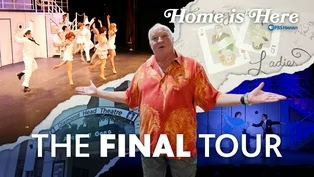
Diamond Head Theatre: The Final Tour
Clip: S2 Ep8 | 7m 22s | A tour through the Diamond Head Theatre ahead of its demolition and reconstruction. (7m 22s)
Providing Support for PBS.org
Learn Moreabout PBS online sponsorship













Support for PBS provided by:
Home is Here is a local public television program presented by PBS Hawai'i