Home is Here
Education, Conservation and Determination
Season 1 Episode 3 | 29m 4sVideo has Closed Captions
Education, Conservation and Determination
Conservation Dogs of Hawaiʻi takes us into the mountains above Oʻahu's North Shore. Buddy Bess recalls the "coincidence of events" that led him to start Bess Press. And 14-year-old Genshu Price explains why he has taken on the task of collecting and recycling millions of bottles and cans.
Problems playing video? | Closed Captioning Feedback
Problems playing video? | Closed Captioning Feedback
Home is Here is a local public television program presented by PBS Hawai'i
Home is Here
Education, Conservation and Determination
Season 1 Episode 3 | 29m 4sVideo has Closed Captions
Conservation Dogs of Hawaiʻi takes us into the mountains above Oʻahu's North Shore. Buddy Bess recalls the "coincidence of events" that led him to start Bess Press. And 14-year-old Genshu Price explains why he has taken on the task of collecting and recycling millions of bottles and cans.
Problems playing video? | Closed Captioning Feedback
How to Watch Home is Here
Home is Here is available to stream on pbs.org and the free PBS App, available on iPhone, Apple TV, Android TV, Android smartphones, Amazon Fire TV, Amazon Fire Tablet, Roku, Samsung Smart TV, and Vizio.
Providing Support for PBS.org
Learn Moreabout PBS online sponsorshipKalaʻi Miller Aloha, I’m Kalaʻi Miller.
Education, conservation and determination are underlying themes in this episode of Home is Here.
And we’re starting with a real page turner.
Bess Press is a family-owned publishing company that’s been in business since 1979.
According to co-founder Buddy Bess, it was “a coincidence of events” that led to its creation.
David DeLuca / Bess Press Director of Publishing / Development Education is probably the one singular thread that runs through everything that we do.
It's been a lot of the guide map for what it is that we publish.
Buddy Bess / Bess Press Co-Founder I worked in publishing in New York and had a corporate background and met Ann on a bookmobile in Little Rock, Arkansas, and she had a job offer to come to Hawaiʻi.
So when I came here, I looked for publishing jobs, couldn't find them, and started another company called Hawaiian Book Service and basically, I was selling books on a commission basis.
And then in 1978, the Constitutional Convention was passed that mandated Hawaiian history, language and culture be taught in the schools.
The first book that we did was called Hawaii Our Island State written by two authors locally Potter and Kasdon published in 1960.
And another book called Hawaii the Aloha State, written by a California educator who came out here.
When I started the company, I would visit every school in the state.
And once a year, I would knock on the doors and visit with the school librarians, the teachers, etc, and trying to sell mainland stuff.
And then I bought the rights to those two books because they kept saying we need something at that fourth grade level or at the seventh grade level and those two books filled the niche.
Ann Rayson / Bess Press Co-Founder Our first original publication was called the Hawaiians of Old, written for the fourth grade by a teacher here, Betty Dunford.
The Hawaiians of Old was desinged in our dining room.
And she gave us a handwritten manuscript.
She didn't even type so this is how we started.
Buddy Bess / Bess Press Co-Founder We did work out of houses, where we lived, and we have three children, and Ann was teaching at the university so I became Mr.
Mom quite a bit.
And it was at the time, exhausting, and I sort of wanted to go just to an office and work but in retrospect, it was one of the most valuable things in life, having the children raised with the business but also meeting writers, illustrators, educators, musicians.
A different part of their education was really at the Bess Press.
Ann Rayson We used to pay our small boys like $1 an hour to shrink-wrap filmstrip kits and things like that until one day we found the older one had shrink-wrapped the head of the the younger one and put a straw in his mouth so he could breathe.
He didn't get paid that day.
(Laughing) Buddy Bess Over the last four decades, we've had a lot of changes, successes and failures and based on outside influences, the pandemic has certainly been our biggest challenge in the last few years.
We’re small, we’re able to pivot.
I think the biggest hurdles we've had, were just the evolution of the book industry itself from from print to Amazon's trying to sell everything to digital.
And just people's habits changing and wanting to be either educated or entertained in an in a different fashion.
So all these things we can't control but we adapt.
We are committed to publishing local regional materials that started out with one book and it's expanded to the entire Pacific right now.
Ann Rayson Who we're doing this for, is the local community, really.
And by that, I mean, also Micronesia, American Samoa, the Pacific that is part of Hawaiʻi.
We depend on the local population for our input for our artists, our authors.
Our translators, especially.
Schools.
It's because of this community that we're able to do what we do, and we try to supply what the community needs.
Buddy Bess We're a family run business and our son in law, David DeLuca, had been with us for 15 years has grown up here learning the business.
And his, I think taken advantage of some of the opportunities to present themselves in a different format.
David DeLuca I feel honored to be able to carry on the work that they originally did with seeking out new generations and moving it forward, because local businesses, family businesses, particularly in Hawaiʻi, that's the thread of what makes this place special, right?
It makes that dynamic of how people want to seek out and interact with particular organizations or companies, is the localness of it.
And when you have the ability to have something that becomes multi generational, I think that there's just there's much more of profundity and a validity that solidifies the mission and objective of what that original company started off doing in the first place.
And so our realm has always been to try to put together voices that are generating worthwhile content from a local perspective, whether it's Hawaiian, Filipino, Japanese, Micronesian, and so on, and make that available to the community at large so that we, as a group can have a better understanding of each other, or these little niche communities or cultural practices or histories that influence everything that we do and what makes up our local community now.
da Shop was originally created in this mindset of being a community resource.
The idea of an independent boutique bookstore, is really based off of this concept of authenticated experiences, right?
There's nothing more real than when we can engage in a dialogue or in a conversation with each other and the bookstore has provided us with the opportunity to do that with the people that we're creating content for.
Oddly enough, we've grown during the pandemic.
It turns out that having to stay at home is a reason to buy a book, or a reason to start reading the books that you always wanted to.
And the business that we're in of providing a service by generating educational textbook materials, but also in the same realm is producing popular interest titles, biographies, memoirs, children's books, nonfiction titles about Hawaiʻi, and having having a retail shop.
All these things at their heart are providing community with resources from which they can read and learn and become more knowledgeable.
I mean there's always going to be an audience for books, we know that.
There's always going to be an audience and a place for technology and the digitization of content.
But it's our job to figure out where and how to make that appropriate for the right audience and the right kind of content.
Buddy Bess The most popular book we've published, I believe is Pidgin To Da Max.
Ironically, we did not originally publish it.
It was self published by three or four people, but they eventually wanted to get out of the publishing business.
And we, we took that over, and we developed it into a series of different different books, Fax to Da Max, Pupus to Da Max, etc.
Pidgin to Da Max was and still is successful, because it hit the the pulse speed of working and playing people in Hawaiʻi.
The working man's language, but it also identifies one as being from the place, even a word or two.
It just is captured.
It's humorous.
The illustrations are a little dated, but and part I think that's that's some of the charm too.
And how good is your pidgin?
Umm.
Don't even try.
(laughing) Kalaʻi Miller Obedient and nimble with a superior sense of smell.
Dogs are being put to work to protect our endangered species as well as sniff out threats to our ecosystem.
This conservation effort is being led by K9 trainer Kyoko Johnson and her group of dog handlers and their four-legged companions.
Kyoko Johnson / Conservation Dogs of Hawaiʻi Founder & K9 Trainer Hi, this is Guinness, he's a Dutch Shepherd mix.
We don't know what the other half is, but he's a three year old male, and he's a love bug.
Conservation Dogs of Hawaiʻi is an Oʻahu based nonprofit organization.
We have a two fold mission to utilize dogs to detect invasive species that are harmful to the environment and to other wildlife, and also to detect endangered species so that we may gather data to help protect them.
I started this program because in Hawaiʻi, there is a huge need for conservation.
Okay, find it.
There's several components to teaching a dog to do scent detection training.
One of it is you know, building their hunting motivation by using their food and toy and whatnot.
Also exposing them to different types of search challenges whether it's an elevated hide or underground or you know, behind obstacles, etc.
But as far as imprinting them on the odor that you want them to search, Good boy, what a good boy!
it's all classical conditioning.
It's similar to Pavlov's dogs where they associate the bell with food so they start salivating.
We pair the target odor that we want them to find with either their food or their toy, whichever they're motivated more to search for.
And then once they made that association, we take the food or toy away and they're motivated to find just the odor by itself followed up by the reward.
So some of the projects that our dogs have worked on, include avian botulism, which is a disease that affects native waterbirds such as Koloa Maoli.
So the dogs detect the carcasses and remove them from the environment.
The dogs have also been trained on yellow crazy ants, which is a highly invasive ant that can kill and attack seabirds, especially the ones that are on the ground.
Okay, let’s go find it.
A lot of our dogs detect devil weed, which is another invasive species.
It affects the environment negatively and it's also toxic to livestock.
So it's important to keep it away from agricultural areas.
The red is what Roberta drew.
So in late October, I organized a big group outing to some trails up in the North Shore hills, and the idea was to find as many devil weed plants as possible before the flowering season coming up in December, Yes!
Good job.
Because once the plants flower and seed, it just spreads like crazy.
CDH consists of both volunteer dog handler teams, as well as staff dog handler teams.
The dog handler teams in the invasive plant program are all volunteers from the community.
Most of them started out as my own personal scent work students, and I just saw a lot of talent and ability to do field work.
So the four dog handler teams that came on the group outing, Sandy and Ruger, the Weimeraner and Roberta and Qana, the Malinois.
They started maybe in 2019, when we first started the program, so they really kind of helped me develop the program as well from you know, learning from our mistakes and developing protocols.
And then the other teams David is quite new.
He came to me in my regular pet dog nose work class, but I could just see that his dog was not suited for three minute searches on a leash because she's just like, a wild hunting dog.
Let’s go find some more.
And Julie and Ula the Chocolate Lab came to us maybe a little over a year ago, and they had actually taken scent work classes before that.
So they're already experienced in that part.
So they integrated with a program very quickly and easily.
Roberta Bitzer / Dog Handler Volunteer The reason why a volunteer is because I'm not from Hawaiʻi.
I'm from Brazil.
But I've been living here for about 15 years.
I always felt the need to give back to the island.
Qana come.
Good girl.
Good girl.
Let’s go.
She loves her Frisbee.
She loves to play.
And she loves to hunt.
And this is a perfect combination for her.
She enjoys the whole process.
Where is it Qana?
Kyoko Johnson / Conservation Dogs of Hawaiʻi Founder & K9 Trainer I would say that any dog can learn to detect an odor.
All dogs have amazing olfactory systems, even you know, little Chihuahuas and French Bulldogs.
However, to do field work, it does require a certain level of stamina and hunt drive and you know, motivation to work for their food or their toy, or whatever their motivation is.
So, not every dog is suited suited for field work.
Especially with this devil weed detection, it's physically intensive for both dog and handler.
So that's one of the criteria that we have for the teams, the dog might be a rock star, but if the handler has bad knees, or, you know, shoulder problems, or whatever it is, then it's, it's just not gonna work out.
It's dangerous, and we don't want to put anyone in danger.
Roberta Bitzer / Dog Handler Volunteer She does look like she's on odor and it's tricky when we are on an edge of a mountain like this because it could be coming from real far and up to 50 meters away.
There was a nice breeze coming this way and it looked like she was on odor but when it switches she loses it.
We're kind of just working, working the wind, the terrain to get to the source.
This is a very challenging condition right now there's not one breeze?
The way I know she's on odor when we are hiking is she there will be a change of behavior.
She will go from just cruising around to typically a head turn.
And it'll be towards the wind.
Show me.
Yes, good girl.
Yeah, good job!
Yeah you worked for it, you earned it.
Yeah.
It's funny because she will take you right to it and then she can't see it and it's a big plant and it's like she's passing it and it's just I just stop and wait for her to see it.
After we find it, so I usually play with her a lot, give her some water.
But I leave her with her frisbee because that's what she did all that work for.
So I let her enjoy it and then I pull as much as I can.
If it's too much, then I just mark it on the map, and then we come back another day to pull it.
But if it's just a little bit of plant like this, we we I'll just uproot it myself.
And today we got a volunteer so we can pull as much as we can.
The flower is very light.
The seeds are very small too.
So, when hikers come by or bikers, it just gets stuck in your pants, shoes, hair.
Even the dogs when we are doing survey and it's flowering.
We got to make sure we decontaminate them before we move on.
Kyoko Johnson / Conservation Dogs of Hawaiʻi Founder & K9 Trainer The goal is to find our targets, whether it's invasive or endangered species, but there are times when we don't find anything, especially with endangered species.
They're endangered because they're rare.
So there will will be days or weeks where we don't find anything.
And some dogs are okay with that, because they just like to be out in the field and hunt and some dogs get demotivated if they don't find enough.
Good job!
Roberta Bitzer / Dog Handler Volunteer Even one plant is highly rewarding for me because it's a plant that we found it's one less plant out there that could turning into many, many more once it matures.
But for her I don't think it matters if it's one on a or a hundred, it's the satisfaction of finding it and getting rewarded.
Good job!
We may not be able to eradicate it, devil weed on Oʻahu, but at least control and stop it from spreading and going into other islands.
Kyoko Johnson / Conservation Dogs of Hawaiʻi Founder & K9 Trainer I would say that a good day in the field is when the dog is successful.
Whether or not they find anything, if they don't find anything, then you can say that the area is probably clear.
And if they find something and let you know about it, then it's a huge success for science and as well as for the dog.
My hope for CDH in the future is that we can expand our programs and we can expand to the other islands as well.
I would love to get some of my dog handlers trained up to a point where they become trainers as well and help other people become dog handlers.
Also, just to make more connections with natural resources managers and biologists and understand more the needs of conservation in Hawaiʻi so that we might be able to pick projects that are suitable for the dogs because not all of them are.
In my world, a good day would be being out in the field with my dog.
You know, I think running the nonprofit organization, there's so much behind the scenes work, bookkeeping and grant writing and responding to emails, writing proposals, and it's all important work.
But it's the most fun thing is to be out with the dog in the field.
Kalaʻi Miller It takes determination to collect and recycle millions of cans and bottles to raise money for college.
That’s what Genshu Price is doing, but the cash isn’t just for his future.
With the help of his parents, he started the non-profit Bottles4College.
The goal is to provide scholarships for other students, so cost is not an obstable towards a higher education.
Nats cans My name is Genshu Price and I’m 14 years old.
Genshu Price / Bottles4College Founder So initially, I started recycling when I was 10 years old.
But Bottles4College really started when I was 13.
At the very end of 2020.
I first started because my dad, one night at dinner we were talking, he said, "Hey, here's an idea, collect cans and bottles to try to get a million cans and bottles to try and help with at least part of your college tuition.” Nats cans After that first deposit, which was about, I think, like 775 cans and bottles, I realized two things.
One was that it's going to take forever to get to a million, um, might as well be in college debt by the time I even get to close to 100,000.
And the second thing was that this can be so much more.
Most Hawaiʻi families are probably going through some sort of variation of what I'm going through right now where we want to go to college, but you're not exactly sure if that's actually a possible reality, because of things like high living costs and other social problems that we are faced despite being in such a beautiful paradise.
So I decided instead make it for other students, and that's how Bottles4College kind of started.
Maria Price / Genshu’s Mom When Genshu first told me about wanting to do Bottles4College on the scale that's more about helping others, it was definitely something I wanted to support.
Nats glass bottles As a parent, though, we wanted to make sure that he was really committed to it.
So we took the baby steps to make sure that that's something that he wanted to devote himself to.
So it did start out with him, you know, having the courage to ask his neighbor's or people at the beach, or the parks, if they're done with their cans and bottles.
And it really started small like that and he's really proven to us every time over and over that he's willing to, have that courage to do what it takes to do that, continue to sort and do the recyclables.
Genshu Price / Bottles4College Founder The goal of Bottles4College is to create a system where each year we collect two to four million cans and bottles so annually one to two Hawaiʻi students can get a full four year ride to college.
So one million cans and bottles is roughly $50,000.
And the reason why we chose two to four million cans and bottles a year is that we can kind of cover a variation of different college prices.
Maria Price / Genshu’s Mom So, the four pillars of Bottles4College are education, environment, community, and lifestyle.
So, the education is to inspire and aspire for higher, higher education.
Genshu Price / Bottles4College Founder I've always liked school and enjoy going to school.
But most people, most students don't share that same thought about school.
In fact, they just rather not have school altogether.
And I kind of want that to change because education is very important.
It gives you better jobs, it gives you a lot more opportunity.
And I'm not saying that everyone has to go to college, because that's not made for everybody, but to be able give that possibility at all.
Maria Price / Genshu’s Mom The environment, of course, is to protect our ʻāina and our environment altogether, we've really helped keep the cans and bottles out of landfill.
That's one of our big goals.
And then community because we cannot do this without the whole communities effort.
Genshu Price / Bottles4College Founder It makes me feel great that the community has been very supportive.
And it's just like, wow, okay, this is something that can actually happen.
It reminds me that I have to keep on working and doing my part so the community can keep on doing their part and it's like a two way connection in that sense.
Maria Price / Genshu’s Mom One of the reasons why the four pillars the lifestyle is there is because when you really start recycling, you know it's an ongoing effort.
So, the kids they learned so quickly and they enjoy that so Mic-key can already, he's six years old now but he can already look at a bottle and say if it's the big or the small, and it really gets them conscious every time we're driving or walking and we see a can or a bottle one of them is running down to go get it.
Genshu Price / Bottles4College Founder So because of the pandemic, everything until the very end of 2020 was almost stagnant.
But we had our first public drop off people at King Intermediate School where I attended for seventh and eighth grade.
There we have multiple student artist painted bins there for the community drop off their cans and bottles.
And then on New Year's Eve we launched our second public drop off depot at the Kualoa Grown Farmers Market at Kualoa Ranch.
And there, we have a bin there for the people who drop off their cans and bottles there as well.
Nats bottles Sorting can be a very physical activity.
It's at least two to three hours, because I do have school and stuff.
It does take up a good majority of my day.
But when I can, I am usually sorting.
So it's about two, three hours on the school day.
And on the weekends or something, I might even just take the whole day to sort if we have a lot of cans and bottles.
Nats crushing cans We have to like crush cans, we stomp on them we use different manual can crushers and also just like the repetitive activity of taking off caps putting them away moving the bags into our area where we store them and so forth.
So, it's definitely a lot of work.
There are a few days where I do get a little tired of sorting like, oh, my gosh, this is super overwhelming.
But it's just a reminder that there are ups and downs to everything and you have to just stay motivated, keep on going.
Things that keep me motivated includes the fact that there's just so much support coming from the community or like, everyday, we're getting some sort of contact saying, “Hey, we have cans and bottles are you doing a pickup, are you planning an event?” And of course, we have so much more growing to do, but it's just that constant reminder that this is a way to give hope and a way to inspire the communities here in Hawaiʻi to go for more.
Is that okay?
Maria Price / Genshu’s Mom We talk about this with Genshu too, but every time somebody says yes to him, it means so much to him.
It could be one person or a business but every, I mean everything that Bottles4College has been able to do it's because one person said yes to him and so that means so much to him and us all together as a family too.
Genshu Price / Bottles4College Founder I definitely could not do it without my family.
My parents, they drive me pretty much everywhere I have to go so and they also helped sort they helped me with all the logistics, all the paperwork and all that just showing me the ropes.
And I'm absolutely grateful for them because without my family I this would not have happened.
I honestly it was my dad's idea to like start this and I just built on top of that.
Maria Price / Genshu’s Mom I absolutely think that this has been such a great rewarding effort for Genshu, not just for the activities he's doing with Bottles4College, but just all the things that he's learning when it comes to work ethic or even just all the fundamentals of that.
So, he's learning how to communicate to people over email over phone calls, he's really impressed us that way.
So you just contact us.
Send us a picture, your address and we’ll figure it out.
Okay, thank you so much.
You take care.
Genshu Price / Bottles4College Founder There is a lot of reasons why I chose to do Bottles4College and give back instead of just recycling and doing it myself.
Nats plastic bag One, is that there's just so much more I could do for others and that kind of like just opens so much more doorways to be able to give back to the community.
Because we're all about our ʻāina, we're all about family, we're all about that here in Hawaiʻi.
Maria Price / Genshu’s Mom I really do love Genshu for his heart and I'm very proud of him for that and wanting to help others.
That's, I think, something that has been in his nature, always.
Genshu Price / Bottles4College Founder My message to anyone else, especially kids, my age, older, younger, that have an idea that may seem out of this world, honestly go for it.
Because at this point, especially since we're young, you really have nothing to lose.
If you want to give back if you want to do something for others for the community, then you should absolutely go for it and do your best.
Kalaʻi Miller Thank you for joining us.
Go to pbshawaii.org for bonus features from this episode, including a story on how rats, yes rats, could be used for conservation efforts.
For Home is Here, I’m Kalaʻi Miller.
A hui hou.
Buddy Bess We felt that our niche was more grassroots, rooted withe kamaʻāina and that proved to be ultimately successful for the company.
Kyoko Johnson The dogs who do the field work love it.
I mean they know when their handlers load equipment in the car or as they drive up to a certain area where they typically do surveys, they just start wagging their tail and drooling in excitement.
Genshu Price Oh my gosh it’s sometimes overwhelming where I have a few days where it’s like, man this is a lot and yes there are a few days, but like, it’s, like it’s just a reminder that hey there are ups and downs and you have to just stay motivated and keep on going.
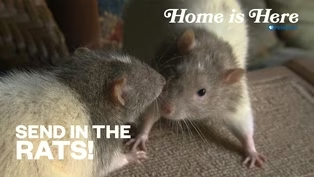
Clip: S1 Ep3 | 3m 37s | How canines aren't the only furry, four-legged animals sniffing out invasive species... (3m 37s)
Providing Support for PBS.org
Learn Moreabout PBS online sponsorship













Support for PBS provided by:
Home is Here is a local public television program presented by PBS Hawai'i