
Oxford Shooting Impacts/Gun Control Debate
Season 5 Episode 41 | 26m 46sVideo has Closed Captions
Oxford Shooting Impacts/Gun Control Debate | Episode 541
This week on One Detroit: The aftermath of Oxford. One Detroit’s Christy McDonalds hears how Oakland Schools’ mental health team is supporting schools after the Oxford school shooting; teachers share their perspectives on the shooting and how they’re supporting students; and Stephen Henderson and Nolan Finley talk about gun control. Episode 541
Problems playing video? | Closed Captioning Feedback
Problems playing video? | Closed Captioning Feedback
One Detroit is a local public television program presented by Detroit PBS
Oxford Shooting Impacts/Gun Control Debate
Season 5 Episode 41 | 26m 46sVideo has Closed Captions
This week on One Detroit: The aftermath of Oxford. One Detroit’s Christy McDonalds hears how Oakland Schools’ mental health team is supporting schools after the Oxford school shooting; teachers share their perspectives on the shooting and how they’re supporting students; and Stephen Henderson and Nolan Finley talk about gun control. Episode 541
Problems playing video? | Closed Captioning Feedback
How to Watch One Detroit
One Detroit is available to stream on pbs.org and the free PBS App, available on iPhone, Apple TV, Android TV, Android smartphones, Amazon Fire TV, Amazon Fire Tablet, Roku, Samsung Smart TV, and Vizio.
Providing Support for PBS.org
Learn Moreabout PBS online sponsorship- Hi, I'm Christy McDonald.
And here's what's coming up this week on One Detroit.
The aftermath of the Oxford High School shooting that has shaken our community.
Its effect on our feelings of safety and anxiety in classrooms across southeast Michigan.
We'll hear from teachers.
Plus helping students and families cope.
Then, Nolan and Steven on gun legislation.
It is all coming up this week on One Detroit.
- [Announcer] From Delta faucets to Behr paint, Masco Corporation is proud to deliver products that enhance the way consumers all over the world experience and enjoy their living spaces.
Masco serving Michigan communities since 1929.
- [Announcer 2] Support for this program is provided by the Cynthia and Edsel Ford Fund for Journalism at Detroit Public TV.
The Kresge Foundation.
Community Foundation for Southeast Michigan.
- [Announcer 3] The DTE foundation is a proud sponsor of Detroit Public TV among the state's largest foundations committed to Michigan focused giving.
We support organizations that are doing exceptional work in our state.
Visit DTE foundation.com to learn more.
- [Announcer 4] Business leaders for Michigan dedicate to making Michigan a top 10 state for jobs, personal income, and a healthy economy.
Also brought to you by and viewers like you.
- Hi, I'm Christy McDonald and welcome to One Detroit.
I'm so glad that you're with me.
A change in background in my house as we get ready for the holiday season.
But it has been such a difficult week here as we have all been processing the horrific shooting at Oxford High School last week.
The sadness, the questions, the anxiety of students wondering am I safe in my school?
The anger of how could this happen.
We'll get into all of that this week.
You'll hear from teachers about their anxieties, keeping kids safe.
Plus, what our kids need now, and how parents can help them cope.
Then, our One Detroit contributors Nolan Finley and Stephen Henderson meet up to talk about the policy surrounding this.
And the debate of gun legislation and gun owner responsibility.
And then, we take a breath and end on a lighter note and preview a beautiful holiday concert this weekend with singer Alice Mcallister Tillman.
It is all coming up.
When the shooting at Oxford happened, our local teachers connected to the PBS NewsHour student reporting labs to share their perspectives.
We also reached out to teachers that we worked with to see how they are all feeling about their safety, and how they're talking with their students.
- Watching previous school shootings and events at high schools around the country we tend to focus on the school where everything took place.
Having to be so close to us, Oxford High School is 27 miles directly north of here.
And it may as well be right across the street because it's affecting us.
- My wife, everybody, we all like took that moment to be like wow.
I can't believe this happened.
It is happening very close.
It's something you always see on the news, but now you see it and you're like wait a minute I know that building.
I see people I know.
- I can't tell you how many people I've talked to over the past few days that started off really angry or mad about something.
And in the end, they really, it wasn't about being angry.
It's about the fact that they are so sick, sad, and almost scared for what might've happened to their own child.
And that's really touched me.
- We've talked a lot about how important it is for them to help each other feel safe by paying attention to those loner students, or the ones who were a little bit more quiet.
We have some group activities going on this week and I noticed they seem to be a little bit more open to paying attention to those kids who didn't have a group, who weren't selected for their own group.
And, you know, I too have been encouraging them to let's just kind of open up and pay attention to the kids around them and how they're feeling and how they're doing.
- There are some people that are still processing, you know, that have had different experiences with COVID, and different experiences now processing the shooting.
So that if we could meet people where they're at I think it's probably the best way to put it.
- You know, it's on the news, it's in the radio, it's in the social media.
They have opportunities to talk about it.
You know?
So when they come to school this needs to be the safe place where, you know, it's business as usual.
Everything, you know, I'm here to teach.
They're here to learn.
- Students want to talk about it.
They want to voice their opinions about it.
They're being very smart about it.
They are having pretty profound conversations.
They're following facts.
They're not following the social media hype or rumors.
I have a feeling this is going to be with us for quite some time.
- We've also tried to make sure that they understand the importance of their voice.
That their voice is their first line of defense and making sure that we as a school community is safe.
That they have the opportunity to speak up and to share and to feel secure in knowing that speaking up is not considered a negative thing.
- I think we just have to be really compassionate right now and just listen to one another, and be kind, and more importantly have some grace because that's what people need right now.
- I'll just be here for my students.
I'll be here.
I'll be here tomorrow and I'll be here next week.
So I'm here for them to listen when they want to talk or give them the space they need when they need their space.
So that's the plan moving forward.
- The ripple effect of the shooting on parent and student anxiety is far reaching, and really played out last week when dozens of schools shut down for various reasons including the trauma of not feeling safe.
My three kids were home.
Our district closed.
This week begins the rebuilding of coping, acknowledging the fear, answering tough questions, and working through it.
I spoke with Karen Anthony.
She's an early childhood mental health consultant with Oakland schools, which helps support schools county wide.
She's providing support in Oxford this week.
Karen, I can only imagine some of the difficult questions that parents are now hearing and teachers are hearing from their young students after the aftermath on Oxford which is really am I safe?
Do we know that this will never happen to me?
- So that's a really good question and I think that it's difficult for us as adults to answer.
But one of the things that I've really kind of moved adults toward thinking about is letting kids know they are safe.
That there are adults, teachers, police, firemen.
There are so many people out there that are out there to keep us safe, especially in the classroom.
Teachers are trained in this and trained in knowing how to respond to any kind of crisis.
And so the idea is, is that we should be letting kids know that school is a safe place to be, and that it's okay to be there.
- And you work now with Oakland schools, you are in Oxford and you are helping the teachers who deal with our youngest students in figuring out how to move through this and how to talk about it.
What are you telling them?
And what are some of the things that I guess as parents that we can take away about how to talk to our kids?
- So it's interesting 'cause I think we have to think about the different age groups.
And so different kids at different ages will understand different things.
Very, very young children, so those that are infants and toddlers probably have no idea what's been going on themselves.
However, they do react to the adults around them.
So when there are adults around them that are having difficulty managing this it is going to be the kids will feel it.
They will physically feel it from the adults.
So we have to really do our best.
I continue to tell adults self care is really not about self-care, it's about you being in a good place to care for the kids.
So the one thing that I've been really trying to get teachers to understand and parents to understand, just give them an answer to their question.
Keep it short.
Keep it sweet and small because oftentimes they just wanted an answer and then they move on.
And that's kind of how three and four year olds behave.
As you move into elementary school, there's going to be a lot more understanding of what has occurred.
And so again it's adults being present with kids, listening, spending a lot of time listening and hearing what kids have to say.
And kind of again going back to letting them know they're safe.
- You know and when you kind of move up the chain and you're working with older kids too; and I have three teenagers, a middle schooler and two high schoolers.
Sometimes it's also not solving it for them.
And just sitting and being with the uncomfortable grief, anxiety, and fear of what's happening, and saying yeah this is how it feels when something like this happens 10 minutes down the road from you.
- One of the questions that had come up with a group of teachers that I was talking to that have kids in high school they were asking me should I make sure that my kid gets into some kind of mental health counseling?
And what I had said was, you know, does it sound like that's what they need?
So kind of listen very carefully.
But also to know what I think we'll be having more of kids, especially in high school, they don't want to talk to their parents.
They really want to be with their friends in most cases.
So maybe it's thinking about having them get the friends together.
Having an adult nearby, whether that's a professional or a parent.
But at least letting the kids lean on each other and share their experiences with one another.
That's really important in this.
They in high school, they really need each other.
- School shootings have been a part of our lives here in America for 20 years.
But when it happens, it's you think about how are we prepared?
And I guess how would you explain the mental health component with Oakland schools and being able to reach out to a district like Oxford, and work with them now when they've had to face really the unthinkable.
- So one of the things that we're doing here is we're really trying to be interconnected.
So us at the ISD we are collaborating with local mental health agencies to get support for our programs.
When children return to school, there will be mental health professionals in our school in those schools.
I'm not sure necessarily how much children will actually reach out to those mental health professionals.
However, sometimes it's just knowing that they're there makes you feel better.
- But what is the long term thing that we need to think about as parents for our children and to talk to them about things that may or may not happen in life?
- This is gonna be a process.
This is gonna take some time here.
I think it's, I don't want anybody to think that this is gonna end very quickly.
I really feel like the retraumatization can happen.
I think we saw it on Friday night at the vigil when we saw some kind of emergency that happened and people started to run.
And it really comes to that's a trauma response.
- Can you explain that.
Can you explain retraumatization?
- So it's the idea that once we've been in a traumatic situation that truly our entire body feels it.
Our entire body... We want to separate our brains from our body we can't.
It's all part of the same system.
So what you feel trauma through your whole body.
And so what happens is when you start to be in that calm state again and you're feeling better, if something can trigger it.
And again, in this situation, it was somebody fainting I think in the crowd.
That someone screamed and as soon as they heard the scream your mind goes to remembering what that scream was like- - In the worst case scenario.
- Yeah.
- Yup.
And you just, your body reacts.
Your body is gonna move into fight, flight, or freeze.
So that's, I think a big piece too is that we have to think about keeping as much calm as we can for kids to give them a chance to recover from this.
It's gonna take time.
- What else should we be thinking about as we move forward as a community?
- I'm loving...When I was in Oxford this morning I was just so impressed with the outpouring of so many locals.
Even just restaurants saying do you need lunch?
We'll send you lunch.
I mean like that was just beautiful to think that people really are trying to come together.
I think people don't know exactly what to do.
Feeling okay with silence is okay.
I think for the adults I really want them to know to take care of themselves so that they can take care of kids 'cause these kids are depending on us.
And I also want you to kind of everyone in this situation needs to really look at how long this is going on.
So when you start to see trauma responses and they're going on for more than four to six weeks, and they're not getting better definitely seek a mental health professional.
But I think as a community, what we're going to see is a lot more healing, and a lot more coming together, and hopefully a lot more feeling safe.
But it's gonna, again, it's gonna take time.
And I think we have to allow ourselves that time.
- Each time we have a mass shooting, a school shooting the policies of buying guns and owning guns come into play.
Our One Detroit contributors, Nolan Finley of the Detroit News and Stephen Henderson of American Black Journal met up to talk about what's happening in Michigan now.
- So Nolan every day it seems we learn a little more about the circumstances that led to Ethan Crumbly going to school with a gun and shooting his classmates.
This, I think from the beginning, has looked really different than other shootings.
And the response I think is shaping up to be really different to.
- Well, I mean Karen McDonald, the prosecutor out there, is taking a very aggressive approach and not one tried so much by other prosecutors in previous shootings in that she has charged the parents.
And she now is also going after school officials and that's never happened.
There has been a few cases, three or four, were prosecutors that have gone after the adults not involved in the shooting, but considered to have enabled the shooting system.
Very rare position she's taken in under Michigan law.
She can do it because maybe, you know, while Michigan law usually doesn't hold adults responsible or the gun owner responsible for acts committed with their weapon in the case of school shootings it does.
And that's what she's using here as sort of to make an example or to set up a point.
I don't know how successful she'll be, but it is again a more aggressive move then she's seen.
Steve, I wrote a column earlier this week that got a bunch of pushback.
She's also trying this 15 year old as an adult.
And in Michigan you're considered, for criminal purposes, an adult at 18.
And my position was that 15 is a long way from 18.
And I just don't think he should be tried as an adult.
- Yeah.
I, you know, that's a really hard question to answer.
And I think it challenges those of us who have been really critical of the criminal justice system for its treatment of minors particularly kids of color.
If you go and look at the people who get tried as adults in the state of Michigan of course it falls more heavily on black kids who are often thought of as more mature or more threatening than white kids.
And we've been pushing for a long time to say look this is wrong, but if it's wrong for those kids it's gotta be wrong for everybody, right?
- With children, there's a reason the law considered you a child until you're 18.
Your cognitive ability, your ability to put together rational plots, and understand permanence I think is much limiting.
They could try this kid in the juvenile system and then reconsider it at 21 and sentence him as an adult if necessary.
- Yeah, I think that's right.
And then the other dimension here is, is this broader question of guns and gun ownership?
I mean the decision to charge the parents who in this case seemed to have provided the gun, not just irresponsibly left it unlocked somewhere, but they bought the gun for him is one thing.
But you know I've said this before, every gun that is used in the commission of a crime in this country was at some point bought in illegal sale.
And it's gone from legal space to illegal space.
And we have not concentrated enough on heightening the responsibility for people who decide they want to own guns to say look if this ends up in the hands of a criminal, and it kills somebody then you have to be held responsible for that.
- I couldn't agree more Steve.
As a gun owner, as a very strong advocate for the second amendment I do believe that a safe storage law should be passed in Michigan.
11 states have them.
Michigan doesn't.
But if you've got guns, particularly got guns with a child in the hall, you should have to lock them up.
I've got guns and all of mine are locked in a gun safe.
And they always have been through my children's growing up years now with my grandchildren in and out of the house.
It's a simple thing to put a trigger lock on a gun, or to lock them in a cabinet, or a safe.
We concentrate on these big dramatic situations where there's a school shooting.
300 kids a year get killed accidentally including many in the city of Detroit.
Get killed accidentally when they find a loaded unlocked gun and they shoot either themselves or another child.
It's a simple law we ought to be able to get consensus on.
- I actually there's maybe some opening here to get those kinds of changes enacted because of the implosion of the NRA.
I mean it's weaker right now than it has been in the past.
I've always said that the NRA is not an advocacy group for gun owners so much as it was for the gun industry, which has really different interests.
I think what you just said really does reflect what the majority of gun owners feel which is that look they want to be responsible.
They, most people try to be responsible and it's a threat to responsible gun owners rights when irresponsible gun owners let those guns go into in the dangerous hands.
There's no reason we can't pass legislation that would address that.
- And it's not a slippery slope.
And I think, you know, all rights come with responsibilities.
And I keep telling gun owners I keep saying this over and over, if you want to keep your second amendment rights you've got to help be part of this gun violence solution.
Because every time something like this happens people go after our guns.
And so responsible gun ownership is key to maintaining the second amendment.
If we can get the legislature to respond to that, I think we could pass important legislation at this time.
- Thanks to Nolan and Steven.
And just head to OneDetroitPBS.org for more of our coverage on Oxford and students' safety.
And finally, let's take a deep breath and turn to some arts and culture to end the show this week.
This weekend, take in the holiday sounds with "Once upon a December Eve".
Bill I'll caught up with singer Alice Mcallister Tillman about her performance in Detroit this weekend.
♪ Do you remember me ♪ I sat upon your knee - Christmas has always been one of my favorite times of year.
I remember as a child, my mom taking us down to the old Hudson's building on Woodward and we would go to that sandwich shop, and it was such a magical time for me.
And a magical time for my siblings.
We all sang together.
I do the show with Willie, Dwayne, and Peter, but we have four sisters as well.
So back in the day we were the Mcallister singers.
We sang Christian music and did lots and lots of our singing in the church and local churches in Detroit, around the state, and some in other states as well.
♪ These are a few of my favorite things ♪ "My favorite things" is one of the pieces that we do.
It's a bluesy jazzy orchestrated arrangement that I love to sing.
♪ Raindrops on roses and whiskers on kittens ♪ ♪ Bright copper kettles and warm woolen mittens ♪ ♪ Brown paper packages tied up with string ♪ ♪ These are a favorite I am classically trained, but have lots of experience in the other genres.
This arrangement is a collaboration between myself and my brothers.
And then we have wonderful instrumentalist who soloed during this piece as well.
So "Once upon a December" came out of an engagement that I had with the Detroit symphony orchestra.
They invited me to participate in their home for the holidays concert series and asked that I would sing "Once upon a December" from the Disney movie Anastasia.
And after that engagement, I went to my incredibly talented brothers, and said this is what I'd like to do.
Let's start planning.
And "Once upon a December Eve" was born out of that.
That first show was in 2007.
So it has really become a holiday tradition here in the Metro Detroit area.
Last year we streamed the concert live from the Stone Chalet in Ann Arbor in collaboration with Great Lakes performing artists associates.
This year, we're going to offer a hybrid of that program in person at the garden theater as well as live stream if you choose that option.
There are things that our folks tell us that they really love and they really like and they really want to hear.
There are some things that are staples for us like the Ave Maria.
I've incorporated Ave Maria with heart.
And a really good friend of mine, Maurice Drawn, accompanies it.
And it's just been a favorite.
One that I'm not able to not do on the show.
It's so meaningful to me.
The text is so involved and so beautiful.
- You can find out more about "Once upon a December Eve" at onedetroitpbs.org.
And for more stories just like this join us for One Detroit Arts and Culture, which airs on Monday night at 07:30.
That is going to do it for me.
Have a great week.
Make sure you come back here and see me next Thursday for One Detroit.
Until then, take care.
- [Announcer 5] You can find more at onedetroitpbs.org, or subscribe to our social media channels, and sign up for our One Detroit newsletter.
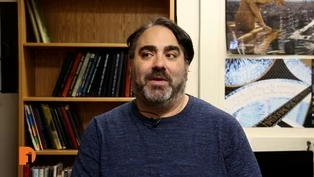
Educators React to Oxford Shooting
Video has Closed Captions
Clip: S5 Ep41 | 3m 33s | Educators react to the Oxford school shooting and discuss how they're supporting students (3m 33s)
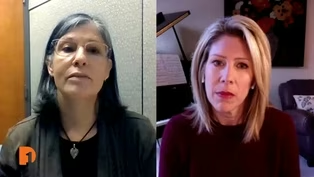
In the Wake of Oxford, Schools Deal with Difficult Questions
Video has Closed Captions
Clip: S5 Ep41 | 7m 20s | Christy McDonald checks in on the support provided after the Oxford school shooting (7m 20s)
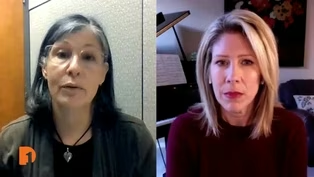
Karen Anthony Interview (Extended)
Clip: S5 Ep41 | 9m 34s | Christy McDonald checks in on the support provided after the Oxford school shooting (9m 34s)
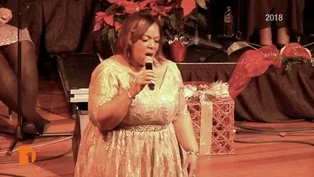
‘Once Upon A December Eve’ Returns Live & Online
Video has Closed Captions
Clip: S5 Ep41 | 4m 35s | "Once Upon A December Eve" returns with live show & livestream of annual holiday concert (4m 35s)
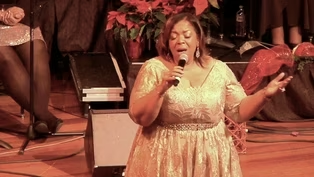
Once Upon a December Eve (Web Exclusive)
Clip: S5 Ep41 | 4m 31s | Once Upon a December Eve (Web Exclusive) (4m 31s)
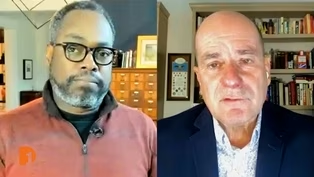
Should Michigan Have Stricter Gun Ownership Policies?
Video has Closed Captions
Clip: S5 Ep41 | 6m 10s | Stephen and Nolan discuss gun ownership in the wake of the Oxford school shooting (6m 10s)
Stephen & Nolan's Oxford Shooting Discussion (Extended)
Clip: S5 Ep41 | 6m 17s | Stephen & Nolan's Oxford Shooting Discussion (Extended) (6m 17s)
Providing Support for PBS.org
Learn Moreabout PBS online sponsorship
- News and Public Affairs

Top journalists deliver compelling original analysis of the hour's headlines.

- News and Public Affairs

FRONTLINE is investigative journalism that questions, explains and changes our world.












Support for PBS provided by:
One Detroit is a local public television program presented by Detroit PBS