
Higher Ground,' Virgil Taylor, Architect Minoru Yamasaki
Season 6 Episode 1 | 26m 46sVideo has Closed Captions
Dance Theatre of Harlem, Wearable Artist Virgil Taylor, Architect Minoru Yamasa
A preview of the Dance Theatre of Harlem's 'Higher Ground' performance, which pays tribute to Stevie Wonder's music. Then, Metalwork artist Virgil Taylor takes viewers inside his art studio to show some of the latest wearable art pieces. Plus, hear more about Detroit's architectural history and the impacts architect Minoru Yamasaki left with his designs. Episode 601
Problems playing video? | Closed Captioning Feedback
Problems playing video? | Closed Captioning Feedback
One Detroit is a local public television program presented by Detroit PBS
Higher Ground,' Virgil Taylor, Architect Minoru Yamasaki
Season 6 Episode 1 | 26m 46sVideo has Closed Captions
A preview of the Dance Theatre of Harlem's 'Higher Ground' performance, which pays tribute to Stevie Wonder's music. Then, Metalwork artist Virgil Taylor takes viewers inside his art studio to show some of the latest wearable art pieces. Plus, hear more about Detroit's architectural history and the impacts architect Minoru Yamasaki left with his designs. Episode 601
Problems playing video? | Closed Captioning Feedback
How to Watch One Detroit
One Detroit is available to stream on pbs.org and the free PBS App, available on iPhone, Apple TV, Android TV, Android smartphones, Amazon Fire TV, Amazon Fire Tablet, Roku, Samsung Smart TV, and Vizio.
Providing Support for PBS.org
Learn Moreabout PBS online sponsorship- Hi, I'm Satori Shakoor and here's what's coming up this week on "One Detroit Arts and Culture."
A dance company pays tribute to a Motown great plus a wearable artist, and then a designer's modern architectural creations.
It's all just ahead on "One and Detroit Arts and Culture."
- [Narrator] From Delta faucets, to Behr paint, Masco corporation is proud to deliver products that enhance the way consumers all over the world experience and enjoy their living spaces.
Masco, serving Michigan communities since 1929.
- [Narrator] Support for this program is provided by the Cynthia and Edsel Ford Fund for Journalism at Detroit Public TV.
The Kresge Foundation, Community Foundation for Southeast Michigan.
- [Narrator] The DTE Foundation is a proud sponsor of Detroit Public TV.
Among the state's largest foundations, committed to Michigan-focused giving.
We support organizations that are doing it exceptional work in our state.
Visit dtefoundation.com to learn more.
- [Narrator] Business Leaders for Michigan.
Dedicated to making Michigan a top 10 state for jobs, personal income, and a healthy economy.
Also brought to you by, the Fred A. and Barbara M. Erb Family Foundation and Viewers Like You.
(bright upbeat music) - Hi, and welcome to "One Detroit Arts and Culture."
I'm Satori Shakoor.
Thank you for joining me.
Coming up, the Dance Theater of Harlem takes on the Motown sound and rehearses at Hitsville USA.
Plus, a wearable artist creates unique and meaningful pieces including bracelets, necklaces, and more for his customers.
Then, celebrating a design icon for his architectural genius shaping Detroit's skyline.
It's all coming up on "One Detroit Arts and Culture."
The Dance Theater of Harlem recently performed a tribute to Motown great, Stevie Wonder at the Michigan Opera Theater.
The dance troop also had the once in a lifetime opportunity to rehearse right where all of those Motown hits were created, Hitsville USA.
One Detroit's AJ Walker, caught up with the company during their rehearsal.
- One, two, three, four, five, seven and one- - [Walker] The Dance Theater of Harlem combined movement, melody, and history at the Motown Museum, when they previewed some of the dance moves for their upcoming show at the Michigan Opera Theater.
- All right, good.
Good, good, good, all right.
Let's go now with just me not shouting.
- The premier is a ballet to the music of Stevie Wonder.
The title of it is "Higher Ground", named after that great, great song by Stevie Wonder.
And here we are in Studio A, where Stevie Wonder got his start.
It is really quite remarkable to be in this space.
I can smell the artistic intention, and the artistic energy of the past years flooding forward and moving us forward into the future.
One, two, three, four, five, seven and one.
- [Walker] Robert Garland, resident choreographer of the troop said they chose the music of Stevie Wonder because his music has a message.
- Now, we need his music more than ever.
It is very rare you hear artists now that address in full frontal fashion, the things that are going on at the time.
And I felt that Stevie Wonder's music was appropriate for this moment.
- I mean, you listen to "Higher Ground" and you watch their performance and it is just, it's moving, because so much of it is still so relevant.
- The music that was created during the seventies post civil rights, was music that was ready to address absolutely everything about what wasn't happening.
After the great walk of Dr. King and his assassination.
- [Walker] The song "Hire Ground" was written in 1973, just a few years after the civil rights movement.
It was on Stevie Wonder's, "Inner Visions" album, which featured tracks that addressed social injustice.
- I think we're in that moment right now too with the Black Lives Matter movement.
It is exactly the same tone, exactly the same politic, just 50 years later.
- [Walker] Lindsey Donnell, senior company member with the Dance Theater of Harlem says the recent social justice protests had an impact on her passion for dance especially this upcoming performance.
- Living through the pandemic and the Black Lives Matter movement, it's really, I think it's changed the way all of us approach the piece and feel about the significance of the work and that it's just so meaningful and like to represent a time and bring that forward into today, kind of what the same message, I think is really special for our company.
- [Robert] Yeah.
- [Walker] Their trip to the Motown city has been several years in the making.
It was pushed back indefinitely due to the pandemic.
- I'm happy to return to Detroit in 2021 because actually this ballet was to have premiered in 2020, in March.
But we had to go back to New York city and wait until this moment due to the pandemic.
- [Walker] But now that they're here, they say the wait, built up anticipation, and the history in this building filled them with inspiration and purpose.
- Just being here in Detroit, coming to the Motown Museum I think is really going to continue to inform our performance in January.
- It's good to see the dancers get an opportunity to interact with their history.
We can't lift the museum up and take it to New York.
So, we brought the dancers to Detroit.
- [Walker] Robin Terry, CEO of the Motown Museum, says their presence coupled with the legacy of legendary Motown artist was momentous.
- But having Robert Garland and these really talented dancers from the Dance Theater of Harlem right here in Detroit in the belly of Motown at Hitsville USA to not only be inspired, but to give inspiration.
I mean, their dance was absolutely stunning.
And for these young people to have an opportunity to be here in Detroit at the place where Stevie Wonder got his start, where he was in inspired to greatness for them to have that opportunity, as they prepare to do their performance to higher ground was just something extra special.
- [Walker] After their performance preview, the dance troop took a tour of the museum.
- You are so empowering in your own right and through your dance and just your mere existence.
I just want you to know the power you have.
- [Walker] While this performance is a chance to prepare to dazzle the crowd during the show to come.
- Of course, practice makes perfect.
- Our preparation with Mr. Garland, you know, we learned the steps and then we continue to practice it, continue to fine tune all the details.
- [Walker] They say, dancing in a Motown Museum dazzled them as well and will be an inspiration when they take the stage.
- [Lindsey] The more that we learn about the history of Stevie Wonder himself and the Motown legacy, I think has just been really wonderful to like continue to add that and to make it more special, more personally meaningful, which I think will come out in our performances in January.
(upbeat music) ♪ Till I reach my higher ground, oh no ♪ ♪ No one's gonna bring me down ♪ - For more about the Motown Museum, go to our website onedetroitpbs.org.
Next up, wearable artist, Virgil Taylor, finds most of the inspiration for his wearable art from ancient Middle East and African culture.
But other times he'll find his muse in the very materials he's working with.
Detroit Performs had to meet up with Taylor as he was creating a very special piece.
Take a look.
(upbeat music) - I play with fire.
I zone out on working with metal.
It spoke to me.
I'm an artist.
I'm not a jeweler, and there is a difference.
I have friends that are jewelers that are brilliant.
Some of the stuff they do I could never do.
I don't have the patience nor of the temperament for it because materials talk to me.
(upbeat music) I grew up in Detroit around Central High School.
My mom was a huge art fan.
And so it was also, when I think back about it now like nothing in our house ever went unused.
We were always creating stuff.
And so, I guess I had a natural aptitude for it.
(upbeat music) I had a very interesting life, but I wasn't doing my craft all the time.
I come back to it, I'd do it.
And then this particular facility Birmingham Bloomfield Art Center, I was in my 30s when I discovered this place.
And so this place started getting me back into it.
(upbeat music) I have an affinity for certain types of jewelry.
Most of the stuff that inspires me comes out of the ancient Middle East, that's kind of why I call it the ancient craft, ancient Africa, or African nations, Middle Eastern nations.
My inspiration tends to be around those regions, those processes.
I have an affinity for ancient techniques.
I went to Africa last year and spent time with the Maasai.
I was really honored to do that and fascinated by their processes because they're so raw.
I mean, when you have people making like a knurling metal over dangler ovens, I mean, which is pretty fascinating to watch.
(upbeat music) I do a lot of really organic stuff.
I'm very fond of happy accidents.
You know, a lot of times other people will go for refining something and I'm like, no, no, no, no, no, that's perfect, leave it just like that.
It works for me.
So, I don't strive to make art that is real refined.
(upbeat music) I have a ring that I'm working on now.
I had no clue when I started with this ring what I was gonna do.
And I ended up with a stone that I had no idea I was gonna get.
But it just kind of all evolved and the final touches are this evening on that piece.
(upbeat music) I have a client that's Ecuadorian.
I did some pieces for him, I did a bangle bracelet for him that was really interesting and the design ended up being my interpretation of an ancient Ecuadorian palatial Aqua duck.
And so it was filled with a blue resin.
It was done in copper, 18 karat gold and sterling silver.
And so the resin that I used in it is blue.
So it looked like it was a pool at the top.
And it looked like there was blue running through the veins because I cracked it open.
I had another client, a young man she was very close to was killed in the Naval accident off of the coast of Japan a few years ago.
And she went to his funeral at Arlington, and they gave her one of the shell casings from when they did the 21 gun salute for him.
I was in that president's honor guard, I was in the unit that did that.
So, when she sent me the shell casing and she was like I need something made out of this.
And then I took the shell casing and turned it into part of that bracelet.
So, it came out pretty remarkable, I was really proud of it.
That's tremendous honor for me.
And I have had people give me their parents jewelry or grandma's jewelry or different pieces.
I got this urn that I'm getting ready to do.
I think that's just a huge honor for somebody to entrust that kind of thing to me.
(upbeat music) I recently have been doing some bracelets.
They're African, with different parts of Africa, but they currency of jewelry what they would call wearable currency jewelry.
Some people get a little miffed because when they see them a lot of times, they see it as representing slavery.
But the reality of it with those bracelets though was that yes, they sometimes were involved in slave trading but the people that were using those bracelets and these wearable jewelry, they had little or nothing to do with slave trade.
That was a method of people currency, wearing it because they didn't have pockets and things.
And so they would wear these things and sometimes it would be a display of wealth.
People would barter with them.
So, would be the equivalent of us wearing dollar bills, or a $100 bills on our wrist.
So, I've been doing some of those recently.
I've been casting those.
(upbeat music) The beading that I do, I typically use African trade beads.
They're typically ancient and they have a value and a lot of significance.
So, the stuff that I create has some historical significance or some meaning to me.
So, when I create it, it's more than just a bead of bracelet or a bead of necklace.
(upbeat music) I feel like it's where I come from.
It resonates with me, it always has.
For me working with any of those materials, is the ability to take something and create something beautiful that someone will enjoy and other people will marvel at and look at and say, "oh, that's so beautiful or interesting or whatever."
This is always cool.
I guess it always resonates with me that like why are we attracted to jewelry?
And just like, why do we sing?
Why do we dance?
Why do some things make us happy?
And wearable art or jewelry for me is just part of that beautification.
Traditionally humans like to embellish, they like to beautify themselves, whether it be with paint.
If you go back and look at old cave drawings, people would paint themselves with mud or whatever, and then they would adorn themselves with bones, or beads or rocks or whatever that they found, feathers that they found that were beautiful.
So, there's something to me that resonates with us as humans about be beauty, about the embracing of beauty.
For me I think it's a reflection of our psyche, our desire to always embrace the beautiful.
And so jewelry and wearable art is just another component or aspect of that.
(gentle music) - For more info on Virgil Taylor, go to our website at onedetroitpbs.org.
Minoru Yamasaki's most famous design, was the World Trade Center.
But he also had a hand in creating the skyline of Detroit.
Yamasaki's designs include One Woodward Avenue, McGregor Memorial Conference Center on the campus of Wayne State University and even Temple Bethel, in Bloomfield Township.
Here's a piece on Yamasaki from our documentary "Detroit Designs The World."
Check it out.
(upbeat music) - We remember Yamasaki today as the designer of the World Trade Center in New York, the twin towers that unfortunately were lost on 9/11.
Beyond that he was a leader in what we call mid-century modernism, which took the basic efficiency of modernism, glass and steel and cling lines and kind of infused it with some warmth and beauty that we associate more with something like the arts and crafts movement.
Yama, what we say so often inhumanized modernism in some really important ways.
- So many modernists had struggled for so long before the '50s, to try to create and convince people of a modern architecture that didn't rely on the past, that was of the 20th century, and didn't need to use arches and other elements from the history.
- [TV Narrator] We will succeed in creating the first modern, technological, humane, prosperous civilization.
- Inspired by his travels he was incorporating sure elements of Italian Renaissance architecture and the French Gothic architecture.
He was used using Islamic arches and he was using the notion of the screened window from Islamic architecture.
He used a lot of elements from Japanese architecture.
So, he didn't limit himself to the western history, like some modernists tried to.
He really was a pioneer global architect.
The problem was that in the mid '50s, modernism was still very strong and still very influenced towards rejecting that historical past.
- At the end of world war II, the Detroit firm of Smith, Hinchman and Grylls was looking for a new chief designer and heard about this young Manuri Yamasaki in New York and hired him to come to Detroit.
And I think like a lot of people who come from far away from Detroit, he probably thought he'd be here for a couple years and move on, instead he spent the rest of his life here.
Well, Yamasaki started out with Smith Hinchman doing some first of the first modernist buildings in Detroit.
The Federal Reserve's building in downtown Detroit that was highly praised and much imitated.
(upbeat music) - [Pierce] As early as 1948, he was really pushing the envelope for these sleek lines and large glass windows.
And the Annex is a beautiful example of that.
People walk by every day and don't even really notice that that is one of the most famous architects in the world.
- [John] He got his reputation fairly quickly here.
He did schools everywhere, and then he became Wayne State University's almost in house architect.
He did their McGregor Conference Center on the campus, which is one of his very best buildings.
And by that time, his reputation was growing and he started doing buildings around America and around the world.
(upbeat music) - [Dr. Dale] McGregor is really, I think, in the architectural world considered to be his masterpiece.
It's one of the first buildings he designed after his world tour.
And it goes farther, I think, than any other work that he did in terms of incorporating disparate elements and disparate influences from around the world.
(upbeat music) For instance, it has elements of a Greek temple to it.
It has elements of a Gothic cathedral.
It has a little bit of those Islamic screens that I mentioned.
(upbeat music) Pools outside the building is a very Japanese sort of atmosphere.
And he kind of brings all these different ideas together.
(upbeat music) And in the other work that he does after this, he never seems to reach out to as many different kind of influences as he did at McGregor.
Plus McGregor, I think is just well done in terms of the details and the proportions and the relationship between the inside and the outside.
- In the 50s, Yama began to work on a project for the Michigan Consolidated Gas Company which needed a new headquarters.
And it created what is now known as One Woodward, a skyscraper.
- It was his first skyscraper.
People don't realize this, but it wasn't even completed at the time that he was hired to do World Trade Center, which was gonna be the world's tallest buildings.
And here he had just a couple of tall building designs under his belt.
But one of the things that's evident even in that building, his first skyscraper, is that he's looking for a different way to do it.
The typical way of designing skyscrapers back then and constructing them was use a steel frame and you build it up as many stories as you need, and then you cover it with some sort of skin which at that point was a lot of glass and maybe a little bit of metal.
And he felt like that was becoming too kind of commercial and packaged.
And he wanted to find a different kind of expression.
- [Jeanette] It's a beautiful building and he sleek and tall and it has a little bit more of some Zouch to it, you know?
I mean, he was kind of tired of the just glass boxes that had come previously in the '40s and '50s and wanted to have a little bit of feeling to the building.
- He likes the feeling and the texture of the concrete wall and it has those strange shaped windows which are very elongated.
(upbeat music) He also was trying to emphasize the verticality of the building.
He felt that one thing that had kind of disappeared from tall building design in the decades after world war II was the emphasis on the height of the building and the emphasis on verticality.
One thing that Yamasaki was always trying to do in his public buildings is to bring the public and to have them feel comfortable to have the the buildings be beautiful.
I think one of the other criticisms that struck me as I researched his work was the number of times that he used the word "beauty" in the '50s and '60s when other architects weren't.
(upbeat music) - [John] But when I think about what Yamasaki gave to architecture, and besides a lot of great buildings that are still there and will be there like McGregor.
At the same time, the notion that any important public building needs to have some outdoor space for users, a plaza, landscaping, greenways, bike paths, a sculpture garden, anything like that.
That is so part of our architectural and planning DNA now that you can't conceive of an important building that would ignore that stuff.
And you don't necessarily think that that's what Yamasaki gave us.
But in fact, it is what he gave us.
(upbeat music) - For more on Manuri Yamasaki and Detroit Designs The World, check out our website at onedetroitpbs.org.
That's it for me, but we leave you with a performance from Detroit Performs, live from Marygrove.
It's Trey Simon, performing "The Impossible."
See you next week.
(guitar music) ♪ I know that we've had a rough times ♪ ♪ Lately things haven't felt all right ♪ ♪ Don't forget the words that I pledged ♪ ♪ On our wedding day to my last breathe ♪ ♪ We're having so much to fight for ♪ ♪ I hate that I had left you hurt, so ♪ ♪ I'll do anything to make it right ♪ ♪ One last day on the front lines ♪ ♪ On the front lines ♪ ♪ We can do the impossible ♪ ♪ Baby I won't let us fall ♪ ♪ I know we're standing on the edge ♪ ♪ But we're stronger than this ♪ ♪ We can do the impossible ♪ ♪ Baby I'm still standing tall ♪ ♪ And I know that still it hurts ♪ ♪ And I won't make it worse ♪ ♪ Baby just reach out and grab my hand ♪ ♪ Our love will never end ♪ ♪ We can do the impossible ♪ ♪ We can do the impossible ♪ ♪ Iye iye ee ♪ ♪ Honey just think about our kids ♪ ♪ It's so unfair to them to see us in like this ♪ ♪ Let's push through when things get rough ♪ ♪ Show them the meaning of true love ♪ ♪ I'll work so hard to gain your trust ♪ ♪ I know my words don't mean much ♪ ♪ I'll become the man that you dreamed of ♪ ♪ I'll prove that to you just watch me love ♪ ♪ Just watch me love ♪ ♪ 'Cause we can do the impossible ♪ - [Narrator] From Delta faucets to Behr paint, Masco corporation is proud to deliver products that enhance the way consumers all over the world experience and enjoy their living spaces.
Masco, serving Michigan communities since 1929.
- [Narrator] Support for this program is provided by the Cynthia and Edsel Ford Fund For Journalism at Detroit Public TV.
The Kresge Foundation, Community Foundation for Southeast Michigan.
- [Narrator] The DTE Foundation is a proud sponsor of Detroit Public TV.
Among the state's largest foundations committed to Michigan-focused giving.
We support organizations that are doing exceptional work in our state.
Visit dtefoundation.com to learn more.
- [Narrator] Business Leaders for Michigan.
Dedicated to making Michigan a top 10 state for jobs, personal income, and a healthy economy.
Also brought to you by the Fred A. and Barbara M. Erb Family Foundation and Viewers Like You.
(bright upbeat music) (gentle music)
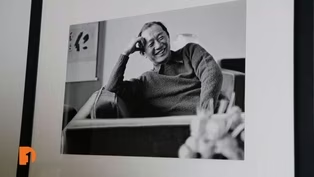
Architect Minoru Yamasaki's Mark on Detroit's Buildings
Video has Closed Captions
Clip: S6 Ep1 | 6m 42s | Taking a look at the mark architect Minoru Yamasaki left in Detroit. (6m 42s)
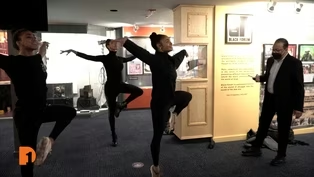
"Higher Ground" Performance Pays Tribute to Stevie Wonder
Video has Closed Captions
Clip: S6 Ep1 | 5m 50s | The Dance Theatre of Harlem visits the Motown Museum, previews 'Higher Ground' (5m 50s)
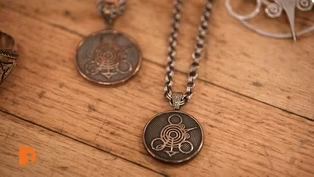
Metalwork Artist Virgil Taylor Discusses His Inspirations
Video has Closed Captions
Clip: S6 Ep1 | 7m 2s | Metalwork Artist Virgil Taylor discusses the inspiration behind his wearable artwork. (7m 2s)
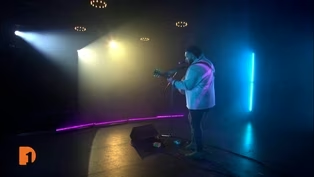
Singer-Songwriter Trey Simon performs "The Impossible"
Video has Closed Captions
Clip: S6 Ep1 | 2m 4s | Singer-Songwriter Trey Simon performs "The Impossible" for Detroit Performs (2m 4s)
Providing Support for PBS.org
Learn Moreabout PBS online sponsorship
- News and Public Affairs

Top journalists deliver compelling original analysis of the hour's headlines.

- News and Public Affairs

FRONTLINE is investigative journalism that questions, explains and changes our world.












Support for PBS provided by:
One Detroit is a local public television program presented by Detroit PBS