Spotlight on Agriculture
Equine Program
Season 4 Episode 3 | 56m 39sVideo has Closed Captions
Explore Auburn's equine science program and championship equestrian team.
The equine program at Auburn University includes an Animal Sciences Department focused on nutrition, breeding and care; the College of Veterinary Medicine, which is the oldest in the South; and an Equestrian Team that has won multiple national championships since 2002. Meet students, faculty, and riders and discover the economic importance of horses in Alabama.
Problems playing video? | Closed Captioning Feedback
Problems playing video? | Closed Captioning Feedback
Spotlight on Agriculture is a local public television program presented by APT
Spotlight on Agriculture
Equine Program
Season 4 Episode 3 | 56m 39sVideo has Closed Captions
The equine program at Auburn University includes an Animal Sciences Department focused on nutrition, breeding and care; the College of Veterinary Medicine, which is the oldest in the South; and an Equestrian Team that has won multiple national championships since 2002. Meet students, faculty, and riders and discover the economic importance of horses in Alabama.
Problems playing video? | Closed Captioning Feedback
How to Watch Spotlight on Agriculture
Spotlight on Agriculture is available to stream on pbs.org and the free PBS App, available on iPhone, Apple TV, Android TV, Android smartphones, Amazon Fire TV, Amazon Fire Tablet, Roku, Samsung Smart TV, and Vizio.
Providing Support for PBS.org
Learn Moreabout PBS online sponsorship(light upbeat music) - [Broadcaster] Alabama Public Television presents Spotlight on Agriculture.
- The equine program at Auburn University is strong and well.
I want to tell you just a little bit about a couple of things that I think are so important.
We really have three different components of our equine program.
On the one hand we have our animal science department.
It brings in undergraduates and graduate students.
They work on horse nutrition.
They work on breeding.
They work on care of the horses.
So, it's a great program.
It interacts with our College of Veterinary Medicine.
That college is the oldest college of Veterinary Medicine in the South and all of the students that go through that, that become veterinarians, actually have experience in small animals, large animals in equine.
And then the real jewel that's been added in the last 15, 17 years is our equestrian team.
We have a number of young women who ride horses, they compete at the national level.
In the 17 years that we have had an equestrian program they've won five national championships and countless Southeast Conference championships.
So for people who care about horses and care about the future of equine, this is going to be a great program for you.
(light music continues) - Research is a very important part of what our college does.
Our research really spans every aspect of animal health and it applies very often to human health.
And we study diseases of animals of all types, whether they be agricultural animals, companion animals, athletes, because we have so much to learn about all of them.
And what we learn in research applies directly to what we practice in our teaching hospital.
So, we like the fact that our research filters in to what we do in the clinic and what we teach in the classroom.
And it's really all one big united effort.
(upbeat music) We want to make sure that we understand how animals and humans interact.
And that constantly changes, over a 10 year span, it changes considerably.
And so we need to adapt our profession to match that.
And so it's very important that we understand how animals are being used, how animals are being appreciated in society so that we can train the next generation of veterinarians and conduct research that's very relevant.
The Auburn equestrian team is just absolutely amazing in terms of their success under coach Greg Williams.
And we thoroughly enjoy the opportunity to be able to partner with them because what's interesting about equestrian is it's about the human athlete and it's about the equine athlete.
And to be able to understand that dynamic, that relationship, between the human and the horse is really important.
And that's part of the success that I see of Auburn equestrian, is the student athletes that are in that program understand husbandry.
They understand what it takes for a horse to be in condition to be able to compete.
And we're proud, the College of Veterinary Medicine to be able to be a part of that by making sure that those horses are sound, that they are appropriately managed and that they are able to uphold their part of that competitive process.
And by being able to partner with a program with such huge success as Auburn equestrian and to have our College of Veterinary Medicine be a part of their success, that's something that's really special as Auburn faculty and his Auburn administration.
- Well, I'd be part of all the history of Auburn equestrian 'cause I started the team in 1996.
I was running the horse program here and started with just a small group of girls.
And so I was a club coach for six years and then in 2002 we became a varsity sport.
And then ever since then, we've been on the move up.
(upbeat music) They are hundreds of teams but they're in different formats and in different associations.
And the association that we compete in, in the NCAA, I think we've got 26 teams right now that are NCAA.
They are that compete at our championships.
We have been having 12 that qualify for the championships out of those 20 something and this year we dropped it down to eight and fact is we're about to vote now to find out what we're going to keep it at.
And there's hundreds of them that are, some of them are even varsity, but they compete in the IHSA, and there's a lot of those in that format.
There's some other associations as well.
So, if people are looking to ride in college there's a spot for all of them.
(upbeat music) And the NCEA, that stands for the National Collegiate Equestrian Association.
And we've got to give a few more schools.
And fact is D3 does not count in our numbers.
And if that gets voted in and D3 votes it in as a countable sport for them then we'll easily be at the championship level of schools.
That's when the NCAA can start hosting the national championships.
And so we keep it in the NCEA right now because we're the ones that put on the...
It's our coaching association that puts on the championships.
And that coaches association will exist even when the NCAA takes over just like the other sports all have a coaching association as well.
In that, Big 12 has a full conference, The ACC has a conference, and then there's a conglomerate of schools that don't have enough to have their usual conference sponsor their championships.
So they have to go to ECAC, which they can have several different conferences pulled together and have a championship.
And the ACC, it's like a lot of sports were tough in and just about every sport there is, but it's particularly so with equestrian because in this format that we're in now, which the first championships were in 2006, for that only these four schools that are competing in The ACC conference right now have won the national championship.
So it's extremely, extremely tough in our region.
(upbeat music) But I think the thing I'm most proud of is actually this head-to-head format.
I mean, we're in the IHSA, which I still love the IHSA.
We started an IHSA team here just a few years ago.
But the one thing I really wanted to do was to take something to make the horses neutral where competitors would compete head-to-head on same horses.
I also wanted to have an association that there weren't any kind of division levels, any skill levels.
That each school was out just recruiting the best riders that they could get, and to me that just mirrored the other sports that we had here at Auburn.
And so, probably what I like, that I'm most proud of is creating this format and having the others buy into it.
And now that that's something that we all compete in is in this format of head-to-head competition.
(upbeat music) - I came to Auburn on an unofficial visit my junior year and I fell in love with not only the school but the program, and this was the place I decided to come.
On a typical meet is there's 20 points on the table, 10 in the jumping seat, 10 in the western side and then five for the horsemanship reining.
And for the western side, it's judged on a 70-point scale, with 70 being average.
In each maneuver you can go up 1 1/2 or down 1 1/2 with penalties and maneuvers.
And the highest score on the head-to-head ride...
Head-to-head means that both teams ride the same horse and whichever competitor has the highest score will win that point for the team.
(upbeat music) Usually when I'm in the competition I think about riding every stride.
I can't let my mind wander too much because every maneuver counts and I just have to make sure every maneuver's sharp and that the horse is with me.
Sometimes I talk to the horse a lot when I'm riding, so there's that, but usually it's focused on every stride and try to plus the areas I can plus on that specific horse.
(upbeat music) Obviously winning the national championship my freshmen and sophomore year was really cool, but I would say the proudest moment was this year winning (indistinct).
The team went through a lot and had to sacrifice a lot with COVID.
So, just having all that hard work throughout the season payoff was really rewarding.
(upbeat music) - I was raised around horses and cattle.
Horses are definitely my passion.
I could probably ride it around the same time I was walking.
And I've decided to take that passion to the next level and really continue my career in the industry.
(upbeat music) I had toured actually a lot of other colleges and Auburn was low on my radar until I went to a National FFA convention, found them there and came, took a tour here at Auburn.
Fell in love with the school before I even knew they had an equine science track.
Then came back in February, that following February, got more in depth with the Ag department self, found out they had an equine science track, which was icing on the cake at that point, got familiar with the facilities here and knew this was definitely the spot I wanted to be.
(upbeat music) So, I am a volunteer here at the equine science center.
I do do some additional work here, being the acting President of the IHSA team.
We are required to come out here and do some work, helping out with the everyday barn workers and just making sure that the horses we use are in good working condition.
But we compete and show just like any other organization.
We stay mostly here in the Southeast.
We have both English and Western riding options.
Right now I'm a rider on the Western team and we have positions where students can come and compete at these shows.
They can be a non-competitor, where they can still gain horse-riding experience or they can be a general member, still come out here and just be a part of the team and be around the horses.
I've met some of my best friends at Auburn while here on the team.
And again, you do not have to have any experience to be on the team.
We've come from all walks of life.
A good friend of mine is an engineering major, another is a horticulture major.
I'm an equine science major.
We all came from all walks of life but we were able to come in here, become really good friends.
Bonded over the amazing facilities and program that Auburn has created here.
(upbeat music) - At the Equestrian Center, as I said, I'm the Director of the facility so I am in charge of the care and maintenance of all of the horses out here.
I also oversee all of the student workers, the volunteers, I do all of the scheduling for the Animal Science classes or anything else that comes out here.
And I also work with athletics.
So I'm helping them schedule their horses and arena use.
And I also am the Head Coach of the IHSA equestrian team.
(upbeat music) There are a lot of activities that take place out here at the equine center.
So it is a shared facility.
So we have the NCAA equestrian team that's riding out here and we also have the IHSA club team that's riding out here.
All the Animal Science classes take place out here and we always have veterinarians out here working.
And we're super excited we work with the FFA and the 4-H.
So there's a lot of different organizations that use this facility.
(upbeat music) We are very, very fortunate to have some of the top facilities in the country.
So right now we're standing in the Williams Barn and this is a state of the art 20-stall barn.
Baddie's showing off one of our fancy stalls.
We also have four riding arenas here at Auburn.
One of them is covered.
We have another 16-stall barn located in the back of the property.
We have a six-horse walker so we can help exercise the horses even when we are not riding them.
The NCAA team also has a team room, a training room and a locker room.
Here at the Equestrian Center we have 57 horses on property right now.
It's a 60-acre facility and all of our horses do live outside unless they have an injury or something going on.
So, Baddie is hanging out with us right now.
He's rehabbing from an injury that he had.
(upbeat music) The horses are acquired here through a donation process.
So all of the horses come in on a trial and if we accept the horses, if they work in the program, they are donated.
And from there, if we have to get rid of the horses or re-home them, we do the best we possibly can to try to find them new homes.
If it's within a three-year period of them being donated, they'll go to another nonprofit.
And at Auburn we really, really strive to try to make sure that we're supporting equestrian as a whole.
So, currently right now we actually have 10 horses that are at other universities on their IHSA teams.
So we do that.
And then the horses also can go up for a closed bid and people can bid on them and we'll re-home them that way.
(upbeat music) We are very fortunate to have the vet school located right across the street.
Dr. Jennifer Taintor and Dr. Sanchez come out here.
They're here at least once a week, normally more than that.
But having the vet school, we get to work with them.
They help, with their students working on all these horses.
They have different laboratories that they'll do out here that helps us not only financially but it's helping these equine athletes.
So we have a great, great working relationship with the vet school.
(upbeat music) - So besides lecturing at Auburn, I also help with some extension events, support the IHSA and NCAA equestrian team, and I also serves an advisor for two of our clubs, the Collegiate Horseman's Association and the Block and Bridle Club.
You're ready?
- Sure.
- [Courtney] Fabulous, the nose and hip move in opposite directions of each other.
So our goal is we're going to try to keep this lead (indistinct) soft.
- Okay.
- Because if we start pulling on her face, then it's going to hurt.
She's going to get all wiggly.
- Okay, got it.
- But we will take anyone in this program who's interested in learning more about horses.
And it can be really intimidating if someone doesn't have a whole lifetime of horse experience but we're a great place where not only can you learn something new, if you do have a lot of horse experience, but we can give you from-the-scratch education and hands-on experiences.
With an emphasis in the equine science track at Auburn, we have a wide range of students who are pursuing careers in veterinary medicine.
They might go on and pursue higher education, a master's degree, a masters of science or masters of agriculture.
But then of course we have many students who go back into the industry.
So this could be horse training, breeding operations, even just managing barns and lesson programs.
We have a massive amount of hands-on learning experiences.
So you can learn anything from how to take vital signs, assess and formulate the nutritional requirements for various classes of horses.
We even had an exercise physiology lab where students could track the changes in the heart rate, respiration, et cetera, and also some horse training classes as well.
My role with the equestrian club team, IHSA is mainly kind of a support system.
So, I'll judge scrimmages for them but then also just spread the word to students.
It's a really cool organization that you don't need a lifetime of riding experience in order to compete.
Interestingly, I found that a lot of students that are in the IHSA club team come from other majors.
So they might be pursuing business degrees, for example, and just have an equine interest.
Students involved on the club team just gain a wealth of experience, not only in comradery and teamwork, but horse handling skills, riding skills, time management skills is a very important one, 'cause not only do you have to oftentimes work with your class schedule, maybe a part-time job, but fulfilling the requirements to practice, coming out to actually care for your horse and get your horse ready for practice and monthly care as well.
(upbeat music) We have a brand new class starting in the fall here at Auburn, and it's the Introduction to Equine Care and Use class.
So this is the class that if there's an art major on campus and they're like, "You know what, I want to learn about horses, "learn how to handle them," you just learn A through Z.
If you have a lifetime of horse experience you're going to, I guarantee, you'll learn something new in this class.
Everything is based on the foundation of science and what the industry is currently doing.
So it might be different than your operation at home.
So the biggest thing, it can be hard to break in or feel like you don't belong, or your an outsider if you don't have a lot of experience but that's actually my favorite.
I love...
I was one of those kids who didn't have my own horse but just absorbed every book I could.
So, I have a whole library.
(Chuckles) And so that's one of my favorite things to do, is get students involved who might not have a lot of horses experience.
(upbeat music) A couple of the specific equine courses we offer at Auburn.
We have an equine nutrition course where you actually learn how to formulate equine rations and how to do that in a safe manner, not only by hand but also using some really cutting edge industry software.
In that class, we've just learned about old horses because horses are living longer, more fulfilling lives and we also talked about miniature horses and donkeys and mules.
So, it's not just your standard horse education.
We get a lot here.
We've got those equine behavior and training classes, a exercise physiology and an equine marketing class.
So, if you see those horse sale pictures online and you say, "How is that horse standing so well "without a halter?"
I'll teach you how to photoshop a halter out.
We have a good time in that class too.
(upbeat music) - My job primarily is to teach our fourth year clinical students about equine surgery but I also have responsibilities to teaching the first through third years performing research as well.
(upbeat music) But my passion is the equine athletes.
So, I think that our horses are incredible athletes and do a lot for us, not only emotionally but physically.
And so my passion is to keep our equine athletes comfortable and doing their job as effectively and as long as possible for as long as they want to do that.
So, my main focus of research is actually how we use regenerative therapeutics to promote joint health.
So, I really like looking at joint disease and how we can prolong and have better therapies to prolong the life of our athletes.
Regenerative medicine is sort of a field of medicine that looks at how we can improve the repair and ultimately the rebuilding of tissues.
And so many of our musculoskeletal tissues, particularly our joints and our soft tissues, our body repairs but it repairs with a lot of scar tissue, and that means that we have less functionality.
So, what we're trying to do is enhance our body's messages and mechanisms for repair so that we have a more functional repair tissue that can keep working and not be prone to reinjury.
We would like to get to the point where we can regenerate tendon and we can regenerate ligament and we can regenerate cartilage.
But we're not there yet, we're making strides towards that.
The horse is actually a great translational species for looking at research in the human field and the equine field.
So horses are athletes.
They are trained and used for performance.
And we have to enhance that performance with the use of medications much like our human athletes.
Our human athletes are constantly undergoing physical therapy, rehabilitation, strength and conditioning.
And that is certainly an area of research in horses but there's also an area of research looking at treatment of injury.
And so, our human athletes, they get torn menisci, they get torn interior cruciate ligaments.
Our horses have the same anatomy.
They have the same makeup.
And so, by using them to treat and see how we can enhance performance, that translates to the human model because we have methods of evaluating their performance, much different than we do, say in our (indistinct) species.
(upbeat music) I think the more we do research the more we have people give funds towards us being able to do research that is translational; only drives us forward, only helps our athletes do their job better and happier.
I think that it's incredibly important that the public know what we do as far as research and that that research is incredibly important moving that field forward and finding new ways that we can treat human and equine athletes.
- So I have been the head veterinarian unofficially for the equestrian team since about 2005.
So, I primarily handle all the equine athletes.
I help coordinate veterinary care here as well as when they go away for meets at The ACCs and also the national championship.
With the ambulatory service as well as it lameness elective and also our podiatry, dental elective, basically take care of the health of the horses during the year.
So that includes vaccinations, dental care, foot care, and then additionally dealing with any issues that come up.
So those include like lameness, which is the most primary problem we run across with our equine athletes.
And so we'll see them for any kind of issue they encounter with lameness during practice or during the year.
But also other things, like lacerations, they'll colic occasionally, which is abdominal discomfort, sometimes they have an eye problem, respiratory problem.
So anything that pops up, like normal athlete, anytime they have a problem they go see a doctor, well, that's what we do.
With the Auburn Veterinary School, we actually have... there's two of us who are on equine ambulatory.
So it's myself and Dr. Sanchez and we handle pretty much the day-to-day.
We come every week to check on the horses.
We have a list and we go through that list.
But additionally, Dr. Lindsey Boone, who runs the lameness elective's involved twice a year.
And what they do is they come out and do soundness evaluations for all the horses prior to the beginning of the season, which is an August, and then again prior to the championships for The ACC and national championship, and it's about six months apart.
So that helps look for any problems that are coming up and go ahead and get them ready for those kinds of competitions.
Additionally, Dr. Sanchez runs a dental and podiatry elective.
And so what that does is take care of all the dental care for the horses as well as look at any kind of foot problems that may be encountered.
So, for the most part, we kind of handle everything, from the tip of their toes to the tip of their tail.
So typically, just a standard wellness check, which is just like when you go to the doctor they kind of listen to your heart, listen to your lungs, take your temperature, just ask if there's any problems and go ahead and maybe give you vaccines, along those lines.
So that's pretty much what we do with our horses as well.
So, twice a year, they'll get checked over, they'll get their vaccinations, they also get the warmer.
We don't weigh them because they don't have a scale out here but we do go ahead and body condition scores.
That way we can kind of see whose weight is on target and who went a little quarantine 15, and get them on a diet plan.
But for the most part we look at him twice a year for that aspect.
But then we also do, checks...
The soundness exam is a little bit different.
And that's where we look at the horse going.
So we watch them walk and then watch them jog, look to see if there's any lameness issues.
And so that's another kind of wellness check that we tend to do here twice a year with the lameness elective.
So we can look and potentially foresee any problems that are going to come up and nip them in the bud before they really get rolling.
So, during the equestrian season we tend to be very busy.
So, there in the summer, it's kind of quiet.
They do have camps but the intensity level is much less.
So, in the beginning of the year, right before season starts the lameness elective with Dr. Boone will go ahead and do their soundness evaluations.
And so within a two week period they evaluate approximately 60 horses.
And so they'll get everybody kind of checked out, see what's going.
And then as their season starts, obviously they compete, regularly we'll have anywhere from three to four meets a semester, so three to four meets in the fall and then three to four meets in the winter, and then we'll have the championship as well.
Obviously they practice every day.
And so just like human athletes, with practice and with competition will sometimes see injuries occur, and with that we tend to stay busy.
So we tend to be really busy if we have a lot of meats back-to-back.
We tend to be a little busier when we have a little stretches between meets.
It gets a little slower.
But they'd be truthful.
As far as equine ambulatory is concerned, Dr. Sanchez and myself are out here every week, usually for a good morning, during busy season we may be out here for a whole day to evaluate horses that are having issues and we try to jump on them as soon as possible because we'd like to take care of it when it's simple than when it gets complicated.
So we're out here every week, sometimes twice a week, but when season starts it gets busy.
We have a great relationship with the team.
Coach Greg Williams believes in education, believes in teaching.
And so because of that, the senior students who are going through their clinical year with Veterinary Medicine are rarely involved with the team.
So the thing is a nice thing about our here, is one, they get to get some lots of hands-on activity without clients hanging over them and kind of getting worried and then the other thing, is two, is allows them to basically build those foundation skills, that knowledge, those skills and those techniques.
So what's nice is when we come over here with our senior students, they pretty much do everything.
So if we need to do nerve blocks we're doing nerve blocks, if they need to do joint blocks or joint injections they're doing those.
They do the full physical exams.
They're pretty much responsible for these patients and it's very hands-on for them.
So the nice thing for the seniors, and we've gotten a lot of feedback in relation to the electives and also equine ambulatory, in that they get to feel like a veterinarian.
So what's nice is they come over here, they practice these skills in labs, they've taken this knowledge from classes and now they actually get to apply it.
And the nice thing is the coaches here and also the Director, Lisa and Katie Renfroe is also Manager... What's really nice is they're patient.
They understand the students are learning.
Sometimes it may take them one try or two to get it completely right, but they understand that.
And so the thing is it's really nice 'cause we can take that time, the student can gain that experience and they don't feel pressured because there's a client watching them or a bunch of people watching them.
It's a living laboratory for them.
And so the senior students are very involved.
We also let them know, like for example, the lameness selective this spring, they were involved with going through the sound's evaluations and getting horses ready for the championship.
The team won The ACC Championship for 2021 and we go ahead and let the students know: "Hey, just to let you know, your efforts actually paid off."
So we kind of let the students know when they come through and especially if they get really involved with one horse, we kind of give them a heads up: "Hey, remember all that time you spent on Toby, guess what?
"He did well this weekend, he had the top score "with the riders this weekend."
And so it's really nice because they get feedback and they understand that their efforts actually have a positive factor.
So it's really nice for them 'cause it's a real world experience.
(orchestral upbeat music) - I chose Equine Science because in 2014 I lost one of my horses to a tornado along with our house and I realized that I want to be able to help horses in more ways than possible.
So this is the best way for me to do that.
I'm kind of undecided about my career path but if I had to pick something I totally would say I might want to be a barn manager.
My current plan right now is to pursue either a master's in Ag or a master's in science and hopefully Equine Reproduction.
I really love the foals.
So that would totally be my dream job.
(chuckles) I actually am a student worker here.
I've been working here for about a year and a half now.
And I am currently a shift leader so I lead all of the shifts and take care of the (indistinct) horses we have here.
It entails a lot, very early morning.
So our morning shift started about 6:30 in the morning.
So we'll get here, and shifts can last anywhere from two hours to five hours.
I've been here in the morning shift till one o'clock one time.
So, they're long but we feed all of the horses.
So that includes everybody inside, outside.
We clean all of their stalls every single day.
And then all of their treatments.
Right now we have about six hand grazes that take about 15 minutes a piece and then some other ice boots and stuff to do.
So, it's a lot but it's a lot of fun and it's very rewarding.
I've learned so much just the year and a half I've been here.
So, I hope I can stay as long as I possibly can because I love it.
(upbeat music continues) So, before coming here, I actually used to board at a facility where we helped autistic children.
So we kind of did equine therapy.
So I ended up using my own horse that I trained myself through natural horsemanship to help these autistic children.
One in particular had a lot of speech impediments and they spent thousands and thousands of dollars in therapy and nothing worked and somehow we ended up actually getting him to talk within a couple of weeks.
So, it was kind of miraculous and we just kept doing it with more children.
And it's unbelievable what it does for them.
(upbeat music) I did not ride competitively.
I've simply only trail rode and then I do a lot of natural horsemanship with my horses back at home.
I ride every time I can go home and then anytime they'll let me ride here.
I do a lot of the rehab riding here.
Last summer, I rehab rode about four different horses all summer.
So, that was a lot (chuckles) of fun.
(upbeat music) - I currently work at Stratford Equestrian Farm.
I'm going to continue there.
We're trying to get a therapeutic riding program up and started.
I work with (indistinct) kids.
I take basic care of the horses.
So it's just where I want to be until I learn how to do it all myself.
I've been with horses since I was five years old and that's when they were first introduced to me.
Originally I wanted to be a vet but within my first semester here, I believe, was about when I decided not to do vet school.
And instead of the pre-vet track, I was introduced to the Equine Science program, and that's how I got onto that path.
I grew up just doing trails.
So I didn't really have that big of a variety of different horse experiences.
And being here at Auburn and getting to go through the equine program, the intro class with Horse Management Training was what really showed me all the different things you can do with them, all the different disciplines that there are.
And that way I delve a little deeper into some of the other things.
And I'm actually starting to go into English now.
I see myself hopefully getting my own place started, figuring out which exact part of it I really want to dive deeper into.
There's also a hospital closer to home that does some more of the reproductive side of things.
So hopefully, maybe I'll go through that too.
We have a vet that's going to let me shadow with him.
So, he can also show me more of the different options there are as well.
(upbeat music) It's kind of like a therapy for me.
It's my stress relief.
So with all these finals coming up I'll definitely be spending a lot of time out at the farm with them.
(upbeat music) - The IHSA team is by a tryout process.
So, normally it's the first Saturday when they come back to school.
And we'll have a meeting that first week and then they come in.
And it's all different levels.
So, we have students that have never sat on a horse to people who have been competing their entire life.
So, in the tryout process, we're watching everybody for the level they're at.
And from there we'll place them in a different division and then do the best we can to get everybody riding opportunities.
(upbeat music) Greg Williams was the person who actually started all of the teams out here at Auburn.
He's been here about 25 years.
And he actually started this with an IHSA team, just like we have now, but he took that IHSA team and he helped start the NCAA team.
And it actually started the whole format for NCAA across the country.
When I took over as the director out here, six years ago, Coach Williams and I talked and realized that we needed to bring back more opportunities for riding 'cause the NCAA team is phenomenal but they're elite riders.
So they're the most elite riders in the country.
We wanted to give more riding opportunities for the normal student out here.
So we added the IHSA team back.
So, it started with an IHSA team, went to an NCAA team and now we're fortunate enough to have both the IHSA and NCAA.
(upbeat music) - On the Western side, we've got two events.
We've got a horsemanship and then we've got reining.
Both of them are prescribed patterns.
The horsemanship is very technical.
It's a little bit slower than the reining but you've still got the same type scoring system where you start with a basic score of 70 and then you can go up to plus 1 1/2 to minus 1 1/2 per maneuver.
And so they keep scoring throughout all the maneuvers that way and then that's going to get them their finished score.
You also have to apply penalties.
And those go by the AQHA and NRHA rule books.
Reining is the same scoring system and it's also a prescribed pattern but it's just a lot faster.
They've got the rundowns and sliding stops, the fast spins and large circles.
And both of these events, it's required that we have AQHA judges.
You can use NRHA judges for the reining but you have to have AQHA judges, American Quarter Horse Association judges for the horsemanship.
On the hunter seat side, that's something that you see a lot on the Olympics.
So we've actually changed what we've called hunter seat for a long time, we call it jumping seat now because the United States Equestrian Federation said this is kind of a step towards the Olympics for those riders.
And so we have two events in that; it's equitation on the flat and it's equitation over fences.
The important reason that you use the word equitation is because it's about the rider not about the horse.
And again, the riders go head-to-head in this competition.
The over fences, as you can imagine, is the jumping.
You see a lot of that on TV.
But here it's not just whether you knock a rail down, it's how you do it.
It's a judged event.
The equitation on the flat is they're not jumping but they're doing a lot of maneuvers.
And it's how well that rider can get the horse through that pattern.
In a dual meet, everybody identifies their starting lineup and those are entered into the computer.
And then we use... A computer randomizer actually does the draw for us.
So it's completely random.
Nobody knows what horse they're going to get on that day.
And then there's a set of horses for each event.
That horse will go once for each team.
And so your job is still as a competitor is just to beat the girl that draws the same horse that you do.
(upbeat music) One of the questions we get a lot is about the horses traveling.
Well, in the regular season meets the horses do not travel.
And so it does create a little bit of a home horse advantage, even though the home rider may not know what horse they're getting on that day, they should have some familiarity with that horse.
So it does give them a little bit of an advantage.
But these riders practice day in and day out.
They practice making the unfamiliar become the norm.
And so they're used to being able to, in a small amount of time, figure a horse out.
So typically the best rider does get the best pattern out of a horse each time.
So, that part makes it a fair system.
Now in the post-season, you'll hear sometimes about schools hauling horses and that's because we all contribute to a large pool of horses so that there's a neutral pool at The ACC championships, there's a neutral pool that the national championships.
So, while Auburn horses may be there, they won't be in any of our competitions.
It may be Fresno State against Baylor on some of the Auburn horses, where when Auburn's in a competition with somebody, who may be on Oklahoma State and TCU and Georgia horses or something like that, but is there just there to contribute to the large pool.
(upbeat music) Well, our sport, we're an equivalency sport, which is what you might look at like baseball, where it's not football as a headcount sport to where it's either a full scholarship or none.
Baseball, equestrian, track and swimming, several of other sports, we are equivalency sports, meaning that we can divide up scholarships.
So, when we're recruiting we're going to go to some of the largest junior events across the country.
On the Western side, that would include a lot of the World Show, The Quarter Horse Congress, maybe the Reining Horse Derby, things like that.
And on the jumping seat side, it's going to be what we call the big (indistinct) competitions or the large finals that are held in the fall.
And those are our primary, primary recruiting grounds.
We also use camps and clinics very heavily here because that's where we can see what these kids do on college horses and also get to know them.
So, camps and clinics are huge in our sport.
(upbeat music) I think something that's important about our sport, every sport has a starting lineups and some that are not going to be starting for that game or for that meet, but for us, our starters actually do less riding on that day than the non-starters do.
'Cause when you're hosting a meet, you've got to have... there's so much work that goes into it, plus all the horse setup and warm up has to be done by a group of non-competitors for that day.
So, I would say that everybody that's working their way into a starting position, they drive that whole lineup, but for us they're extremely important in setting the horses up on meet day as well.
I would say the one thing that our sport has helped do is allow some of our riders that were going to go pro to get a college degree and then go pro.
There's a lot of them that were just gonna not attend college and just go straight, start working their way into the ranks right out of high school.
And now I feel like they've gotten the advantage of not just getting a college education, which I think is a great safety net for anything you do, but it also got to broaden their horizons and some of them that thought they were going to go pro in the industry actually found other paths and careers that they didn't even know existed for them, and they chose those instead.
(upbeat music) - The Equestrian Club team, I am the Head Coach and also the Advisor.
And as I said before, I did start the team six years ago, started it back up, and I think it's a wonderful thing and a great opportunity for so many students to get hands-on experience with these guys.
(upbeat music) I think the value of the club team experience is A, getting to be with the horses and learn about the horses.
They also get to meet other students that have the same interest as them.
But it's giving them a lot of responsibility.
So they're not just riding.
They work out, they do community service, they do fundraising.
So it's really preparing them for life as a whole but at the same time doing what they love with the horses.
(upbeat music) At the Equestrian Center, we do have lots of volunteering opportunities out here.
Currently I have six students that volunteer.
All of them are pre-vets but they're all in the Animal Science track, but they can come out.
I require them to do at least four hours a week but they do everything with the horses.
So we teach them how to handle them, we teach them how to feed them, how to wrap their legs.
And a lot of times there's rehab.
So they're learning how to treat the horses and they also learn how to give IV shots, administer medication, do IM shots.
So, all different things to prepare them once they leave Auburn.
(upbeat music) - Auburn has been... We've been very dominant in this past decade and particularly in these past few years, stringing together undefeated seasons even.
And we worked very hard to create a program that top riders want to come to, but it also involves a lot of work.
And so something that we talk about here is that when you get the talent, if you still keep the accountability and don't take shortcuts and put in all the work and effort and ownership, then winning is just a byproduct.
They practice all these steps every day and so winning just becomes a natural byproduct of doing everything right.
Obviously you do got to start with some of that initial experience and talent but to win day in and day out is something that they've got to work constantly at.
(upbeat music) - Riding with Auburn Equestrian teaches you to ride for something more than yourself.
Coming into this, the industry, it's very individual.
So when I first came here I wasn't just riding for me, I was riding for the 40 other girls behind me and I knew I had to do my job in order to win.
And then it really just teaches you about the hard work.
Like that's what makes this team, and winning is so rewarding, is because we put in the hours of hard work behind it.
And that's something that I will take away from this program.
(upbeat music) - Before I came to Auburn, my family owns a farm so I grew up riding in the Northeast.
And I did all of the equitation; jumpers, hunters, anything that was going to help me get on the team pretty much is what I (indistinct).
(upbeat music) I came to Auburn because of the small town and the homey field, but I also came to ride.
I came to a couple of camps that helped me get on the team.
And the first time I came onto campus I knew that was where I was going to go to school.
(upbeat music) A team wins in an equestrian event by accumulating the most out of 20 points.
So you will ride head-to-head against the other school, meaning one person from one team and one person from Auburn will ride the same horse and the person that gets the highest score out of the two rounds wins a point for the overall score.
Hunt seat is judged based off of the rider and equitation.
So, the judge will judge you over a course of jumps, so you have to do a specific order of jumps and they score you based on that out of 100.
And the equitation on the flat is judged based off of a pattern, which we receive the week before competition and we learn that in practice and then each maneuver or each box is worth 10 points.
So the judges score you out of 10 points there and that's also 100.
(upbeat music) Competing on the team, I mainly did jumping.
So growing up, jumping is something that I've always worked on.
It's very natural for me.
And then every once in a while I also got to compete in the flat, which is definitely out of my comfort zone but I did enjoy it when I got to compete in it.
(upbeat music) My favorite horse is Ducati.
He actually was my horse when I was competing as a junior in high school.
And he came to school because he had an injury that had trouble healing and then the owners decided that it would be best to drop him down to the collegiate level.
And it was great having him here for the four years.
(upbeat music) When I'm in competition I mainly get on the horse and I just focus on what's happening underneath me, and I have to just try to figure out what the horse's quirks are and what he needs me to do to help him complete the course successfully.
Going through my mind, I just always try to keep a rhythm in my head that will help me see the distance of the jump and be able to get the correct space in between each jump.
(upbeat music) I would have to say my proudest moment actually is a memory from two years ago today exactly.
We used to volunteer at an elementary school in Auburn and we'd serve lunch for them, and after we won the national championship in 2019, we came back and the entire elementary school threw a Tiger Walk for us for a surprise.
And all of the kids were gathered around and cheering our names and congratulating us, and it was just something that I've always been very proud of and I've held very close to my heart ever since then.
(upbeat music) I am planning on going to dental school in 2022.
So, this next summer I'll be working for a trainer, Frank Madden, who travels to New Jersey for the summer and does all the Northeast shows and then back to Wellington for the winter.
And then dental school, I really hope to just get in and I either want to do oral surgery or orthodontics.
Something to do with implants.
And I'm very into the restoration part of the dental field.
(upbeat music) - I have been riding since I was six.
I competed mainly in the hunters.
I did some equitation, but not that much before I got to school.
(upbeat music) To be honest, before I found out about the team I didn't know what Auburn was (chuckles) but then I came on my unofficial visit and it was the first time I'd been on campus and I absolutely loved it.
So, I guess essentially I came for the team but I fell in love with the school as soon as I got here.
So, flat is judged on a score out of 100.
There are nine different maneuvers and then an overall score for the rider, like their position and how they make the horse go and everything.
So you get a pattern at the beginning of the week and they have a bunch of different maneuvers and you follow the pattern.
Every maneuver gets a score out of 10, and then it adds up at the end to be a total of 100 points.
(upbeat music) I am on the jumping seat side.
I mainly specialize in the flat with my time on the team.
The flat is kind of similar to a dressage pattern.
So, you just have different maneuvers that you make the horses do.
It's not as fancy as dressage but it's kinda the same idea and that's what I've been specializing in since my time on the team.
On competition day I would say what goes through my head is to keep the horse happy and to ride the horse I have that day.
I feel like sometimes you kind of get wrapped up in knowing the horses and it's really important on competition day to ride the horse you have.
(upbeat music) One of my favorite memories of being on the team was after we lost ACCs our freshman year, it was very tough and we came up with the hashtag for the team that was #fallforward.
And I feel like it was just like a really special time because we had suffered such a hard loss.
And then we kind of all rallied together, like we were so successful after that.
So I feel like that was a really big moment for us.
(upbeat music) - We're all in this together.
A big component of that are the graduates, the alum.
Tomorrow will be my 48th anniversary of graduation from the vet school there.
So that means that day after tomorrow, I start my 49th year in practice.
So, I have a little skin in the game.
Our veterinarians here have skin in the game.
We have Auburn students, Auburn graduates through the Equine Science department that work here at the practice.
You're asking for equine industry involvement?
You might not be a veterinarian, but you can certainly be of benefit to a veterinary practice.
Several years ago, Joe Mollner who a professor at Auburn, I think in the Agricultural Economics department was funded by the state Tourism Department, Department of Agriculture, a lot of things on the state level, and he did an economic impact study of the equine industry in Alabama.
And it's amazing when you compare the economic impact of the equine industry to, I'm not going to pick on any one in particular, but for example, to the cattle industry.
You still have the basic land utilization, feed production, that sort of thing, but one thing about when you grow a yearling out, you load him up and you take him off and sell him, and that's it.
The horses, you load them up, put them in that 50 or $70,000 truck with a 50, $75,000 trailer and you'd take them to horse shows all over the South, all over the nation, just depends on how far you want to go.
You buy gas, you buy tires, you spend the night in hotels, you eat at fast food places, you eat it at nice restaurants, you have to have show clothes, you have your work clothes.
Just the expansive aspect of that that we don't really see with the bovine industry, the cattle industry, you don't see it with the poultry industry.
Sure, there are big dollars involved but those are smaller transactional units.
But that the horse industry, based on the mobility of the horses and the things that happen, they go all over the country, they have a big economic impact about anywhere you go.
- There are a lot of opportunities for kids who want to come to school at Auburn.
If you're a young student wanting to get involved, we do things with the 4-H, we also help with the FFA.
So we have a judging clinic that we do out here every year for both of those.
We really want to support those organizations and getting involved when you're young is going to help you as you come up through the years and up into college.
Coming out to a camp or a clinic out here, coming to those judging things, you'll get to not only meet the people and the horses out here but you'll learn a lot about how to get prepared for college.
(upbeat music) - Auburn Equestrian has taught me to be part of a team.
Coming into school, it was always an individual sport so I had never been part of a team, and it's kind of taught me to put others before yourself and to be a part of something bigger than yourself, and it's something I will always hold close to my heart.
(upbeat music) - So being on the team, the greatest value I would have to stay was getting to know my friends which are now my family.
And I definitely learned a lot about myself and what it takes to be part of something that is bigger than just myself and working with a group of people that before here, I didn't know.
So I worked a lot on that and just being around everyone and working hard.
And it's really all about working hard here.
So, it's definitely something that I've learned to value.
(upbeat music) - Auburn has recently made some truly incredible strides, in my opinion, in the right direction in giving students a kickstart into the equine industry, whether it gives you all sorts of options from equine nutrition to a barn manager to even, for those students and those individuals that want to continue on to vet school, it gives you a lot of hands-on experience that many of applicants lack.
You get a true full circle understanding of horses, their care, what all goes into the industry, all the different facets of the industry and just every open door possible, Auburn presents to you.
- The cool thing that we don't think about is if there's something in the human world that you do, there's something in the horse world we also do.
So you can be an equine nutritionist, you could do equine pharmaceutical sales, be a feed representative.
There's just a huge...
It's a multi-billion dollar industry.
Just a very multifaceted and dynamic group of people, some with a lifetime of horse experience, others are just passionate about horses.
- If you're wondering about what you can do here in Auburn, you can do anything you want to do.
This place, I wanted to come here for as long as I can remember I wanted to be pre-vet but I started to do equine science.
There's nothing wrong with changing your mind.
Pre-vet's not all of it.
You can still get all of the care in the horses you want in the world here, but this is the best place you can come.
You can come out here and volunteer, you can work out here, whatever you want to do you're going to get every opportunity.
Dr. Heaton, I know, has helped me beyond belief and she has been a true support system as well as my boss, Lisa Dorsey and Katie Renfroe.
They have been top of the line.
No questions asked.
If you got a question, they're going to answer it.
You want some help?
You want to learn something?
They're going to teach you no matter what amount of experience you have.
Just don't be afraid to come out here.
Just come out here and give it your all and it'll pay off, I promise.
(upbeat music continues)
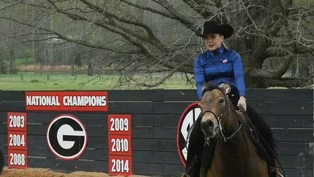
Spotlight on Agriculture Meets Champion Equestrian Team
Preview: S4 Ep3 | 1m | How did a fledgling team at Auburn team end up winning 5 national championships? (1m)
Providing Support for PBS.org
Learn Moreabout PBS online sponsorship
- News and Public Affairs

Top journalists deliver compelling original analysis of the hour's headlines.

- News and Public Affairs

FRONTLINE is investigative journalism that questions, explains and changes our world.












Support for PBS provided by:
Spotlight on Agriculture is a local public television program presented by APT