
Deidre D.S. Sense/Amaryn Olmeda
Season 4 Episode 19 | 23m 45sVideo has Closed Captions
Deidre D.S. Sense/Amaryn Olmeda| Episode 419
A conversation with Vice President of the Detroit Symphony Orchestra Erik Ronmark about their plans to have audiences back in orchestra hall for the new season. Veteran Detroit hip-hop artist Deidre D.S. Sense paired her latest album "Copper St. Chrysalis" with what she called her Quarantine Concert Series. Episode 419 Episode 419
Problems playing video? | Closed Captioning Feedback
Problems playing video? | Closed Captioning Feedback
One Detroit is a local public television program presented by Detroit PBS
Deidre D.S. Sense/Amaryn Olmeda
Season 4 Episode 19 | 23m 45sVideo has Closed Captions
A conversation with Vice President of the Detroit Symphony Orchestra Erik Ronmark about their plans to have audiences back in orchestra hall for the new season. Veteran Detroit hip-hop artist Deidre D.S. Sense paired her latest album "Copper St. Chrysalis" with what she called her Quarantine Concert Series. Episode 419 Episode 419
Problems playing video? | Closed Captioning Feedback
How to Watch One Detroit
One Detroit is available to stream on pbs.org and the free PBS App, available on iPhone, Apple TV, Android TV, Android smartphones, Amazon Fire TV, Amazon Fire Tablet, Roku, Samsung Smart TV, and Vizio.
Providing Support for PBS.org
Learn Moreabout PBS online sponsorship- Hi, I'm Christy McDonald and here's what's coming up this week on One Detroit Arts and Culture.
The Detroit Symphony Orchestra aims to have audiences back at Orchestra Hall this fall.
Vice President of the DSO, Erik Ronmark, fills us in.
Then hip hop artist, Diedre D.S.
Sense, on connection and music.
Plus Detroit filmmaker, Ken Legend Williams on his newly released movie "Ashbury Park," and a violin performance from the Sphinx Competition.
It's all coming up right now on One Detroit Arts and Culture.
- [Advertiser] From Delta faucets to Behr paint, Masco Corporation is proud to deliver products that enhance the way consumers all over the world experience and enjoy their living spaces.
Masco, serving Michigan communities since 1929.
- [Advertiser] Support for this program provided by The Cynthia and Edsel Ford Fund for Journalism at Detroit Public TV, The Kresge Foundation, Community Foundation for Southeast Michigan.
- [Advertiser] The DTE Foundation is a proud sponsor of Detroit Public TV among the state's largest foundations committed to Michigan-focused giving.
We support organizations that are doing exceptional work in our state.
Visit DTEFoundation.com to learn more.
- [Advertiser] Business Leaders for Michigan dedicated to making Michigan a top 10 state for jobs, personal income, and a healthy economy.
Also brought to you by the Fred A. and Barbara M. Erb Family Foundation and viewers like you.
(gentle upbeat music) - Hi there and welcome to One Detroit Arts and Culture, I'm Christy McDonald, so happy to have you with me.
Concert junkies, theater lovers, and gallery fans are counting down the days until we can get back to enjoying the arts together.
And a recent announcement from the DSO has us looking forward to audiences at Orchestra Hall this fall.
Coming up, I'll talk with DSO Vice President, Erik Ronmark, about the new season.
Plus, Diedre D.S.
Sense, Detroit hip hop artist and activist on new music and connection.
Then, the new movie "Asbury Park" that's out now by Detroit filmmaker, Ken Legend Williams.
He tells Stephen Henderson how it explores mental illness and police brutality, it was all filmed here.
And we'll end up with a violin performance from this year's Sphinx Competition.
It's all just ahead.
We're starting with the announcement of the Detroit Symphony Orchestra's new season and the plans for audiences back at Orchestra Hall.
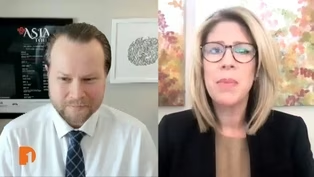
I talked with Vice President and General Manager of the DSO, Erik Ronmark.
Give us an idea, Erik, of the conversations that have been going on recently behind the scenes that got you to make this decision and really this big announcement.
- Well, I think you hit it right on the head there, Christy.
Hope, arts and culture, I think is here to provide people with a sense of hope.
And that has been on our minds since we started talking about what we could do this season even.
We had a lot of conversation last summer about coming back and doing something in our hall, but we didn't know what we were gonna be allowed to do, how this pandemic was gonna affect us all.
But working together with the musicians of the orchestra, we came up with a great plan, a safe plan, to come back and do concerts even this season.
- What is the DSO doing to make sure that things are as safe as possible?
- As we slowly start to bring audiences in even this spring and then hopefully coming back to the fall, we're gonna follow all of the safety procedures as we have during this season.
We have great UV filtration in our HVAC systems.
And we wanna make sure, even to the point of electronic tickets, contactless entries and stuff like that, it's really important for us to be safe.
And right now, we could have audiences up to 250 people per the guidelines that are out there now and that's what we're hoping we can get to as we get later on into the spring.
- Rewind a year, DSO made the big announcement that Jader Bignamini was going to be the music director and a very exciting announcement at that.
And then all of a sudden, the pandemic hits.
So 2122 will really be his first full season.
Talk a little bit about the programming that is going involved in that and what audiences can expect to see.
- Right, yeah, Jader has been a true champ in this.
He actually has been here conducting already two times in the fall and has come here and quarantine safely, and conducted the orchestra in three different programs this fall and we're gonna see him again in May.
And you're gonna see a lot of different repertoire, a lot of diverse repertoire, something that the DSO has always been a champion on is really promoting diverse artists.
So, out of the whole season, we're gonna have a third of the composers next season are gonna be living composers, over 25% are gonna be black composers, and this is something that has been at the core of the DNA of the DSO for 40, 50 years.
But we know we can always do more.
So, there's some great programs.
We're gonna have Branford Marsalis come here and play a Saxophone Concerto.
We're gonna open with the Sibelius Violin Concerto and large Italian repertoire.
And you're gonna see Beethoven 9.
- With times of great trouble, sometimes we see great transition and great creativity come out of it.
What do you think that we're going to be seeing musically in the next five years or so coming out of the pandemic and just maybe some things that we haven't seen before, experience before?
- When you have the time to sit down and think about how do we want to be different, not just as the DSO but as an industry, and I think the orchestral industry as a whole, really, it's been a wake up moment for us during this year as a pandemic, missing the audiences, but also the social unrest that we've seen in this country and the focus on diverse composers, diverse artists.
I think for us that's something that we've always done but we really wanna do more.
We would really wanna do more for Detroit and not just Midtown where we are but in the city as a whole.
- How would you describe it, Erik, to people when they sit together and they consume music together?
- Music is an art form that you experience in real time.
And so, when you come to Orchestra Hall, you and 2,000 of your closest friends are sharing that experience together, and once that concert is over, that experience is gone.
No two performances are alike.
So it is truly a shared experience that you are living in real time and I think that's what's so unique about music.
(lively orchestral music) - For the DSO schedule and so much more, just head to our website at onedetroitpbs.org.
It has been a long year for musicians who haven't been able to get close with their audience and their fans because of COVID, but it hasn't stopped them from reaching out in new ways.
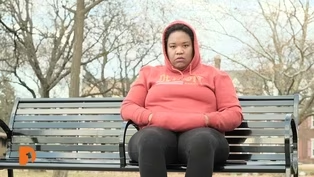
Detroit hip hop artist and activist, Diedre D.S.
Sense Smith, created what she calls her quarantine concert series.
One Detroit, Will Glover, has more.
(gentle music) (gentle upbeat music) ♪ One of you, I ♪ One of you, I - To give people a little bit of sense (chuckles) as to who you are, what you've been doing, how long have you been a artist, musician in Detroit?
- Close to 20 years, I would say.
I started as a teenager hitting the open mic circuits, and I was essentially a vocalist, R&B, Neo-Soul, that wave was big then, but I'd always been an emcee at heart.
And oddly enough, I was nominated for a Detroit Music Award for Best R&B.
And around that time, I was really itching to step into the waters of hip hop.
♪ Style biting is off limits ♪ I guess it's justice ♪ Needs that just fit ♪ Sense is intense ♪ Been this way since I could grab mics ♪ ♪ Why you wanna act like I ain't the best doing this ♪ And I'm more comfortable as a hip hop artist so for the last 20 years or so, I've been really pushing that hip hop agenda (chuckles).
♪ The feeling is just incredible, don't you agree?
♪ - Your latest release is "Cooper St.
Chrysalis."
First of all, tell us about the name of that album, "Cooper St. Chrysalis," what brought that about?
- Yeah, well, that's my homestead.
I'm a native Detroiter, an Eastside girl, and that's where my family home is.
Cooper St. is home to me, it always will be.
My family was one of the first black families to integrate into the neighborhood that was primarily Jewish and Italian at the time.
And so, my roots run deep on the Eastside of Detroit.
- Artists are always open to a challenge to something new, to something changing, whether it be good or bad, there's a way for an artist to participate, to distill, to translate, and you did something recently with taking us through a walk in the park.
So, tell us a little bit about what that was and what got you to the point in wanting to put this out?
- Much like the rest of the world, my world had gotten a little quieter, naturally reclusive, a bit introverted.
And so, I really felt like this was the time to show the rest of the world how to operate in such quiet and stillness.
I think that if you change your perspective about what this time is about and search for the silver lining if you have the guts to, you'll find that this is an opportunity to reinvent yourself, to tap into those facets of yourself that was your plan B, and artists know all too well about plan Bs and being told to consider your plan B.
Well now, plan Bs are at the forefront.
Being an artist, I got up with my plan B self (chuckles), and I show my audience how you can make lemonade out of lemons.
♪ Embark on a whole new journey ♪ ♪ A love where we both feel worthy ♪ ♪ Shucks, I blush when you say I'm pretty ♪ ♪ No biggie, you blush when I say you're pretty ♪ If you feel like you're in a place of despair, what better way to get yourself out of that than to take in the artistry of nature.
Look around at the colors, listen to the sounds of that first and foremost.
And within that, you'll find something to draw on.
You'll reinvent yourself eventually or come back to yourself.
Whatever you need to do with yourself, you'll eventually do it if you get out in nature.
And so those that were a little more reluctant to come out, I decided to come out.
I decided to walk the streets.
I decided to walk the park.
Those that are in the fear of isolation, I decided to show them what isolation looks like when you choose to change your perspective.
(upbeat music) Isolation isn't loneliness.
It's an opportunity to get to know yourself and that's all I was doing.
I was taking folks on the ride with me as I got to know myself, I reinvented myself.
They were familiar with my long locks and I had cut those and I crop my hair, and I wanted to be just as naked and vulnerable as being a vocalist made me.
- What is one of the things that you're looking forward to most?
- I'm looking forward to the alleviation of fear.
I wanna see those people that I've seen a certain amount of fear come over them, I wanna see them free and certain again.
I would put out little videos on Instagram and I would say, "I can't wait to see you on the other side of this."
Just to anybody who would view the videos.
I would always end it with, "I can't wait to see you on the other side of this.
I look forward to see you on the side of this."
And so, I wanna see those that make it on the other side of this along with me and you will.
I wanna see you smile again.
I wanna see you confident again.
I wanna see you hug again.
(chuckles) I wanna see you kiss again.
I wanna see all those things that make us human again.
- There's a new movie out at local theaters and streaming called "Asbury Park" which is a real street here in Detroit.
The movie was created by local filmmaker, Ken Legend Williams, and it tells the story of four Detroit kids growing up into adulthood, exploring challenges of mental illness and police brutality.
Stephen Henderson talked with Williams on American Black Journal.
- Let me ask you a question.
What's the first thought that goes through your mind when the police rolls up on you?
(tires screeching) (sirens wailing) - Where you runnin' huh?
(eerie suspenseful music) - I hope I don't get a ticket.
- I hope that I make it home alive.
- Quite frankly, I was in fear for my life.
The suspect was noncompliant with our orders and was just obstructing our investigation.
- So sick of going to funerals, dog.
- The Civil Rights Act only resulted because of a nation of African Americans coming together and taking the stand.
- [Actor] You people think it's okay to break the law.
- Those of us who are from Detroit or live in the area know that Asbury Park is a street on the Westside.
It's now the title of your film but it's also where you're from, is that right?
- Yeah, I grew up on Ashbury Park Street right off Seven Mile.
- So talk about the inspiration for this film, the street that you grew up on, the experiences that you had there.
- The biggest thing behind this film is survival.
Like I said, each of the kids, they have their own different things that they're going through and dealing with.
And I thought it would be interesting to see this from kids' perspective.
There are so many games that are going on in the world right now with police brutality, mental health awareness, just a lot of different things.
And as adults, we have a hard time grasping our heads around it and dealing with it.
So, to be able to see this from a kid's perspective, I think it's necessary because I'm a parent and I know as I watch the news and see the things that are going on, I know how I'm trying to deal with it, gravitate to it.
And I think just as a community, we just have to do a better job of actually checking and see what's going on with our kids, to see how they're dealing with it, to see what they think about it.
Because I think if we did that, I think we'll really be blown away by some of the responses that we get, because they're not stupid.
They see what's going on.
- Talk about the differences between what maybe you experienced as a kid growing up in that area and what your characters in the movie experienced.
Is there a big difference or?
- To be honest, it's a direct reflection of what I experienced as a kid.
I grew up in a single parent home.
My father left when I was six years old.
And when that happened, I was no longer able to be a six year old.
I had to start both highways, the running joke is when I was six, I was actually 16 because the level of responsibility shifted, and I wouldn't no longer able to be a carefree kid to just sit back and say, "Hey, everything is okay."
There were certain things that I did to try to protect the house.
I was the kid who, I'll pull out the toolbox when something needed to get fixed.
I'm doing that now.
I'm checking the windows at night and looking out to make sure that my mom is protected and things like that.
So I took on a much older persona than I actually was due to my circumstances.
And the reality is that's not uncommon.
The drug dealing and the shooting, yeah, that happens, but I feel like this portion of it is often missed.
Everybody is often trying to be tough and things like this but what's often missing in those films is the vulnerability.
I think one of my biggest motivations behind this film is my youngest son.
I looked at him one day and I laughed.
And I was like, "Man, you're like really a 10-year-old," 'cause when I was 10, I had responsibilities, I had, you know what I mean?
It was just a totally different animal.
And to see him just be carefree, I wasn't able to be carefree as a kid.
- So I wonder, what message you think people who aren't from Detroit and who may not know anything about Asbury Park, the street, might take away from this?
So I'm always curious about how we project to everybody else from this city.
- Asbury Park isn't even necessarily a Detroit story.
It actually takes place in the fictitious world of the inner city because while it is relevant in Detroit, it's also relevant in Baltimore, in St. Louis, just all over the country.
But I think oftentimes when you're going through things, because you're dealing with it in real time, you don't stop and think.
Hey, somebody is dealing with it over here, or someone's dealing with it over there.
So for me, like I said, it's much bigger.
And honestly, my goal and my hope is that people that are not from that environment will take a look and start asking questions because I feel like that's how you evoke change.
- Here, it's just a fight to breathe!
- And for more stories from American Black Journal and all of the arts and culture stories that we're working on, just head to our website at onedetroitpbs.org.
That is gonna do it for me this week, but we always like to leave you with a performance.
The Sphinx Competition is a national competition offering young African American and Latinx classical string players a chance for scholarship and mentorship, and their goal of increasing diversity in classical music has been going strong for over 20 years.
So we're going to leave you now with the performance from Sphinx Junior Division winner, Violinist, Amaryn Olmeda.
Enjoy and I'll see you next week.
(light playful piano music) (energetic violin and piano music)

Video has Closed Captions
Clip: S4 Ep19 | 5m 34s | Asbury Park | Episode 419/Segment 3 (5m 34s)
Video has Closed Captions
Clip: S4 Ep19 | 5m 49s | Deidre D.S. Sense | Episode 419/Segment 2 (5m 49s)
Video has Closed Captions
Clip: S4 Ep19 | 4m 35s | Erik Ronmark | Episode 419/Segment 1 (4m 35s)
Providing Support for PBS.org
Learn Moreabout PBS online sponsorship
- News and Public Affairs

Top journalists deliver compelling original analysis of the hour's headlines.

- News and Public Affairs

FRONTLINE is investigative journalism that questions, explains and changes our world.












Support for PBS provided by:
One Detroit is a local public television program presented by Detroit PBS