Signature Dish
European Classics
Season 1 Episode 11 | 28m 29sVideo has Closed Captions
Chateaubriand (French), Scacce (Italian), Jägerschnitzel (German)
French, Italian, and German cooking techniques come to life in this episode. Chateaubriand – a perfectly cooked beef tenderloin – is the signature dish at L’Auberge Chez Francois in Great Falls, VA, while Piccolina in D.C.’s Penn Quarter offers up scacce, a delicious Sicilian stuffed flatbread. Seth's tour ends with a German classic, jäegerschnitzel, at the Old Stein Inn in Edgewater, MD.
Problems playing video? | Closed Captioning Feedback
Problems playing video? | Closed Captioning Feedback
Signature Dish is a local public television program presented by WETA
Signature Dish
European Classics
Season 1 Episode 11 | 28m 29sVideo has Closed Captions
French, Italian, and German cooking techniques come to life in this episode. Chateaubriand – a perfectly cooked beef tenderloin – is the signature dish at L’Auberge Chez Francois in Great Falls, VA, while Piccolina in D.C.’s Penn Quarter offers up scacce, a delicious Sicilian stuffed flatbread. Seth's tour ends with a German classic, jäegerschnitzel, at the Old Stein Inn in Edgewater, MD.
Problems playing video? | Closed Captioning Feedback
How to Watch Signature Dish
Signature Dish is available to stream on pbs.org and the free PBS App, available on iPhone, Apple TV, Android TV, Android smartphones, Amazon Fire TV, Amazon Fire Tablet, Roku, Samsung Smart TV, and Vizio.
Providing Support for PBS.org
Learn Moreabout PBS online sponsorshipANNOUNCER: And now, Signature Dish, a WETA original series.
SETH: Today on Signature Dish, we're enjoying some European classics.
(pop) JACQUES: C'est magnifique.
SETH: We'll get started with a bountiful platter served with a dose of Gallic charm.
JACQUES: I'm gonna add a little bit more tarragon and, voila.
Ready to go.
SETH: Then prepare a Sicilian original using an ancient technique.
AMY: And as you can see, it's really steady, constant heat.
SETH: I can see it.
I can also feel it.
(laughs).
AMY: Very hot.
SETH: And, whip up a schnitzel straight from the German woods.
All right.
DIRK: Great.
SETH: I think we got one we can serve up at the restaurant here.
DIRK: Absolutely.
SETH: Should we raise our glass?
MIKE: Prost.
DIRK: Cheers to that.
SETH: I'm Seth Tillman, WETA producer and DC native.
And, I love good food.
That's why I'm traveling to restaurants across the DMV.
At each stop, looking for the one thing you just gotta try.
That Signature Dish.
Once upon a time, fine dining in Washington was European dining.
Regal French restaurants like Rive Gauche, La Salle Du Bois, Colony and Sans Souci towered over the District's dining scene.
Other continental fare could be found at restaurants like Roma, or the German haunt Old Europe, first opened on Wisconsin Avenue in 1948 and still standing there today.
While the DC area's upscale culinary offerings have fortunately grown far more diverse, venture around the DMV and you can still find plenty of classic dishes from the old world.
That's why I'm first driving up the narrow winding roads that lead to Great Falls, Virginia.
I'm making my way past impossibly huge mansions to visit L'Auberge Chez Francois, a sprawling country inn.
JACQUES: My folks came over in 1947.
My father, Francois, and my mother, Marie Antoinette.
He was Alsace, she was from the Basque country, two opposite extremes.
He started as a chef in The Three Musketeers restaurant and then opened Chez Francois, a block from The White House in 1954.
SETH: Chez Francois quickly became a popular dining destination and landed on Washingtonian Magazine's inaugural Best Restaurants List in 1968.
One of only three restaurants from that original list, still in operation today.
JACQUES: Dad always wanted to do a country inn.
And, he had a property down the road here and he looked around and he found this place.
It was a country store.
It was called the River Bend Country Store.
You know, ham hanging from the ceiling and deli sandwiches and all that.
So, we purchased that in 1972, closed the restaurant downtown in '75 and opened up here in '76.
SETH: Francois continued to oversee the restaurant into his 90s, as captured in this 2008 WETA documentary.
FRANCOIS: And tonight, we have shrimp bisque.
We have the root vegetable puree.
JACQUES: And it was his life.
(speaking French).
JACQUES: Our joke was, at home he would say, "Mama, hey can you help me find something?"
And she'd say, "Hey, get it yourself."
And, here, he'd go like this.
And 10 people would jump around and say, "Monsieur Francois, what can we get for you?"
Where are you hangin' out?
And he, uh, tasted the sauces every day.
Went home one evening at 90 plus, fell down, was gone the next day.
Se très bol!
I mean it was a way, a great way for him to pass on the legacy.
SETH: Jacques has continued to build on that legacy, adding a more casual brasserie in the basement, and expanding the outdoor garden space, which is where I'm meeting him today.
JACQUES: But, look, I mean, this is impressive.
I mean, look at these.
SETH: Chef.
Hey.
JACQUES: Seth, how are you?
Great to see you.
SETH: Great to see you, as well.
JACQUES: Welcome to L'Auberge Chez Francois, and one of my favorite, uh, things to do here is the gardening.
SETH: Oh, it's beautiful.
JACQUES: We, we love it here.
Stephanie is the lead gardener, makes sure everything gets done and that everything's planted at the right time.
We get something almost year round.
You know, this is part of France, though the climate's a little different here.
SETH: I felt like I traveled somewhere very far away.
JACQUES: Yeah.
Right?
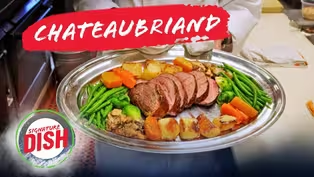
And we're today picking haricots verts, slender red green beans, which is an integral part of our signature dish, chateaubriand.
But it's just wonderful to come out here and pick something and take it right in the kitchen.
C'est magnifique.
SETH: Well, I can't, I can't wait to see what that adds to the chateaubriand.
Should we, uh, head back to the kitchen and I'll wa, watch you work your magic?
JACQUES: I wish you would.
Come on back.
Can't wait to show you the inside as well.
We've tried to create, we have I believe, an authentic Alsatian look and feel and cuisine.
We've been here a long time.
45 years.
So, it seems to be working.
Seth, welcome to L'Auberge Chez Francois kitchen.
I want to show you how to make a chateaubriand.
Probably our most favorite dish.
It's a romantic dish.
Something for two.
Let me make sure my knife is... SETH: Nice and sharp.
JACQUES: Absolutely ready to go here.
So, it's the center cut, so you can probably get two out of a nice size beef tenderloin.
The beef tenderloin is very little fat.
Uh, and what I like to do is, is cut it, put cracked peppercorns on the meat.
And we're gonna sear it first and then roast it in the oven.
Takes about 20 minutes or so, 20-22 minutes for a medium rare.
SETH: Well I do like medium rare for sure.
JACQUES: You shall have it.
You can always cook it more.
You can't cook it less.
That's the thing.
Freddy, here, we're gonna roast this.
Medium rare, please.
All right.
And here are the garnishes.
A chateaubriand comes with a bouquetiere, as we say in France, of vegetables.
Many from the garden.
So, what we try to do is prepare them separately, because each one has a different flavor profile and needs a little bit of different seasoning.
And, it is served with a bearnaise sauce.
I'm gonna taste the sauce.
I'm gonna add a little bit more tarragon.
And voila, ready to go.
Freddy, can I have the medium rare chateaubriand, please?
FREDDY: Yes, sir.
It's ready.
JACQUES: Ready to go.
SETH: Oh.
You can see it has a nice crust on it.
So, you're going to slice this?
JACQUES: I'm going to slice it, but I've got to wait at least 10, 12 minutes to slice it.
So, we'll let it rest.
We're gonna usually make six nice slices out of this, against the grain.
Then I'm gonna put it on the platter.
And then add all the garnishes around it.
And that will go under the broiler or in the hot oven for three or four minutes, just to warm everything back up.
And then we'll send it out and enjoy it with our bearnaise sauce.
Seth.
Here we are.
We have Tom.
He's gonna bring out the chateau and serve it... We always serve it table-side.
SETH: Wow.
It really is all about presentation, Chef.
Isn't it?
JACQUES: It is.
And all the fresh vegetables from the garden.
Thanks for helping me pick them.
I know you worked up an appetite.
But, while Tom is dishing out the chateau, we ought to have a glass of bubbly.
SETH: Of course.
JACQUES: French tradition.
(pop) SETH: Oh.
JACQUES: Oh!
That sound.
Oh.
The best.
The best in the west.
My, in the old days they'd even carve it out here.
That's when the maitre d's were running the restaurants.
Then, when the chef's took over, it sort of changed the dynamics.
Where, we didn't want the maitre d's and the waiters messing with our food too very much.
The final step is to put the bearnaise sauce on the plate.
The tarragon right from the garden.
And before we start, cheers Seth.
SETH: Yes.
JACQUES: Great to have you.
SETH: Cheers, chef.
JACQUES: Bon appetite.
SETH: Bon appetite.
Thank you.
Mmm.
Delicious.
JACQUES: Please enjoy.
SETH: Mmm.
Chef, that is so good.
JACQUES: I'm glad you're enjoying it.
SETH: That nice peppery crust on the outside.
And, you know, for such a lean cut of meat, it's retained so much of its juiciness.
JACQUES: Long as you cook it right, long as you let it rest a bit and cook it right.
Plus, it's great quality meat.
You know, top of the line.
SETH: All right.
I'm gonna take a bite of these green beans, as well.
JACQUES: They're fresh.
Right out of the garden.
SETH: Mmm.
JACQUES: A little crispness.
Nothing beats going right out to the garden and picking it and serving it that day.
That's the epitome.
SETH: So, you guys have been open now for almost 70 years.
What's the secret?
JACQUES: This is what we do here.
We, we emphasize the classics.
SETH: You know what you're gonna get when you come out to L'Auberge.
JACQUES: We tr... Well, Papa's motto was, uh, a nice ambience, a good service and a good food at a reasonable price.
Food brings everyone together.
And, I hate to call it nostalgia.
It's a, just an experience that they thoroughly enjoy and want to celebrate again.
Let's put it that way.
SETH: Well, it was absolutely delicious.
Thank you for showing me the garden space.
JACQUES: My pleasure.
SETH: And everything else.
And, I look forward to coming back.
JACQUES: We appreciate having you.
SETH: Cheers.
JACQUES: Cheer, "a votre sante".
That means, to your health.
SETH: I'll drink to that.
♪ ♪ After winding my way back to DC, I'm heading to Pen Quarter's CityCenterDC development to visit Piccolina and get a taste of rustic Italian cooking.
AMY: I grew up in Arlington, Virginia.
And, as far as Italian cooking, I loved to cook pasta with my mom and always loved basil and tomatoes and things like that.
I worked in a number of Italian restaurants in Washington.
I felt it was really important for me, as a woman chef, so that I could be successful in this industry, to create my own space in it.
I could make my own decisions.
SETH: Chef Amy opened her own restaurant, Centrolina to immediate acclaim in 2015, focused on light, modern interpretations of Italian classics.
Three years later, she opened a more casual space across the street.
AMY: Piccolina, to me, is really like my passion project.
It seems to me, like, the truest, most simplest expression of, of Italian food.
And I've always wanted to, kind of, work on bread.
Likewise, I love wood fire cooking.
So, I felt like the best way to, to accomplish all those things was to, you know, install a really, incredibly large wood fire oven and have the bread, and have it all be this, like, marriage of beautiful ingredients.
Piccolina, by design, is all built around wood, basically.
So, everything that you get at Piccolina is cooked in our wood burning oven.
So, that's eggs, that's sausage, that's soup.
We make soup in, in the wood burning oven.
Um, jam.
We don't have another method of cooking.
I was really excited about going back in time and, kind of, doing everything the way it was done a very long time ago, and, you know, with all that soul to it.
SETH: Chef.
AMY: Hello.
SETH: Nice to meet you.
AMY: Nice to meet you.
SETH: I'm always in the mood for great Italian food.
But, what are you preparing today.
AMY: Today we're gonna make scacce, which is our signature dish at Piccolina.
SETH: Scacce.
I can't say I'm actually familiar with that.
AMY: So, this is something I discovered from Sicily.
It's actually from the town of Ragusa, and it is, um, their signature dish.
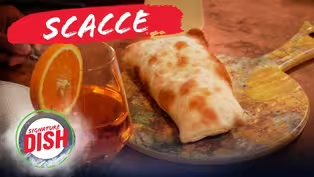
So, it's a very thin rolled, uh, sheet of dough.
And, it's layered with ingredients.
SETH: Well, a signature dish all the way from Sicily.
I can appreciate that.
So, how do you get started here?
AMY: So, this is a dough made out of flour, olive oil, yeast and water.
And, then we're just go about rolling it out.
And, as you can see, there's a lot of olive oil in it, and water, which makes it really, um, flexible and pliable.
You can also see the little air bubbles.
That's the yeast doing its thing.
So, the idea is here is we want to get it as thin as possible.
And, then, it's gonna be rolled over and over again.
So, when you do that, it creates layers of flaky pastry.
SETH: This is not gonna be a doughy pastry.
AMY: Nope.
SETH: It's gonna have a nice sort of crackly feel to it.
AMY: This is gonna be crackly and crispy, and as light as a stuffed pizza-esque dish can be.
So, we're just gonna make into, kind of, a perfect rectangle.
And, we're gonna put a little semolina flour on it.
Basically, what you're gonna do is take a little bit of tomato sauce.
And, then, we're gonna add broccoli rabe, salt and pepper.
This is fennel sausage.
So, you're gonna put it in raw.
SETH: Okay.
AMY: And, then in the oven, you know, it'll cook the rest of the way.
And we have mozzarella.
SETH: It is looking quite pizza-y at the moment.
AMY: It is.
Okay, so we have caciocavallo, here.
A little bit of basil, little bit of oregano.
And, then we're gonna fold it over.
Now, the good thing about this pastry is, is that it can be messy and still be delicious.
So, that all the raggedy edges that aren't perfect, end up becoming crispy or there's a hole, like, the mozzarella will shoot through it.
And, it's all good.
SETH: Caramelize the outside.
It's just an explosion of flavor.
AMY: So, yeah.
Exactly.
It's meant to be imperfect.
So, the second layer, we'll put a little bit more mozzarella.
I put a little hot pepper.
And then we're gonna roll it over again.
Tamp it down.
SETH: One more layer of flavor.
AMY: Yeah.
This one's gonna get all the works.
SETH: All right.
AMY: And, then, you know, you'll want to take it easy with the sauce, because that's gonna end up making it soggy.
So, we don't want that.
SETH: Still keep that crackly crust.
AMY: Yeah.
SETH: All right.
AMY: Exactly.
SETH: I like the idea of just folding these flavors on each other.
AMY: Yeah.
SETH: Making these little pockets.
AMY: So, somebody called it a gl, a fancy hot pocket.
And, you know, I mean, listen.
It's not my... SETH: Hey, hot pockets are delicious.
AMY: It's not my best, uh, you know.
It's not the best description.
But, it works.
Okay.
And, then this is the final layer.
Just cut it.
You want to seal off the edges.
That's it.
So, I'm gonna flour up the pizza peel.
Now we're gonna put it on the peel.
So, why don't we walk this way and I'll show you how to put it in the wood oven.
SETH: Sounds great.
Let's do it, Chef.
Oh.
Wow.
Chef.
There is a lot of heat coming off this oven.
AMY: Yes.
SETH: What is this thing?
AMY: So, this is a huge wood fired oven.
And, as you can see it's really steady, constant heat.
SETH: I can see it.
I can also feel it.
AMY: Very hot.
This is definitely not for the faint of heart.
SETH: Heh, heh.
It's definitely not for me, either.
I definitely wouldn't be able to do this.
AMY: In terms of the way that it cooks, it has a dry method of cooking.
So, instead of a traditional oven with gas, where you have a closed door, this takes the moisture and humidity out.
SETH: So, it's not gonna steam as much.
You'll get that nice, kind of, crackly... AMY: More caramelization.
SETH: Caramelization is always good.
AMY: Yeah.
Whether it's a piece of fish or a pizza, or, yeah.
SETH: Got it.
Got it.
AMY: We always want to position the logs in the corner so that you have good air circulation.
SETH: You want the air, kind of, circulating across the top of the oven.
AMY: Yeah.
Yeah, you... SETH: Just like...
Okay.
So, it, it's kind of like a pizza oven in that sense.
AMY: Oh, yeah.
Alright, so, now that these are hot, we're gonna put the scacce in the oven.
So, we're just putting it right on the deck.
It's gonna take about, I'd say, somewhere between five and, five and 10 minutes, until all the layers are cooked inside.
And, we're gonna turn it, like, one or two times, to get it crispy all the way around.
SETH: Wow, Chef, this looks terrific.
AMY: My pleasure.
My pleasure.
SETH: Glad we could come to maybe come to a cooler spot to, uh, to dig in.
So, how did you even get started on something like this?
AMY: Fork and knife.
SETH: Oh.
AMY: Yeah.
SETH: Look at that melty cheese.
AMY: Help yourself.
SETH: There we go.
Ho, ho, ho.
You can even hear when you were cutting it.
I could hear the crackle.
Mmm.
AMY: Mmm.
SETH: Wow, Chef.
That is fantastic.
Heh, heh.
My, uh, my frame of reference is a calzone.
I've had so many doughy calzones in my day.
AMY: Mm-hmm.
SETH: But, it almost has that, yeah, that flat bread, that cracker like consistency on the outside.
That's really terrific.
AMY: Thank you.
SETH: I like the broccoli rabe.
You know, I'm not always a broccoli rabe fan.
But just that little bit of bitterness... AMY: Mm-hmm.
SETH: That it gives to it is really nice.
AMY: Punctuates the other flavors.
SETH: So, is this the, uh, the Sicilian way of making scacce?
AMY: They are so many different ways that they prepare this in Ragusa, the home of scacce.
You know, so this is sort of a more traditional, like, Neapolitan pizza-esque flavor going on here.
SETH: You know, unlike a pizza, you could just pick this up and eat it as you're walking down the street.
AMY: You could definitely pick it up and walk right out the door, and keep going.
(laughs).
And I see all this other beautiful bread.
AMY: Yes.
There's, Piccolina was meant to be a project around bread and all kinds of different doughs.
So, everything is hand crafted.
The bread is made in-house.
And, you know, I really wanted to have a beautiful, you know, breakfast, lunch, dinner spot that people could feel relaxed in and enjoy, like, really terrific food, um, without fuss.
That's it.
SETH: Well, I love it, and this is delicious.
Thank you, so much.
AMY: Thank you.
♪ ♪ SETH: I'm finishing up way, way outside of the District, just shy of the Chesapeake Bay in Edgewater, Maryland.
I'm paying a visit to the Old Stein Inn, a venerable German institution.
MIKE: In 1983 my father and mother, Karl and Ursula Selinger, from Rhineland Pfalz in Germany, decided to open up the Old Stein Inn in Edgewater, Maryland.
Like any American immigrant coming to the country, they wanted to bring what they brought from home.
They wanted to bring their food.
They wanted to bring their traditions to this area.
So, in 2010, we unfortunately had very serious fire.
We had closed for almost 10 months.
The nuh, support of the community was really what kept us going.
People would email, call and tell us how much they had, uh, missed us, and they wanted us back, and it was a blessing in disguise.
We came back with a better restaurant and we're still here after 39 years.
DIRK: Germany is a pretty small country, but we have the ocean on the, uh, Northern.
And, we have the mountains in the South.
So, it's all about, like, um, bringing everything together, and just trying to do the best out of it.
It's coming from the soul, from the heart, you know, to cook German cuisine.
It's like a family restaurant that everybody loves to come in here and it's like a generation for generation stuff going on, you know.
The parents teach their kids, "That is a schnitzel.
That is the spaetzle."
So, they all come here and I will do my best to make that never end.
CUSTOMERS: Cheers!
SETH: Chef, nice to meet you.
DIRK: Hello, Seth.
It's very nice to meet you.
SETH: It smells great in this kitchen.
Uh, what are you making today?
DIRK: I'm going to show you, today, how to make like a traditional German jagerschnitzel.
SETH: Well, I've had plenty of schnitzel before, but I don't know about jagerschnitzel.
Uh, what is that?
DIRK: Well, the jagerschnitzel means, like, the hunter schnitzel.
You go in the forest and shoot some deer or wild boar.
You use, like, the bones and everything to make a demi-glace.
And, the fresh ingredients like the herbs, the mushrooms, some cream from your cows.
SETH: All right.
So, this is just a rustic, kind of, country German dish right here?
DIRK: Yes.
It absolutely is.
SETH: So, how do you get started here?
DIRK: I will turn, uh, on the fire now and put in some butter, you know.
Butter is like the most important thing in German kitchen.
Then you add some seasonal mushrooms, some onions, and a little bit more butter on it.
Butter is always good for you.
SETH: I love butter.
DIRK: And, so, you will add some pepper, some salt.
I'm so sorry the hood is coming on.
(laughs).
You know, but it's supposed to be right here.
SETH: Hey, we're cooking.
We're cooking.
DIRK: So, then you add your own demi-glace.
Uh.
SETH: I can tell how nicely reduced that stock is.
It's already so syrupy in this pan right here.
DIRK: It is.
And the demi-glace takes like, really, two days to cook this.
SETH: Really let those flavors get nice and concentrated.
DIRK: Absolutely.
And, then, you add, like, the herbs.
You can add, like, oregano, add rosemary, some, uh, chives, you know, to make it look, uh, nice.
Um, then, just like butter, very important in the German kitchen, you will add some heavy cream.
SETH: Of course.
DIRK: And, at the end, bring it to a boil.
So, Seth.
That's, that's your whole deal about the jager sauce.
Now, if you don't mind, we go over there and beat up some schnitzels.
SETH: Beat up some schnitzel.
All right.
Uh, so is this pork right here?
DIRK: Yeah.
It's pork tenderloin.
We just have to give it some salt and pepper on it, on both sides.
And, then we have to beat it up a little bit.
SETH: You want that nice, kind of, uniform, uh, thickness throughout.
DIRK: Yeah.
SETH: Nice and thin.
DIRK: Yeah.
Absolutely.
You know what, it has, it has to, uh, be a schnitzel and not a steak.
SETH: So, in the old days for the jagerschnitzel, I mean, they'd be going into the forest to hunt for the boars to make this dish, right?
DIRK: Oh, yeah, absolutely.
They did, you know.
I mean, uh, back in the days, uh, we didn't have pork, have pigs and cows at home.
So, we just went to the forest.
That's how we created the word jagerschnitzel.
But, by now, I'm glad I can buy it and don't have any extra hours to go in the forest at night.
SETH: Save you a trip.
That's nice.
DIRK: Absolutely, yeah.
SETH: So, how do you, uh, how do you pound this thing then?
DIRK: You just start on one side, turn it around.
SETH: You are not messing around.
DIRK: So, in Germany we say you beat it down from $9 to $18, you know on the sides.
All right Seth, you saw how I did it, so maybe you want to give it, uh, a shot.
SETH: All right.
DIRK: Here's the hammer.
Just go and do it.
SETH: Hammer of Thor.
All right.
So, we're gonna use the, uh, the flat side here.
DIRK: Yes, you do the flat side.
SETH: I don't know.
DIRK: Just do the, do it.
SETH: I'll go to town on it.
Oh my.
Good stress relief right here.
DIRK: Yeah.
Absolutely it is.
SETH: I haven't gotten it quite to $18 yet.
I got a few more, few more, uh, strikes to go here.
DIRK: Yep.
My boss is not paying you the extra hours until you finish.
But, you're doing just fine.
SETH: All right.
DIRK: Great.
SETH: I think we got one we can serve up at the restaurant here.
DIRK: Absolutely.
The last steps is, like, to bread it.
You want to put it in flour, wave it off, put it in egg.
And, then you put it in, the, uh, Japanese panko bread crumbs.
And, then, we are ready to cook it.
So, the next step is cooking the schnitzel in butter and oil.
And you will cook it for, like, four minutes and flip it around.
The next step you do is, do the side dishes.
The red cabbage is basically caramelized sugar and salt.
And the spaetzle is like every noodle.
You just have, uh, eggs and flour and water.
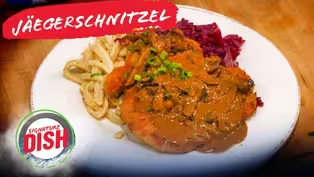
So, after we plate it, the final step is ladle the jager sauce on the schnitzel.
And, then, we will sprinkle on our garnishes.
And then we will be all set.
SETH: Mike, Dirk, thank you so much for letting me come back into the kitchen.
This looks incredible, but you guys are not messing around with this beer here.
MIKE: Oh, we're so happy to have you, uh, Seth.
We definitely don't mess around with German beers.
We source great beers from Germany.
Beers you won't get anywhere else.
SETH: Cheers to that.
Or should I say... MIKE: Prost!
SETH: Prost?
MIKE: It is the German way of saying it.
SETH: Prost.
DIRK: Prost.
SETH: Prost.
DIRK: Prost.
SETH: Let's drink.
Oh, good.
I know the schnitzel is going to be the perfect accompaniment to that.
MIKE: Oh, let's dig in.
SETH: All right.
Got to make sure I get some of that sauce in this first bite, too.
MIKE: Oh, Dirk does a great job.
What do you think?
SETH: That is delicious.
That sauce, it's got such a nice richness, and the mushrooms are so perfectly cooked.
That's really wonderful.
DIRK: Thank you, sir.
MIKE: Great, Seth.
DIRK: Thank you very much.
SETH: I like with the panko that you were able to get that nice, crispy crust, but it still stays so nice and juicy and flavorful on the inside.
DIRK: Why I put the sauce in the middle is that you can have a look, always on the crust, on the panko, you have, like, a mix of the texture of the sauce in the middle and the crusty, crunchy panko with the really tender cooked meat.
SETH: What are some of these other sides that go with it?
DIRK: Well, it's like the spaetzle, it's like German kind of noodles.
And, of course, you add cabbage.
You know, the most, uh, famous, uh, side dish, uh, in Germany.
MIKE: Next to sauerkraut.
DIRK: Next to sauerkraut.
It's like, uh, uh, family secret, so I can't tell the recipe.
(laughs).
SETH: I just love, also, the hearty portions.
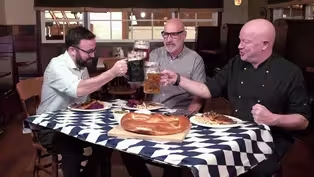
The beer, this plate of jagerschnitzel, this giant pretzel.
I just like how you guys aren't skimping on the experience.
MIKE: Right.
That's actually, we have a German word for it.
It's called Gemütlichkeit, which means a comfortable, homey place that you bring family and friends.
And, that's we're, uh, about at the Old Stein Inn.
Glad you got to experience it, Seth.
SETH: It's Oktoberfest everyday.
Well, thank you guys, again.
Uh, shall we raise our glass?
MIKE: Absolutely.
♪ Ein Prosit, ein Prosit ♪ ♪ Der Gemütlichkeit ♪ ♪ Ein Prosit, ein Prosit ♪ ♪ Der Gemütlichkeit ♪ (laughs).
SETH: Prost to that.
MIKE: Prost.
DIRK: Cheers to that.
But now you have to drink it all.
(laughs).
♪ ♪ ♪ ♪ ANNOUNCER: To find out more about great food in the Washington Metro area, visit WETA.org/signaturedish.
French Taste Starts in the Garden at L’Auberge Chez François
Video has Closed Captions
Clip: S1 Ep11 | 5m 44s | Seth Tillman visits L’Auberge Chez François in Great Falls, Virginia. (5m 44s)
Preview: S1 Ep11 | 30s | Chateaubriand (French), Scacce (Italian), Jägerschnitzel (German) (30s)
See How Authentic Jägerschnitzel is Made at Old Stein Inn
Video has Closed Captions
Clip: S1 Ep11 | 7m 39s | Seth Tillman heads to the Old Stein Inn for a traditional German jägerschnitzel. (7m 39s)
The Sicilian Flatbread at Piccolina is Stuffed with Flavor
Video has Closed Captions
Clip: S1 Ep11 | 6m 23s | Piccolina Chef Amy shares the secret behind her Scacce, a delicious thin flatbread. (6m 23s)
Providing Support for PBS.org
Learn Moreabout PBS online sponsorship

- Food
Christopher Kimball’s Milk Street Television
Transform home cooking with the editors of Christopher Kimball’s Milk Street Magazine.









Support for PBS provided by:
Signature Dish is a local public television program presented by WETA