
Evictions/Facial Recognition
Season 49 Episode 38 | 26m 46sVideo has Closed Captions
Evictions/Facial Recognition | Episode 4938
A report on the financial assistance available for tenants who fell behind on their rent during the pandemic. Plus, we’ll examine the controversy over facial recognition technology. And, a conversation with the host of Detroit Public TV’s new show, “Detroit Performs Live from Marygrove.” Episode 4938
Problems playing video? | Closed Captioning Feedback
Problems playing video? | Closed Captioning Feedback
American Black Journal is a local public television program presented by Detroit PBS
Evictions/Facial Recognition
Season 49 Episode 38 | 26m 46sVideo has Closed Captions
A report on the financial assistance available for tenants who fell behind on their rent during the pandemic. Plus, we’ll examine the controversy over facial recognition technology. And, a conversation with the host of Detroit Public TV’s new show, “Detroit Performs Live from Marygrove.” Episode 4938
Problems playing video? | Closed Captioning Feedback
How to Watch American Black Journal
American Black Journal is available to stream on pbs.org and the free PBS App, available on iPhone, Apple TV, Android TV, Android smartphones, Amazon Fire TV, Amazon Fire Tablet, Roku, Samsung Smart TV, and Vizio.
Providing Support for PBS.org
Learn Moreabout PBS online sponsorshipJust ahead on "American Black Journal", a report on the financial assistance that's available for tenants who fell behind on their rent during the pandemic.
Plus, we're gonna examine the controversy over facial recognition technology, and we'll have a conversation with the host of Detroit Public Television's new show, "Detroit Performs Live From Marygrove."
Stay right where you are, "American Black Journal" starts now.
NARRATOR 1: From Delta faucets to Behr paint, Masco corporation is proud to deliver products that enhance the way consumers all over the world experience and enjoy their living spaces.
Masco: Serving Michigan Communities Since 1929 NARRATOR 2: Support also provided by the Cynthia & Edsel Ford Fund for Journalism at Detroit Public TV.
NARRATOR 3: The DTE foundation proudly supports 50 years of "American Black Journal" in covering African-American history, culture and politics.
The DTE Foundation and "American Black Journal" partners in presenting African-American perspectives about our communities and in our world.
NARRATOR 4: Also brought to you by AAA, Nissan Foundation, Impact at Home, UAW Solidarity Forever, and viewers like you, thank you.
(cheerful music) Welcome to "American Black Journal", I'm Stephen Henderson.
Now that the federal eviction moratorium has expired, hundreds of thousands of renters across the country are facing the reality of losing their homes.
The ban on evictions was put into place to help people who became unemployed during the pandemic.
But now that the back rent is coming due, tenants can apply for federal funds through the COVID Emergency Rental Assistance Program.
Producer, AJ Walker, and community journalist, Deja Moss, report on a Detroit family that's seeking help after falling behind on rent payments.
That's tight.
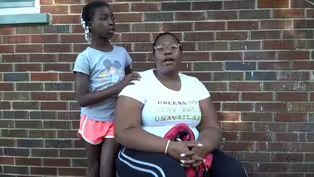
WALKER: As Jay Maria Gordon sits on the porch of her West Detroit home helping one of her four children dress, she is also worrying.
Because I'm in the process of getting evicted.
My landlord has told me if I haven't paid up to three grand by September 10 that they was gonna go on with the eviction.
So I'm in that process.
WALKER: She says her housing problems are due to the COVID-19 pandemic.
I was working, but I have young kids, so they have to have daycare, and (kid coughing) the person that watches my kids, caught COVID, so I could no longer work, it forced me out of my job.
WALKER: She says she's been looking for a new job and a new childcare provider.
Meanwhile, rent has been piling up and now she says she owes so much, it feels impossible to pay it.
The 36th District Court sent me a letter saying that if I didn't pay the 3,000, by September 10, that they was gonna go on with the eviction.
So that's what I was tryna' do, but it's already, August 25th.
And I don't know if I'm gonna be able to come up with 3 grand by then.
WALKER: She's tried to get help.
I filled out the COVID relief assistance, rental assistance, no one got back to me.
I did that May 8th, 2021.
No one's contacted me, nothing.
So as of now, I don't know, right now, what to do, or what I'm going to do.
WALKER: The program, Jay Maria applied for is CERA.
It is designed to help people like her who are struggling to pay rent due to the pandemic.
We spoke with Kelly Rose at the Michigan State Housing Development Authority to find out more about the program and how people can take advantage of it.
So the COVID Emergency Rental Assistance Program which we call CERA is designed to help renters and landlords.
So renters can get up to 15 months of rental assistance and they can also get help with their utilities.
So really the program is designed to help the renter preserve their housing stability and to also help the landlord to recoup those rental payments that the tenant was not able to make during the pandemic.
WALKER: Although the program can help tremendously, there are also a tremendous number of people applying for it at the same time.
So in Detroit, because they are having such a high application volume, it is taking generally about eight weeks to get applications processed.
In some cases it's faster.
In some cases it's slower, because they are working to prioritize eviction cases.
So if the landlord has already filed for eviction, and that case needs to be processed faster then they're, you know, just sort of moving into the front of the line to try to make sure that cases are processed quickly enough to avoid that eviction.
So it really does vary a little bit, but it is something that we're working with the Detroit providers, United Community Housing Coalition, as well as Wayne Metro Community Action Agency, to really speed up that process.
WALKER: But it's taken much longer for Jay Maria's claim to get processed; she filed back in May.
Michael Centi, a director at Wayne Metro says they aren't handling Jay Maria's case, but he was able to find out some information.
He says the case is under review by the United Community Housing Coalition.
He also shed a light on why some cases take longer than others.
Wayne County in general has received about 40% of the state's applications.
And so, any longer times are really a result of the, you know, tremendous demand that we're seeing in our region.
In July, Wayne Metro distributed about $10 million in rental assistance for about 1,500 households.
In August, we doubled that, you know, so we're really moving at a really fast pace right now.
We're assisting, we're paying out or distributing rental assistance for over 7,000, I'm sorry, 700 households per week at this point.
So, I just wanna kind of reiterate that this is really a freight train, kind of moving at full speed at this point, you know, we have about a hundred million dollars of rental assistance came to Wayne Metro on March 15th.
And you know, we've distributed over half of it at this point.
And we have, we're on pace to really distribute the rest of that by the end of the year.
WALKER: At the state level, Kelly Rose says they've been working hard to put a dent in the number of cases coming in.
We've received over 62,000 applications statewide for the program.
In a Detroit alone, we've seen over 16,000 applications.
WALKER: While also trying to get more people to apply.
Release the funds.
CROWD: Release the funds.
Release the funds.
CROWD: Release the funds.
Everyone in charge needs to be ashamed of themselves.
WALKER: But waiting for rental assistance has frustrated and outraged some people.
We caught up with a group called Moratorium NOW!
they were speaking out, along with other organizations to demand that CERA funds be released more quickly to help people stay in their homes.
Nobody should be evicted, or even thought about being evicted, until every dime is released.
WALKER: Rose points out, there are other factors that slow up the process.
So we're really working to try to reach people, but we also have about 15,000 applications statewide, where the landlord has applied, but the tenant has not yet applied.
So we're really working with our Service Agencies as well, to reach out to those tenants, to try to understand why they haven't applied and to be able to provide them assistance in applying.
WALKER: You can apply for CERA funds using your phone, tablet, or computer, you can also mail your application in.
We've got over a billion dollars of rental assistance to deploy in Michigan.
We think we'll have these programs available for the next two or three years.
So we're really hoping to be able to really effectively serve people at the local level.
And if you're wondering if you might qualify for the program.
Say for the Detroit market, a single person up to $44,000 of income, will qualify.
In a family of four, up to $62,800, will qualify for the programs.
This program is here for you.
We want to serve you and to come in to apply.
Jay Maria says she wants to believe that, because right now this is the only hope she has for her and her children.
Mommy have a kiss?
Love you.
I have four kids that I have to take care of, that needs a roof over their head.
I can't pay the back rent right now, and I need assistance.
And a quick update, we checked in with Jay Maria Gordon.
She has not yet heard from the courts, or about her CERA application.
This is the first of several reports produced in partnership with the COVID 313 Community Coalition of Families and Students about critical issues here in Detroit.
You can join the groups virtual town hall on Thursdays at noon, at www.dptv.org.
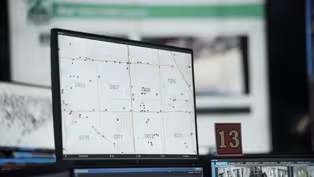
We now turn to the controversy over the use of facial recognition technology by law enforcement.
Detroit received a lot of attention last year for a wrongful arrest that occurred as a result of this technology.
One Detroit's Bill Kubota reports on how facial recognition works and where it stands as a crime fighting tool.
The best way to put it is that we have entered a world of policing, that is the stuff of science fiction.
I have 57-19.
BILL: We've been watching this stuff, facial recognition, technology, biometrics - CLIP NARRATOR: The machine sees everything.
BILL: In movies, on TV, for decades.
What the heck?
Is that a facial recognition scanner?
The technology is here.
How do we make it efficient and reliable enough that we can depend on it?
BILL: Tyrone Carter worked in law enforcement before becoming a state rep.
Very few things have really changed about policing, except technology has enhanced it, made it better.
When I hired in, I tell people, I carried a .357, We didn't even have semi-automatics back then, a huge radio, handcuffs.
And that was it.
BILL: Last year, Carter wanted to slow the roll on facial recognition, needs more discussion, but he says it can be a good investigative tool.
Shobita Parthasarathy looks at technology inequity issues.
And we published a report a year ago and looked at this and we saw that it really is being used around the world, but without much regulation.
BILL: The Michigan state police has the SNAP program using facial recognition, not regulated, really, MSP observes a policy developed by the FBI.
Our database consists of roughly 54 million images.
If they were arrested in our state or have a valid driver's license in our state, then that's what we would have.
BILL: Odds are you're in there, maybe a few times.
The state police facial recognition package comes from DataWorks Plus in South Carolina.
The Detroit Police Department is also a client.
The image was so clear because it was amazing.
Facial recognition came to the fore when police started watching video feeds from around the city.
The program, Project Greenlight.
The high school I went to, the colors were green and white, so I have a thing with green.
BILL: Cass Tech alum, and then police chief, James Craig explains Greenlight to out of town reporters in 2018.
Our car jacking's plummeted and reason why that happens because frankly carjackings were occurring at gas stations and liquor stores.
BILL: So we're being watched, but if they ID us with live video without probable cause?
There are civil libertarians who don't like that idea.
That contract stated that an objective, a project objective was to run facial recognition across live Project Greenlight feeds.
BILL: No indication that's happened, but many worried it could.
For better or worse, Detroit is a leader when it comes to use of facial recognition technology.
BILL: But then, how does facial recognition work anyway?
There are biases that make it less accurate, essentially among anyone who isn't a white man, because the training data was very homogenous.
Then the assumptions that this algorithm makes is based on the measurements of your average middle-aged white guy.
BILL: But this is Detroit where cameras point mostly at people of color.
These communities of color have extremely long legacies of surveillance, even that back to the founding of the country.
BILL: Certain people had to carry lanterns for easier identification, when slavery was a thing.
Remember COINTELPRO, electronic eavesdropping on Martin Luther King?
But these are different times.
What's to worry now?
If you're not doing anything wrong, what's the big deal?
Our client, Robert Williams had his photo in the database and he wasn't doing anything wrong.
And that didn't stop the Detroit police from, based on a facial recognition check, arresting him one day in his front lawn in front of his wife and two children, taking him to jail and holding him for approximately 30 hours where he had to sleep overnight on a concrete bench.
BILL: All this revealed last year when a Detroit cop used William's picture from the state police database in the shoplifting case.
MSP did not say it was a positive match, but the arresting officers seemed to take it that way.
Our investigative lead reports do indicate rate on them that it's not probable cause for arrest, that it is a viable candidate.
You know, that further investigation is required to utilize that lead.
BILL: So was it about the technology, or is it about just bad police work here?
I think it's about both the technology and the police work, and it's about the causal effect between the two.
The simple fact is using shoddy technology creates shoddy police work.
We know this from our daily lived life, that when the computer tells us something, we're inclined to trust it, and sort of confirm what had already tells us.
BILL: Like Phil Mayor says, taking directions on our GPS.
I don't know hardly anybody who can't recount having turned the wrong way because Google Maps told them to even when they knew very well that they were turning the wrong way at the time.
Gets you hands of me.
BILL: Someone else arrested for raising his voice about facial recognition.
We're gonna take a five minute recess.
BILL: Willie Burton, Detroit Board of Police commissioner, gavelled out of order.
MAN: Let the commissioner go.
Police departments struggle to correct the bad apples, but yet as an elected body, you move swift to arrest someone for simply questioning the policy and the procedure.
CROWD: Let the commissioner go!
I stood up to protect our civil liberties.
BILL: Burton said he got a concussion.
He's suing the PD.
San Francisco banned this technology.
Portland banned the technology.
Berkeley banned this technology.
BILL: Berkeley, as in California, Boston and Minneapolis, banned it too.
We just had a county called King County in the state of Washington, one of the whitest counties in America, just banned this technology.
Why does America's blackest, poorest city, Detroit has to- It doesn't make any sense.
BILL: The commission voted strong approval of the technology, perhaps Burton's arrest prescient, coming before the Williams incident and two others, both African-American men in New Jersey, Nothing like- and again, in Detroit.
That's only three, that isn't very many people that have been picked out wrongly by this facial recognition technology.
To, which I would say Bill, only three that we know of and have been able to be proven.
This is a tip of an iceberg type problem that the vast majority of people are never told when facial recognition technology is used.
In Mr. Williams' case, the only reason he found out was because the police were so surprised when they were speaking to him to realize that the photo was wrong, that they said, huh, the computer must have got it wrong.
BILL: The commissioners have set guidelines for the technology only to be used for violent crimes.
And last month city council passed what's called the Community Input Over Government Surveillance Ordinance.
And we hope that this will safeguard residents from having surveillance technologies forced upon them.
That don't do what they were told that they would do.
There will always be some form of surveillance.
If you're African-American, you're always gonna have that.
Now we've become the majority of elected and appointed officials, and we're gonna double down on stuff and with history and research behind it, that says it doesn't work.
At the end of the day, it comes down to thinking or lack of.
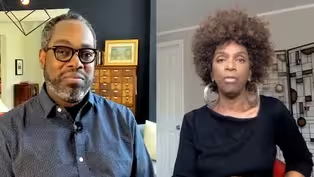
Finally today, a preview of the new show Detroit Performs Live From Marygrove.
It premieres right here on Detroit Public Television, October 6th at 7:30 PM.
Now this reboot of Detroit Performs is hosted by local storyteller and artist, Satori Shakoor.
Many of you may know her as the founder and host of the Secret Society of Twisted Storytellers.
I spoke with Satori about this exciting new role.
I first wanna talk about this new role for you, as host of Detroit Performs Live From Marygrove.
That is really exciting.
Tell us about what that means.
It just seemed like an absolutely perfect fit for me because I get to introduce some very talented, exciting, diverse within their disciplines artists, that maybe Detroit, obviously some of them Detroit has heard of, but all of them Detroit can be proud of.
So I get to not only introduce them, and see their performances, but I get to sit down and talk with them and hear their stories and ask questions that hopefully will bring them closer and have Detroit know them even more intimately.
So for Detroit Performs, tell us, you know, everything is different and somewhat disrupted because of all of the things that are going on.
What should we expect from Detroit Performs Live?
Well, we're in the beautiful Marygrove Theater on the campus of Marygrove College.
And it's always something magical when you step into the theater, whether you're stepping on stage and you're getting the lighting, it's just a transporting kind of experience and it's alive.
Although there are very, there is not really an audience present.
There are people there, technicians, other performers supporting, but the viewing audience will have a full and very powerful experience of their performances.
DPTV does an excellent job of filming, and making it feel like you're right there, sitting in one of those seats that soon we will be returning to.
Detroit can expect some explosive performances from a vast intergenerational group of artists, over the spectrum of the performances.
But a lot of times we see people's work out there.
We hear their music, but we don't know the people who actually produced that wonderful work.
And so it's always good to see the human being, who's just as regular looking as everybody else, (both laughing) see them be just like you, and they're expressing their artistic ability, which all of us have.
Yeah.
I think COVID showed some of us and pushed some of us in the direction of doing what we've been procrastinating over for such a long period of time.
Yeah.
So, for viewers who are not familiar with you, or The Secret Society of Twisted Storytellers, let's tell them about that exciting work, which I have loved since you started it.
Thank you.
Well, and you've appeared on our stage I have.
And in fact hosted all these beautiful journalists that again, we see on the TV, but the have them right there, where people can go up to them and just, you know, there's so much humanity out here in the city of Detroit and in the world.
And we just, until they tell their story, they just look good and smell good, I always say.
(Stephen laughing) And so the work that I do as a storyteller, as a director, as a producer, I want to put the people in Detroit and all over the globe on our stage, and sort of unzip that beautiful package and hear their journey in life, which when they tell their story and always the way I listen, and the way I curate, is to deliver a little package of wisdom that can make a powerful difference to the viewer, the listener.
And there are people who never walk into the right- live right here in Detroit, but they are avid about our YouTube channel.
So we make sure that the delivery system of these stories are forever and accessible to people via social media.
Yeah, when you started this, I mean, you had been a storyteller for a really long time, and this was sort of an expansion of that idea and that franchise, but did you ever imagine it would grow to the extent that it has been?
This is a very wide reaching and broad production that draws in people from all over the place, not only to perform, but also to come see the performances.
Is this what you had in mind when you started?
Well, I think that if you talk to any artists, and especially if you talk to an artist like me, who has, you know, been on stages, with 80,000 people in the audience.
I mean, even when I was in college, and I was imagining my career, I would put on a Gino Vannelli album, with the live so I could hear all of the applause, and imagine myself.
So I did imagine it being something that would make a difference, but how it would grow with all of the support and all of the people coming to it.
No, no.
And when I did imagine it, I imagined at first at the Gym theater, if it was like, no little girl, no one knows what storytelling is.
you better go back to that little 45 seat and build it up.
And so I'm excited because I sort of feel like the person who holds the space of this platform and the community tells me what to do.
"Oh, it would be nice to have musical performance.
"How about if so-and-so were on the show, "they just did a movie, "Desiree Cooper and Mr. Schillinger, "Aaron Schillinger, "they're doing a movie about the Boblo Boats," Really?
And so I am discovering through the community, what's possible with the platform of The Secret Society of Twisted Storytellers, because I could never imagine all of what everyone else imagines.
So this is also a place of collaboration, of ideas and trying new things, and rolling with the COVID hiccups.
And so it's a creative opportunity.
It's sometimes, it's devastating.
I mean, I'm crying.
And sometimes, you know, it's just part of the road.
And now I feel this balance, and absolutely I'm supported by the people who say, "When are you coming back?
"I have a story!
"Oh, my God, there's so much has happened."
La la la!
It's very exciting to have you hosting Detroit Performs Live.
We are all jazzed up about that, but especially thank you for being here with us on "American Black Journal".
Thank you, Stephen.
Take care, be well.
You too.
Alright.
Before we go today, we've got an important programming note.
"American Black Journal" is moving to Tuesday nights at 7:30, beginning September 28th.
And you can catch the encore presentation on Sundays, now at 9:30 AM, We hope you're gonna join us on our new day and time.
That's gonna do it for this week.
Thanks for watching.
You can find out more about our guests at www.americanblackjournal.org, and you can always connect with us on Facebook, and on Twitter.
Take care, and we'll see you next time.
(soft upbeat music) NARRATOR 1: From Delta faucets to Behr paint, Masco corporation is proud to deliver products that enhance the way consumers all over the world experience and enjoy their living spaces.
Masco: Serving Michigan communities since 1929.
NARRATOR 2: Support also provided by the Cynthia and Edsel Ford Fund for Journalism at Detroit Public TV.
NARRATOR 3: The DTE Foundation proudly supports 50 years of "American Black Journal", in covering African-American history, culture and politics.
The DTE Foundation and "American Black Journal", partners in presenting African-American perspectives about our communities and in our world.
NARRATOR 4: Also brought to you by AAA, Nissan Foundation, Impact at Home, UAW Solidarity Forever, and viewers like you.
Thank you.
(piano music)
Detroit Performs Live From Marygrove
Video has Closed Captions
Clip: S49 Ep38 | 7m 17s | Detroit Performs Live From Marygrove | Episode 4938/Segment 3 (7m 17s)
Video has Closed Captions
Clip: S49 Ep38 | 6m 55s | Evictions | Episode 4938/Segment 1 (6m 55s)
Video has Closed Captions
Clip: S49 Ep38 | 7m 38s | Facial Recognition | Episode 4938/Segment 2 (7m 38s)
Providing Support for PBS.org
Learn Moreabout PBS online sponsorship
- News and Public Affairs

Top journalists deliver compelling original analysis of the hour's headlines.

- News and Public Affairs

FRONTLINE is investigative journalism that questions, explains and changes our world.












Support for PBS provided by:
American Black Journal is a local public television program presented by Detroit PBS