
Examining Nevada’s Presidential Preference Primary
Clip: Season 6 Episode 28 | 18m 6sVideo has Closed Captions
The Nevada Independent’s Jon Ralston talks about our state’s role in the election.
We’re a few weeks away from Nevada’s Presidential Preference Primary. The Nevada Independent’s Jon Ralston talks about our state’s role in this election.
Problems playing video? | Closed Captioning Feedback
Problems playing video? | Closed Captioning Feedback
Nevada Week is a local public television program presented by Vegas PBS
Examining Nevada’s Presidential Preference Primary
Clip: Season 6 Episode 28 | 18m 6sVideo has Closed Captions
We’re a few weeks away from Nevada’s Presidential Preference Primary. The Nevada Independent’s Jon Ralston talks about our state’s role in this election.
Problems playing video? | Closed Captioning Feedback
How to Watch Nevada Week
Nevada Week is available to stream on pbs.org and the free PBS App, available on iPhone, Apple TV, Android TV, Android smartphones, Amazon Fire TV, Amazon Fire Tablet, Roku, Samsung Smart TV, and Vizio.
Providing Support for PBS.org
Learn Moreabout PBS online sponsorshipIt's Presidential primary season with early voting in Nevada starting January 27.
And this year, Nevada's Republican voters find themselves in a unique situation.
Here to help explain is John Ralston, CEO and Editor of The Nevada Independent.
John, thank you for joining.
(John Ralston) Thanks for having me.
-So put yourself in the shoes of a Republican voter in Nevada who wants to have a say in who becomes the Republican candidate for President.
What are your options?
-Well, there are two options: You can vote in the primary-- actually, there's three: You can vote in the primary, vote in the caucus two days later, or you can vote in both.
But only one of those votes, let's keep this straight, will have any tangible impact, that is, in sending delegates to the national convention where the nomination occurs.
That's the caucus being run by the Republican Party on the 8th.
The primary is essentially a preference poll, but most Republican voters are getting, or all if the mail works, are getting mail ballots that have names on it that are going to not make some Republicans happy because Donald Trump is not on that ballot, because he opted for the caucus, instead of the primary.
And the Republican Party has forbid any candidate from being on the caucus and primary ballot.
So do you think we've confused enough people yet?
-Another notable name not on the primary ballot is Ron DeSantis.
How often are you and your staff getting asked: Why isn't Donald Trump on the primary ballot in Nevada?
-We are both getting emails and calls and seeing stuff addressed to us on social media about this every day.
And it's not surprising that people are confused.
They get a ballot and they don't see Trump or DeSantis on it, and they're wondering why.
And Nikki Haley is on that primary ballot, by the way.
And she essentially is the only candidate who is in the race who was still on that ballot.
You have a couple of folks who are not in the race anymore, Mike Pence and Tim Scott, I believe, who are on that ballot too.
But DeSantis and Trump are on the caucus.
Well, they both had to pay an exorbitant amount of money to the state Party, like $55,000, and agree not to be on the primary ballot.
-Do you know why Nikki Haley chose to be on the primary ballot that's not going to count for anything?
-So I don't know for sure, but I can speculate.
First of all, there is a great feeling out there that the Republican Party infrastructure is fixing the caucus so Trump will win.
Now, I don't think they had to do that.
I think he probably would have won the primary as well.
But I think Haley said, Why bother going into that--Trump is going to win.
I think DeSantis probably should have made the same decision, because the way that we pick Presidents is so crazy with Iowa having so much impact, and then New Hampshire.
It's all about momentum.
If you were on the primary ballot and you could say that you won the Nevada primary, you can get momentum coming out of these other states.
Nikki Haley now, I think, is going to be thankful that she's on that ballot.
If she does well enough in New Hampshire and can hold Trump to a reasonable margin in South Carolina, she's going to have a headline on the night of February 6, unless "none of the above" which is also on there, beats Nikki Haley.
Which by the way, in this crazy world that we're in now with all these Trump voters, who knows?
But so that is why she didn't file.
She thought it was fixed.
It is fixed.
-Okay.
So Nikki Haley could win the primary in Nevada and use it for headlines, but it won't mean a thing?
-Well, assuming she's still in the race.
But, yes, she could use it-- -We still have New Hampshire, right?
-Yeah.
We have New Hampshire and South Carolina for the Republicans.
Assuming she's still in the race, she could use it for headlines.
But you know, this is a common phrase.
You said, "It doesn't mean anything."
I think our reporters, we've written a lot of explainers about this because there's so much confusion saying, "It doesn't count."
What that means is Republicans and Democrats nominate their Presidential candidates at a convention by doing a roll call of the delegates.
Nevada, it's going to send 26 delegates to that national convention.
You can't get any delegates from being in the primary; you can only get them from being in the caucus.
So in that sense, your phraseology, "It means nothing," it means nothing in a technical sense.
Whether it means anything for momentum or not, we'll find out.
-And that was a decision by the state's Republican Party.
Why did they opt for a caucus instead of a primary which was established by state lawmakers in the 2021 legislative session?
-They've come up with a lot of explanations for that, Amber.
It doesn't make any logical sense.
You're gonna have a much bigger turnout in a primary than you will in a caucus.
Did they think the much bigger turnout might give Trump a smaller margin because moderate Republicans might not vote for him?
Trump's base is very strong, will always vote for him.
The Republican Party infrastructure, though, is dominated by people who love Trump.
Michael McDonald, the Chairman, has been in Trump's camp for many years.
Sigal Chattah, who is the Republican National Committee woman, is a big Trump supporter.
So that is why there's so much suspicion around this, that they just want this caucus, which is going to be a much smaller turnout and much easier to manipulate, even though the argument that Chattah and others have made is, We don't trust the State to run this election.
Again, bringing up dissent of the whole election integrity, voter fraud stuff that was brought up in 2020.
-Here's the problem: The latest Emerson College polling survey found that, quote, More Republican voters in Nevada plan to vote in the Republican state-held primary, compared to the Party caucus.
It just doesn't work out well.
It doesn't seem to make sense to me.
-You shaking your head and throwing your hands up, that's how most Republican voters are right now.
It doesn't make any sense to them, which is why so many of them are so incensed that they don't see Trump on their primary ballot, which is why the Republican Party is doing everything it can now to try to get out word about the caucus meaning something, counting, as opposed to the primary and trying-- and some of these Republican voters, "This is a Democratic plot.
They're keeping Trump off the ballot."
This is the state Republican Party's choice to keep them off the primary ballot.
-Something that was written in The Nevada Independent about this being set up for Trump.
You called it a "trumpus," not a caucus on X, formerly known as Twitter.
But that quote, Republicans who don't support Trump, who don't support Trump, argue that the caucus rules favor Trump because there's a rule barring super PAC participation in the caucus, which would greatly impact DeSantis.
So is Trump not equally supported by super PACs as DeSantis is?
-Well, he doesn't need it as much as DeSantis.
DeSantis' super PAC, called Never Back Down, raised like $200 million, a fantastic amount of money.
There's a lot of, you know, postmortems in Iowa now about how he has wasted a lot of that money.
But when they made that rule, which was targeted at DeSantis because he had so much money in that super PAC, one of the people affiliated with that super PAC said that obviously, they were trying to fix it for Trump.
They barely even tried to hide it.
Michael McDonald came out and endorsed Trump, the Chairman of the Party endorsing before the primary or caucus occurs.
Very unusual, Amber.
So I understand why the DeSantis folks have been suspicious and why their super PAC was specifically banned.
They know why.
-Speaking of endorsements, we're taping this on a Thursday.
The Nevada Independent reported today that Governor Joe Lombardo is going to be endorsing President Trump in the caucus.
-Yeah, he's gonna caucus for Trump, and he's gonna vote for none of the above in the primary.
You might ask, why are you doing that?
He says he wants to keep his perfect voting record in elections up, essentially, is why he's doing that.
It's interesting Lombardo has done this, because he kind of was like super gushing about Trump.
And then he was like, well, he's been indited.
I'm a little concerned about that as a guy with law enforcement.
And then when our reporter, Tabitha Mueller, interviewed him today, he said, Oh, he's looking pretty good in that case, and he's innocent until proven guilty.
Which, yeah, it was this very strange thing to say.
But I think they just don't want to be bothered with all the Trump people pummeling them for the endorsement.
He wants to get it out of the way.
He actually, somewhat surprisingly, even though a lot of people think this, said, The race is over, so why not endorse him?
-Is the race over?
And especially because, shoot, most of the voters in Nevada are nonpartisans anyway.
I mean, the largest voting bloc is, at least.
And we-- I say "we" because I guess we're both nonpartisan.
We both talked about that.
We cannot vote in the primary unless we go and re-register as either a Democrat or Republican for whoever we want to support.
So does the primary in Nevada even matter?
-Um, I hate to ever say that we don't matter, you know?
That goes against my branding of we matter.
Listen, it's probably not gonna matter that much.
Um, the way that the nomination process works now is that Haley is within striking distance, maybe, of Trump.
Maybe in New Hampshire.
She thinks that she can do pretty well in New Hampshire and, as I said, hold down his very large lead in South Carolina and then come here and get the headline, as you put it, that she could still be in the race.
I still think that's kind of a bankshot over bankshot that's tough to pull off.
And I think there is a conventional wisdom building out there that Trump is going to, going to win the nomination.
It's been thought for a long time, though, this is a Biden-Trump rematch.
So it's not that.
It's just the way it's happening.
I think it's sooner than some people thought.
-You've brought up the Republican Chairman Michael McDonald a couple of times.
And when we talk about this debacle between the primary and the caucus, I imagine it's going to garner some national media attention and maybe highlight the fact that he is one of six Republicans who are part of this lawsuit for being fake electors, submitting Donald Trump as the false winner of the 2020 election.
That trial starts in March.
What are you most interested in finding out from that?
-Well, you're right.
He was, he and the other fake electors were indicted, and they're facing state charges.
A lot of people have been critical of the AG, a Democrat, Aaron Ford, for taking so long to do this, right up until the statute of limitations, but it's going to be interesting.
They all have different lawyers now.
And Michael McDonald is represented by one of the best lawyers in the state, criminal lawyers, and Richard Wright, who has defended him when he's faced some other ethical issues in his long-storied career of ethical issues.
So it's gonna be interesting how they justify this.
One of the big differences between Nevada and other states that had these alternate elector ceremonies is in other states, they said, This is provisional.
If Trump manages to win, then we want to be Trump electors.
They didn't do that here.
They said, We're the real electors.
They held what they thought was a solemn ceremony in front of the legislative building and said, We are the electors for that.
He said, Michael McDonald began that meeting, and people can see the video of this, it's online, saying, This is a meeting of the Electoral College of Nevada.
But it wasn't.
Now, whether they're guilty of a crime or not, is completely different in the fact that they tried to-- they were fake.
This is a false ceremony.
And Michael McDonald and the others there were part of trying to undermine faith in Joe Biden's win here, which was by about 33,000 votes or something.
-Yeah.
You correctly made that prediction back in 2020.
-Thanks for reminding everybody.
-So let's say it is Donald Trump and Joe Biden again, come November.
Willing to make a prediction now?
-Nationally, or in Nevada?
-In Nevada.
-I think, listen, I think the Democrats are very worried that, you know, they've won the state presidentially here every year since 2008.
But the margins keep getting closer.
And you mentioned it yourself, the plurality of voters now in the state are independents.
They're not registered with either party.
And so it's going to be harder for the Democrats.
I think it's gonna depend on Jacky Rosen and whether she runs a very strong race for US Senate and can really energize voters to get out.
I still make Biden a small favorite here just because of the Democrats' track record, but a very small favorite.
-Do you want to make a national pick?
-I do not.
But have me back right before the election, then I will.
-Yeah, we sure will.
I want to move on now to The Nevada Independent itself, celebrating seven years this month.
Congratulations.
-That's why I look like I'm 95 years old.
It's aged me.
-No, I was guessing like you're in your 40s, right?
-There you go.
Keep talking.
Save that clip!
-So in a column, you wrote that in the seven years, you have quadrupled your staff and that hundreds of thousands of people visit your website every month.
You also wrote, though, that for the first time, you're going to start taking ads on the website, political and campaign ads as well.
Why is that a big deal?
-I hope it's not a big deal to readers.
One of the things-- and by the way, I am so proud of the people who work for The Independent.
They have made-- it's the thing of my career I'm proudest of and I had the least to do with.
I had the idea to start it, but these reporters and the people who really make The Independent go, they've really built something, we have built something, that I'm really proud of, and I needed to say that.
But you know, times are tough out there, and the macroeconomics of journalism are not good now.
A lot of nonprofits and for-profit journalism sites are struggling.
Washington Post and LA Times laying off people .
The biggest most successful nonprofit in the country, Texas Tribune had layoffs last year.
We have not had to do layoffs.
And I'm knocking on this, even though it's not wood.
I hope I never have to do that.
We've had some people leave.
But I have to tell you, we need money.
We do.
Not just from donors, not just from grants.
I've been very stubborn about taking ads, and I've talked to a lot of my colleagues in the nonprofit world, including people at the Texas Tribune, as I mentioned.
They've taken ads for a long time.
And I guess it's me just being stubborn thinking there was something that wouldn't look that good about us taking ads.
But what is the difference ethically between taking six figures from a casino company and taking an ad from Jacky Rosen or Sam Brown or somebody else for their campaign?
You either have integrity or don't.
You're either going to be affected by the money or you're not.
When people read The Independent, they know we're not affected by it.
I'm concerned about the user experience on the site.
We're not going to have ads dropping down when you come up onto the site as some sites do, or popup videos, which really annoy people.
It's going to be as unobtrusive as possible.
But you know, we're new at this.
It's going to start, I think, in a few weeks if everything goes right, and we'll see what happens.
We're going to reserve the right to reject any ads, but we're going to take most ads.
We really are.
And I don't see a problem with that.
I've come along from being a stick in the mud.
I have to say that.
-When you were talking about taking money from a casino, for example, that was your previous format in which, at the bottom of the article, you would list how much money you have taken as a donation from different entities or politicians.
-Exactly.
-So you have already been acknowledging and taking money from certain politicians, for example?
-Yeah.
And some of those politicians gave before they got into office, and some of them have given since then.
But you know, I see no reason not to accept that.
People have to judge it by the work.
There's always going to be hyperpartisans who will attack you.
I expect that.
I've gone through that before I even started The Inde, but the work needs to speak for itself.
Will we make mistakes?
I'm sure we will.
But in general, I think we're going to stand up to the test.
-Last thing.
Well, we certainly here at Nevada Week want The Nevada Independent to be viable.
We rely on your reporters to come in and give great insight.
We're also part of a partnership, the Nevada Democracy Project.
We're holding listening sessions in the community.
And from that, it informs what we cover.
We held our first one at the West Las Vegas Library.
Our next one is at the West Charleston campus of the College of Southern Nevada.
That's on February 13.
Takeaways from the first session, what you hope out of the second session as well?
-First of all, I wanted to say that you and our reporter, Naoka, just have done a phenomenal job at that first one.
And I'm so glad that you're part of this partnership.
I really am.
My takeaway was the attendance was much better than I expected.
I was really worried, but 70 or 80 people showed up on a weeknight and asked good questions.
And we want, we wanted to listen to what they had to say.
Some were quite critical, right?
And they said we're missing stories.
And you and Naoka then followed up, and we did a story about redlining still existing in West Las Vegas.
And then you did it on the air as well.
I was just telling our Board, even though this isn't something that's going to raise us any money or help our financial stability, I'm so proud of this, because this is what we have to do as journalists now.
People are so down on us as a business.
They don't trust us.
They're in their silos too much, the validation culture.
This is a sincere attempt by us to go out into the community, especially underserved communities, and say, Tell us what we're missing.
We want to listen to you.
We're not here to tell you anything.
You're here to tell us something.
I don't know of that going on in many communities at all.
I'll say again, I'm thrilled that PBS and you specifically are involved with us, and I'm really proud of the partnership.
-All right.
John Ralston of The Nevada Independent, thank you for your time.
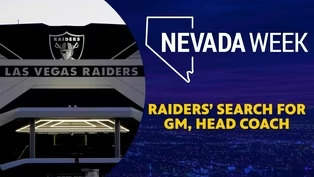
Raiders’ search for GM, Head Coach
Video has Closed Captions
Clip: S6 Ep28 | 7m 28s | Mike Pritchard breaks down efforts to hire new coach and manager. (7m 28s)
Providing Support for PBS.org
Learn Moreabout PBS online sponsorship
- News and Public Affairs

Top journalists deliver compelling original analysis of the hour's headlines.

- News and Public Affairs

FRONTLINE is investigative journalism that questions, explains and changes our world.












Support for PBS provided by:
Nevada Week is a local public television program presented by Vegas PBS