
Examining the rise of political violence and polarization
Clip: 1/31/2026 | 14m 39sVideo has Closed Captions
Examining the rise of political violence and polarization
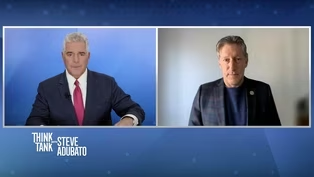
Steve Adubato sits down with Shannon Hiller, Executive Director of Princeton University’s Bridging Divides Initiative, to examine rising political violence and discuss the role of civil dialogue in easing polarization.
Problems playing video? | Closed Captioning Feedback
Problems playing video? | Closed Captioning Feedback
Think Tank with Steve Adubato is a local public television program presented by NJ PBS
Examining the rise of political violence and polarization
Clip: 1/31/2026 | 14m 39sVideo has Closed Captions
Steve Adubato sits down with Shannon Hiller, Executive Director of Princeton University’s Bridging Divides Initiative, to examine rising political violence and discuss the role of civil dialogue in easing polarization.
Problems playing video? | Closed Captioning Feedback
How to Watch Think Tank with Steve Adubato
Think Tank with Steve Adubato is available to stream on pbs.org and the free PBS App, available on iPhone, Apple TV, Android TV, Android smartphones, Amazon Fire TV, Amazon Fire Tablet, Roku, Samsung Smart TV, and Vizio.
Providing Support for PBS.org
Learn Moreabout PBS online sponsorship- Hi, everyone.
Steve Adubato.
We kick off the program with an important, compelling and timely, unfortunately, timely conversation about political violence with Shannon Hiller, who's executive director of Princeton University's Bridging Divides initiative.
Shannon, good to have you with us.
- Great to be here, Steve.
Thanks for having me.
- We'll put up the website for Princeton and for the Bridging Divides Initiative, what is the initiative and why is it so timely and important?
- Yeah, thanks, Steve.
We are part of the Policy school at Princeton, and we focus on tracking and mitigating political violence specifically here in the United States.
And as part of the policy school, we do that not just to understand the problem, but to help communities navigate these periods of heightened tension to hopefully address a lot of the underlying drivers that got us to this place, and ultimately to support the type of democracy where we can all belong.
- We're including this as part of our series, "Democracy in Danger."
The graphic will come up and it'd be hard to debate that democracy is not in danger.
That being said, I'm curious about this.
I was struck by, after the horrific murder, the assassination of Charlie Kirk, I thought that was an opportunity on some level to have a meaningful dialogue about political violence.
I also thought the same thing after January 6th.
I also thought the same thing after the attempts to assassinate President Trump as a candidate.
What's it gonna take for people to stop blaming the other side for the violence and stepping back and trying to understand it and what we can do about it?
Loaded question, I know.
- Well, it's a really important question, and frankly, it's one we hear throughout our research, so we hear it when we talk to local officials.
We hear the same question when we talk to communities trying to address the direct impacts of this climate of hostility, and we hear it from policymakers who are interested in solutions.
I think what you're expressing is that there's a lot of frustration around these missed opportunities.
I would add to your list.
I also thought the attacks on the legislators in Minnesota and the long list of targets there was another opportunity we missed to turn the tide.
So frankly, after the tragic murder of Charlie Kirk, one of the first things we said, both from our research and experience from those conversations, is we have to accept that this isn't an inevitable escalation.
- Say that, it is or it is- - It is not.
Yeah, it is not an inevitable escalation in part, you know, I started my career working in countries around the world addressing conflict, working on longer term peace building, and what we see is that no matter how bad it gets, there's always an opportunity to turn the corner.
So you're exactly right that these moments are each of them an opportunity and we have been failing to rise to the occasion collectively.
I'd be glad to talk about some of the things and some of the bright spots we have seen.
- What, bright spots?
- You know, especially I would say at the state and local level, we have seen some bright spots.
As I said, when we talk to leaders, community leaders, elected leaders, everyday people, there's exactly the same hunger for turning the tide and for pushing back on this climate.
They see the effects it's having on their community.
And so I think, we do see opportunities where, whether it's Governor Cox speaking up in the aftermath of the shooting in Utah or otherwise, where leaders rise to the moment, what we hear sort of the headwinds, on the other hand, are that the national discourse and the instinct to call for broad-based retribution against political opponents in these moments are really strong headwinds for a lot of those local and state efforts in many cases.
- There are a lot of causes, a lot of contributing factors, and I'm not a fan of people blaming any one person or any one organization or one political party, but I am curious about this, about the, I've been obsessed for years about the tone and tenor of our political dialogue.
From the research that you've done with your colleagues at Princeton, to what degree, if at all, has President Trump's public conversation, his rhetoric contributed to the environment, in which political violence, if not an inevitable outcome, should not be a shocking outcome and only complicate things, not just public rhetoric.
But after taking office in January of 2025, a blanket pardon to everyone involved in the effort, the insurrection effort of January 6th to attempt to overturn the election and many calling for the, quote, "hanging" of then-vice President Mike Pence, who as vice president had a constitutional responsibility to certify the outcome of the election.
I know it's a complicated question, but how much of this political violence or the environment of it falls at the feet of the president?
- I think it's a fair question.
Let me take those one part at a time please.
So you're asking, first, or, well, you asked second about sort of the specific pardons around January 6th.
- January 6th, yeah.
- I think it's particularly timely.
We're coming up on the fifth anniversary, it's hard to believe, of the January 6th attack on the capitol.
You know, I know you just had Andy Kim on the show too, and I think, you know, he is an excellent example of members of Congress trying to figure out a way to think about the legacy of that day that actually unifies instead of divides.
When we look at the impact of the blanket pardons, and I emphasize blanket because I think, you know, there may have been a legitimate case, - Absolutely.
- I've written about this before, to pardon some of this, the lower level offenders, including people who expressed remorse for getting caught up in that day.
But exactly as you highlighted, the president chose to not just pardon some of those lower level offenders who had been charged, but individuals who had violently attacked police, members, leaders of groups that had literally staged armed individuals in Virginia with a plan to invade the capital later in the day when it comes to Oathkeeper leaders and others.
And I think, that missed an opportunity, exactly as we were just talking about, and missed an opportunity to move us forward from that day.
- But did it also... Sorry for interrupting, Shannon.
Did it also send a message about when and under what circumstances political violence is okay?
- I think it was of a piece of the president and his advisor's tendency to see the data and the real trends around political violence with an explicitly partisan lens.
And so, I do think pardoning violent offenders who did not express remorse shows that type of behavior, if in support of the president's agenda will be allowed.
At the same time, many of those leaders that have been pardoned, have not gained huge followings since then, even though they're still active.
So, you know, as you said, kind of from the bigger picture, there's a lot of complex factors at play, but I do think it was a dangerous precedent to issue those blanket pardons.
- And it's not a comparable, nothing's comparable, when you're talking about these horrific events, but the assassination of Charlie Kirk, at least for me, and it's not for me to express an opinion, but there are questions to be asked of those who even engaged in conversations about, "Well, what was Charlie Kirk talking about?
What was his ideology?"
As if there was any correlation, any remotely credible or logical correlation between what he was saying publicly and the horrific assassination of him in a public situation that leaves two small children and his wife without their father and their husband.
But along those lines, complicated, multifactorial, if you will, are there any specific recommendations, Shannon, that you and your colleagues at the Bridging Divides initiative at Princeton University are putting out there that would help us move forward instead of just describing it or explaining it?
Please.
- Right.
Well, as you can imagine, some of our initiative focuses on understanding and creating trusted, timely information about what's actually happening.
But you're exactly right, that's not the full solution.
So we get asked this question from government officials, as I said, everyday people, community leaders.
And so I'll kind of answer it the highest level first.
I think we have to invest in resources and systems that help us with early prevention.
So it's right that we've been increasing spending on keeping people safe when they run for office, and that kind of reactive physical safety, that's a piece of the picture.
But we also have to be able to invest in the types of mental health resources and systems that help to identify risk very early on.
And so we have to invest in those types of systems and resources for early prevention.
- What role do you think we play, those of us in media, particularly public media?
Do we play a meaningful role?
And by the way, meaningful because those of us in media could be helpful or could fuel it.
Please.
- I think that's right... In any given moment, we say in a lot of different types of research, trusted voices, right?
And so different communities have different trusted voices.
You and the folks at PBS are speaking to a particular audience.
And so in a moment of conflict or attention, the ways that you deliver the news and analysis can make an impact on where we go in the sort of overall conflict environment.
And that's the same for trusted voices to any different community around the country.
And so I think we could get into, it's not our area of focus about how the changing media landscape has reduced... has created real challenges in trying to address that.
But, on the other side, we're often encouraged that in that real challenging media environment, people are turning increasingly to trusted voices in their own communities.
So sometimes those are folks in the media, sometimes that's faith leaders or others.
And so I think that's really the commonality of what we see that can help is people in positions of trust speaking up and speaking out.
You know, that's the other thing I'd say is we have to expect better from our leaders.
We have to expect them to be part of the solution.
And when they don't live up to that expectation, we have to hold them accountable.
And this is a democracy.
One of the main ways we hold leaders accountable is at the ballot box.
And I think we have to be more consistent in that, as a polity, if we wanna see change in how it impacts our civic space.
And maybe the last thing I'd say, and this was sort of implicit in some of your questions.
We have to, people all up and down, have to get involved.
If we don't wanna see inevitable escalation, go out and get training in deescalation or mediation, we have a resource on our website where we have trainers of all different kinds and all 50 states and DC.
These resources exist in our communities.
Talk to your neighbors about hard issues.
If we don't talk about these hard issues, they will just continue to plague us and be fodder for those who would prefer to divide us.
- To Shannon Hiller's point, also accept that different people have different points of view.
It doesn't mean they're your enemy, it doesn't mean there's a civil war going on in our country or that there makes any sense for that to happen.
Accept that different people have different points of view.
And could you imagine, as Shannon Hiller just said, have a conversation.
It's an original thought in the eyes or in the thoughts of many who believe... Nevermind.
Now that's what happens, Shannon, when I get on my soapbox about political violence and the need to have dialogue.
Shannon Hiller and her colleagues, I'm talking about it, they're doing important work at Princeton University's Bridging Divides initiative.
Shannon, thank you so much.
We'll continue the conversation.
- Thanks, Steve.
- You got it.
Stay with us, we'll right back.
- [Narrator] Think Tank with Steve Adubato is a production of the Caucus Educational Corporation.
Funding has been provided by The New Jersey Education Association.
Community FoodBank of New Jersey.
IBEW Local 102.
NJ Best, New Jersey’s five-two-nine college savings plan.
Hackensack Meridian Health.
New Jersey Board of Public Utilities.
The Turrell Fund, a foundation serving children.
Horizon Blue Cross Blue Shield of New Jersey.
And by South Jersey Industries.
Promotional support provided by ROI-NJ.
And by NJ.Com.
- [Announcer] What is your child's dream for the future?
Doctor?
Teacher?
Architect?
Whatever they aspire to be, a college education may realize those dreams and NJ Best can help.
It's the college savings plan specifically designed for New Jersey families.
Start saving today with as little as $25, because now is the time to invest in their future.
To learn about NJ Best 529 college savings plan, its investment objectives, risks and cost, Read the investor handbook available at njbest.com.
Sen. Andrew Zwicker addresses pivotal issues in NJ
Video has Closed Captions
Sen. Andrew Zwicker addresses pivotal issues in NJ (12m 19s)
Providing Support for PBS.org
Learn Moreabout PBS online sponsorship
- News and Public Affairs

Top journalists deliver compelling original analysis of the hour's headlines.

- News and Public Affairs

FRONTLINE is investigative journalism that questions, explains and changes our world.












Support for PBS provided by:
Think Tank with Steve Adubato is a local public television program presented by NJ PBS