
Expansive Expeditions
Season 8 Episode 2 | 26m 48sVideo has Closed Captions
We’re off to Governor Dodge State Park. It's one of Wisconsin’s largest state parks.
We’re off to Governor Dodge State Park in the heart of the Driftless Area, as host Angela Fitzgerald explores one of Wisconsin’s largest state parks. Also, meet a woman who became Miss Black USA, visit a farm that planted millions of sunflowers to brighten the COVID-19 world, ride in a carriage race and uncover the “Cold War” bridge of two German professors at the University of Wisconsin-Oshkosh.
Problems playing video? | Closed Captioning Feedback
Problems playing video? | Closed Captioning Feedback
Wisconsin Life is a local public television program presented by PBS Wisconsin
Funding for Wisconsin Life is provided by the Wooden Nickel Fund, Mary and Lowell Peterson, A.C.V. and Mary Elston Family, Leon Price & Lily Postel, Stanley J. Cottrill Fund, UW...
Expansive Expeditions
Season 8 Episode 2 | 26m 48sVideo has Closed Captions
We’re off to Governor Dodge State Park in the heart of the Driftless Area, as host Angela Fitzgerald explores one of Wisconsin’s largest state parks. Also, meet a woman who became Miss Black USA, visit a farm that planted millions of sunflowers to brighten the COVID-19 world, ride in a carriage race and uncover the “Cold War” bridge of two German professors at the University of Wisconsin-Oshkosh.
Problems playing video? | Closed Captioning Feedback
How to Watch Wisconsin Life
Wisconsin Life is available to stream on pbs.org and the free PBS App, available on iPhone, Apple TV, Android TV, Android smartphones, Amazon Fire TV, Amazon Fire Tablet, Roku, Samsung Smart TV, and Vizio.
Providing Support for PBS.org
Learn Moreabout PBS online sponsorship- The following program is a PBS Wisconsin original production.
- Coming up on Wisconsin Life: A farmer harvests joy with millions of sunflowers.
A pageant winner shares her talents with the world.
- Whoo!
- A pair of professors building a friendship by exploring their heritage.
And a family takes a carriage ride into the past.
It's all ahead on Wisconsin Life.
♪ ♪ - Funding for Wisconsin Life is provided by Lowell and Mary Peterson, Alliant Energy, Stanley J. Cottrill Fund, American Transmission Company, Focus Fund for Wisconsin Programs, and Friends of PBS Wisconsin.
- Hello!
I'm Angela Fitzgerald and this is Wisconsin Life.
Today, we're visiting the expansive Governor Dodge State Park.
This Iowa County Park sits in Southwest Wisconsin's Driftless Area so it's full of scenic views.
The park's beginnings can be traced back to 1948 when the county presented a farmstead here to the state, allowing generations to enjoy the area's natural beauty.
At more than 5,000 acres, this is one of Wisconsin's largest state parks.
That means there's plenty of room to explore.
Visitors can go hiking or horseback riding through the hills.
Go fishing, boating, or camping near one of the park's two lakes.
There's also one of Southern Wisconsin's most popular waterfalls.
[water splashing down] Before we hit the trails, let's check out our first story.
We're off to Bristol to meet a farmer who converted their fields into a sunflower oasis.
- Strawberries are our biggest thing.
You know, I mean, we have the vast majority of our customers come from strawberries and now we've solely kinda morphed into, we have pick your own pumpkins.
We did pick your own raspberries.
When the pandemic hit, we're like, people are gonna be looking for some happiness.
♪ ♪ Let's give them that, you know, that extra activity and let's do the sunflowers.
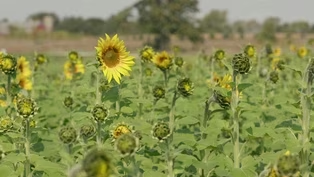
[peaceful guitar] Well, I bought 2.2 million seeds and I don't have any left.
So, I'm guessing somewhere in there.
We just kept going and we're like, oh, that's not enough.
Buy some more.
Alright, that's not enough.
Keep going, keep going.
You can go right in the middle of the field and you can turn around and it's just sunflowers everywhere.
You're just engulfed by the field and I think that's something that's really neat that people could just come in here and just kinda just get lost inside the field.
♪ ♪ You know, I thought it would be kinda cool to plant sunflowers.
I didn't realize that everybody loves sunflowers.
I had no idea and it's like and now we've got some notoriety.
I've been getting fan mail from all across the US.
I've been get-- you know, people just thanking us for growing these sunflowers.
♪ ♪ I was kinda thinking, okay, people would need this, you know, let's do, you know, something for people or whatever.
I didn't realize that it would make me feel good.
There are some long days here on the farm as, you know, as all farmers know.
We had to be able to get all these people out here and they're just thrilled that we can give them this opportunity to kinda walk out here.
It really makes it all worthwhile.
♪ ♪ - Now, let's head to Madison where a dedicated woman highlights her crowning achievements from the classroom to the community.
[excited cheering] - You got this girl.
- Announcer: Your queen is Miss Black... Wisconsin.
[joyful scream and cheers] - In that moment, life for TaKema Balentine changed... [thunderous applause] ...and in many ways stayed the same.
- I feel like I'm the same person.
I mean here in Wisconsin, I'm just TaKema or Kema, you know what I mean?
- TaKema is Miss Black USA 2019, has two part-time jobs, and is a full-time student at Madison College pursuing a nursing career.
- It gets really busy at times.
Most days, I'm driving back and forth from Watertown for skills, pharmacology, fundamentals.
Hi, Dolly, my name is TaKema.
I'll be your nurse today.
- Months after TaKema's coronation, her classmates are hearing about the title for the very first time.
- So, I won this pageant over the summer.
- What pageant?
- Miss Black USA.
- Classmates: Whoo!
- Miss Black U-S-A?
- Oh, my gosh.
- Sounds like kind of a big deal.
- For TaKema, it is a big deal for several reasons.
- Historically, Wisconsin tends not to produce beauty queens and when they said my name, I looked around the stage at all of the other contestants because I was like, not really, like, not me, really.
Wisconsin?
Wisconsin won the pageant?
- Wisconsin did win the pageant and with it came confidence.
- The motto of the pageant is to empower Black women to be who they are, to be the best version of themselves, and to move forward and reach back for the next one.
They've provided me with a platform and I try to make it obvious what I value.
[background chatter] - Good morning, Huegel Eagles!
- At Huegel Elementary in Madison, TaKema puts her words into action.
- I didn't really apply myself in school.
I think I probably could have done a lot better and I feel a lot of it had to do with the responsibilities that I had at home.
- Yeah.
- You live in a castle?
- No, I don't live in a castle.
I just live in a house.
I want other young girls who may be in a similar circumstance to know that those circumstances aren't permanent.
Following your lead, ladies.
I had a low teachers tell me, your only way out, your only way to change the cycle in whatever is going on in your family is an education.
I think it means a lot to young girls in Wisconsin to see a brown person in a crown but also who has determination and goals.
Good morning.
For girls to see that I'm in nursing school.
That's a profession that's all about caring for another person.
Well-being of the community, your society because we have to lean on each other.
Like, nobody lives in this society alone.
I grew up with a famous father.
My name is Martin Luther King, the third.
One school at a time, one child at a time, one heart at a time, that is how the world has changed by reaching out to other people with kindness and compassion.
- Her message echoes beyond the classroom, to the highest levels of Wisconsin government.
- TaKema is a Madison native and she graduated from Madison East High School right here.
The Wisconsin State Legislature is so excited to honor TaKema Balentine as Miss Black USA 2019.
[applause] - Good afternoon and thank you for having me.
Today, I stand before you finding it difficult to express in words the gratitude and appreciation I feel for our community.
It really does make me feel like I have the support of my entire state behind me.
Sleep with this tonight, stick it under my pillow.
- On this day, TaKema goes from the classroom to the Capitol, and now, on to an evening gala with the Madison Black Chamber of Commerce.
Miss Black USA of America to TaKema Balentine.
- Whoo!
[applause] - Yeah!
- TaKema Balentine.
- Wow, y'all look good out here.
Dang.
I have no experience in running a business, but I know what it means to be a person of color, wanting to make a difference, wanting to leave a footprint, and wanting to just be an example for other brown children, other brown people.
Honestly, I just want to be the-- I wanna be the person to break the mold.
I want to be the person to be outside of the box.
And I don't know about y'all, but I'm ready to eat so... [audience laughs] - Helping her break the mold and the box is her partner Megan.
- I wouldn't be here without her, but I think just for people to see that love comes in all different shapes and forms is really important.
Jo, come here, Jojo.
- It's a life they share with a menagerie of pets.
- Bucky, the badger?
- Yes.
The ball python was my reward to myself for winning the pageant.
They can get up to six feet.
- TaKema's pets and family keep her grounded and when she looks back at her journey, this is what she sees.
- I've done something that I was afraid to do.
I've done something that was a big challenge for me to do.
I reached out of my comfort zone.
I had to learn to be assertive.
I had to learn to be tactical.
I had to learn to ask for help, and so, it's taught me a lot about myself.
I don't feel that I live the life of a typical pageant queen and maybe that's just because my life hasn't really changed that much and so I just try to be the best person that I know how to be.
- I'm enjoying the scenery at this beautiful state park in Southwest Wisconsin.
Rolling hills, serene swimming spots, and endless trails to explore.
Governor Dodge State Park is another gem to be found in Wisconsin's Driftless Area.
No one knows that better than park superintendent Kathy Gruentzel.
- Well, we're over 5,000 acres, so we have a lot to offer.
We've got two lakes and with Iowa County being one of the counties that doesn't have a lot of surface water, but it's one of our big draws is the two lakes that we have.
So, canoeing, kayaking, swimming.
- Oh, blue heron!
- Kathy Gruentzel: Fishing.
One of our lakes has muskie in it.
- I didn't bring my camera.
- We've got 300 campsites-- all different kinds of camping available.
So, we've got a lot to offer.
- A lot to offer including hiking trails, miles and miles of them.
- Well, I like getting out on the trails; I really do.
There's, like I said, over almost 50 miles of trails.
So, there's a different-- a different spot for a lot of different features.
We've got prairie, we've got open area, we've got forested area.
So, whatever you're looking for, you can find.
[insect chirping] - A peaceful place that long ago served a different purpose.
- The park, again, is over 5,000 acres and most of that acreage was old farmsteads.
We've got a lot of local families still in the area that remember growing up in the park.
We have the Stephens family, which Stephens' Falls is named after.
They, again, are still in the area and they have what we call Stephens Falls, the waterfall.
Plus, we have their spring house, the Stephens' Spring House.
What that is, is basically, that's the refrigerator that the pioneers and the old farmsteads used to keep their food cold and their milk cold.
[water babbling] - Prepped with a little history and appreciation for the landscape, it was easy to find places to explore.
[footsteps crunch on gravel] [cheerful chatter] - I like to just get away.
I like to get out on the trails and just, you know, kinda get away from the other park visitors and just enjoy the peace and solitude that you can get.
It's just a totally different experience than being in an office or being in your car.
It's just, it's nice.
It's peaceful.
Refreshing.
[insects chirping] - Whether you enjoy the trails or just a day on the water, there's a lot to explore.
♪ ♪ Next up, we meet a pair of professors exploring their German heritage through stories and friendship.
♪ ♪ - Wisconsin has always been a beacon of German culture.
[traffic] Now, it is undergoing a renaissance at the University of Wisconsin Oshkosh.
- Monika: Schlafen, wach, es war noch weniger.
Es war vielleicht zwei Minuten.
- Heike: Zwei Minuten, na, gut.
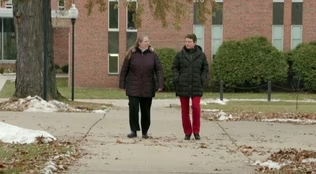
- Professors Heike Alberts and Monika Hohbein-Deegen both started on campus in 2003-- on the very same day.
- Monika: I noticed that somebody from Germany was there, ja.
- Heike: Which is a strange coincidence because there's not many Germans here.
- A "“strange coincidence"” because while both are German, their paths to Oshkosh are very different.
Heike grew-up in West Berlin, completely surrounded by communist East Germany.
- And I always thought that all cities had Walls.
So, this here is a satellite map of Berlin.
So, it was zigzagging around the neighborhood like this.
It was absolutely normal for me.
Yeah, I did not know life without a Wall.
- On the other hand, Monika grew up in southwestern East Germany.
- In my hometown.
It's called GrosßBrüechter.
Yeah.
This was my childhood home.
So, I did not live in Berlin, but I lived relatively close to the inner German border.
- 2019 marked the 30th anniversary of the peaceful revolution that toppled the Berlin Wall.
- The anniversary is a chance to share what life was like growing up on opposite sides of the "Cold War."
[announcement in German] - Sometimes, I tell my students to try and to understand what this life was like.
Yes, on one hand side, we were very restricted.
On the other hand side, it was a normal upbringing.
This is a little bit difficult to, to balance that because you don't want to paint it too black or too rosy.
It was something in between.
- The fall of the Berlin Wall, a topic that is dear to both Professor Alberts and me, because as most of you know, we come from Germany.
If you don't know, you hear it by our accents.
[students laugh] - At this campus event, students hear a unique perspective from these eyewitnesses to history.
- Heike: So, this is one of my memories of childhood, that it was never dark at night because, of course, the Berlin Wall completely surrounded us, and we lived really close to the death strip.
And so, they always had these floodlights.
Something that I didn't know until a couple of years ago, that there were three escape tunnels right in my neighborhood.
Right, nobody had told me.
Right there.
- This is October 9th, 1989, in Leipzig, exactly a month before the Wall would eventually fall.
- Monika lived only kilometers from the inner German border... and was restricted from going anywhere near it.
On a visit to Berlin in the 1970s, she saw the Wall from distance for the very first time.
- Monika: That was in front of the Brandenburg Gate.
That's actually me.
Back there, that white, is the Berlin Wall.
And so, that's the closest we could get to the Wall was right there.
- On the other side, Heike could get a much closer view of the Wall and glimpse into the East.
- The service train was just elevated enough that you could look into the death strip.
So, that is what you would have seen.
And if you're honest, that's a little scary.
[class bell rings] - Good morning, everyone, welcome back and happy Tuesday.
- Both professors now teach about a wall they themselves were never taught about in school.
- So, it was pretty crazy to grow up with the Berlin Wall, to say the least.
- Monika: I usually teach them about post-World War II German history, but focusing on the Cold War and East German History.
- Student: Stücke-ID.
- Monika: Ja, Stücke oder Teile, ja.
- Their study abroad programs teach these Oshkosh students on the streets of Berlin.
- When we are in Berlin, of course, we don't learn out of a book.
We go to the sites.
- Heike: There is Checkpoint Charlie.
This is a famous checkpoint where the Allied Forces would have crossed.
This is at Bernauer Strasße, the famous memorial where you can actually look into how the death zone would have been.
I really want them to take off their American hats and see things through the eyes of other people.
- Monika: But with the ultimate goal, what do you learn from that history?
[jackhammering] - Back in 1989, the East German people took to the streets.
The world witnessed the fall of the Wall.
[excited cheers] - Monika: If you were in Berlin that night, it was probably the biggest party you could have imagined.
- The days that followed became an adventure for these future Wisconsinites.
- After the Wall had fallen, I went out with one of my friends.
This is one of the very few photos of me being, like, 17-years-old.
I really like this one here because this one actually has a date, 1989, written in the gap.
And then, this is the photo that my dad is sort of proud on.
My dad and I really wanted to get pieces off the Wall for ourselves, too.
This is one of my most prized possessions in here because these are original pieces of the Berlin Wall.
- Heike's high school band marked the occasion by marching into East Germany.
- I was always in the first row.
They had just cleared the death zone of all the nasty equipment.
But this was also the first time I really set foot on the death zone... ...that had killed so many people before that.
- Monika's experience going east to west is a bit different.
- I never forget when I actually came to America the very first time.
- She came to the United States on a Fulbright scholarship.
- It was rather amazing because I was thinking, "Okay, this was the enemy country I was taught about, and now I'm here."
- Heike: Gute Zukunft.
- Monika: Was machst du Weihnachten?
- Heike and Monika both feel at home here in Wisconsin following in the footsteps of other German immigrants.
- A lot of students say, "Oh, 'the German,'" right.
"I had a class with 'the German.'"
So I think, if anything, my German identity has become much stronger by not being in Germany.
Now, it's in demand that I speak about those kinds of things.
- Monika: It's cool that you can talk about personal stories.
[crowd murmuring] You never know what history turns out to be.
[cheers and applause] [fireworks booming] - Our last story takes us to Prairie du Chien, where a family is taking the reins for a trip back in time.
[playful instrumental music, hooves clip-clopping] - All right, cheers.
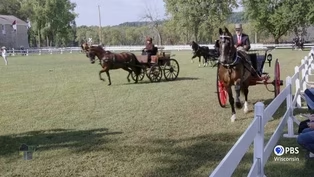
[lively music] - Villa Louis is the largest pleasure carriage driving show in the country.
So this is, you know, the cream of the crop are here and competitors from all over.
My children, Luke and Beth Dahlberg are both driving this weekend.
- Luke: What we try and do is reenact what they did years ago.
And we dress up and we look nice and we go out in our top hats and our fancy clothes with our carriages polished up.
- Julie: Brass will be polished and gleaming.
The harness will have the best shine, the horse will be brushed.
[lively music] - The people come to see the horses, but also to see a way of life that really doesn't exist much anymore.
I mean, the horses and the vehicles they see would have been used every day up to probably the First World War.
They can see the horses, they can hear them, they can smell.
They can hear the churning of the wheels, which used to be a very everyday occurrence.
- Luke: So, we do a walk and a trot, and we do different speeds at the walk.
- Announcer: Demonstrating a slow trot... - Luke: We do a slow trot and a fast trot.
- Julie: You're kind of on the hot seat there, right in front of the judge, on what looks the best, what horse is moving the best, what harness and cart are the nicest.
- Everybody wants a little bit of a challenge.
So, it's always fun to see if you're as good as the next person.
We want to get on the road.
We want to find out what's new, what's next, 'cause they enjoy it, or put up with it.
My parents were into it, so I was basically driving since I was three.
It's as much fun to watch them compete as it is to do it myself.
- Julie: I'm just thrilled that they fell in love with horses.
And I didn't have to, you know, run off to the ballet and pretend that I like that.
[laughs] So, it's been great.
[lively classical music] - Woman: The people who enter the picnic class are set up on the Villa Louie lawn.
- Man: It has urchin bars, which are these spikes, so the street children wouldn't grab a hold and go for a ride.
[laughter] - Julie: They come with their horses and rigs, and then they stop and they spread out a picnic.
- Man: Tomatoes, boiled eggs, which would have been a typical picnic food at the time.
- Julie: They are going to be judged not only by their horses and the rigs, and also, the food that they offer.
[driving classical music] - Obstacle courses were going on today.
Different obstacles set up with a point value.
It's a big mind game and a memory game for folks trying to remember those courses because there's no roadmap in front of you once you get out there.
- Luke: You can't go in a straight line very fast but you can turn really sharp, really quick.
But after the time that we've spent together, we basically know each other in and out.
- Horses are kind of the glue that keeps us together.
This is just kind of our special opportunity to share with not only the spectators here about our sport, but just to, you know, kind of celebrate all the hard work that we've done at home, and the bond with our horse.
It just is our opportunity to shine.
Just kind of makes your heart swell.
- All right, ponies.
- Julie: Have fun, kids.
- Walk on.
Thank you.
- I've had a great time checking out the diverse landscape of this spacious park.
If you wanna learn more about Governor Dodge State Park or the people we featured today, visit Wisconsin Life dot org.
We love hearing from you.
So, send us your ideas at stories at Wisconsin Life dot org.
I'm Angela Fitzgerald, and this is our Wisconsin Life.
Bye!
- Funding for Wisconsin Life is provided by Lowell and Mary Peterson, Alliant Energy, Stanley J. Cottrill Fund, American Transmission Company, Focus Fund for Wisconsin Programs, and Friends of PBS Wisconsin.
Video has Closed Captions
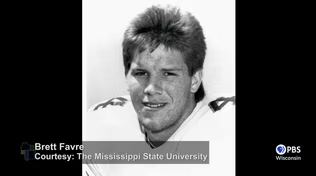
Clip: S8 Ep2 | 27s | Green Bay Packers QB Brett Favre was a student in Monika Hohbein-Deegen's class. (27s)
Video has Closed Captions
Clip: S8 Ep2 | 4m 17s | Competitive carriage driving evokes the long bygone era of elegant horse-drawn transport. (4m 17s)
Video has Closed Captions
Clip: S8 Ep2 | 2m 36s | A local Wisconsin farm plants over 2 million sunflowers to brighten people’s day. (2m 36s)
Video has Closed Captions
Clip: S8 Ep2 | 7m 12s | UW-Oshkosh professors bridge the Cold War divide in Germany to teach in Wisconsin. (7m 12s)
Video has Closed Captions
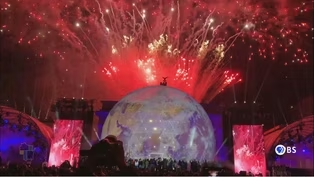
Clip: S8 Ep2 | 48s | Winners and losers of Germany's reunification. Hear Monika Hohbein-Deegen's perspective. (48s)
Video has Closed Captions
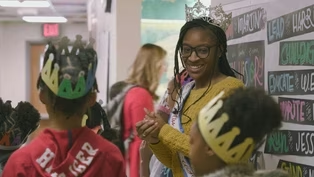
Clip: S8 Ep2 | 6m | TeKema Balentine reflects on becoming Miss Black USA and what that experience taught her. (6m)
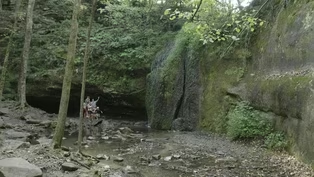
WL Host Angela Fitzgerald Explores Governor Dodge State Park
Video has Closed Captions
Clip: S8 Ep2 | 2m 57s | Angela Fitzgerald visits one of Wisconsin’s largest state parks, Governor Dodge State Park (2m 57s)
Providing Support for PBS.org
Learn Moreabout PBS online sponsorship













Support for PBS provided by:
Wisconsin Life is a local public television program presented by PBS Wisconsin
Funding for Wisconsin Life is provided by the Wooden Nickel Fund, Mary and Lowell Peterson, A.C.V. and Mary Elston Family, Leon Price & Lily Postel, Stanley J. Cottrill Fund, UW...