Across Indiana
Exploring Carmel's Miniature Museum
Season 2026 Episode 10 | 8m 55sVideo has Closed Captions
Miniatures, are they toys or art? We visited the Museum of Miniature Houses to find out!
Since opening in 1993, the Museum of Miniature Houses and Other Collections has been visited by countless Hoosiers and miniaturists alike. With teeny-tiny treasures and delightfully detailed dollhouses around every corner, it's easy to see why! Learn how this curious museum got started, as well as how they maintain their massive yet minuscule miniature masterpieces.
Problems playing video? | Closed Captioning Feedback
Problems playing video? | Closed Captioning Feedback
Across Indiana is a local public television program presented by WFYI
Across Indiana
Exploring Carmel's Miniature Museum
Season 2026 Episode 10 | 8m 55sVideo has Closed Captions
Since opening in 1993, the Museum of Miniature Houses and Other Collections has been visited by countless Hoosiers and miniaturists alike. With teeny-tiny treasures and delightfully detailed dollhouses around every corner, it's easy to see why! Learn how this curious museum got started, as well as how they maintain their massive yet minuscule miniature masterpieces.
Problems playing video? | Closed Captioning Feedback
Where to Watch Across Indiana
Across Indiana is available to stream on pbs.org and the PBS app.
Providing Support for PBS.org
Learn Moreabout PBS online sponsorshipWith miniature things, there's a sense of all encompassing knowledge that you can have about it.
You can see it from every angle in a way that you can't the full size of something.
And I think one of the senses is being able to have this sense of full knowledge, the sense of full control over a miniature object.
You can fully wrap yourself around it much more easily, both with your physical hands, but also your eyes and your mind.
While Carmel, Indiana is a big town.
It's also the home of a miniature museum full of teeny tiny treasures and delightfully detailed dollhouses.
But most of these dolls aren't for playing, theyre for viewing Which begs the question how do you distinguish a toy from a work of art?
It is a fine line, but it sort of has to do with the level of quality I think... We think of ourselves as art in miniature.
And you don't mess with that.
The world of miniatures is very diverse, and there are miniatures that are made for young fingers that are non breakable.
So there's the dollhouse that you play with and no one's saying, “Oh be careful, don't do that.” But then there's the dollhouse.
Like dollhouses like we have here are not playthings.
So how did this simultaneously massive and minuscule collection get its start?
A lady died in the community who had beautiful things.
Miniatures collections, gorgeous crystals and porcelain, and they all vanished.
You know, things were winding up in trash bins and goodwill boxes and all kinds of things when they were beautiful works of art.
My sister, who is Suzanne Moffet and two of her friends, Suzanne Landshof and Nancy Lesh, were miniatures back in the day.
And they realized that there are beautiful things in Indianapolis and in the area that belong to the world and should be kept and taken care of.
And since then, their collection has only grown between room boxes and houses.
I'd say we probably have 100 to 200 miniatures in general is a lot harder to count because inside of each miniature house there is all of the furnishings, there's all of the accessories.
You know, a kitchen might be fully stocked with cutlery and plates and all of the glassware.
But throughout our collection, we also have individual items of all sorts of things.
And so across our collection, that number balloons from 200 to probably over 1200.
You know, we have houses like the one behind me here that is four feet by seven feet by six feet.
And then we have miniatures that are four millimeters by six millimeters by seven millimeters.
And so sometimes it's apples and oranges.
With so many mini houses, figurines and fixtures around every corner.
Maintaining a collection like this is a full time job.
Diego's full time job, to be exact!
I typically sum it up as collections, curation, conservation, making sure that pieces, once they are moved, retain all of their pieces in place.
With miniature houses, you have wood, you have plastic, you have fabric.
Typically it is the wood and plastic that I'm dealing the most with.
It's mostly just about making sure that the pieces are as put together as we can ensure them to be.
Just like a full sized house, you need to maintain it.
You need to clean it out.
You need to make sure that you change out the light bulbs.
I'll say it's very tricky.
While caring for these pocket sized pieces requires an eye for detail.
Actually creating one is on a whole other level.
Oh scale is critical.
If you've got things that are not congruent and the scales are out of whack, it just it'll destroy the piece if you're not consistent.
So scale is important.
And when you get down into the really small quarter inch, you know, half inch to an inch, sometimes it's hard to tell.
So hard to tell that you can spend a lifetime trying to figure it all out.
Which is exactly what Joann Crippen did with her magnum opus miniature house, The “Manoir Hypotheque” The manor has something for everybody.
Took 25 years for the lady that built it.
She did it over 25 years.
The lady that built this, had such a sense of humor.
There's a baker carrying a cake, and the cake is toppling over.
And just some some action things in this piece that are quite unique.
And getting a miniature manor as massive as this one into the museum wasn't easy.
I remember when Joann first called... I was like, oh my gosh, that piece is so huge!
you know, how will we be able to do that?
And I think we originally told her we wouldn't be able to house it.
And then Diego and I went to visit her and we walked in the living room, walked in the front door.
This had a room of its own.
And once we saw it and the magnificent work that she had done, we said, okay, we're gonna find room, we're going to, we're going to make room.
And I'm really glad we did.
When we first brought this in, we had to empty out completely.
And I spent about six months putting everything back in place, along with Kathy.
So the two of us have had a really intimate relationship with this piece.
I'm still not tired of looking at it, and I still find new things inside of it.
But not every large, small scale project has to take a lifetime.
Across the room from the magnificent manor is an equally entertaining house of hauntings that took just one year to create.
Depicting famous characters and scenes from The Addams Family.
This was, the artist Kelly Kuehnert.
She was commissioned by Linda LaPage.
This piece was actually inspired by this museum!
In our gift shop... There was an electric chair.
Why that's the case?
I don't know!
But she found an electric chair in the gift shop.
And that inspired her to try and make the Addams Family piece.
But then she started working on it with her daughter, and they very quickly realized that the whole Addams Family mansion is too big of a project for them.
It's full of references both to the classic show and the 90s movies.
And since then, there have been a couple of animated movies, The Wednesday Show.
But at the time that this was made, those those things hadn't come out yet.
So it's really interesting getting to see all of this intergenerational appeal.
And if you're more into history than dollhouses, you're in luck.
The featured exhibit celebrating America's semiquincentennial is currently on display.
The arrangement of the pieces for the America 250.
I went for a general geographic theme for it, and so we move from the East coast towards the West coast.
And because of the layout of the room, there actually happens to be a bit of a temporal move that way too.
And so the exhibit gets to shift along both geographically and temporally.
Another one of my favorite pieces is actually being shown in the America 250 exhibit.
And that is a flapper doll.
I often find the dolls inside of these miniatures a little in the uncanny valley.
Often they're, It's not off putting.
Then I'm neutral on them.
It's hard to make a really good doll.
The flapper doll has such subtlety of emotion, has such a elegance of pose.
And I think the the, dress that she's wearing is just absolutely fantastic.
While the Museum of Miniature Houses and Other Collections is hosted, more than 110,000 visitors from all over the United States, it feels like they are STILL one of Indiana's best kept secrets, and one that they hope gets out.
I think a museum like this is so important because it is trying to inform people about an art form whose existence largely has been sidelined because it's been hobbyist and because it is primarily done by women.
And the sense of hobbyist art, and being able to elevate that to the sense of fine art is something that's important, not just for the viewers who are coming in and learning about this as an art form, but also important for the miniaturist themselves, who so often don't see their work with the same value that we see it as here.
There are castles, there's the modern house, there's a log cabin, there are gardens.
There's everything that you want, and you can just merge into it.
There's nothing you can't do.
There's no place you can't go.
Nobody's ever come to the museum and said, “UGH, that was a waste of time!” “I, I don't care for that art form!” >:( People just get enthralled here.
It will capture you.
It will.
And you'll be back.
For more Across Indiana stories visit WFYI.org/AcrossIndiana
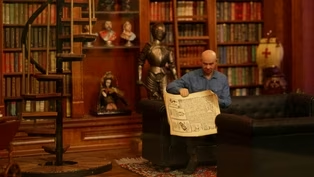
"The Sahlberg" a Miniature Masterpiece
Video has Closed Captions
Clip: S2026 Ep10 | 2m 23s | How did this hyper-detailed miniature mansion get its name? (2m 23s)
Providing Support for PBS.org
Learn Moreabout PBS online sponsorship













Support for PBS provided by:
Across Indiana is a local public television program presented by WFYI