
Signature Dish
Exploring Europe
Season 4 Episode 9 | 29m 5sVideo has Closed Captions
Café Sophie in Gaithersburg, MD, Ruta in Capitol Hill, D.C., The Harp in Brookland, D.C.
In this episode, Seth embarks on a European expedition across the DMV. Aboard a small prop plane, Seth lands at the Montgomery County Airpark for Norwegian kjøttkaker at the airport’s European-style eatery, Café Sophie. Next, he's off to Capitol Hill for comforting Ukrainian holubtsi at Ruta. Finally, he makes one last stop for elevated Irish-fare in Brookland with pan-seared monkfish at The Harp.
Problems playing video? | Closed Captioning Feedback
Problems playing video? | Closed Captioning Feedback
Signature Dish is a local public television program presented by WETA
Signature Dish
Exploring Europe
Season 4 Episode 9 | 29m 5sVideo has Closed Captions
In this episode, Seth embarks on a European expedition across the DMV. Aboard a small prop plane, Seth lands at the Montgomery County Airpark for Norwegian kjøttkaker at the airport’s European-style eatery, Café Sophie. Next, he's off to Capitol Hill for comforting Ukrainian holubtsi at Ruta. Finally, he makes one last stop for elevated Irish-fare in Brookland with pan-seared monkfish at The Harp.
Problems playing video? | Closed Captioning Feedback
Where to Watch Signature Dish
Signature Dish is available to stream on pbs.org and the PBS app.
Providing Support for PBS.org
Learn Moreabout PBS online sponsorshipANNOUNCER: And now "Signature Dish," a WETA original series.
SETH: Today on "Signature Dish," we're taking off on a tour across Europe.
Our taste buds will take flight starting with a Scandinavian specialty.
So, you're not too worried about uniform shape?
TOM: Yeah, it's the taste that matters.
They got to be drowned in our delicious gravy.
SETH: We'll elevate an Eastern European original.
MYKOLA: Usually, this dish is for celebration, for Christmas, for New Year.
I think it's part of our history.
SETH: And raise our glasses... RUAIRI: Sláinte.
SETH: Sláinte.
...to a Gaelic delicacy.
So it's kind of the poor man's lobster no more.
RUAIRI: It's the Irishman's lobster now.
SETH: I'm Seth Tillman, WETA producer and DC native, and I love good food.
Nice to meet you.
That's why I'm traveling to restaurants across the DMV, at each stop looking for the one thing you just gotta try... ...that Signature Dish.
Buckle up for the first stop on this European adventure.
We're flying across the wild blue yonder on our way to Gaithersburg, Maryland.
I'm hitching a ride with my friend and amateur pilot, Guy Federico, to visit the Montgomery County Airpark.
It's here in the terminal that you'll find Cafe Sophie, a pan-European cafe with a Scandinavian flair.
SANDY: So, back in 1960, my father and grandfather obtained the land.
They built the airpark.
I would come out on weekends with my father and he would fly us places.
And I got into aviation myself, too.
I got instrument rated as a pilot, so this was my playground.
TOM: I'm from Bergen, Norway they call it the capital of the fjords.
I came over here in 1986 to get my pilot's license.
I did the corporate flying and charter flying.
And some of those flights, I came in here, and that's how I met Sandy.
So, I ended up landing and I never took off again.
SETH: Tom and Sandy opened Cafe Sophie in late 2021.
TOM: I always missed typical Norwegian food.
Meatballs with boiled potatoes and good gravies, and I also missed open face sandwiches and pastries.
So, we had a chance to try that ourselves.
We have English breakfast, and then we have German sausages, and different items from all over Europe.
So, there's always a little bit for everybody.
SANDY: The cafe's named after our dog Sophie.
Sophie is a miniature golden doodle, but she has just been a big hit here.
We have people call that say, "Is Sophie going to be there today?"
She's a big part of the airport.
♪ ("Danger Zone" by Kenny Loggins) ♪ (radio chatter) SETH: With the airpark in our sights, we're now cleared for landing.
♪ Revvin' up your engine.
♪ ♪ Listen to her howlin' roar.
♪ ♪ Metal under tension.
♪ ♪ Beggin' you to touch and go.
♪ ♪ Highway to the danger zone.
♪ ♪ Ride into the danger zone!
♪ SETH: Tom!
TOM: Hi, Seth.
SETH: Good to meet you.
TOM: Nice meeting you.
SETH: Sandy.
SANDY: Hi, Seth.
Welcome to Cafe Sophie at Montgomery County Airpark.
SETH: And it looks like we have someone else with us today.
Who's this?
SANDY: Yeah, this is Sophie.
She's the namesake.
SETH: You're Sophie!
Oh, look at you, girl!
We're going to make you a star today, I promise.
All right.
Well, Guy let me know up in the air that I'm in for a real treat today.
What are you making?
TOM: We're making a traditional Norwegian meal called kjøttkaker.
SETH: Kjøttkaker.
All right.
That's a little bit of a mouthful for me.
What does that mean?
TOM: Kjøttkaker is meatballs or meat cakes.
And if you've been to IKEA, this would be one notch above the Swedish meatballs.
SETH: All right.
Well, I'm ready for some next level Scandinavian cuisine.
Should we head on in?
TOM: Yeah, let's go.
SANDY: Come on, Sophie.
SETH: Come on, Sophie.
Let's go.
TOM: All right, Seth, this is where we're going to make our kjøttkaker or meat cakes.
That's ground beef from Wagner's in Mount Airy.
We make sure we use a local provider.
SETH: Oh, wonderful.
All right.
It looks like these are going to be very well-seasoned meat cakes here.
How do you get started?
TOM: All right, so we're going to start off with the salt.
So, a couple of minutes with this, and then we start with the potato flour.
And then we continue with some allspice and ginger and nutmeg.
Nutmeg is very common in Scandinavian cuisine.
SETH: And, uh, is this a family recipe here?
TOM: Somewhat.
Most Norwegian chefs or home cooks, they do it the same way.
SETH: Yeah.
So, there's a pretty standard kjøttkaker.
Am I saying that right?
Kjøttkaker?
TOM: Kjøttkaker.
Very, very close.
We do actually have three extra letters, and one of those is in that name.
SETH: Well, yeah, I can't be held accountable if there's letters that I've never come across before.
TOM: Oh, you're doing great.
And I'm going to put in two eggs and milk and pepper.
And this is going to blend up for a few minutes.
All right.
And we're going to form this into medium-small meat cakes.
SETH: All right, and what makes a meat cake different from a meatball?
TOM: That's a very good question!
Well, the shape is slightly different.
It looks more like an American football or an egg.
And we just form it like this.
And I'm sure in different Norwegian kitchens, they may shape them differently.
SETH: So, you're not too worried about uniform size and shape.
I mean, these have almost a little bit more of a rustic look and feel?
TOM: Yeah, it's the taste that matters.
If they're not perfect, who cares?
And they got to be drowned in our delicious gravy.
So, these are now ready to go in the oven, and I'm going to show you how to make the sauce.
SETH: Oh, that sounds great.
TOM: So, making the brown sauce, we got to put in about two tablespoons of butter.
You got to be patient with this because we want to wait till it turns brown.
The browner the better, but you don't want it to burn.
So, that's a very thin line.
Keep stirring it around a little bit and just wait till it gets the color you want.
SETH: And a dark brown sauce like this, I mean, this is just kind of part and parcel of Norwegian cuisine, right?
TOM: Yeah.
Meat and potatoes and good gravies.
I could always smell when my mother cooked, because I could always smell the gravy.
Okay, then two tablespoons of flour.
Now, we're going to put in some beef stock.
Whoo-hoo!
That's going to thicken up pretty quick.
So, this is one of our secret ingredients.
It's a Norwegian goat cheese.
SETH: Ooh.
TOM: Caramelized from the sugar in the milk.
SETH: That looks beautiful.
TOM: So, we put some of that in.
Next, we're going to put in some allspice and some Worcestershire sauce to make it a little darker.
Stir that around.
And I see the goat cheese has melted in there.
SETH: All right, this sauce is looking nice and silky.
TOM: It's looking pretty good.
Now, that our meat cakes are done, we're gonna pull them out of the oven.
And to complete the dish, we're going to ladle some gravy over the meat cakes, and we're going to garnish the dish with boiled potatoes, mushy peas.
And we're going to add sauce and lingonberries.
And then the kjøttkaker will be ready to eat.
SETH: All right, these meat cakes look delicious and a beautiful spread on this table.
Looks like a refreshing cocktail to go along with it.
What are we drinking here?
SANDY: These are our lingonberry mimosas, our signature drink here.
SETH: All right.
Cheers.
SANDY: Cheers.
TOM: Cheers and skol.
SETH: Skol.
Ooh, nice, zesty start to the meal.
All right, I'm going right in.
That is just plane delicious.
(laughter) TOM: Not too shabby.
SETH: I'm sorry.
SANDY: That was good, Seth.
SETH: The meat cakes are just so fresh, so flavorful.
And you can pick up on the spices, which give it a little bit of a sweetness, too.
TOM: Definitely pick up that nutmeg and the allspice.
SETH: What kind of peas are these, Tom?
TOM: Green peas that we just mushed together with a little bit of cream.
That's all you need.
SETH: Yeah, really nice freshness from those peas is a great counterpart to that gravy.
And, you know, I think like a lot of Scandinavian food, it's just doing its job of being warm and filling and delicious.
TOM: Yeah.
After a long day of skiing on a Sunday, when you come home and your mother has made the kjøttkaker, then you're in heaven.
SETH: And as someone who loves planes, I'm in heaven right here.
Just watching all these taxiing and taking off behind us.
And besides the kjøttkaker, are these other examples of Scandinavian dishes on the table here?
SANDY: Yes.
So, what's in front of you here are smørrebrød, which is a typical Scandinavian-type of sandwich.
Smørrebrød is an open face sandwich and there's different varieties.
Right in front of you is a crogel with smoked salmon.
It has a little bit of cream cheese, cucumber, and some caper.
SETH: Crogel?
SANDY: Yeah, it's a combination of a bagel and a croissant.
Nice crispy... Yeah.
SETH: I'm loving that crogel and that crispy buttery bread.
And there are restaurants with a view.
And then they're sitting here literally feet away from an active taxiway.
I've got two young kids.
I can imagine they would just love this place.
TOM: Yeah, we have families, especially on the weekends, they bring in their kids and their grandkids, and then, "Where do you want to sit?
Inside or outside?"
"Outside, we want to see the airplanes."
You know, and they're all excited about that.
SETH: Oh, and it looks like Sophie rejoined the party here.
SANDY: Yes, yes.
Oh, yeah, she's always good for a snack.
SETH: Do we have a hungry dog?
SANDY: Yes.
SETH: You want a little treat?
There you go.
Good girl.
SANDY: Yay!
TOM: You've got a friend for life now.
SANDY: Yeah.
SETH: All right.
Well, this has been a fascinating adventure.
I cannot wait to come back.
I'll probably drive next time to try more of these great Scandinavian dishes.
Thank you both so much.
SANDY: Thank you, Seth, for coming out.
TOM: Thank you.
Thanks for coming.
SETH: What a good girl you are!
I'm next headed to the Eastern Market area of Capitol Hill.
Along Seventh Street, you'll find Ruta, DC's first full-service Ukrainian restaurant, run by owner Ruslan Falkov.
RUSLAN: My own personal story starts with Crimea.
It's a big picturesque peninsula in the south of Ukraine, which was illegally annexed by Russia in 2014.
I worked a lot for the public diplomacy.
I worked for the President Poroshenko team in Kyiv.
And after that I was assigned to the Chief of Staff of Ukrainian Embassy.
For the whole time here, I felt that DC is my second home.
And at the same time, you'll find a lot of different cuisines represented, but not Ukrainian, at the time.
Ruta's kitchen is headed up by executive chef Mykola Yudin.
MYKOLA: I'm from east of Ukraine, my home city Donesk.
And it's very, very wonderful and beautiful city, before... After war started, I sent my family to Germany and and go into USA and start my new life.
SETH: Ruta opened its doors in April 2023, just over a year after the war began.
RUSLAN: I felt that the culinary diplomacy, it was underestimated.
So, Ruta is now ambassador of Ukraine.
Our goal was to open Ukraine for them, so they can see real Ukraine, not from the news, but from our food, from our cuisine.
I believe that food is one of the most old languages in the world because it's very important to talk while share food.
It's very interesting.
This is part of my art.
SETH: Chef, good to meet you.
MYKOLA: Hi, Seth.
SETH: I am excited about Ruta and my goodness, look at that head of cabbage right there.
What are you making today?
MYKOLA: Today, we make our signature dish at Ruta, meat holubtsi.
SETH: All right.
Holubtsi, uh, not familiar with that.
MYKOLA: This is stuffed cabbage dish.
You can find this dish at all part of Ukraine.
Usually, this dish is for celebration, for Christmas, for New Year.
I think it's part of our history.
SETH: All right, well, I am ready for a celebration.
How do you get started with this cabbage here?
MYKOLA: First, we need a big size of cabbage.
SETH: Yeah, and that cabbage is no joke.
MYKOLA: Yes!
And very good and fresh cabbage.
Let's flip our cabbage and just cut this part.
SETH: This is the tough part of the cabbage.
MYKOLA: Yeah.
Here we go.
We have very hard-boiled water and I can use cook's fork and tongs for this because it's very, very, very dangerous.
SETH: We're dropping the whole cabbage into the water.
MYKOLA: Oh, yeah.
Look at this.
SETH: You are definitely not overcooking these cabbage leaves at this stage of the process.
MYKOLA: Yes.
SETH: They look like they still have some nice freshness to them.
MYKOLA: I like cabbage.
Now, we're done with our fresh cabbage, cover, and put for cooling our leaves and start making our stuffing.
And for start, we need very hot oil.
So, I'm mixing it for light brown color.
SETH: And it's smelling really nice.
MYKOLA: Yep.
I can't repeat this because she puts her love inside.
I can make it.
SETH: All right, so this is the restaurant version of home cooking.
MYKOLA: Yeah, we make the restaurant version, but a little bit of Ukrainian soul you have inside.
And now we're ready for carrots.
We need to soften a little bit.
We're going to add salt and pepper.
Look how the color is a golden color.
Our carrots and onion ready for stuffing.
Our bowl.
And we can start our ground beef.
Ground chicken.
SETH: Chicken and beef going into these.
MYKOLA: Yes.
Ground chicken thighs because it's more fat meat and more juicy.
We have more juicy holubtsi.
And now, we can add our boiled rice.
And we're ready for half of our cooked vegetables and save half vegetables for our sauce.
And add our salt, add our garlic powder.
SETH: Lots of garlic powder going in.
MYKOLA: Yes.
And now our black pepper.
And we mix it.
Now, our stuffing is ready.
We can start to make our sauce.
We're going to use the carrot and onions.
We add some water and sugar, salt, and pepper.
Now, we can start rolling the holubtsi.
We put up our stuffing and roll it up.
Now, we have all of our holubtsi in the pan.
We are going to put bay leaf and cover up our holubtsi with the sauce.
We're going to put it in the oven for one hour to braise.
Now, we're going to serve it in the plate.
We're going to put some herbs and micro-greens and the radish, and our dish is ready to eat.
SETH: All right, gentlemen, this table, full of beautiful colors.
None more so than this drink right here.
RUSLAN: That's right.
And signature dishes and signature drinks as well.
This is our signature cocktail called Patriot.
So, in Ukraine, our flags symbolize two things.
Blue symbolizes our clear sky, and yellow symbolizes wheat.
So, we have blue curaçao and some Ukrainian khrenovuha, horseradish liquor in it.
SETH: Horseradish liquor.
All right.
I would say cheers, but I'm sure there's a better way to say it in Ukrainian.
RUSLAN: We say "budmo."
SETH: Budmo!
MYKOLA: Budmo!
SETH: All right.
Well, that has whetted my appetite for this holubtsi right here.
RUSLAN: Important thing, don't forget to use sour cream.
SETH: All right, you got it.
That is first-rate.
I love that rich tomato-y flavor.
There's a little hint of sweetness, but the filling inside, so juicy and flavorful.
And the cabbage just holds it all together, literally and figuratively.
Well, Chef, I can't hold it up against your grandmother's version of holubtsi.
MYKOLA: Yes.
Exactly.
SETH: But I can certainly taste a lot of love in that dish as well.
MYKOLA: Thank you, I appreciate this.
My grandmother makes it more delicious, but I can't repeat it.
SETH: I have to imagine this is pretty close, but it looks like we have an entire Ukrainian feast here.
I think I'd recognize this anywhere in the world.
Are we talking some borscht right here?
RUSLAN: It is.
It is a staple of Ukrainian cuisine right in front.
Borscht was recognized as Ukrainian heritage by UNESCA recently.
So it's definitely one of the most recognizable Ukrainian dishes.
SETH: Great, earthy depth of flavor.
And just the tiniest little kick of spice, maybe coming from some paprika in there.
MYKOLA: Yeah, we have different type of borscht.
And this one represents from my home city from Eastern Ukraine because west of Ukraine don't use a lot of tomato.
And sometimes without the potato, just vegetables, cabbage, and beets.
RUSLAN: In Ukraine, you'll find at least 20 different versions of borscht.
MYKOLA: I think even more.
RUSLAN: Even more.
SETH: And how do you feel about Chef Mykola's eastern take on borscht?
RUSLAN: It's one of the best.
SETH: Clearly.
I can't leave here without trying something sweet.
And this thing has caught my eye from the moment I sat down.
RUSLAN: You're looking at the best dessert of Washington DC, 2024 recognized by Washingtonian.
And it's called honey cake.
MYKOLA: Maybe most traditional dessert in our country.
RUSLAN: Yeah, it's not too sweet as American desserts are.
And Ukrainians are very famous for their desserts, too.
SETH: I can see why.
That is creamy and delicious and a perfect way to end this meal.
All these dishes have been pure comfort, and I really appreciate all you've done to open your doors and teach myself and so many other people here in DC about the wonders of Ukrainian cuisine.
RUSLAN: Thank you.
SETH: I'm wrapping things up in DC's Brookland neighborhood.
I'm paying a visit to The Harp, a pub and restaurant serving up elevated Irish fare.
RUAIRI: I'm originally from County Cork in Ireland, West Cork out in the middle of nowhere up in the mountains.
The pub in Ireland is always the heart of the community.
It's like the third place that people tend to stay now.
You forget about all your troubles, you forget about the week, forget about the day, forget about the family.
You know, you can forget about anything you want at the pub.
SETH: Ruairi, a former Guinness pint pouring champion back home in Ireland, opened The Harp with close friend and beverage director Jacob Schoonover.
The two first met working together at the celebrated Capitol Hill whiskey bar, Barrel.
JACOB: Brookland was definitely missing the bar scene, the pub scene after COVID hit, but I think this neighborhood has rebounded quite a bit.
People are excited.
People got smiles coming in every day.
It has really made our job easier to be a great neighborhood spot where people can come back, not just once a month, but twice a week, three times a week even.
SETH: To run the kitchen, Jacob and Ruairi tapped two more friends from their time at Barrel: husband-and-wife team, Walfer Hernandez and Ashley Lee.
RUAIRI: Walfer is an incredible chef and has a great palette for food.
And Ashley is a Culinary Institute of America graduate.
So, she brings all the technique and flair to it as well.
So together, they're a fantastic team.
WALFER: The idea behind the scratch kitchen of The Harp is use the best ingredients that you could possibly get from local sources.
People have kind of underestimated what Irish cuisine can be.
We wanted to show people that there is so much in there, not just shepherd's pie.
Irish cuisine has been influenced with a lot of cuisines, like Asian cuisine and Indian cuisine.
And I think it's just all that combination is fascinating.
RUAIRI: My vision for The Harp was like our tagline, basically.
It's traditional fare with a modern flair.
So, it's kind of bringing the Irish pub into the future.
Just kind of give people a modern idea of what to expect.
If you're in Cork City, like where I'm from downtown, if you walk into a pub, what you'd get now rather than what you would've gotten like 30 or 40 years ago, you know?
SETH: Chef.
WALFER: Seth.
SETH: Good to meet you.
WALFER: Good to meet you, Seth.
How are you?
SETH: I am excited about some Irish food today.
I see some fish.
What do you got in the works?
WALFER: So, today we're making a pan-seared monkfish.
SETH: Ooh, monkfish.
Uh, not the prettiest fish in the sea, right?
WALFER: Absolutely not.
Very scary looking fish, but very delicious as well.
One of the reasons people like monkfish is because it has a meaty, sweet, firm texture that some people call poor man's lobster.
SETH: The poor man's lobster.
All right.
WALFER: You basically start with seasoning them very heavily.
I'll add kosher salt, add some pepper, have a little bit of oil.
So, then your pan is very hot.
So, you go with the fish.
So, to go with this pan-seared monkfish, we're going to make Gaelic cream sauce.
Turn down your heat.
And as you go, you're going to start incorporating your vegetables.
We're going to start with some leeks.
We got a mixture of creminis and oyster mushrooms.
You're gonna add rainbow carrots, our Yukon potatoes.
SETH: And of course, there has to be potatoes, right?
WALFER: Gotta be.
It's an Irish cuisine.
There gotta be some potatoes.
Make sure your sauce doesn't break, so reduce down your heat.
Meantime, your fish should be ready to go.
There you see it's a good-looking sear.
SETH: Oh, you got a nice little crust forming there at the bottom.
Oh, that's beautiful.
WALFER: So, for the next step, we're going add two pats of butter.
Meantime, your sauce is almost ready to go.
So, go ahead and add a little fresh lemon zest for aroma.
A little bit of fresh thyme.
Then we're going to baste this bad boy over here.
SETH: And so, you getting a little bit of that brown butter effect too, right?
A little nuttiness?
WALFER: Correct.
Exactly.
And as you finish the dish, you're going to make sure this is well-seasoned.
SETH: Always got a taste as you go.
What do you think, chef?
WALFER: It's perfect.
SETH: Great.
WALFER: Our fish is almost ready to go, so we're going to go ahead and squeeze fresh lemon juice.
SETH: All right.
WALFER: Go ahead and coat this again.
Alright Seth, this is ready to go.
So, let's plate this dish.
Put your cream sauce at the bottom.
And then we're going to place this beautiful fish right on the center.
The little bit of fresh greens really looks nice and pretty.
And Seth, here is our pan-seared monkfish.
SETH: Wow.
It is a beautiful, colorful dish, and I cannot wait to try it.
WALFER: But before we do that, why don't you go meet Ruairi and he'll show you how to pour a perfect pint of Guinness.
SETH: All right.
Gotta have some Guinness.
Catch you back to the table?
WALFER: Sounds good.
SETH: Thanks.
Ruairi?
RUAIRI: How's it going, brother?
SETH: I hear you have quite the Guinness pouring pedigree here.
RUAIRI: Yeah, I guess so.
I'm a former Guinness pint-pouring champion, you know.
They say "former," but you never lose the title.
SETH: So, they give out awards for that?
RUAIRI: They do, amazingly.
SETH: All right, well I'm excited to see what it's all about.
RUAIRI: Okay, so the first most important thing is you get yourself a nice clean glass, okay?
And you're going to have your thumb and your index finger either side of the two harps.
You're going to stick it under here to guide it.
Front harp.
Straight back.
SETH: And you go right on the glass?
RUAIRI: Right on the glass.
And we're just going to let her fill away up there until she gets to the top of the harp and you start leveling it off and you just put your top back up so that your Guinness should be at the top of the harp line.
There are three million bubbles in a pint of Guinness.
And the reason is it's a nitrogen instead of a CO2, and it's agitated in the nozzle to create that creamy head.
It takes 90 seconds for a Guinness to settle perfectly and then you top it off.
It's like the old saying, "Good things come to those who wait."
So, once your 90 seconds has elapsed, you're going to grab your pint.
You're going to push back on the tap to top it off.
And then you want it to top so that there's a nice little dome on it, and there are no bubbles on top.
SETH: That was some true expertise and not a drop over the sides.
I'd like to at least just try my hand at this as a rank beginner.
RUAIRI: Absolutely, brother.
You're up.
SETH: Here we go.
All right, beautiful clean pint glass right here.
Going right on the harp.
RUAIRI: Lovely.
SETH: So far so good?
RUAIRI: So far so good, brother.
SETH: All right.
RUAIRI: You're a natural.
SETH: Start to tilt.
Uh-oh, feeling the pressure.
RUAIRI: It's not too bad.
It's not too bad.
She looking all right.
All right, Seth, so, I think we're at our 90-second mark there, brother, so you can give it a go at topping her off.
SETH: All right.
The pressure I'm feeling about getting it right to the top of the glass.
Let's see.
Not quite the perfect dome for a first try.
What do you think?
RUAIRI: Hey, God loves a trier, brother.
All right, Seth.
No offense, but I think it might be best if I poured a rest of these for the table.
SETH: Okay.
None taken.
RUAIRI: Cheers, brother.
SETH: All right, gentlemen, beautiful Irish spread on the table.
And I know Americans have created this craze.
You got to try to split the G on your first sip, but I've never done it before.
So, should we go for it?
RUAIRI: Absolutely, brother.
Let's go.
SETH: All right.
Sláinte?
RUAIRI: Sláinte.
JACOB: Sláinte.
WALFER: Sláinte.
SETH: Not even close.
Did any of us succeed?
JACOB: No, not even close.
SETH: But I'm here for this food.
This monkfish looks amazing.
I'm diving right in chef.
All right, that is a superb bite.
That monkfish has such a nice firm, meaty texture, and a great, mild, subtle flavor that pairs really nicely with that sauce.
And Chef, that little bit of acidity that you added with the lemon juice and the lemon zest kind of brightens the whole dish right up.
WALFER: Absolutely.
It gives a like nice sweetness.
RUAIRI: Yes.
And this dish is so special for us as well because monkfish has become so popularized in Ireland.
So, for many years, we were exporting all of our monkfish to France and we realized what a good thing they had going, so we decided to take it all back.
SETH: So, it's kind of the poor man's lobster, no more.
This is actually a delicacy.
RUAIRI: Yeah, it's the Irish man's lobster now.
SETH: And some more beautiful Irish dishes, some potatoes as well.
Are these some chips right here?
WALFER: Correct.
So, these are our triple-fried chips.
We boil them, and then fry them for two minutes, and then let the rest for another two minutes.
And the final two minutes are like, when they are ready to be served.
SETH: Well, the process is working because you get that great crunch on the outside, but in the middle, still so nice and creamy.
And looking at this table and the spread here, I know you can find a good pint of Guinness at a lot of places around the DMV, but it feels like the food is an equal star of the show here at The Harp.
JACOB: Yeah.
When we got together, we wanted to make sure food was the most important, if not as important as a pint of Guinness.
We slow braise our beef.
Everything is made in-house.
Walfer and Ashley, they're just constantly turning out top-notch stuff.
They show a lot of love in it, and we can obviously tell by the spread we have here.
SETH: Well, the love is obvious.
And sitting here enjoying this great food, looks like I was finally able to split the G. Took a few extra sips to get there, but I'll be back to try again along with some more of this great food.
Thank you all so much.
RUAIRI: Sláinte.
SETH: Sláinte.
JACOB: Sláinte.
ANNOUNCER: To find out more about great food in the Washington Metro area, visit weta.org/signaturedish.
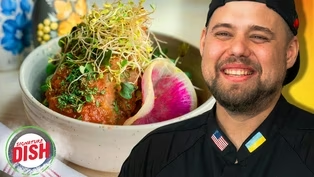
Holubtsi: Stuffed Cabbage Rolls at D.C.'s First Ukrainian Restaurant
Video has Closed Captions
Clip: S4 Ep9 | 5m 29s | Seth visits Ruta on Capitol Hill for holubtsi, Ukrainian stuffed cabbage rolls. (5m 29s)
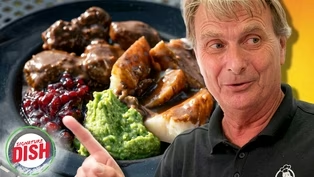
How CAFÉ SOPHIE Makes Kjøttkaker — Norwegian Meat Cakes in Gaithersburg, MD
Video has Closed Captions
Clip: S4 Ep9 | 4m 48s | Seth visits Café Sophie at the Montgomery County Airpark to sample Norwegian kjøttkaker. (4m 48s)
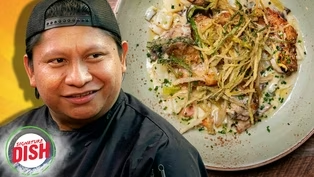
Pan-Seared Monkfish and the Perfect Pint of Guinness at DC's THE HARP
Video has Closed Captions
Clip: S4 Ep9 | 6m | Seth visits The Harp in DC for monkfish, a.k.a. the poor man's lobster. (6m)
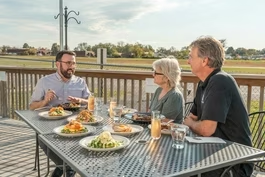
Preview: S4 Ep9 | 30s | Seth embarks on a European expedition across the DMV. (30s)
Providing Support for PBS.org
Learn Moreabout PBS online sponsorship

- Food
Christopher Kimball’s Milk Street Television
Transform home cooking with the editors of Christopher Kimball’s Milk Street Magazine.









Support for PBS provided by:
Signature Dish is a local public television program presented by WETA