Mossback's Northwest
Extended Cut: In the Name of Cod
Clip: Season 11 | 44m 11sVideo has Closed Captions
Co-hosts Knute Berger and Stephen Hegg explore the Alaska Purchase.
Why did the U.S. buy Alaska from Russia? It wasn’t for gold or timber. It was for fish, and it was a politician from the Washington Territory who lobbied the hardest. Mossback co-hosts discuss the geopolitical events that set the stage for the purchase, the far-sighted clerk who helped make it happen and how all of that ultimately transformed the Pacific Northwest and its fishing industry.
Problems playing video? | Closed Captioning Feedback
Problems playing video? | Closed Captioning Feedback
Mossback's Northwest is a local public television program presented by Cascade PBS
Mossback's Northwest
Extended Cut: In the Name of Cod
Clip: Season 11 | 44m 11sVideo has Closed Captions
Why did the U.S. buy Alaska from Russia? It wasn’t for gold or timber. It was for fish, and it was a politician from the Washington Territory who lobbied the hardest. Mossback co-hosts discuss the geopolitical events that set the stage for the purchase, the far-sighted clerk who helped make it happen and how all of that ultimately transformed the Pacific Northwest and its fishing industry.
Problems playing video? | Closed Captioning Feedback
How to Watch Mossback's Northwest
Mossback's Northwest is available to stream on pbs.org and the free PBS App, available on iPhone, Apple TV, Android TV, Android smartphones, Amazon Fire TV, Amazon Fire Tablet, Roku, Samsung Smart TV, and Vizio.
Providing Support for PBS.org
Learn Moreabout PBS online sponsorship(bright music) - Hey everybody.
Welcome to "Mossback," the official podcast of the Mossback's Northwest video series from Cascade PBS.
I'm Stephen Hegg.
- And I'm Knute Berger.
- And today, we're talking about the US's 1867 purchase of Alaska from Russia and how that purchase had everything to do with not gold, not furs, but get ready for it: fish.
We'll hear about a farsighted clerk in the Washington Territorial Legislature who urged the body to lobby the President and the Secretary of State to acquire Alaska, and how all of that helped transform the Pacific Northwest and its fishing industry.
If you haven't already seen the video, take a moment to watch it.
It'll put this conversation in context and bring the Northwest's fishing industry to life.
You can find the video in the show notes but, for now, let's jump in hook, line and sinker.
(bright playful music) Knute, having grown up in Seattle, as you did, it was around fishing a lot.
Fishing was a cultural center point.
What was your experience, as far as fishing, growing up?
- Seafood and fishing were just kind of ubiquitous.
I used to go fishing with my dad up in the San Juans where the reef net boats would be out there catching salmon.
You know, with a Norwegian and Scottish heritage that I have, both sides were fisher people and people who were in fishery science, people who were working on fishing boats.
And you know, there we have some names out there on the bricks at Fishermen's Terminal in Ballard.
And, of course, you know, Scandinavian Ballard is where the Alaska fishing fleet winters.
And so, it was sort of a big deal.
My sister went to the University of Alaska in Fairbanks and in the summers worked at a cannery at Naknek.
So there were lots of connections with the fishing industry.
We're never far away from it, very aware of it.
- Yeah, Alaska just seemed to be the center point of all of this activity.
You head to Alaska where the fish were so bountiful.
- Well, and you know, when you drive across the old Mercer Island, the Lacey v. Murrow floating bridge as you entered the city, it says over the tunnel there, Gateway to Alaska.
I mean, and I think that's something that Seattle, for many, many decades, built its reputation on.
People would joke that Seattle was the southern most city in Alaska.
The connections between here and Alaska were incredibly important to our economy, to cultural exchange, to awareness whether it's Indigenous cultures or, you know, fishery cultures and whatnot.
There were a lot of connections.
- And we had a World's Fair that was devoted to that idea.
The 1909 Alaska-Yukon-Pacific Exposition really celebrated this whole connection and the Gateway to Alaska.
- Yeah, absolutely, I mean, think of the components: Alaska, Yukon, Pacific.
Well, what was that about?
Pacific Rim, gold, the connections, other connections to Alaska and the importance of it.
The last frontier was in our backyard.
The exploitation of resources up there was something that people were very excited about.
And so, you know, in the 1890s, you saw this energy really begin to pick up with the discovery of gold, with steamship traffic going back and forth.
We were connected, we were the place.
If you want to go to Alaska, you came to Seattle and you left from here 'cause we were the closest American port to Alaska.
So, you know, it was a huge factor in the growth of the city at that time.
- So we hear about Seward's Folly, William Henry Seward, the then Secretary of State in the Lincoln Administration's idea to acquire Alaska.
When did people start thinking about getting Alaska?
- Yeah, well, I mean, of course, the Russians claimed Alaska as their territory.
They had fur trading.
They had explored some of the further reaches of Alaska.
They had built a fort in Sitka.
They were trading as far south as northern California for furs.
And, but this was at a time in the late 18th century.
So we're talking about the 1790s.
We're talking about a time when you had multiple empires vying for the Pacific Northwest and the North Pacific.
And so, you had Spain which coming from the south, you had Russia coming from the north, and you had Britain and the United States competing over the Oregon territory.
And I think the idea, you know, arrived in terms of like, whoa, what should America have?
Let's talk about the American viewpoint and the American viewpoint, as it evolved, especially with the opening of the Oregon country, the California Gold Rush, you know, taking California from Mexico in the Mexican War.
The idea, you know, had originated earlier of like, "Wouldn't it be nice if we controlled the entire Pacific Coast of North America?"
- Did this idea exist even before the Louisiana Purchase of 1803?
- Yeah, well, it was back in that time when it was birthed, it was sort of seen as maybe a natural extension of the Louisiana purchase.
Of course, there was a lot of unknown about what was there or how far you could go.
But there was also a maritime element, which is you had ships exploring up in that region, Captain Cook, Vancouver, the Russians.
And so, I think there was a period of time when it was sort of up for grabs, and it was like, which Imperial power was going to sort of seize control.
So the Americans are thinking about it.
There were treaties that permitted some limited access to Alaskan waters between the US and Russia and Britain and Russia.
And there was, you know, talk in the 1830s, 1840s of buying Alaska.
But it never really gelled.
People didn't really know, well, what's the rationale beyond a just kind of naked territorial thing of like, "Well, we should have the whole Pacific Coast and wouldn't that be great?"
I think the sense was, in America, this was the period of expansion, Manifest Destiny.
And I think there was a sense that once we got to the Pacific Coast, we needed to own the whole thing.
- So we had California, we got California.
- We got California, we didn't get Baja, but there were people that wanted that.
There were people that wanted, you know, the bridge, Columbia Coast and Alaska.
And, you know, the rationale of, you know, these guys was America has this destiny to own the Pacific, to be the power in the Pacific.
And so, that was, I think, kind of controlling a lot of those interests.
Now, there was stuff coming out of those, the North Pacific,.
We had whalers were going up there.
There was some fur hunting and fur trading and whatnot.
So we knew that there were resources up there, but nobody knew really what the scope of it was.
- So Alaska was kind of theoretical still- - Yeah, it was.
- as far as its size and what it was, the resources, thereof.
- Right.
- And, you know, the Russians had this kind of tenuous hold on it.
They didn't have a lot of resources to pour into developing it.
And in their early, early settlement period, they'd had, you know, some run-ins with Indigenous people that... You know, you also have to think of the time factor.
If something bad happened to the Russians in Alaska, they were defeated by Indigenous people in a battle up there in Sitka.
You know, but it would take, you know, two years for that information to get back to the capitol, and then another year or two back.
You know, it was far away.
There was no real technology at that time to create kind of instant communication or a network where you could settle something in a more modern way.
But the American expansion was bringing telegraph, it was bringing railroads, it was bringing a more robust maritime system.
And so, things were in place where we could exploit something like Alaska if we so chose.
- I'm curious, was there ever an attempt to get British Columbia?
- Yes, after the Civil War, actually.
- Oh.
- So before the Civil War, Seward who had been kind of a "Let's look at Alaska" guy before he was in Lincoln's cabinet, but when he was Secretary of State, he was in a position where he thought, "Maybe I could do something about this," but- - Before, he was a senator from New York?
- He was a senator from New York.
And so, he was intrigued as were many senators in both parties.
But there were also tons of skeptics, like, "Why do we want this chunk of unknown?
We just, you know, we bought the Louisiana purchase, so we haven't even developed that yet," you know?
And people just thought it was a waste of time and money.
There was nothing there to, you know, ice and snow.
I mean, why would we do that?
So, you know, Seward had some sense that the Russians were maybe looking to get out of it.
They weren't committing to it.
But the Civil War came along.
And the Civil War interrupted the process of negotiating over Alaska.
- Not a good time.
- The Civil War also, you know, had other international implications that affected the northwest, one of them being that a Confederate raider ship attacked the North Pacific fishing fleet, the US fleet, during the war, and sank a whole bunch of Boston whalers and other vessels.
And diplomatically, the US was furious because the ship had been built in Britain.
Britain was supposedly neutral in the war, but they had provided, you know, some aid and comfort to the Confederacy, including building the ship.
So after the war, after the US won the war, Seward's like, "Well, we need reparations for all this damage you did to civilians, American civilians."
- A Confederate ship was in the North Pacific?
- Yes.
Yes, a Confederate ship.
And the result of that was Seward proposed, "Well, why don't you just give us your British colonies between the border in Washington and Alaska?
We'll just take your coast," you know?
- Yeah.
- And this was at a time when the Canadian Confederation was also forming, and they decided to stay British and stay local and join Canada as opposed to the US picking that up.
But you could see that this earlier idea of uniting the West Coast under American rule, you know, during the Polk period, the Mexican War period, "54-40 or Fight!"
- Right.
- You know, this was an attempt to extend our ownership of the land far north.
So Seward tried, he failed.
But in the post-war period, there was perhaps the time when they could bring up buying Alaska or annexing Alaska, getting it somehow.
- What role did the Washington Territory have in acquiring Alaska?
And what was the catalyst?
What was the thing that finally set things in motion?
- Well, that's the interesting thing 'cause it's not well known.
It's been written about in history, but not well-known.
So the Alaska Purchase was many years in the making, I mean, decades in the making and discussions and treaties and all that.
So there was a guy named Joseph Lane McDonald, an Irish immigrant, came to the United States.
He was a seaman.
You know, he was involved in various, you know, walks of life.
And he decided to head to the Pacific Coast and in the Gold Rush period.
So we're talking about 1850s California.
And he goes to San Francisco.
And one of the things that he's interested in is this idea of a transcontinental railroad, "Gee, we really need one of those."
And, of course- - Everybody was interested.
- Everybody was interested in that and had been for a long time.
But, you know, this idea of exploiting the Pacific in the way that we'd exploited the Atlantic, this would be interesting.
So he did a lot of research.
He actually took a trip to Alaska by boat and went up there.
And what he saw was just, you know, this amazing potential in terms of fishing.
Now, we take it for granted today because you can go fish in the North Atlantic, you can flash-freeze, the seafood, comes down to Seattle or goes to Paris or wherever and it's as fresh as if you caught it that day.
The North Atlantic, we knew about.
And you know, the incredible fishing grounds of New England.
And so he recognizes that Alaska offers a lot of potential for fish.
And in the early 1860s, ships from San Francisco are going out to the Bering Sea and other places and coming back with these incredible loads of codfish.
And they would salt it.
So you're getting salt cod in San Francisco.
It's a boom town.
The Gold Rush is, you know, thriving.
And you know, people from back East coming out to the West Coast, they're used to eating cod, a lot of New England, Canadian cod.
- It is the fish, yeah.
- It is the fish.
It is the staple, more than salmon.
And, of course, salmon was, by comparison, relatively more prevalent, but not heavily commercialized.
And so, these vessels begin coming back from remote places in the North Pacific.
And salt cod is suddenly in the markets.
There's a huge appetite for it.
And this triggers this idea, which is, "We could really make a lot of money if we could own that."
And this guy is just back.
So he's trying to get people interested in this idea of a railroad to Alaska, exploiting the fishery.
You know, Russian Alaska is a lot closer than having to go almost to Japan or Russia to get access to some of these cod grounds.
- And were there treaty implications as far as where you could fish?
Were we not able to really exploit Alaskan fishery because of Russia's dominance?
- Yes.
- Yeah, at one point, we'd had a treaty that seemed to allow fishing up there, but it wasn't seen, it wasn't like commercially dynamic, but we could have limited access to Alaskan waters.
But that treaty had expired, so there was no agreement, nothing that allowed Americans to fish in Russian waters, waters claimed by Russia in Alaska.
And so, Joseph Lane McDonald ends up in Washington.
And he is trying to convince people of these various dreams and schemes that he has.
He's writing for newspapers.
He gets a job as a clerk at the Washington Territorial Legislature.
He's a literate guy and a very odd character, apparently.
I found a description of him.
There's only one article I've ever found that goes into some depth about him 'cause there's a lot about him that's kind of not known.
And there's an article from 1921 in "The Washington Historical Quarterly."
And here's the description of this guy: "His appearance here as described by persons yet living," so the author of this article talked to people who knew Joseph Lane McDonald.
- People say?
- Yeah, "was most theatrical.
His body was short.
His shoulder's enormous.
And his head, the face of which was deeply pitted, formed union with a trunk without semblance of a neck.
His manner's bespoke his person.
Adults turned to take a second look and children to stare as he passed by.
Some thought him a wonderful man, but others a halfwit, even bad.
How he made a living, nobody knew.
Though it was gossip that he was a seller of whiskey to Indians, and a smuggler, callings not held in such ill repute then as now."
So, you know, he's out there promoting this idea that we need to get our fishing fleet such as it is access to Russian waters.
- But was he a profiteer?
Is he somebody who personally wanted to make money exploiting this idea and the resource?
Or was he a thinker, a visionary?
- Well, I think, he was both.
I think this is- - But then he became a clerk, a lowly clerk for the legislature.
- Well, you're politically connected.
A clerk in the legislature, is somebody who's writing legislation, who's editing it, who's getting to know the political figures.
And he realizes that in order to get access to Alaskan waters for American fishermen, Washington is in the best position to do that.
We're closest to Alaska.
And he knows that the resources there.
He also knows that, you know, this is the era of big dreams.
You know, where you have a lot of entrepreneurs coming along saying, "Well, what we need to do is," "Yeah, we need to."
In his case, we need to get access to the fish in Alaska, but that's just the half of it.
We need to get our shipping fleet going up there.
We need to get a railroad connecting us with Alaska directly.
So he's also trying to create a railroad company and a navigation, a steamship company, that would unite all this and make big money possible.
He wasn't the only one thinking about that.
And he basically got outmaneuvered by other people who created steamship companies and whatnot that could exploit the resource.
But he convinces the Washington legislature to pass, basically they called it a memorial, a request, for the government to get them access.
And one thing back in that period, it's still true now, if industry wants something and if you can get a bunch of local businessmen and political leaders to say, "Hey, you need to do this and here's why," - Uh-huh.
- that can be very effective.
So he writes to, at this time, this is Lincoln has been assassinated.
So we're in the later, 1860s.
And so he has the legislature draft a memorial that he basically wrote and send it to President Andrew Johnson.
Andrew Johnson's Secretary of State is still William Henry Seward.
He writes to Seward and says, "Hey, we've got this memorial, it's gonna be signed in a few weeks.
I'm giving you a look at it."
And the legislature of the Territory of Washington wants Alaska.
They want access.
He doesn't say purchase Alaska; a treaty, something.
He wants permission for us to fish there, to repair our ships, to be able to go wherever we want.
- Do you think he was aware that Seward was very interested in this very idea all along?
- Yes, yeah, I think many people were.
And, you know, - Seward probably spoke about it and wrote about it.
- Yeah, it had been spoken about, it had been written about, it had been debated in Congress, the wisdom of it.
But the post-war situation is different than the pre-war situation.
And expansion is happening anyway, right?
I mean, Transcontinental Railroad, both under Lincoln, Johnson, you know, this is the era of where the expansion technologically is really taking off.
Well, Seward is known, when he was in the Senate, when he was in the cabinet, as a very, you know, crafty experience, knowledgeable, knows how things are done in Washington.
And he sees this thing as kind of a godsend, you know?
Here is a document I can take to skeptical congressmen and I can say, "Oh, the territory out in Washington really needs this.
We have a constituency here that wants us to get this off the dime."
And that's what happens.
- Was the president interested in this?
- Yeah, I think so.
I mean, he didn't oppose it.
And in fact, I'm sure, you know, Johnson saw the benefit of it.
You know, he was essentially a Southern Democrat.
And Southern Democrats tended to be very expansion-oriented before, during, after the Civil War.
That was a big thing.
They were very interested in exploiting the West Coast.
They had talked about taking California out of the union, creating a potential slave state in the West.
They were really interested.
And, of course, the cotton growers of the South would love to have extended slavery there.
They would love to have had a pacific port.
Even during the Civil War, they were trying to undermine the union in California to get a Pacific port.
So people were looking at all these different configurations about how we could get access out there.
So, you know, it had support of Republicans and Democrats.
- So, we buy Alaska.
- Yeah.
- The deal is done.
- We write a check.
- For $7.2 million, which seems incredibly cheap because I, you know, Googled this.
And 7.2 in 1867 is equal to about 157 million today, which is about what we'd spent on the First Avenue Streetcar, (Knute laughs) if we get that done.
- Right.
- So to me, it says, again, that Alaska, for a lot of people was just a theory.
They had no idea what was there, how big it was, they had absolutely no idea.
So, but not everybody was for this, right?
- No, I mean, there were a lot of people who just thought this was a waste of money.
You know, the government had spent a ton of money on the war, you know?
Why are we outlaying for this largely blank area on the map?
Because, you know, people had charted, were somewhat aware of the inner passage, the coastline.
But the interior was a complete unknown.
And so, it's like, "You're buying a bunch of icebergs, maybe some walruses, you know, what are you doing?"
And that's why it became called Seward's Folly.
That was considered a very, very foolish act.
But it was front page news.
I've gone back and looked through, you know, what were the headlines?
April 1st, wasn't April Fool's Day at the time, I guess.
April 1st, 1867.
(Stephen laughs) - We bought Alaska, yeah, sure.
- It's announced, you know?
And it's, you know, it's front page news in all the papers, "The New York Times" and others.
And in the coverage in many newspapers, Seward has released this document from the Washington Territorial Legislature pleading with the government to solve this problem of access to Alaska.
So he's using the Washington thing.
It not only helped trigger the purchase, getting it going again, it provided him with some political leverage, but he is also using it as PR at the time to justify what people are criticizing.
- So, he noted that the Washington legislature was instrumental, and therefore McDonald was instrumental in this purchase.
- Yeah, it's interesting.
McDonald's name has dropped out of this thing.
You know, he's behind the scenes guy.
He's the guy who contacted Seward.
He's the guy who wrote this and got the legislature to pass this memorial, which begins with cod in the very first sentence.
The memorial reads: "In reference to cod and other fisheries, your memorial as the legislative assembly of Washington territory, beg leave to show that abundance of lead fish, halibut and salmon of excellent quality have been found along the shores of the Russian possessions."
- Why did the Russians sell it?
And for so little?
- I don't think they thought it was maybe so little at the time.
I think they just knew that they didn't have the resources to exploit it.
And they had other, you know, other issues in Russia that they were dealing with.
I mean, they had fought the Crimean War, you know, just prior to our Civil War in the 1850s.
You know, they had an empire that they were, you know, trying to manage and having difficulties.
And there was so little that they had been able to do in Alaska.
And there was so little of it that, you know, it's really... it just kind of fell down the priority chart.
To them, it probably just seemed like a free $7 million out of the blue, why not?
- When did this deal stop being called Seward's Folly?
And when did it finally start making sense to Americans?
- Yeah, well, I think my sense of it is that it was the Gold Rush, the Klondike Gold Rush that really changed the perception.
- So the late 1890s?
- And the access, 1890s.
And I mean, certainly there were people who were going up to Alaska shortly after the purchase to settle, to explore, to try to capitalize on resources.
And, of course, the fishing industry could continue to go to the Bering Sea or, you know, the North Pacific and bring fish back.
If you looking at exploitation of resources, there was a lot of fish here to exploit.
So, I mean, the fishing industry didn't go to Alaska to catch salmon.
- Right.
- You know, the amount of salmon just in the Columbia River or, you know, locally available was enormous.
But you begin to get the infrastructure.
You know, by the 1880s, you're getting massive canneries.
You're getting the technology for processing fish and being able to send it outside the Pacific Northwest, canned salmon being, you know, a huge deal.
And then as you get into the Gold Rush period, you're getting a lot of regular shipping access, you know, going from, well, certainly from the gold fields to San Francisco.
So the whole coast is now involved in the gold business.
But also supplying, we're building infrastructure up there.
We're building ships that can go up there and come back and continue, and fishing follows that.
The technology is changing.
You have the development of diesel engines, not just steam engines.
And so you get a fishery that's built on small, kind of fishing vessels that are sort of like the family farms afloat, right?
A family can get a fishing vessel, they can go up to Alaska, they can make a ton of money in a season.
Canneries are expanding.
They can get to the sell the stuff, there's a ready market for it.
And then, they can come back and take the winter off.
I mean, it's very much an agricultural.
And so as the technology, I think, and as the sort of democratization of who can go fish up there, it doesn't necessarily have to be a factory ship.
It can be smaller vessels.
And there's just so much up there that's exploitable.
And so, yeah, when you get into the early 20th century, the volume of everything sort of begins to go, inch its way toward 11, you know?
- And so that's when Puget Sound and Seattle became really part of the Alaskan fishing industry.
- Yeah, I mean, I think it goes on kind of right on the coattails of the Gold Rush because, you know, there's a whole question about like, "Why did the Klondike Gold Rush, which was in Canada, British territory, why did Seattle become the base for that?"
San Francisco, Portland, Victoria, Vancouver?
There were all kinds of places that could have been the jumping off place.
Became Seattle partly through marketing, Partly because the railroads were finally here.
We were the closest American port to American territory in Alaska.
That made a big difference.
You didn't have the customs issues that you had with Canada, for example.
And so the Gold Rush turned us into the base camp or the gateway.
And, of course, while fish, while codfish had been the sort of leading product, there was now gold, there was now mineral wealth.
There was more to exploit, more to develop.
And yeah, so, you know, people began to look at that.
I mean when, you know, you think about 1897 when the Portland, the gold ship came to Seattle and offloaded a so-called ton of gold, it was actually more like two tons.
It's no longer folly, right?
- Right.
- And the ongoing relationship with the fishery up there, as our fishing stocks deplete in the Pacific Northwest, there's still enormous abundance up there.
And, you know, it becomes this mainstay for Seattle where we have the fishing fleet, we have this active maritime industry, it's modernizing.
And we're just, you know, well-located and, frankly, entrepreneurial.
People seize the opportunity.
- When we talk about Manifest Destiny and the purchase of these territories and that national impulse to expand, I can't help but compare it to a similar contemporary Manifest Destiny impulse that exists today.
This idea that the US could possibly acquire Greenland or the idea that Canada should become the 51st state or other claims and ideas.
Do you see a resemblance there?
And what does that say?
- Well, yeah, I mean, the expansionism in the United States as well as Russia, China, other countries, it hasn't gone away, right?
And we clearly see the Pacific Rim.
I mean, that puts it in this kind of, "Oh, there are trading partners and we're gonna be important figures in that trade," and that kind of thing.
But you know, I mean, we went to war to get the Philippines and to get various islands here.
Hawaii ended up a state.
Alaska ended up a state.
There's now talk about Guam becoming a state.
This is to because we perceive other countries as vying for the ocean that we want to control.
- And it's about resources.
- It is about, of course, it always comes to that, it always comes to resources.
And so, now you have this new competition taking place in the Arctic.
And I mean, the early explorers who came to the Pacific Northwest, Captain Cook, chief among them, they were looking for the Northwest Passage.
They were looking for a shortcut across North America between the Atlantic and Pacific.
And the idea was if you could link those two, you could commercialize, you could make a lot of money, you could shorten these travel times, and we would have direct access to European markets.
You know, the Northwest Passage was a big deal.
And then, you know, but the north remained frozen, so it meant that you could only get through with certain kinds of vessels at certain kinds of the... You know, but up into the early 20th century, it was still ice bound by our standards.
And people, you know, so we sent submarines up there and Amundsen, you know, went across in his boat, you know, trying to prove that it was a viable thing, but you needed the right technology.
Well, now with global warming, changing climate, it's open and easy to access relatively.
Well, this opens up a whole strategic question.
Who controls the Arctic?
Who controls the Northwest Passage?
Russia controls the Northeast Passage because the country extends significantly there.
America has a piece of it because of Alaska.
Canada has a huge piece of it because of how it's situated.
And then, the Scandinavian countries, Norway and Denmark, you know, they have pieces of it.
Territorial claims is, when I say pieces of it, I mean territorial claims.
And China wants to have access and are claiming some rites to the Northwest Passage.
So you're seeing something very similar to what was happening in the, you know, early 19th century, the late 18th century.
This is jockeying for domination of not only the Pacific, but the top of the world.
- In your mind, how would've things turned out if the US had not acquired Alaska?
- Well, that would be really interesting from this an economic standpoint because so much of the Pacific Northwest's and Seattle in particular, our economy tied to Alaska, that wouldn't have existed.
Now, we might have been able to find ways to treaty around that or make that work.
But if another imperial power had gone into Alaska and developed it fully, those fish, that gold, those timber, the resources would be going in a different direction.
It'd be going, you know, they would be going west.
And so, I think it would've had a big impact on the economy.
And certainly, if other factors of history played out the way they have, it would've been a huge security issue for Canada and for the United States to have what essentially, during the Cold War, was an enemy right on our border.
I mean, there's the old Sarah Palin thing.
"I can see Russia from my house," you know?
But that's very different if, you know, you're on the other side of the Ellucian chain versus imagining, you know, Russia, where Southeast Alaska is.
- Whatever happened to Joseph Lane McDonald?
Do we know?
- Not really.
We know a little bit.
So he stuck around, I found a reference to him in a newspaper and in the 1880s.
So his proposal to create the steamship line went kaput.
He got out maneuvered by more powerful legislative forces.
And I don't think he was a guy who could really... I don't think he was sort of a big enough fish in order to parlay this.
I mean, he pretty much got written out of the story.
I think he went up to Alaska at some point, and this clipping I saw from the 1880s, he was submitting to a congress or a representative of some kind in Washington DC, a proposal to allow mammal hunting in Alaska.
So there was apparently a period where that was not allowed or was sort of in jeopardy.
Could we legally go up there and slaughter, you know, walruses and that kind of thing.
It's just a brief mention in a thing.
And in the more extensive history, he basically is, you know, said to have gone back East, I think somewhat disillusioned is sort of the implication.
And then, he just drops out of history.
- Uh-huh.
- Yeah.
So I don't know, I don't know what happened to him.
And the historian who's written most about him doesn't seem to know either.
- This story is interesting because it just deals with these macro developments, these geopolitics, but it's really this one person who's at the center of it who can make a huge difference.
- Yeah, isn't that interesting?
I mean, the historian who wrote kind of the story of this for "The Washington Quarterly" in the 1920s, UW professor, and he wrote a follow up piece to it a year later.
And I don't know whether he took flak for, you know, giving Joseph Lane McDonald such a high profile, but he basically says in this piece, without mentioning him by name.
Of course, these things don't happen because of one person.
And then, he goes into the whole backstory of all the treaty negotiations and whatnot.
So he's covering decades of, you know, interest and concern and politics around the Alaska Purchase.
But, you know, if somebody is key to the whole story as William Henry Seward says, this is the guy who gave me the ammo I needed to make the breakthrough on this.
And he's the obscure Irishman from Washington Territory who had this vision that other people ignored and, you know, credited him with that.
You know, he said this memorial that McDonald had written, was a foundation of the Alaska Purchase.
It's the foundation of it.
You have to take that seriously.
And that's the weird thing.
And I mean, there are all these dynamics of politics and empire and presidents and emperors and, you know, czars, you know?
And then, one guy just kind of, you know, follows a weird kind of almost delusional dream that also happens to have a lot of truth in it.
And bingo, something happens, big.
- Can't have a good story without a good character.
- Yeah, I mean, this description of this guy, he kind of sounds like, yeah, Richard III.
I mean, this kind of freakish guy who, you know, people are kind of fascinated by.
And then, he just kind of disappears in history.
Well, not that Richard, Richard III's body disappeared, but he didn't disappear 'cause Shakespeare wrote about it, you know?
No, Shakespeare wrote about Joseph Lane McDonald, but he sounds like quite a character.
(bright light music)
 New
NewExtended Cut: Upon Further Review: Seattle's Food Evolution
Video has Closed Captions
Co-hosts Knute Berger and Stephen Hegg explore Seattle food history with special guest Rachel Belle. (47m 6s)
Extended Cut: How Skid Road Birthed a Literary City
Video has Closed Captions
Co-hosts Knute Berger and Stephen Hegg explore the origin story of Seattle’s libraries. (48m 58s)
Extended Cut: The Case of the Treasonous Doll Spy
Video has Closed Captions
Co-hosts Knute Berger and Stephen Hegg explore the story of WWII’s “Doll Spy.” (39m 18s)
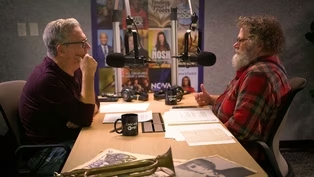 Now Playing
Extended Cut: In the Name of Cod
Video has Closed Captions
Co-hosts Knute Berger and Stephen Hegg explore the Alaska Purchase. (44m 11s)
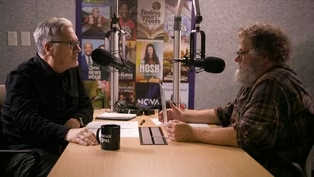
Extended Cut: The Potlatch Riot of 1913
Video has Closed Captions
Co-hosts Knute Berger and Stephen Hegg explore Seattle’s Potlatch Riot. (53m 26s)
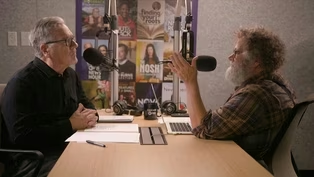
Extended Cut: The Mystery of the Mima Mounds
Video has Closed Captions
Co-hosts Knute Berger and Stephen Hegg explore the Mima Mounds. (44m 20s)

Video has Closed Captions
Season 11 of Mossback's Northwest premieres Thursday, October 9th, at 8:50pm on Cascade PBS. (30s)
Providing Support for PBS.org
Learn Moreabout PBS online sponsorship













Support for PBS provided by:
Mossback's Northwest is a local public television program presented by Cascade PBS