Mossback's Northwest
Extended Cut: The Case of the Treasonous Doll Spy
Clip: Season 11 | 39m 18sVideo has Closed Captions
Co-hosts Knute Berger and Stephen Hegg explore the story of WWII’s “Doll Spy.”
One of the oddest cases of WWII espionage involved a woman, Velvalee Dickinson, who spied on Northwest shipyards for the Japanese. How did she do it? By writing coded letters about dolls. Mossback co-hosts dig into Dickinson’s story, how she was ultimately caught by the U.S.’s first female cryptanalyst and the Northwest’s unique role in international spy games throughout the 20th century.
Problems playing video? | Closed Captioning Feedback
Problems playing video? | Closed Captioning Feedback
Mossback's Northwest is a local public television program presented by Cascade PBS
Mossback's Northwest
Extended Cut: The Case of the Treasonous Doll Spy
Clip: Season 11 | 39m 18sVideo has Closed Captions
One of the oddest cases of WWII espionage involved a woman, Velvalee Dickinson, who spied on Northwest shipyards for the Japanese. How did she do it? By writing coded letters about dolls. Mossback co-hosts dig into Dickinson’s story, how she was ultimately caught by the U.S.’s first female cryptanalyst and the Northwest’s unique role in international spy games throughout the 20th century.
Problems playing video? | Closed Captioning Feedback
How to Watch Mossback's Northwest
Mossback's Northwest is available to stream on pbs.org and the free PBS App, available on iPhone, Apple TV, Android TV, Android smartphones, Amazon Fire TV, Amazon Fire Tablet, Roku, Samsung Smart TV, and Vizio.
Providing Support for PBS.org
Learn Moreabout PBS online sponsorship(gentle music) - Hey, everybody.
Welcome to "Mossback," the official podcast of the Mossback's Northwest video series from Cascade PBS.
I'm Stephen Hegg.
- And I'm Knute Berger.
- And today, we'll be exploring the thrilling Case of the Treasonous Dolls.
It's a World War II era true tale that features espionage, cryptic letters postmarked from Seattle, and a New York City doll shop that served as a front for covert communications with Japanese officials.
If you haven't already seen the video, take a moment to watch it.
It's got footage and photographs from the time, including creepy dolls galore.
You can find the video in the show notes but for now, let's break some code.
(fun upbeat music) So, I love a good spy novel.
I don't know about you, Knute, but if I'm on a plane, for instance, I have to have a spy novel or some kind of a page turner like that.
I just can't go for any kind of fiction, no matter if it's won the Pulitzer Prize.
I love a page turner.
I love spy novels, espionage novels, and I love spy movies.
- Yeah, I'm right there with you.
My father, I think I got it from him, you know, partly because his bedside table was always full of, you know, James Bond, John le Carré.
And I began, you know, taking those, but he was really interested in it.
And at one time, he actually was working on a novel about some spying in the northwest during World War II.
It didn't go very far very well, and I've never been able to find the manuscript to it, but I remember he was working on that.
But also during World War II, he was asked to spy on his base commander in California.
He was in the Army Air Force, and apparently- - [Stephen Hegg] Asked by whom?
- Asked by Army intelligence to spy on the base commander, who apparently was having government and military engineers build a road up to a very fancy home he had built on a mesa.
And they were very interested in this guy and asked my dad to, you know, keep his eyes open.
He was a doctor.
He was a captain.
And my dad did And this guy was eventually caught and went to jail apparently, because it was the middle of the war.
He's taking war material and personnel to build a personal net airy upon.
- It would be great if you could find that manuscript, and then finish it.
- [Knute Berger] Yeah, there you go.
- Well, this isn't the first time that "Mossback," has covered espionage.
I love the story that we did about German espionage in Seattle and the Puget Sound area, or on the West Coast actually before World War I, where they actually blew up a barge full of TNT in the middle of Elliot Bay.
- Yeah, that's an amazing story.
Just because we weren't in the war yet, yet the Germans were here trying to disrupt these material being sent through Seattle to the, to Russia.
Russia was an ally at that point in World War I. I also did a series for us, a written series about a SS intelligence officer who visited Seattle in the late 1930s, 1938, was wined and dined by members of the German community here.
He was a lawyer and he told people, "I'm here on vacation.
I'm on my way to Alaska to go hunting."
Well, he was in fact sent here under orders from Heinrich Himmler to gather intelligence in North America.
He spent a year doing that, and I was able to find a copy of his reports.
- How did you come across the case of the treasonous dolls?
First of all, treasonous dolls sounds like a British band from the '80s, but it is from the very beginning completely intriguing.
- Trees and the stalls?
- [Stephen Hegg] Treasonous dolls.
I think you've- - Treasonous dolls.
(laughs) I heard you say trees and the stalls.
- Did I?
- I'm like, what the hell is that?
The story- - Well, that too.
- No.
- [Staff 1] I thought the same thing.
- Okay.
- You did?
Yeah, I did.
- Okay.
- [Staff 2] I knew what you were saying, Stephen.
- All right, well.
- [Staff 2] Love it.
- All right, well, you can leave that in and let us laugh about it, the trees and the stalls- - That's next season.
Okay.
- Yeah.
- Okay.
How did you come across the case of the treasonous dolls?
It sounds very intriguing.
- [Knute Berger] Yeah.
- Right away.
- I can't actually remember.
I was probably reading about World War II espionage, and I came along across this intriguing name, a woman named Velvalee Dickinson.
- Yes, who is Velvalee?
- Who was Velvalee?
And first of all, the name is just like, is that really a name?
You know, I'd never heard of the name Velvalee before.
And so, I read that she was a woman accused of spying for Japan during World War II, and that she was owned a doll shop in New York City.
And the more I read about her, I realized there was a strong Northwest connection because some of the spying she was alleged to have done took place on the West Coast.
So, there was a Seattle connection.
There was a Portland connection.
And that got me really intrigued because as much as I read about her, the Northwest connection was not front and center.
It was, you know, the more national story.
And it is a significant national story from the war that isn't widely known.
- But Velvalee was from the West Coast?
- So yeah, she and her, she lived in San Francisco.
She went to Stanford.
And she and her husband lived in San Francisco for a time.
And her sideline was as a dealer in kind exotic dolls, foreign dolls, dolls of different kinds, mainly selling them to collectors.
She and her husband ended up moving to New York and they opened a doll shop in a very pricey part of town.
And, you know, it was a high-end enterprise.
And she would travel around the country, meeting customers, buying and selling exotic dolls, and which, you know, an interesting profession.
And she had, when she lived in San Francisco, she had developed some connections with the Japanese community there, the diplomatic circles.
She loved Japanese culture.
She learned the tea ceremony.
She was a Japanophile.
And so in the years right before Pearl Harbor, an arrangement was made with Japanese diplomats in Washington, DC to be a connection for them.
- What kind of connection?
What would she do in New York City?
- Well, this came out and so she was paid a sizable sum of money to gather intelligence, and they were particularly interested in what was happening in naval shipyards on the West Coast.
And she went down to Washington, DC and she was given some, you know, $15,000 or more in cash, which was a lot of money in 1941, and was asked to provide information.
And of course, this didn't come out until after she was caught and she tried to blame it all on her husband.
- So, this was before Pearl Harbor happened?
This is before America's entrance- - Yes.
- Into the war?
- It was right before Pearl Harbor.
And of course, the West Coast shipyards, they were interested in as it turned out and were the ones repairing vessels that were damaged at Pearl Harbor.
So, in other words, you're talking about Bremerton.
You're talking about Mare Island in California.
They were interested the information that she was said to provide was information on what ships were there and what kinds of repairs they were undergoing.
- So, they approached her before Pearl Harbor?
- Before Pearl Harbor.
- Obviously the plan had been set in motion, and they wanted to know what was going to happen to the ships that they were going to bomb.
- Right.
And her contact included the Japanese Naval attache.
In fact, later when she was caught and they found the money, they were able to trace that money to the Japanese embassy in Washington, DC.
- So, how did she do this?
The whole thing sounds so improbable in a way to approach a doll collector, a someone who sells dolls to spy for the Japanese Navy.
How was this done?
Why did they choose her?
- Well, I think they chose her because she had these connections.
She had a deep affinity for Japanese culture.
She was smart.
She was, you know, an intelligent woman.
And I'm sure that her husband was involved in some way, must have known what was going on.
- Did he have a profession?
- He was in business, and it's kind of vague.
He was older than she was.
They seemed to have owned some properties in San Francisco and also in the Seattle area.
So, they had reason to travel.
That was part of a kind of a cover for them when they were asked or when she was asked, "Well, why were you going around the country?"
You know, this is in the era of gas rationing.
And here, she and her husband are driving across the country and they're driving from town to town and this kind of thing.
And this was something that raised suspicion on the part of the authorities when they caught on to there being something odd here.
Her husband died actually fairly early on.
So she was pursuing this basically on her own, although she tried to blame him for everything.
- What was the method of contact?
So what- - Well, this is- - How did this happen?
- Yeah, so here's how the weird part about how it unraveled.
So, the method of communicating was writing messages and doing it under the name of various customers of hers.
And she would describe dolls that she had found, or dolls that to be acquired, or these descriptions of the dolls.
And then, they were mailed to an address in Argentina.
And the one of them, the letter from Seattle, it had been postmarked in Seattle.
And the return address wasn't her return address.
The return address was one of her customers.
So, it looked like a very innocent kind of thing.
Somebody, you know, had sent a letter about dolls to Argentina.
What's the big deal?
Well, you know, sensors at the post office were checking everything.
And they read this letter, and then they got another one and another one.
They began intercepting a series of these over the months.
- And they were all sent to Buenos Aires?
- They were all sent to yes, to Argentina and returned as undeliverable.
And of course, what Velvalee apparently didn't know was that her contact in Argentina had fled or been compromised in some way.
And so the letter drop was no good.
If not for that, the, you know, the information would've gotten into the hands of the Japanese navy.
As it was, they ended up being flagged and intercepted by the sensors who began reading these.
So when they began investigating and the FBI got involved, they found that the people who had supposedly written the letters had not written the letters.
They didn't know anything about them- - But they were real people.
- They were real people and they were all customers of Velvalee.
- [Stephen Hegg] Oh.
- And so this began the sort of unraveling where they began investigating her.
They began investigating her travels.
They were able to determine that some of the letters had been written on typewriters in hotels that she had stayed in.
You know, they began to kind of draw these pieces together.
And of course, the question was, the content was very unusual.
- Yeah.
Well, how did, what did she say in these letters?
- Well, in these letters, she would describe dolls.
And let me see if I can find an example here.
So, here's one that came from Seattle.
It said, "The only three dolls I have are three lovely Irish dolls.
One of these dolls is an old fisherman with a net over his back.
Another is an old woman with wood on her back.
And a third is a little boy."
So, these are very cryptic messages.
And so, the FBI and the prosecutors turned to a woman who was America's first and foremost crypt analysts, codebreaker basically.
And, you know, they said, "What do you make of these letters?"
And all of the letters were similar in terms of using this sort of, here's another one, "I just secured a lovely Siamese temple dancer.
It had been damaged, that is tore in the middle, but it is now repaired.
And I like it very much.
I could not get a mate for his Siamese dancer.
So I am redressing just a small plain, ordinary doll into a second Siam doll."
- So, this was some sort of code that the code breaker was able to make sense of and decipher about ships that were being repaired after Pearl Harbor?
- Yes, they were able to determine that... So, the code breaker, Elizabeth Smith Friedman, she was very experienced at code breaking.
She and her husband were both crypt analysts.
She had been working well since before World War I. She and her husband had worked for a guy, a wealthy millionaire, who was attempting to prove that Francis Bacon wrote Shakespeare's plays and that had done so in code.
And so he, they was having them decipher his correspondence and whatnot in order to prove that he was actually Shakespeare.
And- - So, they met a magnificent obsession by a millionaire.
- Yeah, yeah, exactly.
But World War I came along and they began to work on breaking codes.
And of course here, you have a lot of radio transmissions going on, and it's kind of the early days of crypto analysis.
There was a certain amount of that, like during the Civil War, but then it had kind of gone flat.
Now, it was a reviving.
So, she did work for the US Navy during World War II, breaking radio codes.
She then worked for the Coast Guard during prohibition.
The Coast Guard had a very sophisticated, developed a very sophisticated network for intercepting transmissions.
And so, Elizabeth Friedman became very good at deciphering all kinds of codes, including codes where you're using word substitutions.
You know, where bootleggers might be talking by radio and you know, referring to booze as, you know, some kind of other product, or package, or that kind of thing.
So she sort of, you know, sharpened her teeth doing that.
She was played a key role in busting one of Al Capone's smuggling rings.
And it turned out she also had a connection to the northwest in that in her code breaking during the prohibition era, she brought a lot of her code analysis to the West Coast to try and break bootlegger codes on the West Coast, as well as on the east coast and the Gulf Coast.
And she also was brought into a trial in Vancouver, BC that was a guns and opium smuggling ring run by some Chinese.
And they were getting opium and then sending guns to China.
She was called to testify in that case in which she broke a code in Mandarin.
So, you know, she was used to dealing with pretty complicated- - No slouch.
- Things, yes.
And when she looked at this and was asked, you know, "What do you think this in," she called it jargon code.
And essentially, she's saying, you know, what's going on here is these dolls are actually ships that are in these shipyards.
And they began to correlate some of these to known vessels that were in Bremerton, or at Mare Island, or at Portland or whatever that were under repair.
And of course, this was very important not to let this information get out because you know, the Japanese, you know, military had done huge damage at Pearl Harbor, but they weren't sure how much damage they had done.
And what they didn't know was how quickly the ships could be repaired.
- [Stephen Hegg] I see.
- And turned around.
And of course, that was very key to the war in the Pacific, was many of those ships were salvaged, repaired, and turned around in West Coast ship yards, and then available for the war in the Pacific.
- So when she's writing, Velvalee is writing about a Irish doll, a fisherman with a net on its back, was that a reference to a specific kind of ship and a specific repair?
- Right, the wood on its back was probably an aircraft carrier that was being converted.
The netting probably referred to anti-submarine netting.
You know, that the small doll might have been some, a destroyer of some kind.
But they were able to kind of correlate these two ships that were under repair.
And so, they realized, you know, this is not just gobbledygook.
Somebody is, you know, gathering this information.
And so, the focus centered on Velvalee Dickinson.
- Who were her sources?
Did she go to shipyards and get out the ox and figure that out or how did she gather her information?
- Well, this is the thing, you know.
It was considered somewhat suspicious that she and her husband traveled so much during that early part of the war 'cause there was gas rationing and they seemed to have this expensive doll shop that couldn't really be supporting itself.
So, they had money from somewhere that was enabling them to do this travel.
She eventually basically confessed to the FBI.
And she said that her sources were just people who lived near the shipyards, might be shipyard workers, might be people who had a view of the Bremerton docks.
And she was able to pick up a lot of what would've been very valuable information.
And it, you know, and I, yeah, to me, it's like the thing, the loose lips sink ships.
You know, that was a common slogan and poster during the war, warning people if you work at a factory or a shipyard, don't talk about it.
She was able to get people to talk, just chat.
And, you know, who would suspect her?
And so, that seems to be the basis for a lot of the intelligence that she gathered.
- So, what happened to Velvalee?
- Well, she was arrested.
She was actually arrested at her bank.
She went to her bank to get stuff out of her safety deposit box.
And in that safety deposit box, there was some $13,000 in cash that they were able to trace back to the Japanese embassy.
She resisted arrest, I guess.
She fought with the FBI agents.
They corralled her and she was charged initially with, you know, having violated the censorship law, but they added treason to it, because they were pretty sure that you know, who she was working for and what she was attempting to do.
They really couldn't prove the treason charge, because the letters had never been delivered.
- [Stephen Hegg] I see.
- You know, they'd gone all the way to Argentina and got stamped and sent back.
So, it was just kind of a fluke that somebody caught somebody's eye and they began getting multiple letters and seeing that this was part of a pattern.
And that they were deceptive, that the people who wrote them didn't write them.
The doll collectors involved, yeah, didn't know anything about it.
And so, they had to go through the process of clearing everybody and figuring that out.
Then once they knew what the code was and figured out what that was probably referring to, they ended up dropping the espionage charges.
But in exchange, they told her, "You gotta tell us what you did and how you did it."
And so, that's why we know kind of what she can, you know, she admitted, you know, "I got the money.
I did this.
It was all my husband's doing," but she was the one that carried it out.
- What was her ultimate sentence, charge and sentence?
- Well, she was charged with, you know, wartime violation of the censorship law and she got sentenced to, I think it was five years.
I'll have to have to remind myself what that is.
But she went to federal prison and was there into the 1950s.
And yeah.
- Do you know what happened to the doll shop or any of the dolls?
- I don't, you know.
I mean, I've seen pictures of the doll shop, you know, kind of the window and the dolls there.
And I think, you know, the, I mean the title of the thing, the Case of the Treasonous Dolls we're sort of blaming the dolls who were not at fault here, right?
- [Stephen Hegg] Are you sure?
(Stephen and Knute laughing) - Yeah.
- Because there's something creepy about doll sometimes.
- And she was not convicted of treason, which she would've been if any of those letters had successfully gotten to the whoever the agent was in Latin America.
It's interesting that the two women involved, Elizabeth Smith Friedman and Velvalee Dickinson, you know, that this was kind of happening in South America.
And one of the things that Friedman, one of her charges during World War II was decoding messages between Nazi contacts in South America.
And the American group at the Coast Guard that was working on that, decoding that, was they had three enigma machines and they were able to break them and bring down the SS officer who was in charge of that whole operation.
And it was this big great embarrassment to some of the countries in Latin America that were, you know, friendly to the Nazis and suddenly became very neutral as a result.
So, it was interesting that her work broke the, helped to break the network that Velvalee was funneling these messages to, without realizing that her network had been broken and these things were just going back to the dead letter office.
- But did Smith Friedman have something to do with the breaking of the Enigma code?
- Yes.
Her unit and her husband also was working on Enigma, and he traveled to Bletchley Park.
The Americans and British were sharing information.
And the British, of course, were focused on the North Atlantic and the areas and the Mediterranean areas that were affecting them in the war.
The Americans were focusing on the Atlantic coast of North and South America.
And so they were working on the same machines, but the machines were coded differently.
And so when they would break a code or break part of a code, they would share information back and forth.
So the enigma story goes beyond Bletchley Park, but actually, you know, comes back to this country as well, which is that's a story I don't know much about, but I'm fascinated by that connection.
- Well, this story is fascinating because of the parallel tracks of these two women who have very different lives and obviously are engaged in two very different pursuits.
But I see a movie here.
- Yeah.
You know, the judge was not sympathetic to Velvalee.
You know, he says, "Any help given to the enemy means the death of American boys who are fighting for our national security.
You, as a natural born American citizen, having a university education and selling out to the Japanese were certainly engaged in espionage."
So the court believed, yes, you were a spy.
You weren't just duped into this by your husband.
You benefited from it and you knew exactly what you were doing.
But she got, she, I mean, 10 years sentence is pretty stiff but she wasn't treated as, she wasn't executed as a, you know, for spying.
- Do we know what happened to her after that?
- No, she remained in prison for quite some time and was in a woman's prison and but eventually was released and just kind of went back into obscurity.
- Describe the censorship laws.
What did they prohibit and how would they have applied to some letters about dolls?
- So, I think that there was a large effort, thousands of people were employed in reading mail and seeing whether military secrets or intelligence information that would prove valuable to the enemy was being relayed.
And of course for a lot of people, especially if you're in the military, you know, they were controlled as to what they could say about what they were doing, where they were serving, where they were headed.
There was a lot of information that families simply lacked.
And of course, it was now the reason was not letting the enemy tipping your hand.
And then, you know, we talked about loose lip sink ships.
Well, you know, just innocuous information about, oh, they're really busy down at the Bremerton shipyards these days or whatever could be considered out bounds for things that you could say.
I think in terms of the censorship, it was the censors who noticed that there was something funky about these letters.
The fact that they were getting multiple letters to a place in Argentina, that they were being all returned, that they read weird, you know?
And that caused the FBI to look into it.
And of course then, they're finding out, well, the people who wrote these letters didn't write these letters and someone else did and gee, these coded messages don't make sense.
- And the Buenos Aires address probably raised a few eyebrows.
- Oh yeah, exactly.
And, I mean, it was well-known that both the Germans and Japanese had contacts, diplomatic and military contacts, in other parts of America, and including Latin America, including Mexico.
And there was a lot of activity.
I mean, there were sea battles off of the South America and whatnot, but they knew the intelligence network was pretty extensive.
- Was she doing it for the money?
You mentioned that she was very enamored and interested in Japanese culture.
And it brings to mind, you know, the Kim Philby case in the early '50s in the UK where Kim Philby, and Donald McLean, and Guy Burgess were double agents for the Soviet Union.
They were British and they eventually fled to the Soviet Union.
What is it about being so immersed in another culture that makes you do this or is that just a dumb question?
- I think she liked the Japanese people.
I think she liked Japanese culture.
I think she had friendships that were cultivated on both the East and West Coast.
I don't think she was an ideologue.
There's nothing to indicate like, you know, the Cambridge guys who basically were communists, you know, who were deeply implanted intelligentsia and the intelligence services.
She seems to be somebody who was kind of operating as an independent person out of personal feeling.
You know, she wasn't like somebody who was a communist at heart, or a fascist at heart, or it didn't seem to be that.
It seemed to be much more of a kind of cultural affinity that then became a way that she could make money 'cause she wasn't making a lot of money having a, you know, Park Avenue doll shop that she could sustain.
- When you think about it, there were all sorts of things happening in the Puget Sound area that were of importance.
We covered the Boeing camouflage story, the fake city put on top of the Boeing factories, so it would be less detectable from the air, shipyards, all sorts of things that were happening then and are still happening that other people, other countries, potential adversaries would want to know about.
I remember a long time ago that the stories of Soviet submarines trying to sneak into Puget Sound to see how far they could go.
- Yeah, we weren't, I mean, we think of Seattle back in the early 20th century as being kind of isolated, but we weren't really.
I mean, we weren't on top of mind for people in New York, but when it came to security issues.
I also think that, you know, what's interesting to me is there's certainly this element of, I mean, you know, this hysteria that caused the internment of the Japanese Americans.
You get a hundred thousand plus people put into these camps, sent into the middle of nowhere away from the coast.
This was the kind of, you know, destruction of rights in order to preserve security.
These things are still with us in different forms today, but that impulse is still there.
And what's interesting to me too is the stuff that is mundane.
Now, I mentioned that a SS officer and a SS companion came to Seattle in the late 1930s, and was whined and dined by the low.
They took him to Mount Rainier.
They took him yachting on Lake Washington.
And he told, "I'm just a lawyer from, you know, Germany.
I'm here on vacation."
And yeah, we, I mean we, there's all kinds of proof that wasn't true.
I mean, it was true, but it wasn't the whole truth.
He was here to gather intelligence.
And the kind of intel, the way he went about it was you meeting with the German American community, going to cocktail parties or having people, you know, invite him to cocktail parties with university professors, with lawyers, with movers and shakers and assessing what do these people think about Germany, what do these people think about the war, what do they think about Jews.
And he found, you know, I found the part of his report on Seattle, and it's just interesting because he's, to him, valuable information is, well, the business community here doesn't really like Jews.
Most Americans don't like Jews, so that's good for us.
And he's basically trying to size up what is the sympathy of people here, what could we capitalize on.
And these are things that you would just get over cocktails with businessmen, you know, that kind of thing.
And so, there's this level on which espionage can be big and looking at exclusive military secrets and that kind of thing.
And it can also be conversations with people who have an ulterior motive and are assessing the potential of an attack or a manipulation, or of propaganda, or whatever.
So I mean, all of that is insidious if it's against your people, your country, you know.
But it comes in these different forms.
The whole jargon code thing is fascinating.
It's like- - [Stephen Hegg] It is fascinating.
- Yeah.
- How you could possibly put it together for the perpetrator.
What kind of an agreement would she have with her recipient, so that they would understand what she was saying, how that happened, and then unraveling it.
- Well, some of the most basic codes are these word substitution things or where you use one word for something else.
You know, where you say like a smuggling code might refer to opium as tobacco or, you know, something else.
You just substitute words.
And this is kind of a version of that, but goes to some extreme because they're trying to give you, she was trying to give specific information about specific ships.
And- - I wish we could read the decoded translation by Smith Friedman.
- Right.
I mean, what you get is kind of what she said, and the fact that it's jargon code.
And I haven't seen, you know, those levels of detail that break it down, but you get hints of it, you know.
Well, we think this is the Saratoga, which was damaged here and repaired at Bremerton, and this seems to match the repairs they underwent.
You know, so that you get some of that, but you don't get the detail.
Also, you know, I don't think she ever thought she'd get caught.
I mean, who's gonna suspect a doll dealer who's going to, she had no reason to believe that these letters wouldn't be to delivered.
Yeah, it's just interesting.
I mean, she... It's like it's not exactly hiding in plain sight.
It's hiding in a place that no one would think to look.
And then, you get tripped up by a fluke.
(solemn music)
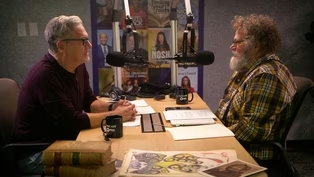 Now Playing
Extended Cut: The Case of the Treasonous Doll Spy
Video has Closed Captions
Co-hosts Knute Berger and Stephen Hegg explore the story of WWII’s “Doll Spy.” (39m 18s)
Extended Cut: In the Name of Cod
Video has Closed Captions
Co-hosts Knute Berger and Stephen Hegg explore the Alaska Purchase. (44m 11s)
Extended Cut: The Potlatch Riot of 1913
Video has Closed Captions
Co-hosts Knute Berger and Stephen Hegg explore Seattle’s Potlatch Riot. (53m 26s)
Extended Cut: The Mystery of the Mima Mounds
Video has Closed Captions
Co-hosts Knute Berger and Stephen Hegg explore the Mima Mounds. (44m 20s)

Video has Closed Captions
Season 11 of Mossback's Northwest premieres Thursday, October 9th, at 8:50pm on Cascade PBS. (30s)
Providing Support for PBS.org
Learn Moreabout PBS online sponsorship













Support for PBS provided by:
Mossback's Northwest is a local public television program presented by Cascade PBS