
FAME program, Family Caregivers Month, Indigenous history
Season 8 Episode 22 | 25m 40sVideo has Closed Captions
WCC’s new program, family caregivers month, Detroit’s indigenous history, weekend events.
A look at Washtenaw Community College’s FAME program and how it connects students to advanced manufacturing careers in Michigan. Area Agency on Aging 1-B's Julie Lowenthal joins the show for National Family Caregivers Month. Learn about Detroit’s indigenous history for Native American Heritage Month. Plus, check out what’s coming up this weekend around town on “One Detroit Weekend.”
Problems playing video? | Closed Captioning Feedback
Problems playing video? | Closed Captioning Feedback
One Detroit is a local public television program presented by Detroit PBS
FAME program, Family Caregivers Month, Indigenous history
Season 8 Episode 22 | 25m 40sVideo has Closed Captions
A look at Washtenaw Community College’s FAME program and how it connects students to advanced manufacturing careers in Michigan. Area Agency on Aging 1-B's Julie Lowenthal joins the show for National Family Caregivers Month. Learn about Detroit’s indigenous history for Native American Heritage Month. Plus, check out what’s coming up this weekend around town on “One Detroit Weekend.”
Problems playing video? | Closed Captioning Feedback
How to Watch One Detroit
One Detroit is available to stream on pbs.org and the free PBS App, available on iPhone, Apple TV, Android TV, Android smartphones, Amazon Fire TV, Amazon Fire Tablet, Roku, Samsung Smart TV, and Vizio.
Providing Support for PBS.org
Learn Moreabout PBS online sponsorship>> coming up on one detroit, a future of work report on a college program that prepares students for jobs in advanced manufacturing.
plus, it's national family caregivers month will talk about the help available for those caring for a loved one.
also ahead, we're recognizing native american heritage month with a look at native american culture here in detroit.
and we'll have some suggestions on fun things to do over the holidays.
it's all coming up next on one detroit.
>> from delta, fossett's behr paint masco corporation is proud to deliver products that enhance the way consumers all over the world experience and enjoy the living spaces masco serving michigan communities since nineteen.
twenty-nine support for this program is provided by the cynthia and edsel ford fund for journalism at detroit public tv.
>> the dte foundation is a proud sponsor of detroit.
public tv among the state's largest foundations committed to michigan, focused giving we support organizations that are doing exceptional work in our state visit dte foundation dot com to learn more.
>> nissan foundation viewers like you.
[MUSIC] [MUSIC] [MUSIC] >> just ahead on this week's one, detroit caring for loved one can be challenging and stressful will talk about the resources available to assist family caregivers.
plus, we'll explore the rich native american history and traditions here in michigan.
and dave wagner of ninety point nine wrcj is here with a list of events to check out during the holiday season.
but first up, our future of work series looks at the workforce needs of manufacturing companies here in michigan, washtenaw community colleges federation for advanced manufacturing education program known as fame provide students with valuable work experience in the industry.
while earning an associate's degree.
i spoke with students on campus about the program and whether they plan to pursue careers here in the state.
[MUSIC] [MUSIC] [MUSIC] [MUSIC] this is washtenaw community college is vice president of workforce development in community engagement.
brandon tucker, he works with southeast michigan employers to fill gaps in the libor force.
>> what we're hearing is that we need people that into that in four years with the people right now with the bay set of skills and will help them grow, encourage them to go back to school or to finish your education.
so a lot of those employees are safe.
i'll hire the right now.
i'll pay for them to stay gore to wash it off and i'll make a commitment to make sure they finished while they're still on the job, getting valuable work experience and in some cases were reportedly a paycheck.
>> the program to take this pad that wcc is called the michigan federation for advanced manufacturing education or pain, work and learn program between wcc in advanced manufacturing employers.
there are chapters throughout the country but wcc started the first in michigan in january.
this is thirty-two year-old andrew denton.
he's enrolled in the fame program for advanced manufacturing in mecca.
try knicks the study of technology, combining electronics and mechanical engineers.
i work at this place called orbit foreman jackson, michigan.
>> great company.
a great group of guys building and impact of the machines work there three days a week and then i come to school the other two days a week and i have a full course load before you made the decision to come back to school.
what was the decision-making process for me?
>> it was like i literally just couldn't keep going the way that i was gone.
i was like if i don't have some type of education, i'm not going to go to get that high pay.
i want i'm not going to be the live the type of lifestyle light at the end of the program.
i should have around eighteen hundred hours of work experience and an associate's degree.
and michael tried it.
>> although denton sees a future here in michigan, the citizens research council of michigan who studies michigan's growth in economic challenges says that overall the state is suffering from brain drain.
the loss of in-state college graduates to other states.
wcc solution is exposing younger students to in-demand fields in careers here in michigan.
we know there's.
>> at any given time hundred thousand jobs open in michigan, we do you what?
i've southeastern michigan, where we're situated has probably about thirty thousand to forty thousand of those shops.
we do that years ago.
there was a real interest and investment and try to get students to think about things other than just the four-year degree.
right to your greatest.
if it gets we try really hard to the college to engage or high school partners early.
>> wcc recently hosted high school juniors and seniors from multiple districts.
>> they had no idea about beckert writings.
they had no idea about cybersecurity.
they had no idea about additive manufacturing that we started reaching back and son say at the high school level, this is an opportunity.
then i think that we go further faster.
>> the fame program is keeping some students in michigan.
but what about students who are a part of it?
so when you're done with your certificate with your degree, you're finished with your program.
are you planning on saying here in michigan?
i'm planning on leaving.
>> live in another state.
>> i want to go.
is it?
so i don't want to atlanta to, you know, pursue that careers will be here.
>> probably less much of an issue there.
anything in particular that's keeping you here.
it's beautiful.
it's a nice day of north.
>> great, great people.
so for right now my plan is to transfer to hbcu my plans to transfer to central state which is in ohio while somerset on heading out of state.
>> wcc graduates like mike rudicel graduated before the fame program began built a thriving careers here in southeast michigan.
>> came here, the first measure of second much welding classes.
and each day i was walking by the metro knicks lab here and kind.
cnn's robots and i know what's what's the deal with these?
you know, as i take a robotics class, and as i'm taking his body classes like a well, what's going on with the cnc machines?
i'm walking by that lab.
and i want to learn about those and a sign of going through the metro knicks program with a focus on the cnc cad cam.
we ought to talk.
numbers are up, please do so.
you know, and the field i was in before chose to come back here.
you know, i've been where i'm at now for about four years.
mine comes more than doubled its nearly tripled if you count not to additional consulting and tutoring a different things on the side as well.
is there a a sentiment?
because sometimes you hear people who are going into highly technical fields that they feel like they have to leave michigan if they want to get a job or become not?
i think so at all.
i think there might be a misconception and how people see factories and how things are made, but that, you know, things are getting becoming more and more technical.
are you planning on staying here in southeast michigan to continue your career?
i will be here for for the foreseeable future.
>> denton's reasons for staying aren't just tied to a career-best.
>> i'm not even looking at it on economic base looking not unlike a world like the east coast floods all the time has crazy snowstorms.
west coast is on fire all the time.
south is crazy.
we have all the fresh water up here.
so i feel like michigan is like the logical place to be.
there's not a lot of natural disasters.
and so i feel like i do not see the trend that a lot of people are leaving michigan, but i have a feeling over the next ten, fifteen years.
a lot of people are going to be coming back to michigan.
>> as we wrap up national family caregivers month, we want to recognize and thank those individuals who care for family members, friends and other loved ones caregiving can be demanding and stressful.
so it's important for caregivers to take care of their own health and well-being of american black journal host and one detroit contributor stephen henderson spoke with julie lowenthal from the area agency on aging.
one be about their support services for family caregivers.
[MUSIC] [MUSIC] >> this is a really important topic right now.
it's a really pressing topic in so many people's lives.
and the way we think about caregiving and caregivers seems like it's changing quite a bit.
i think we're understanding more a bow.
what caregiving is and how crucial it is.
and we're really expanding the way we think about who is a caregiver and what support they need.
it is national caregivers months.
so so tell us where you think we are about the months that that brings the focus to this issue.
>> that's a great question.
so currently in the united states is actually forty eight million unpaid family caregivers and actually michigan.
there's one point seven million michiganders to our family caregivers.
twenty-one percent of all caregivers have reported that this had being a caregiver is actually impacted their own personal help health and wellness.
and there's actually a new statistic that just came out that sixty six hundred billion dollars is how much caregivers are doing towards unpaid care in the united states.
he really and that's the number that most people are unaware asked.
yeah.
>> i want to talk about specifically our defining those terms because they said i think they're growing their expanding a really important and healthy way.
when you say caregiver, give me some examples of of we're thinking up.
>> so family caregivers are anyone who is on being unpaid.
so they're not professional caregiver, but they're being unpaid, provide care to their loved one.
this can be someone who's doing it from a distance.
so caring for a parent that's out of state.
and just, you know, flying in a couple times a week or couple times months, it could be someone who's just handling financial things for their loved one or it could be someone he's doing everyday hands on and care like bathing in housing and, you know, everything from transferring in and out of bed and then wheelchairs, etcetera.
>> yeah.
and i think one way to think about this is a we all i think at some point become caregivers.
i can't think of anyone i know in fact is not in a in one of those categories are situations that some planned their life.
and i think it's probably safe to say that at some point we will all need caregiving, you know, at some point in our in our lives, this really is that really does get to the universality.
i think of of this issue.
it's not certain people are some places.
it's all of us.
>> a hundred percent.
and actually the baby boomer generation, which is one of our largest generations, is that generation that very shortly is going to need to be cared for.
and that is something that us and the aging network are working very hard to make sure that there are resources available to that generation.
>> yeah, so so i want to talk about some of the things that you find a yourselves doing at area agency on aging.
and you our guys there now called region one, be a talk about what that means to support caregivers.
>> of course, i'm so quick thing in southeast michigan.
there are actually three area agencies on aging.
i see one b's serves all of the it basically see around wake county.
so we serve all of the counties.
but wayne and then in wayne county, there are two agencies, the senior lions and then d triple a which is detroit area agency on aging one aging.
it's so and then there are plenty of programs and services out there for caregivers.
there's actually been a huge national push just last year.
a federal government released.
you know what, bunch of funding things as well as a catalog up how we can help a family caregivers within our nation at our agency.
one, we have many wonderful programs and resources available to caregivers and they can always find that information on our website.
but they i would like to highlight a few of those programs that are dear to us to caregivers.
december nine am we're offering a caregiver partners passage through dementia workshop.
and this will be a day-long workshop.
a workshop that helps caregivers gain knowledge, skills, information and tools needed to take charge of their role as that caregiver, especially that caregiver caring for someone with dementia.
we also offer a powerful tools for caregiving course, which is a six-week educational program designed to help caregivers take care of themselves while caring for a relative, a relative or a friend.
and then most recently, we actually lot launched a caregiver respite voucher program, which will provide short-term respite care for informal family, caregivers, of older adults.
and what we found is that access to respite care could help reduce character stress, apply kicker, burnout and also the to better outcomes.
and underneath that specific initiative, caregivers are going to be able to receive up to five hundred and seventy-five dollars towards in-home respite care.
>> yeah.
what kinds of things do you feel?
we need to change from a legislative a policy perspective to make this all easier for folks?
i mean, as you point out, there's this uncompensated care is is something that that many, many families are dealing with, the stress and the burdens of that are are not small.
what kinds of changes would you like to see that would that would ease some of the apps for those of us who are caregiving?
>> well, for one, a caregiver tax credit, i think would really help caregivers, especially those that don't qualify for state or federal funding that just to help alleviate some of that personal financial burden.
also workplace initiatives to allow care evers to take that fmla so that they are able to care for their loved one without the risk of losing their position after work, fifty percent of caregivers to work full time, adding that workplace initiatives in it in place could really help those people.
>> a lot of times when we're talking about caregiving, we're talking about we're talking about end of life or or late in life care.
and i think that the word dignity comes up a lot.
how we think about that, how we define it, not just the people who are receiving care, but also for the ones who are giving.
and i want to give you just the little opportunity to talk about what big monday means in this context and how we make sure our that that dignity is something that defines this experience for people.
>> dignity it can be seen, especially for our aging population is one to not discount them.
even when they are may be showing signs of alzheimer's and dementia.
they still are capable of making decisions based off of what they want.
so making sure that their voices are being heard.
>> november is also native american heritage month.
a time to celebrate the history traditions and contributions of native americans.
one detroit contributor bryce huffman has the story of two people connected with detroit's native american community.
we're working to teach people about the rich indigenous cultures in the great lakes region.
[MUSIC] [MUSIC] >> its key, not just the call native people in november, not just the call native people.
when you need a land acknowledgement, you actually have to do the work of building relationships, the native people and also the land.
>> antonio conte's mean rose.
but schneider arbitrators with deep roots in michigan's native american communities.
both work to take care of the land and connect people to its indigenous history.
>> inician abe is in in our language.
it's translated to like the first people.
so we were the first people and have migrated, you know, from from east coast all the way into this area and unsettled here.
>> cause me works with the sugar but project a partnership between the national wildlife federation, the city of detroit and local groups to bring the native american tradition of making maple syrup to more people.
>> as spring starts to come, it's the most beautiful way to watch the transition of the season is to be outdoor in the forest.
with all of your friends and your community working really hard to together maple sap.
what else does this project hope to give to the traders being that we're in a city and we're so disconnected from nature.
it's really, really important that in the little bits of nature that we do have people can form those sorts of like bonds and that are deeper than traditional relationship with nature.
i think a lot of times people recreating in nature, people are camping.
and, you know, that's fine.
i support all sorts of activities, but participating in a traditional ecological activity with with native people in nature is just such a deeper, richer way to plug yourself into the season.
unplug yourself into the ecosystem that we all come from.
schneider is with keep growing to trade.
>> a nonprofit whose mission is to help the traders grow fruits and vegetables in their communities.
she says the organization is currently supporting about twenty-three hundred gardens across the city.
>> this is my second season now with keep her in detroit and and the only emission of in person on staff.
so that comes with great responsibility to to continue to like create a space, not just for myself but for others.
indigenous people in the community.
the need to feel welcome and unconnected to land.
we've partnered with flecks of the land in the sugar bush operation.
we planted a three sisters garden this year.
we've opened up lots of other opportunities for traditionally the la liga logic analogy be shared.
>> blacks of the land is a group of black brown and indigenous nature lovers who helped fellow people of color have meaningful outdoor experiences.
three sisters garden is one that grows corn beans and squash together to enrich the soil and keep pests away.
agriculture was a huge part of life for all indigenous people basically everywhere in the state of michigan and across the country.
what are some growing techniques or ways that you think about food that would benefit of detroiters of all walks of life?
>> not everyone is going to have the green thumb or the capacity to have like a big thriving garden.
that's why, you know, partner with your neighbors like i can grow this.
if you go this and you know, that kind of trading happens.
we do tons of classes where we teach people how to go in containers, how to guns.
you know, in small spaces, there are tons of community gardens that you can tap into and people with love for for neighbors to come out and grow their own food.
and that's the part of like building community is, you know, sharing skills and resources together.
>> and it's like foraging hunting.
there's a lot of ways that you can you don't have to just grow to food.
sovereignty extends into the water into fishing from the river.
so there's a lot of ways it looks, you know, gathering food in and building relationships with the ecosystem are in.
>> unfortunately, a lot of detroiters, myself included, don't really learn a lot about our native ancestry or routes in the city while we're in school.
what's a good way for detroiters to learn about this and connect with it on a deeper level?
>> it's connecting with india's with indigenous communities.
it's seeking out, you know, reading and following indigenous creators and like learning the actual story.
it's within that, you know, it's on us to to learn these things for self.
yes, you can go out and be educated and, you know, asking native friend, you know, all kinds of bringing questions.
but you have you have to take that responsibility.
>> and i think it's there's a lot of ways to get engaged in and in defending the land, getting away from the food systems that are like, you know, making us sick and unhealthy getting into nature.
foraging meeting with native people, tapping into organizations is a lot of ways that people can connect.
and >> talk to me about some of the lessons that natives and black and brown communities have all been kind of learning by themselves, but maybe need to be leaning on each other to learn and teach.
>> i think there's a lot to be said about the ways in which we have to recognize that colonization is an event that happened in the past.
but it's something that's ongoing.
the happening to this very day in the ways that we manage land and the ways that we orient ourselves towards nature in the ways that we separate ourselves from the ecosystems that were a part of and there's a lot of lessons to be learned in that.
i think people do this, but i think my struggles we're sending our struggle.
>> tip of saying they really need to get away from, you know, like the divisive yes, that that is just so prevalent.
and, you know, continue to connect with these things with it, especially with the land.
>> there's always something to be doing in every season that will connect you with what's going on a nature that point.
and it's a it's a beautiful way to honor the earth and to honor yourself in honor the land of the native people of this land to participate in those seasonal harvesting activities.
you know, ends in spring a mother's day.
black land is going to be doing silver bass run.
you know, we'll be doing out there.
walleye fishing, too.
so, you know, just like think about how the ways in which the season brings abundance in tapping into that abundance is a is a really awesome way to disconnect yourself from the food system into something that's like much deeper.
>> the holiday season is in full swing and there are plenty of events taking place in metro detroit to celebrate this festive time of year.
here's dave wagner from ninety point nine wrcj with today's one detroit weekend.
>> hi there.
i'm dave wagner with ninety point nine wrcj and even with the chill in the air, there's still much to do in and around the city like the downtown detroit markets in cadillac square that are open through january seventh.
there you can support small businesses to check off your holiday shopping list.
starting tomorrow through december third, cirque dreams holidaze will be on stage at the fox theater.
beautiful choreography will be on display now.
a truly marvel at what those performers can do should be a great show.
and on saturday you can enjoy it.
no well night in the midtown and cultural center districts of detroit, the annual event has live music holiday shopping make and take activities and so much more.
it's kind of like an open house celebrating the city's creativity.
also on saturday is the michigan sneaker exchange of hunting in place.
that's right.
you can buy sell and trade your shoes and shop from over one hundred and fifty vendors.
this is michigan's largest sneaker show.
then on sunday, you can walk those new sneakers over to the music hall center for the performing arts where the celtic woman christmas symphony tour will take the stage.
>> and of course, there's so much more to around here.
so stick around to see a few more events coming our way.
have a great weekend.
[MUSIC] [MUSIC] [MUSIC] [MUSIC] >> that'll do it for this week's one.
detroit.
thanks for watching.
head to the one detroit website for all the stories we're working on.
follow us on social media and sign up for our weekly newsletter.
[MUSIC] [MUSIC] [MUSIC] [MUSIC] [MUSIC]
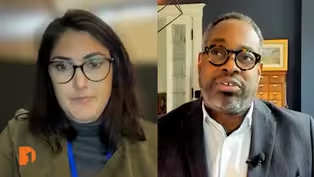
Family Caregivers Month with the Area Agency on Aging 1-B
Video has Closed Captions
Clip: S8 Ep22 | 8m 5s | The Area Agency on Aging 1-B talks about the resources and support for family caregivers. (8m 5s)
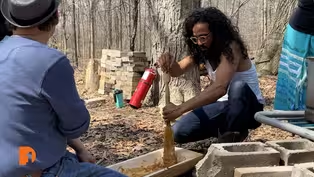
Native American Heritage Month: Michigan indigenous history
Video has Closed Captions
Clip: S8 Ep22 | 6m 31s | Native American Heritage Month serves a as reminder of Michigan’s indigenous history. (6m 31s)

One Detroit Weekend: December 1, 2023
Video has Closed Captions
Clip: S8 Ep22 | 1m 51s | Here are eight winter-themed events to check out around Southeast Michigan this weekend. (1m 51s)
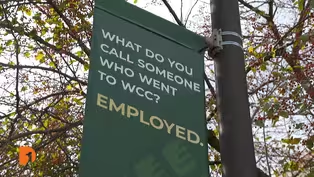
Washtenaw College battles brain drain with new FAME program
Video has Closed Captions
Clip: S8 Ep22 | 5m 38s | Brain drain: Washtenaw Community College’s FAME program connects students to careers. (5m 38s)
Providing Support for PBS.org
Learn Moreabout PBS online sponsorship
- News and Public Affairs

Top journalists deliver compelling original analysis of the hour's headlines.

- News and Public Affairs

FRONTLINE is investigative journalism that questions, explains and changes our world.












Support for PBS provided by:
One Detroit is a local public television program presented by Detroit PBS