
Family Finds
Season 21 Episode 8 | 26m 46sVideo has Closed Captions
Discover family-friendly destinations, including the Whitewater Center in Charlotte.
Discover family-friendly destinations, including the U.S. National Whitewater Center in Charlotte and the Nido & Mariana Qubein Children’s Museum in High Point.
Problems playing video? | Closed Captioning Feedback
Problems playing video? | Closed Captioning Feedback
North Carolina Weekend is a local public television program presented by PBS NC
Family Finds
Season 21 Episode 8 | 26m 46sVideo has Closed Captions
Discover family-friendly destinations, including the U.S. National Whitewater Center in Charlotte and the Nido & Mariana Qubein Children’s Museum in High Point.
Problems playing video? | Closed Captioning Feedback
How to Watch North Carolina Weekend
North Carolina Weekend is available to stream on pbs.org and the free PBS App, available on iPhone, Apple TV, Android TV, Android smartphones, Amazon Fire TV, Amazon Fire Tablet, Roku, Samsung Smart TV, and Vizio.
Providing Support for PBS.org
Learn Moreabout PBS online sponsorship[piano intro] - Next on "North Carolina Weekend", we celebrate family finds from the Qubein Children's Museum in High Point; we'll visit the Whitewater Center in Charlotte; TreeRunners in Raleigh; and go hunting for fossils in Aurora.
Coming up next.
- [Announcer] Funding for "North Carolina Weekend" is provided in part by Visit NC, dedicated to highlighting our state's natural scenic beauty, unique history, and diverse cultural attractions.
From the Blue Ridge and the Great Smoky Mountains, across the Piedmont to 300 miles of Barrier Island beaches, you're invited to experience all the adventure and charm our state has to offer.
[light upbeat country music] [light upbeat country music continues] - Welcome to "North Carolina Weekend", everyone.
I'm Deborah Holt Noel, and this week we are celebrating family finds across our state.
I'm at the Nido & Mariana Qubein Children's Museum in High Point.
It's only been open a year or so, but it's quickly become a destination for kids of all ages.
We'll learn more about it in the show, but first, let's head to Charlotte, where if you have some energy to burn this weekend, the Whitewater Center is the place to be.
[groovy music] - The Whitewater Center was founded here in Charlotte, North Carolina in 2006.
The Whitewater Center is a 1300 acre outdoor facility.
We offer activities, so you can go rafting, you can go biking, you can do high ropes courses, zip lines, trail running, mountain biking, whitewater kayaking, as well as flat water kayaking.
We offer races, events, festivals.
We have a full service restaurant, beer garden, great place to spend the day.
- Charlotte's growing so much.
One, the economy.
We have a lot of folks with 1.3 million visitors.
It's the second largest tourist destination in the Carolinas, so it brings a lot of economic development to Charlotte, Mecklenburg County, as well as Gaston County.
And I think it's an important piece, as it helps people get off the couch and get outside.
- I think the White Water Center is such an important piece of the community here in Charlotte.
It's something that we're all proud to have in our backyard.
It's also something that we're proud to show people who come to visit us from out of town.
And when we spend time outside, that's when we're at our best.
It's when we can learn new things about ourselves.
It's when we can test ourselves and grow and try new things.
It's a place where you can challenge yourself in a controlled environment, and it's a place you can come together with your friends and family.
And I think that sort of gathering space is something that we're really proud to have here in Charlotte.
[upbeat music] Whitewater Center is home to the world's largest manmade whitewater river and we have two different channels that are really specific to different kinds of activities.
Our wilderness channel is great for your introduction to whitewater rafting.
It's a great place for families to learn how to whitewater raft.
You can also whitewater kayak and there's some great play waves in that channel as well.
And then we have our Olympic length competition channel, which is designated for both whitewater rafting as well as the Olympic sports of canoe, of kayak, and slalom disciplines.
- It's manmade, it's controlled, so you're not dealing with strainers and other natural hazards that you would be on a natural river, which makes it pretty valuable for people that are intimidated to either go rafting or learn to whitewater kayak because of those elements.
[jazzy upbeat music] - So a lot of my friends have talked about it before, I've just never been able to join them, so to be able to experience it today was so exciting and it was so much fun.
To be honest, I was kind of scared, but coming here, I felt more secure and safe.
- This is my first visit to do activities.
I've come twice to do a juvenile diabetes walk with my friends and I have never done anything here.
I was terrified and I absolutely loved it.
And then I was ready to go all-in and do all the scary stuff.
[laughs] Now that I've been and experienced it, the fear of the unknown is gone.
Before I never wanted to come because I thought there's no way that I would be able to do it physically.
And now, I don't know what held me back all these years just because they're, they look like they know what they're doing.
There's a lot that are probably doing the same thing as me and just learning as they go.
And it's really easy once you get the hang of it.
[jazzy upbeat music] - It's one of a kind.
I think the biggest piece is it lowers the barrier of entry for folks.
So a lot of outdoor activities can be pretty intimidating.
And so we bring that and try to lower the barrier for people to try to dip their toes in the sand and give it a shot before going out into real white water in Western North Carolina or rock climbing.
- The staff here has been absolutely amazing and accommodating.
You know, it makes you feel very safe here, especially for somebody that's never done it before.
So everybody's super nice.
- Yeah, I felt super safe the whole time.
It was very fun.
It was mild most of the time with a few scary spots, but that I loved, more than I thought I would.
I thought I would be really scared and I was, I felt very safe but that was because of our guide.
- The Whitewater Center is open 365 days a year, all year long, so we're open all year long if you want to come and see us.
One of my favorite things to tell people is the Whitewater Center's just a great place to come and hang out, even if you're not doing activities.
You can come hike the trails, walk the dog, even go for a run out here without actually buying an activity pass.
Of course, if you want to come back and do activities with us, we'd love to have you as well and we have a great number of activities that you can do out here.
- The US National White Whitewater Center is at 5,000 Whitewater Center Parkway in Charlotte and they're open daily.
To purchase your pass, visit them online at whitewater.org or give them a call at [704]391-3900.
Check out this courage climber, it is a big hit here at the museum.
And if you have younger kids who are still really rambunctious, we found a great outdoor park in Raleigh.
It's called TreeRunners.
And when we sent Rick Sullivan to cover the story, he found lots of kids having tons of fun.
[zip line buzzing] - Yeah, I mean we locate our parks in incredibly populated areas, usually fairly or quite urban.
And the reason for that is we want people to be able to escape the city and get into nature without having to drive three hours to the mountains.
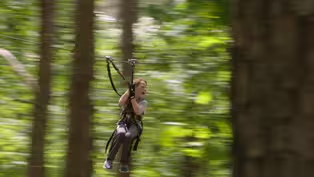
- [Rick] TreeRunner Raleigh Adventure Park is hardly distinguishable from any other patch of trees in the North Raleigh neighborhood where it's located, until you walk into the nearly seven acre woods and look up.
It's one of four such parks created by its parent company, TreeRunner Adventure Parks of Detroit.
The other three parks here in Michigan, all of them cater to a broad audience.
- So we have climbers from age seven up to 92, and then our Raleigh Park even has a junior park for those ages four to seven.
Basically, all of our parks are set up the same way, where we have varying levels of difficulty.
Our park in Raleigh, North Carolina has eight trails over five different levels of difficulty.
It's set up just like a ski hill, if you've ever been skiing, where you know you're gonna go to the yellows and then all the way up to the black diamond and the double black diamond.
So there's a little bit of something for everyone.
- [Rick] On the day I visited, families were scattered about the park, high and low.
Four year old Sienna Licamele was enjoying and excelling on the yellow course, along with her six-year-old brother Nello.
Their mother Claire was able to walk the entire course at their side.
Had these guys done this before?
- No first time.
- Is that right?
- Yeah, our friends invited us today.
They'd been before.
- [Rick] Has this been scary at all?
- Not much.
- No?
- Uh uh.
- [Rick] What's your favorite part so far?
- All of it!
- [Lyla] One, two, three.
- [Rick] These kids look like candidates to move on to more advanced courses soon, but even then, adults who are not actually climbing and zipping with them can still supervise them along the way.
- They are double and triple connected, so I do feel good about it, as her mom watching from the ground.
[laughs] - Our parks have paths under all of our trails.
Parents can follow along with their cell phones, they can give them pointers, which they often do.
Safety, as you might imagine, is priority number one, two, and three for us.
We use and invest in something called a smart belay system.
Basically, it's a pair of clips that once you get on the course, only one clip will unlock out of the pair, meaning you're not gonna be able to unclip yourself from the course until you get to the end.
- It's kinda like a door hinge, yep.
- Everybody who comes to the park goes through a safety orientation, where they learn how to use the clips and learn the basics of the courses and then they'll go through practice lines to make sure they're very comfortable with the equipment so that when they get on the course, they're set up for success and really to enjoy themselves.
- [Rick] While the highest level, double black diamond course, does not hit death-defying speeds nor mountain-like heights that can be found at other North Carolina adventure parks, there is enough challenge available to satisfy most participants.
- [Climber] It's funny, we're only about 12 feet in the air, but I'm scared to death.
- It's not about muscular strength.
This is more about just feeling the thrill, 'cause a lot of 'em are balanced based, and while you know you're perfectly safe, you really want to feel like you're in the sense of danger.
So you really get a lot of, you get a lot of adrenaline up there, you get a lot of nerves.
I've done it on a date day with my wife, you know, take a day off from work and spend some time together.
So we've done this, obviously.
We do it with our kids, they love it here.
And it's for kids specifically too.
Like, as long as you're not by yourself, if you're looking for something to do outside with somebody else, like this is a hoot.
This is a hoot and a half.
- [Nello] Two, three, go.
- [Rick] So they're, they're pretty good at it.
Was this expected by you or is this a new discovery that you're gonna have to do all the time now?
- Well, I think we're gonna have to come again for sure, but I was expecting that they were gonna enjoy it because this is their thing.
[laughs] Yeah.
- [Jeremy] Our goal, more than anything, is we want everybody to leave our parks with the wow.
- TreeRunners Adventure Park is at 12804 Norwood Road in Raleigh and they're open Friday through Sunday.
For more information, give them a call at [919]410-7347, or go online to treerunnerparks.com.
[light upbeat music] [light upbeat music continues] Right now I'm with Megan Ward, the executive director of the Nido & Mariana Qubein Children's Museum in High Point.
Megan, this place is spectacular.
What are kids and adults saying when they visit?
- Well, we're happy to have you here.
As soon as they come in, we see a look of wonder and excitement and kids start jumping the second they come in.
And the adults will check in and the kids take off.
They go toward our climber, to our train table, whatever it is, they can't stop moving.
- I can believe it.
When I stepped in, my eyes were full of wonder too.
Megan, sometimes when you hear the word museum, it feels a little stodgy, but this place is full of energy.
- I agree.
Museum does not quite show what we have here.
There's nothing to walk around and look at here.
It is all hands-on, everything can be played with.
- [Deborah] In addition to the fun though, I understand there's a STEM aspect?
- Yes, we call it our STEAM lab, which stands for science, technology, engineering, arts, and math.
So we include arts in there.
We have an art studio upstairs, and every day, we provide a couple of pop-up experiments where we are doing different STEM activities and then they are also building things.
They're building cars and racing them.
They're building things to float in our air tubes.
Lots of Legos.
I mean just a sea of Legos up there.
And then we have other places that might be a little bit more fun for our big kids.
So 12 year old, 13 year olds that might be, might be a little bored at a children's museum, there's plenty for them to do here.
We have our Hall of Mysteries, which is like an escape room where you don't have to escape.
We see a lot of families working together to solve these mysteries, and there's a sense of accomplishment that they find the answers to these questions.
- [Deborah] I love that.
I also love that there's the play at life stations.
You've got the fire engine and the grocery store.
What are some of the other places?
- So we have WHPU, which is a TV production studio, and we really thought that we would have to teach kids how to use this, but we never do.
They come in there, they know what to do, they read the news and so they could be reporting from a Rockers game or telling about the weather, and even reporting from Mars what the weather is from Mars.
And they can take that video, send it to the editing desk, edit it, put an intro and an ending, and email it to themselves.
- [Deborah] That is so cute.
Megan, also, there's been great consideration for inclusion.
- We are a Certified Autism Center, which means all of our staff has been trained and we are very aware of the different needs that children might have when they come in here.
It can be very overwhelming.
It's a big space.
They can be, some days we have larger crowds, and some kids can be sensitive to noise, sights, even smells.
So we try to prepare families before they come.
There are different ways on our website that they can navigate, learn how to navigate the space, look at ways and know what to expect when they get here.
- [Deborah] Megan, you guys have not been open that long, maybe just a year and a half.
What's been the impact on the greater community?
- Well we have been so excited to welcome so many people.
We were hoping in our first year that we might have maybe 60,000 visitors.
We had 200,000 in our first year, and we were just awarded the North Carolina Visitor Attraction of the Year by the North Carolina Travel Industry Association.
- Awesome.
Megan, it's all so very exciting.
What's in the future?
- [Megan] We're gonna keep getting better.
We're gonna expand our programming.
We've got a lot of plans coming up for that.
And events.
And then we might look at another expansion coming soon.
- Ooh, well it all sounds wonderful and I wish you the best in the future and I can't wait to see more of the museum.
- Thank you.
- The Nido & Mariana Qubein Children's Museum is at 200 Qubein Avenue in High Point, and they're open Tuesday through Sunday.
For more information, give them a call at [336]888-7529, or go online to qubeinchildrensmuseum.org.
This is the Wonder Room at the Qubein Children's Museum in High Point.
It's full of natural artifacts.
We discovered another family find in the mountains, and what's special about this place is all the immersive experiences.
Let's join Teresa Litschke at the Mountain Gateway Museum in Old Fort.
[soft banjo music] - [Farmer] Come over here and crank this one, you can make some chicken feed.
- Mountain Gateway Museum basically started back in the 1960s as kind of a local history museum, and then in the 1970s, the state bought it and it has been part of the state's Department of Natural and Cultural Resources ever since.
- [Teresa] You'll find the Mountain Gateway Museum less than half a mile off I-40 in Old Fort.
It's a four acre site along Mill Creek that helps tell the tales of mountain days gone by.
- You know, their mission is to, you know, carry on a lot of the [hammer pounding] the ways that are being forgotten.
- We have just started homeschooling and we're starting to look for just more local opportunities to learn about local history, local culture, local heritage.
- They need to see the pictures, they need to see the spinning wheels and the plows and all those kinds of things.
- Same way with the water.
Nowadays the children go and open the pump or open the faucet to get water.
And with this, they're fascinated with, especially the little bitty ones, they will pump and then run around and put their hand in it and it quits and they can't quite comprehend that they're powering it and if they quit, it quits.
- We're big into education, of course, but really what we try to do here is to preserve, protect, promote, and pass on to future generations the history and the culture of Western North Carolina.
- [Teresa] hey do that by offering various festivals throughout the year, like Pioneer Days with costumed exhibitors and fun activities, music, and food.
The rest of the time it relies on exhibits, like those found in the Stone Building.
- [Roann] Some of the permanent exhibits that we have are about wildflowers of Western North Carolina and of course, those are flowers that can be used as medicines as well as foods.
We have the exhibit here about a log cabin and what it was like to live in a log cabin.
You know, you really didn't have all the different rooms with a single purpose that we're used to today.
- [Teresa] Other exhibits upstairs include a history of the moonshine industry and that of native animals.
From there, more exhibits can be found downstairs.
- [Roann] We have a new traveling exhibit that's about African American music.
It has a sound interactive with that so you can actually play and hear the songs and the music as well as see the pictures and everything that goes with that traveling exhibit.
- [Teresa] They've also moved two historic log cabins to the property that house events and exhibits.
- The Morgan Cabin, the one closer to the museum is what we call our fiber arts cabin.
It does have a loom in there, so we mainly talk about the kind of materials that people used to make their clothing and what the processing was for cotton and wool and flax, which was made into linen.
So we do some demonstrations in there about spinning and weaving.
- [Teresa] And how to dye those fibers using what they could find long before dyes were available.
- Today we're dyeing with maple bark.
It's been soaking in a bucket of water for a year.
Old literature from the 18th century and back says they got purple from rotten maple bark.
- [Teresa] How our ancestors lived and even thrived generations ago is foreign to most of us today, but fortunately for visitors here, it's on display for everyone to see.
- If I stop doing what I do and a lot of these people stop doing what they do, then our culture disappears.
- Especially, I think the children need to have a lot of chances to use their hands and the grownups too.
- And we call 'em chores back in the day.
Nowadays kids will do it all day because they think it's fun.
- I think finding our roots, finding out where we're from, learning to have that connection, learning to know what our community is in order that we can give back to that community and serve it is incredibly important.
And so I'm so glad this is here.
[soft banjo music fading] - The Mountain Gateway Museum is at 24 Water Street in Old Fort, and it's open Tuesday through Sunday.
For more information, call them at [828]668-9259, or go online to mgmnc.org.
All kids love dinosaurs, right?
Well if you're ever down around the Pamlico Sound, you have to take the family to The Aurora Fossil Museum.
There's some amazing fossils there, and you can dig 'em up too.
- [Narrator] Eight year old Lyla Faith Williams and her family dig the Aurora Fossil Museum.
- Mostly, it's just so much fun.
- [Narrator] Fun to find treasure.
- [Lyla] I knew we found like a lot of mako teeth.
This is mostly my biggest one.
- [Narrator] Her brother AJ is digging up treasure too.
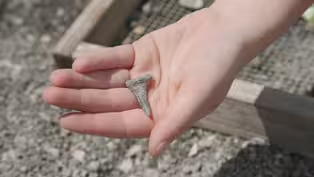
- I got lots of sand tigers, snaggle tooth, which is right here.
They are, these tooths are cool.
I got my mako shark tooth.
Got a dolphin tooth somewhere.
- [Narrator] These piles of fossilized material came from the nearby nutrient phosphate mine.
The sprawling mine complexes in Beaufort County on the southern shore of the Pamlico River.
Phosphate was discovered here in the late 1950s.
- In the '60, mining progressed and they discovered fossils as a byproduct of extracting the phosphate.
- [Narrator] The mining company partnered with the nearby town of Aurora to create a fossil museum.
It opened in 1978.
The main museum contains displays about ancient marine life, like whales and sharks, and fossils from five to 15 million years old.
- [Cynthia] It's a self-guided tour.
- [Child] Look.
- [Cynthia] It's very kid friendly and family friendly, and so people can walk around and understand and learn about science.
- [Narrator] The museum's biggest draw is the megalodon, which is the North Carolina state fossil.
- [Cynthia] He was a humongous shark that roamed the ancient seas.
Estimates of about 50 to 60 feet long at its maximum.
- [Narrator] The museum displays megalodon teeth and a replica set of its jaws.
- And this would probably be a 40-foot shark, which is about the size of a, the length of a school bus.
- [Narrator] Most of the fossils on display in the museum were donated by private collectors who dug them up at the mine when it was open to the public decades ago.
- This is unique that we have a museum in North Carolina that champions the fossil collector, and it's used for education throughout the United States.
- [Narrator] In addition to fossils, the museum displays the area's geology and the mining process that uncovers the fossils.
There are also displays of Native American artifacts.
Across the street from the museum is the Learning Center.
It displays fossils and minerals from all over the world.
- We spent these several summers at Barber Creek.
We recovered some 10,000 artifact.
- [Narrator] The Learning Center also hosts lectures and other educational programs.
Across the street from the Learning Center and museum is the popular fossil park where kids like Lyla and AJ can dig.
- [Cynthia] We have families and school groups and all kinds of, all kinds of organizations that come to the Fossil Park to hunt and dig for fossils.
And a lot of times when you look around in the park, you don't see a lot of cell phone use, other than maybe a selfie to post.
They disengage from that technology and they engage in science.
- It's very awesome.
It's better than Minecraft.
- They love it.
They're very independent.
So of course, when they find something versus buying something, it means more to them.
- We always look for opportunities for the kids to learn, and if they can be interactive while they're learning, I think they retain it better and they have fun.
- [Narrator] Pretending to be an archeological idol.
- Harrison Ford.
- You're like Harrison Ford?
- Yes, sir.
- He wants to be Indiana Jones, but who doesn't?
- [Narrator] Visitors come from all over the US and world.
Marlayli Cifuentes moved from Mexico City to Greenville 12 years ago.
Today she brought her uncles and aunts from Guatemala to see the museum.
- There is so much things to do and see in North Carolina that is worth showing.
- [Cynthia] I want people to enjoy their time in Aurora, and at the museum, and engage with science.
I would like their takeaway to be, "Wow, I can't wait to come back."
- The Aurora Fossil Museum is at 400 Main Street in Aurora and they're open Tuesday through Sunday.
For more information, give them a call at [252]322-4238, or go online to aurorafossilmuseum.org.
We have been wonderfully wowed here at the Nido & Mariana Qubein Children's Museum in High Point.
It is definitely a fabulous find for families.
And if you've missed anything in tonight's show, remember you can always watch us again online at pbsnc.org and you can also find us on our YouTube channel.
Have a great "North Carolina Weekend", everyone.
[light upbeat music] [light upbeat music continues] [light upbeat music continues] [light upbeat music continues] [light upbeat music fading] - [Announcer] Funding for "North Carolina Weekend" is provided in part by Visit NC.
Dedicated to highlighting our state's natural scenic beauty, unique history, and diverse cultural attractions.
From the Blue Ridge and the Great Smoky Mountains, across the Piedmont to 300 miles of Barrier Island beaches, you're invited to experience all the adventure and charm our state has to offer.
[piano outro]
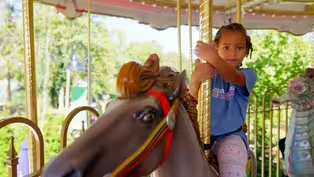
Nido & Mariana Qubein Children's Museum
Video has Closed Captions
Clip: S21 Ep8 | 4m 39s | The Qubein Children's Museum in High Point is a great place to take the kids. (4m 39s)
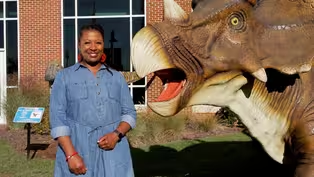
Video has Closed Captions
Preview: S21 Ep8 | 20s | Discover family-friendly destinations, including the Whitewater Center in Charlotte. (20s)
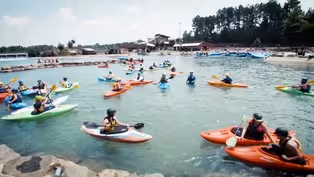
Video has Closed Captions
Clip: S21 Ep8 | 5m 3s | The Whitewater Center in Charlotte features 1,300 acres to run, paddle, ride, and climb. (5m 3s)
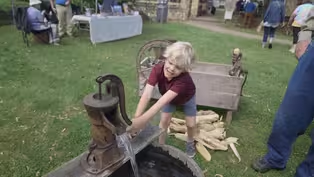
Video has Closed Captions
Clip: S21 Ep8 | 4m 23s | The Mountain Gateway Museum in Old Fort celebrates our state's mountain culture. (4m 23s)
Video has Closed Captions
Clip: S21 Ep8 | 4m 32s | TreeRunner Adventure Park is a premiere aerial adventure park in Raleigh. (4m 32s)
Video has Closed Captions
Clip: S21 Ep8 | 4m 16s | Kids of all ages love to hunt for fossils at the Aurora Fossil Museum. (4m 16s)
Providing Support for PBS.org
Learn Moreabout PBS online sponsorship













Support for PBS provided by:
North Carolina Weekend is a local public television program presented by PBS NC