
Family support plus mentorship equals success
Season 6 Episode 5 | 26m 46sVideo has Closed Captions
Jerry Chambers shares how family and mentors helped him to develop, overcome and succeed.
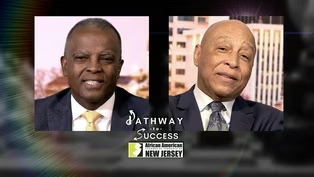
Host John E. Harmon, Sr., Founder, President and CEO of the African American Chamber of Commerce of NJ, talks about building wealth with Jerald Chambers (Chambers Brokerage Group). Mr. Chambers also shares how having family support, mentors and role models helped him to develop, overcome, and succeed. Produced by the AACCNJ, Pathway to Success highlights the African American business community.
Problems playing video? | Closed Captioning Feedback
Problems playing video? | Closed Captioning Feedback
Pathway to Success is a local public television program presented by NJ PBS
Family support plus mentorship equals success
Season 6 Episode 5 | 26m 46sVideo has Closed Captions
Host John E. Harmon, Sr., Founder, President and CEO of the African American Chamber of Commerce of NJ, talks about building wealth with Jerald Chambers (Chambers Brokerage Group). Mr. Chambers also shares how having family support, mentors and role models helped him to develop, overcome, and succeed. Produced by the AACCNJ, Pathway to Success highlights the African American business community.
Problems playing video? | Closed Captioning Feedback
How to Watch Pathway to Success
Pathway to Success is available to stream on pbs.org and the free PBS App, available on iPhone, Apple TV, Android TV, Android smartphones, Amazon Fire TV, Amazon Fire Tablet, Roku, Samsung Smart TV, and Vizio.
Providing Support for PBS.org
Learn Moreabout PBS online sponsorship- Support for this program was provided by Horizon Blue Cross Blue Shield of New Jersey.
- Welcome to Pathway to Success.
I'm John Harmon, founder, president, and CEO of the African American Chamber of Commerce of New Jersey.
Today's guest is Gerald Chambers.
He is the founder of Chambers Brokerage Services, and this is an individual I've known for a number of years, a consummate professional in the insurance industry.
He's a guy that comes to work every day to provide value to those who give him an opportunity to compete for their business.
Jerry, welcome to The Pathway to Success.
- Thank you very much, John.
Very happy to be here with you, my brother.
- So Jerry, you know, I'm just excited to have you here today.
Let's start off with a little bit about yourself, your family, your upbringing, where you're from.
Let's lay some foundation.
- Well, I'm from Passa, New Jersey.
I grew up in Aspen Street Projects.
My mother had nine kids and she became a single parent.
And I have to admit that growing up in those projects was one of the great experiences of my life because it was a very diverse community and it helped ground me.
It helped make me very competitive and I wouldn't have treated that experience of growing up in the projects in the fifties and the sixties for any experience.
'cause I think it made me, you know, the type of person I am.
And also I had a mother who would like Fannie Lou Hamer, who understood it was important to get her kids involved in all types of activities.
I was an athlete, you know, all my life.
I was a musician.
I played in the band.
And that foundation gave me, you know, the, the wherewithal to be who I am today.
- So what instrument did you play?
- I played the saxophone.
Oh.
Oh, I played the saxophone.
I started I think in the fourth or fifth grade, and I played up into high school.
I was in the, the concert band in junior high school and the jazz band.
And it was a great - Experience.
You like Grover, Washington?
- Look, I wish I was like growing Mr. - Magic.
- Yeah, I was Mr. Magic, but one of my only regrets, I hadn't stayed with the, you know, music and playing in the band.
- What was it like growing up in public housing for you?
Because it seemed like it was the highlight of your life or a good foundation for you.
- Yes, it was really a great foundation because when we first moved in, it was brand new.
We had so many strong examples of black manhood that were doing things with the kids that started summer programs and youth programs that were community activists who were great examples for me.
You know, I could walk outside and I can get into a football game or a basketball game.
We had a basketball court.
There was not a lot of crime when, you know, we was growing up later on, you know, it changed.
But it was just a fun place to be.
So, out of the nine kids, where did you fall?
Number seven?
I had five older sisters.
I had older brother and two younger brothers.
- How many of you went to college?
- Three of us went to college.
- So what inspired you to go to college?
- You know, I always wanted to have that college experience.
I used to watch movies about college life and being in the dorms for some reason, it just intrigued me, you know, about going away.
My mother didn't have the wherewithal to send us to school because my mother was on welfare.
She became a single parent early on and she was on welfare until I was in the sixth grade.
So I knew I had to, you know, try and get some type of support to, to go to college.
- Where did you finally land up?
- Well, I finally landed in, in, in the Northeastern University in Boston.
And it's funny, I had never even heard about Northeastern, but I was a walk-on for the, for football.
My third year, Northeastern's a five year school.
I, I had two high school teammates who got killed at the plane crash at Marshall University in 1970.
And one of them I played with for two years at Passe, who was a phenomenal individual in a great athlete.
His name was Arthur Harris.
And he was Allstate football and basketball in 1968.
And I saw him before, I was getting ready to go back to school my second year, and he was on his way to Marshall and he asked me if I was playing football.
I said, nah man, I'm too smart.
He said, Jerry, you crazy, you can hang, you can hang.
And two months later I was back up at Northeastern and I'm getting out the shower and I hear radio about a plane crash at Marsh University.
And Arthur, his father, Arthur Senior, and another friend of mine, Marcel Laman, was killed at Marshall University.
And it was just devastating.
They also made the movie about it, we are Marshall and you know, I just thought about it.
I thought about it and I got the bug.
The next year, my, my third year at Northeastern, I said, I'm gonna try out every game that I played.
I thought about Arthur and, you know, the players that, that was killed at Marshall.
- That's great.
So, so what did you study?
- Well, my first year I was engineering student.
I was very good at math and I thought I wanted to be an engineer.
My first semester I was doing a lot of socializing.
I had, I had three friends who we partied every weekend.
I really didn't concentrate enough on my academics and almost, I almost flunked out.
And my mother and my sister came up after I called home that first semester and told my mother I thought I was going to flunk outta school.
And my mother and my sister flew up and went to every professor that I had talking about, you know, my academics.
And I'm sitting there and I'm looking at my mother and just realizing how important this was for her first child going to school to get a degree.
And I knew I wasn't applying myself and I'm feeling bad.
I'm saying, saying to myself, I'm gonna break this woman's heart.
You know.
So I got serious that next semester and then I switched over to business.
I think that was the, the best move that, you know, i I made because I've been in finance and business, you know, for 48 years.
- So, source of inspiration for you?
- Well, again, my mother was major source of inspiration.
My mother was a very strong woman.
She had principles that was, you know, unbelievable.
I never forget, you know, when the one time when the politicians used to come around the projects during Christmas time, you know, politicking and, and with the Santa Claus outfits, they were on a fire truck and they were coming around through the projects and they throwing Trin trinkets out and the kids running around and I'm getting ready to run out, pick something.
My my mother grabbed me by my arm and she said, look, let me tell you something.
She said, don't you run out there and pick nothing up and said, unless they put in your hands, you don't take nothing.
And that really stuck with me.
And I remember my mother walking me to, to try out for little League baseball when I was seven years old.
I remember her walking me to the YMCA, putting me in swimming class at seven years old, getting me involved in, in summer school for music.
All the different activities that really helped ground me.
I I went to summer camp.
I was one of only three or four black kids that went to summer camp with YMCA to, you know, those were the things that helped, I think expose me to, to different types of people and made me, you know, just a little more eclectic or whatever.
- So, all right.
Fast forward, your mother came in and saved the day, she and your sister and got you back on track.
Now you graduate.
What did you go from there upon graduation?
What was your first job?
- My first job was with co a company called Control Data.
I was involved with putting together a report to project the revenues.
The next job was with a company that did called Amron that did rehabilitation of water systems.
I left that job and that's how I, I went into the financial services.
I got a job as a sales rep with Metropolitan Life Insurance Company in 1977.
And I've been in insurance ever since.
After my first year I became a sales manager.
- So tell me about your first sale, if you remember - That.
Well, I, I don't remember the first sale, but I'll tell you, I'll tell you one that really impacted Andy.
- I'll take that.
- And I had a kid named Louis Valez, grew up with me in the projects.
He was in the next building who used to help me with my paper routes.
I'd give him a dollar 'cause I was only making $5 a week or something like that.
So he was the oldest of 11 kids from Puerto Rico.
And later on I insured Louie.
He had gotten married and I insured him for a policy, I think it was for $50,000 or something like that.
And four months later, I come to my office, open up the mailbox, and I see a death claim for Louis Valez.
And it blew my mind.
I'm like, what happened?
He was only 20 something years old and he was involved in a car accident in Passa going down Henry Street in Passa.
And it was a drunken driver going in the wrong direction and hit him head on.
And it was never an investigation.
And I'm still angry to this day because the kid who killed him, father was on the police force, Lieutenant on the Passade Police Force.
They took the cars, they hid the cars.
There was never an investigation.
Wow.
Got away with - Murder.
You know, that was a, a sale to a personal friend.
And, and then you had this unfortunate circumstance, but, so as you matriculated in this industry, you're now become a sales manager.
So what was that like going from just an agent now?
Overseeing people?
- Yeah.
Training, recruiting, training and overseeing and motivating it.
It was a, a a different experience because you know, you are responsible for helping other people become successful.
Were any of the people that worked for, for you - Older than you?
- Yes, but I started recruiting a lot of young black guys outta Rutgers.
Very dynamic.
And, you know, I helped them, you know, become very successful.
And that's, I really, you know, made the a name for myself.
- What are some of the, the keys to being successful in selling insurance?
- Being disciplined and having, you know, a strategic plan to market yourself.
Insurance is a very difficult area and you know, it's an area that you have to really show compassion for people when you're sitting down.
It's an intangible that a lot of times people don't understand.
You know, knowing the different products and how they fit every circumstance.
- Why don't we stop here?
We're gonna take a break.
We'll be back in a moment - For more information, please visit our website.
- Welcome back to Pathway to Success.
And so Jerry, let's talk about the different products, products that might be more structured to create wealth.
- Well, in the insurance business, there are a lot of products is term insurance, which is temporary insurance.
Then there's the traditional whole life policy, which is a permanent plan.
The premium stay the same each year.
A, a larger percentage of that premium dollar that you pay into that policy goes towards the equity.
So you can build up a equity and build wealth through a permanent whole life policy.
E if Hutton came out with a new type of investment orientated policy called Complete Life, which was basically like having term insurance and having an annuity combined where each month you put money into a bucket and they take out the mortality course or the death course for the insurance and anything left over, you're earning an interest rate on them.
And now they have a lot of those type of products that are really great vehicles for building wealth, which is an index universal life.
And their investments are managed by an investment firm and they have a unique investment strategy, which is more fluid because they manage their investments on a daily basis versus traditional insurance companies that manage from point to point from one month to 12 months later.
I'm showing a lot of people that with their kids, you can put $75, a hundred dollars to young kids and build a lot of equity in that policy over the years 'cause of the time value of money.
- When did the light bulb come on for you to say, Hey, this is the industry?
For me, - I got involved with a district manager who really trained me about the importance of, of trying to make sure you have ethics.
Make sure that when you're sitting down with somebody talking about these various products, that you help them understand the importance of it.
Because, you know, none of us know, you know, when God's going to intervene because you know, you could wake up.
You, you, you cannot wake up tomorrow.
First I was doing a lot of business in Newark, smaller policies, but when I sat down with them, I understood that how this could impact on their family.
If, if God intervened and took the father away, you know, it was important to make sure that there was funds that was gonna provide for the family.
- So when did you establish Chambers brokerage services?
- I got a contract with the Passade County Board of Social Services.
I established it, I believe it was around 1985 after I got that contract with the Board of Social Services.
I said, you know, I, I'm not gonna work for anybody else.
I opened up an office in Patterson, New Jersey after I did the contract and funds was coming in.
And then I just went out on my own.
- So what, what is it like having your name on the front of the check versus the back of the check?
What does it feel like to be an owner?
- It, it, it was never easy, but one of the things that really helped me be successful is I started doing a lot of business with the Head Start community.
And back then when I started doing the voluntary benefits with the Head Start, it was predominantly black women.
And I have to admit to this day, if it wasn't for them sisters at the Head Start, that was those Head Start directors that understood the importance of giving their business to some brothers, I would not be in business.
They kept me in business.
Not only did they keep me in business, they allowed me to flourish because after I started doing the voluntary benefits going in and talk to employees, they started allowing me to do their health insurance.
- So define voluntary benefits.
- Voluntary benefits is just another way of marketing insurance.
But doing it on the job site, it would send benefit counselors to talk to the employees on a one-on-one basis and they would take the premiums outta their paycheck instead of them having to pay it on a monthly basis.
- What are some of the product offerings of chamber brokerage services?
- Well, we concentrate really on all different types of life insurance.
I do a lot of work with people who need critical illness type policies and things of that nature.
- Give us a a sense of your client mix.
- Well, my perspective clients now really are, you know, high net worth people.
We have a, a approach called a restricted property trust that shows people how to, who have companies that are making a certain amount of money, I think over four or 500,000, how to mitigate their taxes.
- Sometimes people just don't understand insurance.
Does someone have to die in order for the, the beneficiary to get paid or the owner of the policy to get paid?
- No, I think that's a misconception of a lot of people.
They just don't understand it.
They're the death benefit and there's living benefits for insurance.
If you have a permanent plan of insurance, you build the cash value each year, a larger percentage of your premiums go towards the equity or the cash value.
So insurance is just like owning property where you have equity.
The longer you have that policy, the more you're going to build up in cash value and that's gonna be part of your net net worth.
I have a neighbor who I sold a policy to was a fireman and he had two kids in college.
So he had built up a lot of equity in one of his policy.
He was able to borrow against it to help pay for their tuition.
- Explain the ability to borrow against a policy versus surrendering the policy.
- Take for example, if you have a policy, you've had it for say 20 years, you may have a hundred thousand dollars, build it in cash value, you can borrow against that cash value, you pay the insurance company's interest rate because you're still building, you're still earning interest on it.
But the policy is still in effect if you die while that that loan is still outstanding, they'll just reduce the death benefit by the loan.
So if the policy is a half a million dollar policy and the loan is a hundred thousand, then your beneficiaries are gonna receive 400,000 versus the the 500,000.
- That's a pretty clear example.
- And if you surrender the policy, you end the policy.
So you just get the cash back that's in that cash value.
There's no death benefit anymore.
- Only in life.
You were, were kind of a community activist, if you will.
You work with the, the late former Congressman Payne.
Let's talk about that.
- Well, I mean I got involved early on because when I was in high school, we had a black student union.
When I was a junior, the black student union and the black students at Passa High School took over.
The, took over, we had a sit-in and we took over to school.
I didn't stay very long because my mother came up there, sent my sister in to get me.
So as one of the leaders, I, I didn't really participate for the whole three days.
So my mother sent my sister in and told me if I didn't come out in 10 minutes, she was coming in and I, I didn't test her so I walked out.
But they stayed up there for three days protesting about various, and had various demands.
So your mother was like the National Guard, huh?
My mother was like Fannie Lou Hamer and I didn't test her 'cause I knew she would give you, she, she was diplomatic.
She would at least give you one chance.
So I wasn't getting embarrassed in front of 400 black students up there when my mother come snatching me out of there.
- But you work with Congressman Payne, he is also one of your former teachers?
- Yes.
He became my sixth grade teacher.
He taught in passe, I think for 10 years at number eight school.
And my first sixth grade teacher had got me kicked off the pa the patrol force in the fourth grade.
In the fifth grade.
And I didn't feel that it warranted me getting kicked off because I was just playing around.
And then I got her as my teacher.
So the first day of school she lined us up and she's giving everybody a seat and assignments and he says, you Gerald Chambers, you sit here right next to me.
And I said, oh no, I am not sitting there.
She sent me down to the principal's office.
I stayed down there for about a week and a half before I told my mother.
The next day my mother went up there and demanded that they transferred me out of that class and put me in other sixth grader, number sixth school or transferred me out.
And that was the best boycott I ever did.
'cause they transferred me out to number eight school, which was brand new.
I left a school that was a hundred years old, didn't have a a gym, didn't have a cafeteria.
And I went to a school that was two years old.
We had a cafeteria, a gym.
I got on the patrol force and at the end of the year I became the patrol board a year at number eight school.
That was the first award that ever won in my life.
I was on the basketball team, sixth grade basketball team and Congressman Payne and was just a great role model.
And he was the first black male teacher that I had.
We played football at lunchtime and after school.
He was young, he was always the quarterback.
I caught a lot of his passes.
He's the one that I think first put the idea of going to college because I remember him talking about going to Seton Hall.
He brought his, his yearbook in and I think that planted the seed to me that, you know, he was somebody that I looked up to that I wanna follow in his footsteps.
- Wow.
So the significance of politics in business, how does that work?
- Well, John, you know, that's a very, very sore spot with me in terms of, of politics and business because I think that our black politicians can do a much better job in terms of creating more op opportunities for black businesses to do business.
You know, with Maynard Jackson, when he became the mayor and Atlanta, Georgia, he mandated that black businesses get a certain percentage of the contracts.
And I don't think that we do an effective job of economically empowering more black businesses in this state.
You know what I mean?
If we don't support one another, who, who's going to support us?
If we can't get business from the cities where we have the majority of African Americans in power, then do you expect us to go to the suburban towns?
They won't even let us - Submit proposals.
Most of the time it, it is bad.
So we're gonna bring this conversation to a close here, but I I have to ask you this, what is the future for Chambers Brokerage Services?
- I've been doing a lot of annuity work, which I never did in the past.
I'm doing a lot more business with young people to show them how they can put money into these index universal life and build a lot of cash.
And, you know, we're doing a lot of work with high net worth folks.
I'm really, you know, grounded now to really try and, you know, develop relationships with more brothers and sisters that are making money that need to, to mitigate those taxes.
- So Jerry, I just want to thank you for joining us today.
John, I want to thank you for those of you who have joined us today on Pathway to Success.
We want to thank you until the next time.
This is John Harmon.
Today's message is defining our expectations.
We think about black and Hispanic contributions to many political campaigns, help a number of people go from lower office to high office.
And all we're asking for is a level playing field, an opportunity to compete, an opportunity to come in, show our products or service a value proposition in order to advance our enterprise, our business so we can take care of our family.
So what is the expectation?
It is basically do whatever you campaigned on.
If you do that, we're all win and we're expecting that from all our candidates going forward.
At the end of the day, we coexist so that we can all live the most prosperous lives possible.
So today as we define expectations, let's define them based on integrity, respect, and mutual benefit.
That's all we're asking.
- Support for this program was provided by Horizon Blue Cross Blue Shield of New Jersey.
Family support plus mentorship equals success - Preview
Video has Closed Captions
Preview: S6 Ep5 | 30s | Jerry Chambers shares how family and mentors helped him to develop, overcome and succeed. (30s)
Providing Support for PBS.org
Learn Moreabout PBS online sponsorship
- News and Public Affairs

Top journalists deliver compelling original analysis of the hour's headlines.

- News and Public Affairs

FRONTLINE is investigative journalism that questions, explains and changes our world.












Support for PBS provided by:
Pathway to Success is a local public television program presented by NJ PBS