
Farm Wisconsin Discovery Center
Season 9 Episode 10 | 26m 48sVideo has Closed Captions
We explore the Farm Wisconsin Discovery Center in Manitowoc, an interactive museum.
Angela Fitzgerald visits the Farm Wisconsin Discovery Center in Manitowoc, an interactive museum celebrating our state’s agriculture industry. She explores hands-on exhibits and learns about livestock. We also meet a motorcycle rider attempting a world record and the founder of Color in the Outdoors, a nonprofit helping others connect to nature.
Problems playing video? | Closed Captioning Feedback
Problems playing video? | Closed Captioning Feedback
Wisconsin Life is a local public television program presented by PBS Wisconsin
Funding for Wisconsin Life is provided by the Wooden Nickel Fund, Mary and Lowell Peterson, A.C.V. and Mary Elston Family, Leon Price & Lily Postel, Stanley J. Cottrill Fund, UW...
Farm Wisconsin Discovery Center
Season 9 Episode 10 | 26m 48sVideo has Closed Captions
Angela Fitzgerald visits the Farm Wisconsin Discovery Center in Manitowoc, an interactive museum celebrating our state’s agriculture industry. She explores hands-on exhibits and learns about livestock. We also meet a motorcycle rider attempting a world record and the founder of Color in the Outdoors, a nonprofit helping others connect to nature.
Problems playing video? | Closed Captioning Feedback
How to Watch Wisconsin Life
Wisconsin Life is available to stream on pbs.org and the free PBS App, available on iPhone, Apple TV, Android TV, Android smartphones, Amazon Fire TV, Amazon Fire Tablet, Roku, Samsung Smart TV, and Vizio.
Providing Support for PBS.org
Learn Moreabout PBS online sponsorship- The following program is a PBS Wisconsin original production.
- Angela Fitzgerald: Coming up on Wisconsin Life: An adventurer attempting a world record motorcycle ride, a foodie offering farm fresh produce, the founder of a club encouraging everyone to get outdoors, and a retired architect creating miniature models of Frank Lloyd Wright buildings.
That's coming up on Wisconsin Life!
[inspirational music] - Funding for Wisconsin Life is provided by Lowell and Mary Peterson, Alliant Energy, A.C.V.
and Mary Elston Family, Focus Fund for Wisconsin Programs, and Friends of PBS Wisconsin.
- Welcome to Wisconsin Life!
I'm Angela Fitzgerald.
Today we're "moo"ving through Farm Wisconsin Discovery Center, an interactive way to learn about agriculture in our state.
The barn-shaped center is located off I-43 in Manitowoc and is open Thursday through Sunday.
There are all sorts of fun ways to dig deep into the world of farming.
Guests can tour the state-of-the-art exhibits, hop on the combine simulator or examine the udderly complex world of dairy production.
The journey of food can be traced from farm to fork, or visitors can explore the ABCs of Wisconsin's produce.
In the birthing barn, expectant cows are brought in for visitors to witness a live birth or see a newborn calf.
[calf moos softly] Virtual tours of a local dairy farm run throughout the day.
If cows aren't your cup of milk, there are some opportunities to meet animals, and learn directly from local farmers.
It's a celebration of the variety of agriculture found across Wisconsin.
We now take off to Ashland to catch up with a motivated motorcycle rider attempting to break a world record.
[upbeat acoustic guitar] - I grew up on a farm in northern Wisconsin.
I like to joke I was raised in a field by cows and a dog.
Part of it's a joke and part of it is reality.
Hey, Harry.
[clicking tongue] - Angela: The reality is Bridget McCutchen has always had an adventurous streak.
- Growing up, I had a lot of freedom.
I'm really grateful for the way I was raised.
I was home-schooled.
It really let me decide who I was as a person before the world told me who I was supposed to be or how I was supposed to act.
- Angela: And then, at age 19... - I left the farm for, really, the first time.
- Angela: Going from one horse [clicking tongue] to an entirely different kind of horsepower.
[driving rock music] Bridget hit the road on her motorcycle and headed for the West Coast.
[motorcycle engine purrs] - I worked on a tall ship called the Lady Washington.
She's been in a few movies.
Like, she was the Interceptor in Pirates of the Caribbean.
She was on Star Trek.
That experience really helped me realize that adventuring wasn't this unattainable goal that only the coolest of the cool people could do.
It pretty much changed my life.
- Angela: Eight months later, Bridget returned to Wisconsin in search of open water.
- I worked for the cruise boats in Bayfield, and now, I work on the Madeline Island Ferry.
You're welcome.
- Angela: Bridget is working towards her Captain's License.
- I really enjoy driving the boats.
- Angela: But her maritime career will have to wait.
There's an even bigger adventure calling her name.
- I will still be 21, and hopefully, by the time I finish, I will just be 22.
[playful rock music] - Angela: Bridget wants to set a world record as the youngest woman to travel around the world on a motorcycle.
- The countries in yellow are countries I may be going to.
Countries in green are countries I know I'm going to.
Probably flying or shipping the bike over to Morocco and up through Spain.
I think not being able to do it scares me more than anything that would happen.
- Angela: To claim the Guinness World Record, Bridget must meet the following criteria.
- I have to go at least 24,900 miles.
I have to cross the equator at least once, and I have to have the same motorcycle the whole time.
They have like 30 pages of really detailed requirements.
And then, at the end, if Guinness thinks it's good enough, then they'll confirm the record.
My mother's immediate reaction was... And my father was like... My dad is really excited about it and my mom is really concerned about it.
- Angela: To help alleviate some concerns... - This is custom, this plate, right?
- Angela: Bridget retrofit her bike for the journey with the help of Northwood Technical College.
- It's thoroughly the most expensive thing I own.
- Angela: Navigating geography and political terrain might be the biggest roadblock.
- I was going to go through the Ukraine and visit my family.
It's kind of upsetting what's happening there.
I was planning to go through Russia and that is no longer an option.
- Angela: Despite those obstacles... - Bye, Bridget!
- Bridget set out in August of 2022 with a family memento in tow.
- It's supposed to ward off, like, evil spirits and gremlins.
[bell ringing] I love that noise.
[bell ringing] This is from my grandmother.
I think it was from her brother in the Ukraine.
I'm scared I'm gonna lose it.
So, yeah, [rings bell] demon be gone bell.
- Angela: Bridget will also take along an abundance of curiosity and ambition.
- I mean, it's a beautiful world and I wanna go see it.
[upbeat music] That's a big part of it is just wanting to go see the world.
Riding a motorcycle, to me, is the best thing in the world and it gives you a sense of freedom and independence.
I really want to inspire other young women like myself.
- Angela: She's driven to set a world record.
However, success will not be measured in miles.
- That was such a gnarly trail!
I think it's going to start out with completing the trip and getting the record, and I would not be surprised by the end of it if it is completely different, because I guarantee you, I will not be the same person when I come back.
- Angela: Now we continue our journey by heading to Horicon Marsh to join the founder of a group encouraging everyone to get outdoors.
[birds chirping] - Christopher Kilgour: I've always loved spending time outside, and even as a kid, I loved sharing that experience with people.
So, I'd always invite my friends to come to wherever we were going, and we'd go hiking or camping or whatever the adventure was that day or that week.
My name is Christopher Kilgour.
I'm the founder of Color In The Outdoors.
It's a organization basically geared towards diversity, equity, and inclusion of BIPOC, differently-abled, and GLBTQ+ individuals who are traditionally marginalized communities in general.
[upbeat music] There is no color pallet like that of the outdoors.
And so, in celebrating the color of and in outdoor spaces, that's where that name came from.
So it is Color In The Outdoors.
It's the people that are out here and the things that we are observing and spending time in.
[birds chirping] As a person of color walking into various places and spaces, you know, there was that palpable feeling, or that palpable vibe, if you will, of being the other in a room.
And there's this "Wisconsin polite" that we're really, you know, that if anyone who's spent any time in Wisconsin knows that this exists, right.
That there's this innate drive to make sure that everyone is polite, but polite isn't always welcoming.
So, those are the kinds of experiences that I really want to work hard at not having others to have to experience.
So, that's the whole point, is trying to bridge that gap, trying to create those relationships and, you know, on some levels, trying to educate folks, because sometimes the behavior is based on ignorance, not necessarily based on negative feelings.
- What's up there?
[birds chirping] - That's a pelican up there.
- Pelican.
- Oh, is it a pelican?
- Groups like ours can go out and explore some of these spaces and can then create safe experiences, safe spaces and brave spaces for people to come out and enjoy the scene.
[upbeat music] The simple answer of why the outdoors is important to me is to say outdoor spaces are, are genuinely places where if you spend any time outside you get it.
And what I mean by that is, it's a calming space.
It's a space that can be a place that you're always learning.
You can go outside and stand in the same place every day and see something new in the outdoor world.
And the more people we have realize the importance of preserving these spaces, then they also have an investment, realize that they automatically have an investment--- we all do-- in taking care of these spaces, not only for themselves, but for others, for the next generation.
- Oh, up in that tree, there's a little spot of black.
See it?
There you go.
- Christopher: I'm also just thankful.
I mean, I think that outdoor spaces are such an amazingly therapeutic thing that I really do feel fortunate to be able to spend time outside.
And I think that that's another, another thing that we lose track of is that moment of just pause, and being able to acknowledge the fact that here we are on this planet.
And there was an 'old-timer' that I worked with years and years ago who said, "As long as we're looking at the petals and not the roots, we're doin' okay."
And so, there are those moments where I really genuinely you know, it's like, you know what?
This is, this is okay.
[strumming guitar] - We're checking out the exhibits at Farm Wisconsin and digging in to learn more about agriculture in our state.
Traveling from field to fork through the ABCs of Wisconsin produce, Farm Wisconsin Discovery Center has so much to do and see.
I met up with Patty Lehn, Executive Director, to find out more.
- We all consume agriculture.
We obviously all eat.
But only 2% of us are involved in the industry of agriculture.
- Really, only 2%?
- Only 2%, yet 100% of us consume, right?
So, our goal here is to teach people about where their food comes from so that they better understand and appreciate Wisconsin agriculture.
I think we have just a holistic approach here at Farm Wisconsin.
We want people to have the experience.
We give them information.
We have the 'wow!'
of the birthing barn, and I'm so glad you got to experience the whole 'wow' factor of the birthing barn today.
And then, we have our cafe and our conference center, and our store that really bring that experience full circle.
- I love that.
I understand, too, that there are some elements of the center that change over time.
- Yeah, I know you saw our goats today.
- I met Kevin, yes.
[Angela laughs] - Isn't he cute?
- I am in love.
- And that's a perfect example of the partnerships that we've been nurturing here.
We bring the consumers here and we're trying to bring in the experts.
So having a goat farmer come in and share their cute animals is one example.
Just wanting to celebrate all that's Wisconsin agriculture and the unique aspects of it that you wouldn't quite think of on your own.
- It's essentially creating an agricultural hub.
What is your favorite part about spreading that message?
- Oh, you know what, you just asking me that just gave me goosebumps!
My favorite part of spreading that message is just seeing the wonder within the eyes of our visitors.
Just about 20 minutes ago, somebody stopped me in the hallway and just said, "This place is amazing."
We don't expect people to come and say, "Hey, I wanna learn."
We want them to have an experience and they will learn and better appreciate.
- Absolutely, and I can relate to that visitor comment, because I think I have a very narrow concept up 'til today, of what farming consists of and what it means.
So, I think this helps expand our general understanding of that.
I set out on a mission to taste Wisconsin-made ice cream and explore as much as I could about agriculture in our state.
From exhibits to hands-on learning, it's an interactive way for families to discover what farming in Wisconsin is all about.
Next up, meet the creator of an innovative Madison space connecting others with farm fresh food.
- Christy McKenzie: Food is so central to who we are.
Food can be something that, like, creates celebration where there isn't celebration before.
When you feed people, it's satisfying on so many levels.
Here at Winterfell Acres, which is a farm that we started working with when we just had opened the restaurant and the Beth's farm was new at that point and our business was new at that point and for me, that, that connection of kind of, like, our businesses kind of growing side by side over the last five years is a real metaphor for what I think about, what we wanted this business to be for in community.
We built the business to, you know, create and celebrate local food and to intentionally purchase as much as we could from as close as we could.
I have a big family and lots of cousins running around, and so we, when we got together for family meals it was, it was not just a small family dinner, it was a production to put on because you're feeding so many people.
One of my first food memories was working with my mom in the kitchen to get ready for one of these bigger events and she wasn't feeling well so she went to bed and I just have this memory of, like, running to her room to like ask her for, like, how do I finish you know, the stuffing?
How do I make the gravy?
How do-- like, does this mashed potato taste right?
And her just encouraging me, like, you know how to do this.
We've done this a million times.
And that reinforcement of like, you know how to feed your people.
Those early experiences of cooking with my mom in the kitchen, cooking with my grandma, really helped me kind of create a basic identity that was tied to, like, food is love.
[laughs] And I babysat for a family who really loved to cook at a whole different level and I learned more about what it meant to, like, really curate a meal and how you were gonna create entertainment around that experience and all of the different ways that we can get together around food to create a richness of life.
I got a sense of, "Wow, food can be something really special!"
I was lucky to travel to Italy when I was in college and got to see, like, what culture looks like around food, and began to really understand that, like, while the foods are different, that commonality of coming together around food is, like transcends the boundaries of, of state or nation.
And in that space in Italy, I really learned that slowing down for food is something to celebrate, and it can be very simple food.
It doesn't have to be extravagant.
It doesn't have to be, you know, cooked for three days, and carefully plated, but it can be, like, simple olive oil from the fields and it can be the, you know, the basic farm stand cheese and a nice glass of wine and that can be a feast.
It kind of created a foundation for me of thinking about food and the connection to where food comes from.
And then, how we bring people together around it that forms the basis for, you know, why we started the business.
[gentle music] How we find space to create that connection for community to local food, really celebrate the season and allow people access to it in a way that helps them root in and feel connected, even in a busy life.
[gentle music] We really started this business to create space for local food economy and to create space for local food culture and we've learned a lot in the last few years about what it means to create a rich and diverse space where we work, and, you know, it's continued work every day and it, it's really exciting to see, the energy that it brings into the business and also, you know, it ripples into the community.
I hope when people come to Pasture and Plenty, they feel like it's an extension of home, that when they show up that they're gonna be taken care of as a neighbor, that they'll be taken care of as a friend.
Our getting to connect into the rhythm of the seasons in a way that makes their life more delicious.
[laughs] And we hope that when people show up at the shop that they, that they feel, like, wrapped in that, you know, gratitude, that they feel, like, wrapped in radical welcome, to be able to, okay, I'm going to get weepy here.
I feel like, I hope people come and feel like they're taken care of and that they feel more connected in that moment.
Food creates a place where we can all get together and find a common ground and find an intimacy that wouldn't be there if we didn't have a shared plate between us.
It creates an environment for creativity and for problem solving and for, you know, inspiration to kind of show up because food creates space for commonality.
- For our last story, we go to Janesville, where a retired architect creates miniature models replicating some of the world's most famous buildings.
♪ ♪ - Judy Olsen: We moved in in June of 1977.
- Ron Olsen, a retired architectural draftsman, designed this scale model of his Janesville home, right down to fine detail on the front door.
- Ron Olsen: We've lived in this house for 40 years.
- His unique designs include an exact replica of the house where his wife Judy grew up.
- Judy Olsen: Lot of good memories.
- Ron also created his childhood home along the shores of Delavan Lake.
- I've always enjoyed drafting.
I might work 15 minutes on something and not get back for a day or two.
But I might sit here at the drafting table for two or three hours at a time.
- These miniature masterpieces are intricate, meticulous in detail, and only the beginning.
- Judy Olsen: We've always liked Frank Lloyd Wright homes and so we travel to see them.
We went down to Illinois and saw Pettit Chapel.
- Ron Olsen: I'd been retired just over a year, I think.
And she said, "Why don't you make a model of the Pettit Chapel in Belvidere, Illinois?"
- Judy Olsen: So he did that and, oh, I love it.
It was the first one, I think, that he'd done.
And then I said to him, "Oh, that's really, really nice.
I love it dearly, but would you please make Fallingwater next?"
- Ron Olsen: So, that was my introduction to building the models and it's just grown from there.
There's Fallingwater.
- Ron drew inspiration from nature and the simplicity of Wright's designs, many on the National Register of Historic Places.
- We finished our tour of Fallingwater.
We walked down the stream a little way and I found a rock that was little bit larger than a hockey puck.
And when I built Fallingwater, Judy had mentioned, "What are you going to use for the waterfall?"
I said, "Well, I wasn't sure yet."
I think I'd made the water out of Saran Wrap and glue.
I happened to be sitting at my desk and saw that rock and I set that in place on the model and it fit perfectly.
So, some of Fallingwater is with the model of Fallingwater.
- Creating these structures to scale is no easy feat and takes hours of research.
- There's photographs in books and magazines all over the place that show the plans, but you have to find all the exterior elevations of the house.
So, that's what takes the time.
- The construction elements are designed from scratch to match real life.
- I try to get color photographs, of course, and get as close as I can to the color of the actual building.
And then, I just begin from there, measuring out, cutting the pieces.
Glue 'em together.
Plenty of glue holds everything together.
Roofs, sometimes I've cut little slices in paper to show shingling.
- The details don't end at the door.
Ron's hope is to mirror the original landscape, just how Wright had envisioned.
- I used moss that I find out in the yard.
Dried sedums that can turn into bushes and trees.
So, I try to landscape as close to the photographs that I have but all the landscaping comes right from our yard.
- Ron's latest recreation is his largest ever.
- I'm working on Wingspread right now.
That looks pretty good to me.
It was the home of the Johnson family.
And until just a few years ago, I think members of the family still lived there.
It's now been turned into a conference center.
Judy and I went and took photographs all around the building so I could start this model.
- The collection spans the American architect's iconic career and has grown to nearly 30 replicas.
- I'd been looking for a home for the models.
I thought, "I'll just take the bull by the horns and contact Mr.
Johnson."
So I wrote a letter.
"Mr. Johnson, I'll keep this brief.
"In retirement, I built scale models of Frank Lloyd Wright houses."
- Mr. Johnson, as in the SC Johnson company in Racine and home to the last Frank Lloyd Wright office building still in use.
♪ ♪ - They were very, very interested and wanted to accept my offer.
I was just thrilled.
It was-- I mean, we cried, both of us, because it's exactly where they should be.
- The historic landmarks are now housed in Fortaleza Hall as part of the SC Johnson permanent collection.
- As you walk in there, the first thing you see is the research tower that Wright built for Johnsons.
It's just right inside the doorway.
And it just takes my breath away.
I put a photograph of Judy and I, our children and grandchildren up in the very top floor of that.
Now nobody can see that.
It's just a lasting thing for our family to know that they're included in one of our models.
- For Ron and Judy, the delight is in the details.
- So pretty.
- It's not just a flat wall.
I've set back windows where they should be, and I put doors in where they should be.
Viewing the models is just like being in front of the real house.
They're just terrific.
Large photos of some of the actual houses are on the wall behind the model.
So you can judge from one to the other how accurate the model might be.
[indistinct conversation between Ron and Judy] - Judy Olsen: Romeo and Juliet.
- Ron Olsen: So, that's been a thrill for me to know that people from all over the world can see some of Wright's work in miniature, but it looks like it should.
- And in this moment, it's hard for Ron not to contemplate what Wright might think.
- He was quite critical of a lot of things, but I think he'd be pleased to know that somebody's trying to preserve some of this.
It's been a terrific experience.
- Judy Olsen: Yah, it's just been a great adventure of love of these models for him and sharing it with me.
- And my name is on them.
That's incredible to see, too.
- Ron Olsen's name is now etched for eternity right alongside famed architect Frank Lloyd Wright.
- It's just nice to think that I put something someplace that people will see for a long, long time.
♪ ♪ - We've explored farming in Wisconsin, all while sharing stories of extraordinary people.
To find out more about Farm Wisconsin, visit us online at WisconsinLife.org or check in with us on social media or email Stories@WisconsinLife.org.
'Til we meet again, I'm your host, Angela Fitzgerald, and this is our Wisconsin Life!
Bye!
- Funding for Wisconsin Life is provided by Lowell and Mary Peterson, Alliant Energy, A.C.V.
and Mary Elston Family, Focus Fund for Wisconsin Programs, and Friends of PBS Wisconsin.
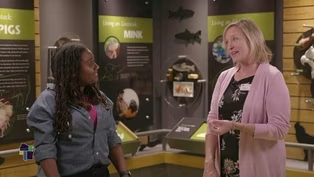
Angela Fitzgerald visits the Farm Wisconsin Discovery Center
Video has Closed Captions
Clip: S9 Ep10 | 2m 33s | Angela Fitzgerald explores hands-on exhibits at the interactive museum in Manitowoc. (2m 33s)
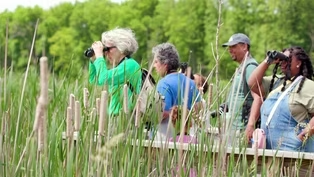
Video has Closed Captions
Clip: S9 Ep10 | 3m 19s | Color in the Outdoors creates safe places for people to learn about and enjoy the outdoors (3m 19s)
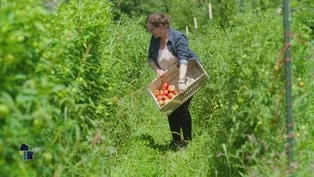
Video has Closed Captions
Clip: S9 Ep10 | 5m 14s | Christy McKenzie shares vision for the innovative food space that is Pasture and Plenty. (5m 14s)
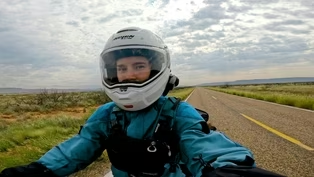
Video has Closed Captions
Clip: S9 Ep10 | 5m 38s | Bridget McCutchen wants to be the youngest person to circle the world on a motorcycle. (5m 38s)
Providing Support for PBS.org
Learn Moreabout PBS online sponsorship













Support for PBS provided by:
Wisconsin Life is a local public television program presented by PBS Wisconsin
Funding for Wisconsin Life is provided by the Wooden Nickel Fund, Mary and Lowell Peterson, A.C.V. and Mary Elston Family, Leon Price & Lily Postel, Stanley J. Cottrill Fund, UW...