
Fast Forward
Clip: Season 5 | 7m 33sVideo has Closed Captions
Fast Forward, is using car mounted tech to inspect lots of power lines quickly. i
How Kearney entrepreneur Dusty Birge and his start-up, Fast Forward, are using car mounted tech to inspect lots of power lines quickly and find issues before they become problems. “What If…” a series about innovation and creativity in Nebraska #WhatIfNebraska
Problems playing video? | Closed Captioning Feedback
Problems playing video? | Closed Captioning Feedback
What If is a local public television program presented by Nebraska Public Media
Fast Forward
Clip: Season 5 | 7m 33sVideo has Closed Captions
How Kearney entrepreneur Dusty Birge and his start-up, Fast Forward, are using car mounted tech to inspect lots of power lines quickly and find issues before they become problems. “What If…” a series about innovation and creativity in Nebraska #WhatIfNebraska
Problems playing video? | Closed Captioning Feedback
How to Watch What If
What If is available to stream on pbs.org and the free PBS App, available on iPhone, Apple TV, Android TV, Android smartphones, Amazon Fire TV, Amazon Fire Tablet, Roku, Samsung Smart TV, and Vizio.
Providing Support for PBS.org
Learn Moreabout PBS online sponsorship(gentle music) [Mike] This power line has a problem.
A transformer is failing, and that will cause an outage.
Dusty knows.
How?
Mental telepathy?
-(powers whirring) -(beams buzzing) X-ray vision?
[Dusty] So you can see the secondary connection here is glowing, hotter than the the others.
So there's an issue right there on that pole.
[Mike] No superpowers needed.
Just a super idea.
Use car mounted technology to inspect lots of power lines quickly and find issues before they become problems.
That's the simple explanation.
More detail about how this works in a bit.
First, let's meet the guy whose real superpower is ideas.
[Dusty] So originally I'm from a small town in Benkelman, Nebraska, my very first business was actually a candy store in grade school.
I had a really great business model.
My mom would go to Walmart and buy candy bars and I'd sold candy out of the bottom locker in school, even to teachers and it was a really good model because I'd sell candy and then when I'd take the money at the end of the day, I'd go to the arcade and spend it.
I had no cost of goods 'cause my mom just kept buying me candy to sell, but I never had to actually buy it.
I had other businesses in school.
I scooped sidewalks.
I started the small engine business.
I'd wake up and I'd take an order from my mom and dad and cook breakfast.
And I charged my parents, you know, for breakfast and I collected tax, but I didn't pay sales tax.
Sounds like you could possibly be audited -at this point.
-Yeah, I think I was underage maybe.
But it was really unique that my parents supported all the crazy ideas that I had.
Even if it was just cooking breakfast at home.
I was so young and I wanted to be in business and so I would look at how people other people were running businesses and I'm like, I wanna try to do that.
[Mike] After college, he worked for General Electric and launched archery, laundromat and drone businesses, selling two of the three.
The stage was set for the next idea.
I really like to solve problems, and we were in a position of needing to think of a business idea that could scale.
I have a big utility background and so I went to utilities and validated, I have this idea, does this actually solve a problem that you have?
And multiple utilities said, yep, that's, that is a legitimate problem.
[Mike] What's the problem?
Start with 6 million miles of power lines in the US most above ground.
[Dusty] And the challenge with our electrical grid is it's so vast that a lot of utilities take over 10 years -to do a system-wide patrol.
-Look out the window as you're driving and just the visual inspection of each structure as fast as you could.
You know, but it's pretty time consuming to, to drive, stop and look and then stop, drive and look, [Dusty] The US actually has more power outages than any other developed country and the challenge is due to the interval between inspections, components fail.
[Mike] And bad things happen when things fail.
-Outages and wildfires.
-In electrical applications when components begin to break down, they generate heat, and that heat will lead that component to failing.
Unfortunately, the human eye does not see temperature so we use thermal cameras to visualize those issues, and so by putting this technology on top of a car, we can drive down the road and highlight issues that the utility doesn't know about.
So it all starts up there, right?
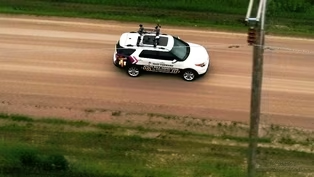
Yep we have four thermal cameras mounted on the roof, two for each side of the road, and then they're mounted on a pan tilt unit that allows us to reposition the camera in the event of uneven terrain or varying pole heights.
And then all the stuff you get up there -comes down into here.
-Yep.
All the cameras feed through about a dozen wires through their rear window and then power a television display, a monitor that allows us to intermittently check and make sure the cameras are in a proper position and properly focused.
By using this joystick here, we're able to independently select cameras and then move them without having to get outta the car, and we can do this in motion.
And this is like a 1970s video game, right?
[Dusty] This is like just an arcade.
It's an arcade joystick with a few buttons.
[Mike] For demonstration purposes Dusty set it up to show realtime results in the car and he put up with a little silliness.
-[All] What if!
-(peaceful music) [Mike] Normally the Fast Forward car gathers thousands of images in a day without stopping, then they're downloaded into software for evaluation.
So when you come back in, you are laying all of the thermography information you've gathered over the map that you've already created.
Correct.
And that's what we've ended up with there with all the dots and the different colored dots showing the problems, right?
-Correct.
-Okay.
[Mike] To demonstrate, we're looking at data captured in Cozad, a city Fast Forward is doing a pilot project with.
All the white dots are pole locations.
Pole locations, okay.
We're able to quantify which structures have issues, but then we're also able to quantify how bad the issue is, and so if you zoom in on the map here, there's different color dots representing different levels of severity.
-We're looking at Pole 415.
-Yep.
[Mike] Which is, looks like it's right in downtown Cozad.
-Yep.
-Okay.
[Dusty] And they, they've since made a repair on this, but we were able to flag this and on this image here, you can see two spots.
Right, there's, yeah.
And they, they look similar, but they really stand out.
-They're very stand out.
-Yeah.
We do this inspection at night because it helps us find really minor issues that may get overlooked during the day.
We're trying to make as little amount of work for the utility as possible to implement the repair.
So they want to know what's wrong, where it's at and how bad it is.
All the other steps that we can automate, that's our goal.
So what is this gonna do for you?
We was able to go out, prevent the outage, do it during working time where we could schedule the outage according to how the customer's needs were needed.
So we get that repaired all without any unexpected interruptions (crowd clapping) [Mike] In 18 months Fast Forward grew from idea to office dedication.
Yeah I've never started a business that has grown this fast.
[Mike] It hasn't always been easy, getting parts and figuring out how to mount cameras to capture 5,000 full pictures a day were challenges.
-I'm Dusty- -But investor and power company interest tells Dusty he's onto something.
[Dusty] That is a scalable and economical way for a utility to implement system-wide and they don't have to increase rates to their consumer because just the cost savings alone on the power outages pay for the whole project.
Is Dusty kind of a game changer in your industry?
-He is.
-The intent is to build the business to a point to where a national entity can acquire the company and build it even bigger, but I like to solve problems and so I think as new technology comes out, there'll be another problem to solve.
(peaceful music)
How We Wrapped a Window to Make an Interview Look Better
Video has Closed Captions
Clip: S5 | 1m 53s | See how we wrapped windows with light diffuser film for a "What If" interview. (1m 53s)
Meet Sci-Fi Author Matt Hebert
Video has Closed Captions
Clip: S5 | 2m 36s | Meet Matt Hebert, who creates interesting worlds for his two science fiction series. (2m 36s)
Video has Closed Captions
Clip: S5 | 7m 47s | D-Wayne Taylor is a high-energy MC, host, DJ, beatboxer, voiceover artist and more. (7m 47s)
 Now Playing
Video has Closed Captions
Clip: S5 | 7m 33s | Fast Forward, is using car mounted tech to inspect lots of power lines quickly. i (7m 33s)
Haircuts, Mentoring, and Counseling...In a Bus!
Video has Closed Captions
Clip: S5 | 7m 30s | A unique approach to youth development, created by two friends who met in a barbershop. (7m 30s)
How Three Faiths Worship & Learn at the Same Place
Video has Closed Captions
Clip: S5 Ep2 | 7m 23s | Tri Faith is a first-of-its-kind interfaith initiative in Omaha. (7m 23s)
Video has Closed Captions
Clip: S5 Ep1 | 15m 48s | Creativity in lots of unusual form is on display at OCon. (15m 48s)
Providing Support for PBS.org
Learn Moreabout PBS online sponsorship












Support for PBS provided by:
What If is a local public television program presented by Nebraska Public Media