
‘Fat Ham’ play in Detroit, Actor Roger Guenveur Smith
Season 52 Episode 41 | 26m 46sVideo has Closed Captions
“Fat Ham” at Detroit Public Theatre and a conversation with actor Roger Guenveur Smith.
A look at the Pulitzer Prize-winning play “Fat Ham” at Detroit Public Theatre. Host Stephen Henderson talks with the play’s lead actor, Duane Shabazz, and the theater’s Marketing Manager Garlia Jones. Plus, contributor Cecelia Sharpe sits down with actor Roger Guenveur Smith at The Wright Museum in Detroit to talk about his collaborations with Spike Lee and the impact of literature on his career.
Problems playing video? | Closed Captioning Feedback
Problems playing video? | Closed Captioning Feedback
American Black Journal is a local public television program presented by Detroit PBS
‘Fat Ham’ play in Detroit, Actor Roger Guenveur Smith
Season 52 Episode 41 | 26m 46sVideo has Closed Captions
A look at the Pulitzer Prize-winning play “Fat Ham” at Detroit Public Theatre. Host Stephen Henderson talks with the play’s lead actor, Duane Shabazz, and the theater’s Marketing Manager Garlia Jones. Plus, contributor Cecelia Sharpe sits down with actor Roger Guenveur Smith at The Wright Museum in Detroit to talk about his collaborations with Spike Lee and the impact of literature on his career.
Problems playing video? | Closed Captioning Feedback
How to Watch American Black Journal
American Black Journal is available to stream on pbs.org and the free PBS App, available on iPhone, Apple TV, Android TV, Android smartphones, Amazon Fire TV, Amazon Fire Tablet, Roku, Samsung Smart TV, LG TV, and Vizio.
Providing Support for PBS.org
Learn Moreabout PBS online sponsorship- We have got a great show coming up for you on "American Black Journal."
The Pulitzer Prize winning play "Fat Ham" has opened at the Detroit Public Theater.
We're gonna talk about the groundbreaking comedy with the lead actor and the theater's marketing manager.
Plus, acclaimed actor Roger Guenveur Smith talks about his roles in Spike Lee's films.
Don't go anywhere.
"American Black Journal" starts right now.
- [Narrator For Commercial] From Delta Faucets to Behr Paint, Masco Corporation is proud to deliver products that enhance the way consumers all over the world experience and enjoy their living spaces.
Masco, serving Michigan communities since 1929.
- [Show Announcer] Support also provided by the Cynthia and Edsel Ford Fund for Journalism at Detroit PBS.
- [Narrator For Commercial] DTE Foundation is a proud sponsor of Detroit PBS.
Among the state's largest foundations committed to Michigan-focused giving, we support organizations that are doing exceptional work in our state.
Learn more at DTEFoundation.com.
- [Show Announcer] Also brought to you by Nissan Foundation and viewers like you.
Thank you.
(upbeat jazz music) (upbeat jazz music continues) (upbeat jazz music continues) - Welcome to "American Black Journal."
I'm Stephen Henderson.
The Pulitzer Prize winning play "Fat Ham" has opened the Detroit Public Theater's 10th anniversary season.
The play, by James Ijames, is a modern take on Shakespeare's "Hamlet."
The lead character, Juicy, is a young Black queer man who is visited by the ghost of his father who demands that Juicy avenge his murder.
I spoke with the actor in the lead role, Duane Shabazz, and Garlia Jones, the theater's marketing manager.
Both of them are native Detroiters.
Duane, I'm gonna start with you.
You are playing Hamlet.
- Yeah, essentially yeah.
- In a way, right?
- Yeah; yeah, yeah.
- There's a little bit of a twist on it, but talk about...
It's one of my favorite plays, "Hamlet" is.
And it's one of my favorite roles.
I think it's such a tortured and complicated role.
Talk about bringing that to Detroit in the wraparound of "Fat Ham" which is a little different than the Shakespeare version.
- Yeah, it's exciting.
It's exciting.
And, you know, like the fact that it is Shakespeare, I actually like when people bring that up.
Because, you know, it is very much still in the vein of Shakespeare, it's still "Hamlet" in the essence of it.
Like the language isn't Shakespearean, but it's Shakespearean-esque given the fact that, you know, the history of Shakespeare is that this language was mostly used.
The language that Shakespeare wrote in was mainly language that was used amongst the commoners or the poor folk.
Now, you know, I feel like James Ijames does the same thing with his take on this version.
It's a mirror of the past and how we speak today.
And I feel like, you know, from an actor perspective, it's very much Ham.
You have to keep that in mind, the fact that it is the Shakespearean piece.
So, you know, although it is a comedy, the needs and the wants of these characters are very desperate.
And every character in this play have something that they're hiding, that they're desperately fighting to not reveal.
And, you know, it's exciting to bring this piece to Detroit especially because I feel like this story that's being told by James Ijames, this story that he created, it's not common that you see this kind of Black story told.
You know, this isn't the stereotypical story that you normally see, you know, that's about a guy who's just different, different than his environment.
- Yeah.
- You know, the people that he was raised around.
He's more of an intellectual versus being a brute.
And I feel like, you know, he's a weirdo, you know.
(Stephen laughs) He likes different things.
And I feel like it's very important to tell these kind of stories to, you know, show that Black people aren't, Black people, we're not a monolith.
You know, we can be, you know, very diverse.
Also as an actor, I just like the challenge of playing someone this outside of myself, but also connected to me in a lot of ways in my childhood.
- This is the 10th anniversary of Detroit Public Theater.
Talk about how big a deal that is.
I mean, I have to be honest.
I didn't know that it was the 10th anniversary.
It seems like things have gone much quicker, like we might be on five or six.
- Yeah.
- But we're on 10.
- No, I mean, I think for Detroit Public Theater to be bringing the type of work that we have been over the last 10 years is really incredible.
And to think about the growth of a theater in Detroit to now have its own space, right?
So now, there is a proper brick and mortar that people can come to, Detroit Public Theater, and experience what that is.
Not only on the stage, but what it is to have that experience in the lobby, what it is to have the experience with someone at the box office that isn't a box office of a different space but is Detroit Public Theater.
So, you know, being able to celebrate I believe this is season three in the space, is really incredible.
I am new-ish to Detroit Public Theater.
We have collaborated on projects for the past couple of years, but I'm now an official part of the staff.
So I have a very interesting view having worked with the producing aides and Dominique, you know, for the last couple of years and then now being like in the sauce, in the mix of what does that day to day mean.
And really how truly exciting it is for me being from Detroit to continue to be part of what theater is in the city, which is a thing I personally have done for the last couple of years.
Not just here, but all over.
So, you know, I think I am thrilled and excited that this is season 10, and also thrilled that Season 10 started with this show in particular.
I love this play.
I'm very fond of... You know, I worked at the public theater and was around for the original.
So I just adore this play being an opening.
And seeing this production, I echo what, you know, Duane shared.
And James Ijames words are just incredible.
And this is a story everyone should get out there and see, I really feel.
I'm thrilled it's in Detroit.
- Yeah, yeah.
No, it's very important that it's in Detroit.
And that's what I think they've demonstrated at Detroit Public Theater is that not only is there such a hunger for great theater in Detroit, but there's a hunger for that local angle that's related to theater.
I mean, the number of plays they do by people here or that are set here is really, really remarkable.
I mean, it's such a great experience.
- Well, I mean, it's so important for Black people in particular to see ourselves on stage.
And so, most of the plays that we see with Detroit Public Theater are from Black playwrights.
And so, this story, you know, just to have a character like Juicy on stage and really be exploring things within himself is just a really incredible thing to be able to show to audiences.
And we don't know who we touch, right?
We don't know who is seeing that story and seeing themselves on stage.
- Yeah, yeah.
Duane, I wanna talk a little about your background.
You are a Detroiter.
- Yes, I am.
- And it's huge that you're playing this role here in Detroit.
But draw the line from being a kid here in Detroit and finding that inspiration and finding that opportunity to become, you know, an actor.
- Oh yeah, yeah, I've been blessed.
It's definitely been a journey.
And I'm still on the journey.
You know, I actually just started.
You know, I just recently graduated from NYU Grad Acting in 2023, May of 2023.
And yeah, it's kind of a full circle moment because Courtney Burkett, who is one of the founders of the theater, she was actually my first director at Mosaic.
- Oh, really?
- Yeah, Mosaic Youth Theater of Detroit.
- That's great.
- Yeah, she was my first director.
And the last play we did together was "The Tempest" in 2014.
And that same year, I worked with one of the actors here named Roosevelt.
I worked with him that year.
And Moba, he did the sound on "The Tempest."
That was directed by Courtney.
And that was the last play I was directed by Courtney.
Courtney didn't direct this play, but this, you know, to be working at her theater, it's full circle.
It's been 10 years since we did "The Tempest."
And so it's very much full circle.
- What was the thing that made you decide this is what you wanted to do?
I mean, you talk about being involved in Mosaic, yeah.
- Yeah, Mosaic, Mosaic, I would say Mosaic, just the feeling it gave me.
And I always wanted to be good at something.
How I grew up, I guess I really didn't feel like I had any other options.
But acting was the option that I had.
And I felt like I was very good at it, or I could become very good at it.
You know, I played sports.
I come from a sports background and I played basketball.
Always wanted to be like LeBron.
(Stephen laughs) But, you know, I ain't that tall.
(Stephen laughs) I'm not blessed with those abilities.
- Had to make a choice, right?
- Yeah, yeah, exactly.
And acting was the clear choice.
But, you know, it's really just something I feel like I'm really good at.
And I feel like I learned so much from it.
And throughout my journey and my journey training in theater, I feel like I learned so much about myself as a person, the kind of man I wanna be and the kind of artist I wanna be as well and the impression and mark I wanna leave on the world.
- Yeah, that's really great.
Okay, well, Duane, congratulations on the role.
- Thank you.
- And great to have you here at home in Detroit for the run of the show.
And congratulations to you and everybody else at Detroit Public Theater.
And it is really great to have had that around for 10 years here in the city.
Here's to 50 or 60 more, right?
- Yes, yes, yes.
- Absolutely.
- And you can catch "Fat Ham" at Detroit Public Theater through November 3rd.
- Award-winning actor Roger Guenveur Smith was in Detroit recently for three solo performances at the Charles H. Wright Museum of African American History.
"American Black Journal" contributor, Cecelia Sharpe of 90.9 WRCJ, sat down with Smith to talk about his long acting career and his many collaborations with filmmaker Spike Lee.
- Roger, literacy played a huge role in your upbringing.
Your mother had a library at home.
And you were a book buff, a history buff.
(Roger laughs) - I was the kid who read the "Encyclopedia Britannica" for fun.
I was the kid who was obsessed with a book called "The World's Great Men of Color," edited by J.A.
Rogers, which my mom had in our home library.
I was the kid who read "The Narrative of the Life of an American Slave" written by himself by Frederick Douglass, 1845.
I was about 10 years old.
I didn't know all of the words in there, but it obviously made an impression upon me.
And when I was looking for an opportunity to do a solo performance when I was an undergraduate, I thought, "Ah, Frederick Douglass."
Well, where did that come from?
That came from that very slim volume that was in our very modest home library.
- And as you moved through your journey from those books in the library at home into college, you were at Yale studying history.
- [Roger] Yes.
- But you decided that you should audition for the Drama School at Yale.
Now did you have an undiscovered acting bug that you knew about that everyone else didn't know about?
Or was this something that you decided like, "Hey, I wanna try this."
How did that come about?
- I had always been interested in performance.
And, you know, the first Frederick Douglass solo performance was called "An Evening with Frederick Douglass," which was a very long evening.
And my own mom told me that it was too long.
So, you know, you need to edit; you need to cut.
- Yeah; oh, absolutely.
'Cause if your mom is tired of watching it, you know you have to do something about it.
- But going to school for history made sense to me.
But also auditioning for the drama school made sense to me.
And I auditioned, and I was accepted into a distinguished class which included Angela Bassett and John Turturro and Charles Dutton.
And I got to work with Mr. James Earl Jones, whom we recently lost.
And he invited me into his dressing room.
I was just a student moving, you know, furniture around.
But he was so kind and so giving.
And his notes took up the entire script.
He was dyslexic.
And as we know, he stuttered as a boy.
And he overcame that, obviously.
So it was fascinating to be welcomed into that world and to be given that kind of inspiration.
And I'm hoping that I can inspire in the same way, passing the baton on to the next generation - Spike Lee.
- Yes.
- You were able to come in at such just a creative time with "Do the Right Thing," "School Daze," and collaborate and work with him.
- I never thought that I would have a career in film.
I was really happy to be playing a season at the Guthrie Theater in Minneapolis.
And I went to see this film called "She's Gotta Have It."
And I sat through it twice.
And I said, "Who is this guy Spike Lee?
"And what is he doing next?"
So I was able to finagle a cattle call audition.
- How did you finagle this cattle call?
Is this top secret?
- No, just like everybody else.
I mean, I stood in line with 100 other people to tell a joke, you know, sing a song, and do a little bit from the script for this film called "School Daze."
And Spike Lee thought that I was demented enough to play a, you know, fraternity pledge named Yoda.
And we've been working together ever since.
But yes, very blessed to be in the same generation as Shelton Jackson Spike Lee.
And I think that we have seen eye to eye, although he's considerably shorter than I am.
(Cecelia laughs) But we do see eye to eye culturally, historically, politically.
And it's been a great collaborative venture.
And it's actually unparalleled in the American cinema.
There's no actor, director, writer, producer collaborations that are comparable to the one that I have enjoyed with Spike.
- I wanna get to that, but before we elaborate on that, you had a lot of creative ability when it came to "Do the Right Thing."
- [Roger] Yes.
- There was the script, but your character wasn't even in the script.
You were able to build and create your character.
What was the inspiration behind Smiley?
- Well, I didn't realize what the inspiration was specifically until after I had done Smiley.
I knew from the draft of "Do The Right Thing," which Spiked shared with me very generously, that Malcolm X had a big influence on this piece.
There was a Malcolm quote, which was attached to the script as a prologue, not the one that's used at the end of the film but another one.
So I knew that somehow, Malcolm was, you know, working on this thing.
And Spike gave me this draft and said, "Take this home, Roger, and come back the next morning "and see what you come up with."
And I say, "Okay."
So I started thinking about Malcolm.
And then I started thinking about Martin.
And then I started thinking about the whole issue of having Black people up on this wall, the Wall of Fame.
And then I started thinking about this photograph of Malcolm X shaking hands with Martin Luther King, which at that time was a very, very obscure image.
But Spike knew it and I knew it.
"And I said, "Okay.
"Well, what if this guy has a stack of these photographs "that he's personally colorizing, "and he's trying to sell them up and down the block?
"And then, at the end, when the pizza parlor burns down, "then why not put this picture of Malcolm and Martin "up on the wall after it's been burned down?"
He said, "Yeah, bet, that's a good idea."
(Cecelia laughs) "Yeah, I like that."
You know, the rest is history.
- Right.
- As we went through the film improvising scenes, Smiley actually became the arsonist.
He was the one who burned down the pizza parlor.
And when I was thinking about, "Ah, where did this come from," 'cause people were asking me.
In fact, people had thought that Spike had hired a disabled person to play Smiley, which I suppose is a compliment to what I was doing.
- [Cecelia] 'Cause (indistinct) that invested.
- But I lived in Bed-Stuy when we were doing it.
A lot of people saw me on set.
And they, you know, were reacting to me in a certain way in the community.
So after the film came out, people said, "Well, where did that come from," when they realized that that wasn't really me.
And I started thinking, and I thought about a man who sold the "LA Sentinel" newspaper, the Black newspaper in Los Angeles.
And my father would go every Thursday night to support him and get his paper from him.
- And you'd be with him.
- And I would be with him.
And I'd be looking up at this very tall man who talked like this and said, "Th-thank you" every Thursday.
And then I thought about, "Okay, well, that must have been influential."
A young man who was a great athlete at my high school, but he was hit by a car.
And he talked like that too.
And he became the locker room attendant after having been a great athlete.
And he's the guy whose passing out towels.
He talked like that, but he had an amazing memory for athletic statistics.
He could name any end zone, any, you know, team, who scored what in what game, and all that.
He had an amazing memory for that.
So I said, "Oh, okay, yeah."
And he had an influence as well.
And then I started thinking about where did the artistry come from?
Well, it was a guy named Jean-Michel Basquiat, who was a friend of mine.
And he, of course, his signature was the crown, which I used on top of M-m-m-m-m-martin King and the X crossing out words, which I used on M-m-m-malcolm X.
And the great, you know, tragedy of this thing is when I was in Brooklyn playing Smiley, creating this character, doing "Do the Right Thing," Jean-Michel expired in Manhattan.
- How did that impact you during that time, losing your friend while filming "Do the Right Thing?"
- It's something that continues to resonate with me today.
And I suppose that's why I'm doing this piece called "In Honor of Jean-Michel Basquiat.
Because it's necessary for me as a friend, as a brother to share with the world what, what he means, continues to mean to me and to the world.
- That does it for us this week.
You can find out more about our guests at americanblackjournal.org.
And you can connect with us anytime you like on social media.
Take care, and we'll see you next time.
(upbeat jazz music) (upbeat jazz music continues) - [Narrator For Commercial] From Delta Faucets to Behr Paint, Masco Corporation is proud to deliver products that enhance the way consumers all over the world experience and enjoy their living spaces.
Masco, serving Michigan communities since 1929.
- [Show Announcer] Support also provided by the Cynthia and Edsel Ford Fund for Journalism at Detroit PBS.
- [Narrator For Commercial] DTE Foundation is a proud sponsor of Detroit PBS.
Among the state's largest foundations committed to Michigan-focused giving, we support organizations that are doing exceptional work in our state.
Learn more at DTEFoundation.com.
- [Show Announcer] Also brought to you by Nissan Foundation, and viewers like you.
Thank you.
(upbeat piano music)
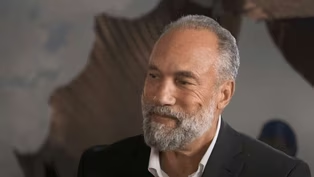
Actor Roger Guenveur Smith talks literature, Spike Lee films
Video has Closed Captions
Clip: S52 Ep41 | 11m 52s | Actor Roger Guenveur Smith discusses the impact of literature and his work with Spike Lee. (11m 52s)
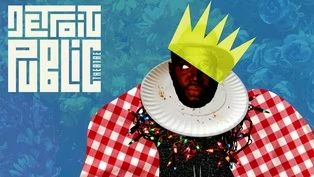
Pulitzer Prize-winning ‘Fat Ham’ at Detroit Public Theatre
Video has Closed Captions
Clip: S52 Ep41 | 12m 7s | “Fat Ham” lead actor Duane Shabazz talks about bringing the award-winning play to Detroit. (12m 7s)
Providing Support for PBS.org
Learn Moreabout PBS online sponsorship
- News and Public Affairs

Top journalists deliver compelling original analysis of the hour's headlines.

- News and Public Affairs

FRONTLINE is investigative journalism that questions, explains and changes our world.












Support for PBS provided by:
American Black Journal is a local public television program presented by Detroit PBS