
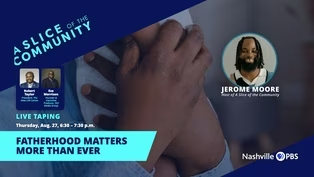
Fatherhood Matters More Than Ever
Season 5 Episode 1 | 26m 46sVideo has Closed Captions
Challenging stereotypes and celebrating the power of engaged fatherhood.
Join Nashville PBS host Jerome Moore for a powerful conversation inspired by the Fatherhood Beyond the Frame documentary. Fatherhood is about more than stereotypes, it's about presence, resilience, and impact. Together, we'll explore the stories of fathers, challenge misconceptions, and discuss how engaged fatherhood strengthens families, transforms lives, and builds stronger communities.
Problems playing video? | Closed Captioning Feedback
Problems playing video? | Closed Captioning Feedback
A Slice of the Community is a local public television program presented by WNPT
Support provided by:


Fatherhood Matters More Than Ever
Season 5 Episode 1 | 26m 46sVideo has Closed Captions
Join Nashville PBS host Jerome Moore for a powerful conversation inspired by the Fatherhood Beyond the Frame documentary. Fatherhood is about more than stereotypes, it's about presence, resilience, and impact. Together, we'll explore the stories of fathers, challenge misconceptions, and discuss how engaged fatherhood strengthens families, transforms lives, and builds stronger communities.
Problems playing video? | Closed Captioning Feedback
Where to Watch A Slice of the Community
A Slice of the Community is available to stream on pbs.org and the PBS app.
Providing Support for PBS.org
Learn Moreabout PBS online sponsorship- Oh no, we're gonna do that anymore.
(upbeat music) A Slice of the Community is made possible by the support of the Community Foundation of Middle Tennessee and R.H.
Boyd.
(upbeat music) (audience applauding) Hello and welcome to another episode of Slice of the Community.
I'm your host, Jerome Moore, and today we are live in studio joined by the wonderful great Robert Taylor and Ese Morrison.
How y'all doing?
- Doing great, doing great.
- [Jerome] Y'all ready for this?
Talk about fatherhood?
- Yes, sir.
- But before we get started though, because I think it's essential that y'all were a part of a great film speaking about fatherhood, Fatherhood Behind the Frame.
And so for people at home that's watching this, I wanted to give them a little teaser, you know, so we're gonna roll that teaser now.
(bright music) - My father has always been present in my life, but at the same time, not present.
So the way how I interact with my kid today is completely the opposite of that, because I longed for that, you know?
- And so that was just a little snippet that they got, a little sizzle.
They can go home and watch the rest of it, right?
But I think it's important for me to set the tone by saying, my father's my hero, you know?
And he's in the audience today, I ain't gonna put him on the spot, but my dad is my hero.
And so I know y'all are fathers yourself, so I want to ask this first question.
What makes you a great father, Robert?
And Ese I wanted you to answer the same question.
What makes you a great father, on the spot?
- Yeah, no, I think for me it was interesting this week, my son who plays football at Tennessee State University he had an opportunity to do an interview for another program.
And during the interview, he talked about what made me a great dad.
And it actually brought me to tears because I just hadn't heard the kids say that.
And one of the things that that he said was just me being present and being involved in all of their activities and showing up for them.
- Ese?
- Yeah, so actually on my way here today, you know, I have a 11 year old and a nine year old, two girls, and I told them exactly what I was doing and what was going on.
And I, you know, just asked them, hey, what makes me a good father?
And it's funny because they didn't rehearse this, they didn't know I was gonna ask them this, but they piggybacked off of each other and they both at the same time were like you tell dad jokes.
And I thought they were gonna leave it there.
And they were like, no, you tell dad jokes.
They're not funny, but when you laugh, it makes us laugh.
And that really made me feel good because I'm very intentional about, just like Robert said, being present there with them and not just present physically, but emotionally as well.
- Right.
I notice a lot of different rhetoric about fatherhood and what that means to be a good father.
A lot of times you hear the challenging aspects of, you know, there are no good fathers, no good men to be fathers.
They're not present.
They don't do this, they don't do that.
A lot of Reddit, a lot of social media banter back and forth, a lot of stuff in the comments.
But I'm curious, are we just, you know, saying these things or are we actually giving fathers the tools to be present, to show up and be great fathers?
And I'll start again with you, Robert, because of your work of what you do.
Is it just a lot of the noise or are we actually equipping fathers who maybe, you know, had a dad in their life, didn't have a dad in their life to be great fathers and have the opportunity to, you know, actually challenge those misconceptions?
- Yeah, I think both things can be true at the same time.
I think that yes, we would be remiss if we didn't acknowledge that we do have a father absence issue that we want to address.
And I think that the reason, one of the reasons why we made this documentary is to be able to allow fathers to tell their own story.
And it gives them an opportunity to say, hey, you know, my engagement and involvement in my children's life may look a little different than someone else's involvement, but I'm here.
And this is how I choose to do that.
And then the organization that I run, the New Life Center, we want to make sure that we provide the skills and the tools and resources to dads that want to be more engaged, but may not know how to because they didn't have that example set for them in their lives.
- The storytelling, well, go ahead.
- I was gonna say, to piggyback on that, a lot of the people, a lot of the men that we talked to during the documentary, one thing, the common theme was they wanted to make sure that they had a different experience with their children than what they had growing up.
And I think that's important to realize that even in that, there's still growth within, because parenting a five-year-old is different from parenting a 15-year-old.
So within that, you still have to grow within your, you know, what you're doing.
- Speaking to the narrative and to the storytelling part of it, a lot of times you don't hear fathers speak up or they're muted when they try to speak up against the misconceptions or the stereotypes.
How important was it for you?
I'm gonna start with you, Ese, on this, to create something that gave fathers, right, a chance to extrapolate on their experience and what it meant to be a father and what fatherhood means to them and the importance of it.
- Yeah, it was very important because I think a lot of times society tells we don't give men the space to be vulnerable.
And I think that's one of the things that this documentary did was give men that space to talk and not feel judged to learn because one of the themes that, a couple of times that we've shown this film is one of the themes that's come out is that every father learned from each other.
And one of the things that we learned was that, hey, what I'm going through, you're going through the same thing, you know?
And how do you handle it and how can I be better?
So yeah, I think it's very important to give men that space.
- Robert, you want to add anything?
- I just, I agree wholeheartedly.
I think that it just provided men an opportunity to tell their own story.
That was the vision that I had when we said we wanted to do a documentary, we wanted to give these men an opportunity to tell who they are because oftentimes they are negative stereotypes and we know that there are positive Black men.
- And so to your work, Robert, I think it's interesting because you provide tangible tools and resources because a lot of times fathers may have the question like, hey, I want to be a good father, but I don't know how.
How do you solve that I don't know how problem?
- Yeah, I think that one of the workshops that we provide is called Training Camp for Dads, and it's for new and expectant fathers.
And what I've learned over the years is that we provide them with the basic tools, changing diapers, helping mom with breastfeeding, helping them to understand that they can create a birth plan with mom for when she does deliver at the hospital, helping them to understand postpartum depression and what the signs are so she can support mom.
That gives those men the confidence to step into their role as a father to know that, okay, I can do this.
I have some type of background knowledge that'll allow me to step into this role that I've never done before.
- Right.
I'm curious too, when you think about fatherhood and the misconceptions or stereotypes, I wonder what are some things that maybe you all don't hear that's considered being a good father that fathers actually do?
- I think for me, speaking of my experience is the cooking.
I'm Nigerian born and raised, both born and raised a little bit in Nigeria, moved here when I was nine.
You don't hear a lot about, you don't see a lot of Nigerian men cook in the household, right?
I think the mundane tasks, and Robert and I have talked about this, about driving your kids to practice, you know, readjusting your schedule to fit what they have going on.
I have one of my daughters is in dance, you know, if anybody is watching is a dance mom or dad, like it's crazy.
Schedule is crazy.
So readjusting your schedule to fit what they have going on is something that's not really noticed or immediately seen, but it's something that we have to do.
- How about you, Robert?
Anything that necessarily doesn't fit stereotypically in somebody's mind, it's like, hey, this is what a father does, but you know, the fathers actually do and that is part of fatherhood?
- Yeah, I can think of one thing that I did years ago when my kids were infants was helping them to latch while my wife was breastfeeding.
And that was one thing that I learned and using lanolin and all of that good stuff.
I think that that was something that as a father-- - Getting confirmation from your wife in the audience.
- She's like, he aint lying.
And so, but that was something that, you know, I was like, okay, I'll get good at this and figure it out to help with the breastfeeding process.
- What can community do?
Because, you know, I think my biggest thing is always, you know, it's easy to highlight the challenges.
It's easy to point out what fathers may not be doing, right?
But what are some things that community can support fathers with if they see there is a void or they want that support and help or they just say, hey, like, I don't have maybe a mentor in fatherhood.
What are some things where community can take an actionable, tangible step to be a part of?
- Yeah, I think that you know, I've been talking to my wife about this and I think that oftentimes we put the onus on the moms to help support dads in being better fathers.
And I think that we as men need to come together and kind of create a new standard.
And say that we're gonna hold each other accountable for being good dads.
And so as a community, I need to say, hey, Jerome, man, have you checked your kids' homework today?
- Yes, every day.
- And so, but helping and supporting each other as men and as fathers to make sure that we're doing the things that we need to do to support our children and our families.
- Yeah, so ushers that point I think society as a whole can do a better job in not seeing dads as secondary.
I think a lot of times we see the mom as the primary parent, but if you see us as equals, I think that it empower more dads to do more.
- Right, and I think that speaks to even how Mother's Day in comparison to Father's Day.
We all got the same socks, I'm sure.
We probably got them all now.
The same wallet, same cologne.
The lotion.
- Maternity leave and paternity leave.
- Exactly.
Precisely.
And so I think, you know, from a societal standpoint, I think it is improvement that can be done on the measurement standpoint, right?
'Cause there's always data that comes out about what fatherhood looks like or what it doesn't look like.
And I think that that may skew things a little differently.
So I'm curious of, should we be looking at data differently, right?
Should we be looking at data as far as are we judging fatherhood based on is the father just in the home, right?
- Yes.
Sorry.
- No, go ahead.
- Yes, because I feel like data, if we look at data, data just measures the structure of the home.
Let's just hypothetically speaking, John Doe is not living in the house, right?
But he's present because he's there for his children every other day, every weekend.
He's picking them up from school, dropping them off.
But society measures that that's an absent father.
But he's not.
You see what I'm saying?
So I think we should look at data differently.
- And that's it.
It's just the data that we look at needs to change.
I think we show a study in the documentary that shows that even when specifically Black fathers are not living in the home with their children, they're more likely to be active and engaged than any other group of fathers.
And so those are the data points that we need to look at is how much time are you spending with your children?
What type of questions are you asking them?
What type of relationship are you developing with your children regardless of what your address is?
- What I liked what you all did in the doc is that you all focused on a multi-generational and racial scope of fathers, right?
And I think people should appreciate that because a lot of times it's that divide and conquer, right?
We're gonna look at Black fathers, we're gonna compare them to some, you know, Latino fathers and we're gonna compare them to white fathers or API fathers, right?
And then this father race in comparison.
Well, I'm a better father than you just based on my skin, right?
And so I like what you all did with that.
But I'm curious though, I have to ask you because it's part of you all identity as to Black men that are Black fathers, how do you navigate that knowing that you may be judged differently on how you father, right or wrong?
- Yeah, it's interesting.
You know, I started doing this fatherhood work at the Metro Health Department years ago.
And these same type of questions would come up around, you know, race and how it affects fatherhood differently.
And, you know, for me, and I'm, look, I know it's live and all of that, but the challenge that I have is we don't ask other races of fathers those types of questions, right?
It's only when it comes to Black fathers that we start being concerned about how is race affecting fatherhood and looking at it differently.
And so for me, I had to say, why are we doing that?
And as a Black father and as someone who does fatherhood work, I want to help change that narrative.
And help refocus us on the fact that we're all fathers.
We all have some of the same challenges.
Now, culturally, there may be some differences in how we execute those challenges, but we're fathers.
We love our kids, we want to support them, and it just may look a little different because of our cultural backgrounds.
- How about you, Ese?
- I think culturally, Robert and I were having a conversation backstage and it also, culturally also goes into how we raise our children, right?
Because the experiences that we need to prepare them for experiences that other races may not go through.
- I'm curious, in the teaser, you know, it talked about presence, right?
And I think presence can kind of sometimes be multi-layered and confusing, just because you're there or in the household don't mean that you're participating in fatherhood, right?
And so I wonder how do you all, or even doing the doc, expound on that and I would even say investigate that, right?
On just thinking like, just because you are there, if you are a father and you say, hey, I'm in the household.
I see my kids every day.
That doesn't maybe always technically mean that you're actually being an active father.
- I think you've hit the nail on the head and I think that those are some of the skills that we want to help fathers learn.
I think yes, you can be in the house all day, every day.
But we know children are like sponges.
They pick up everything you do.
So if you're sitting on a sofa, laying up, watching TV and not engaging with your children, that's what they see as what a man is supposed to do or what a father is supposed to do.
And so you have to be very intentional about how you engage with your children.
And the one skill that we teach fathers is to be curious about your children.
You want to ask your children questions almost as if you're meeting them for the first time.
So that you learn about who they are, what their interests are so that you can engage with them on that level.
- Yeah.
And I think it's all about the relationship that you build with your children listening to what they're saying.
I know every day after school, I make it a point to not ask my kids, how was school?
Because then you get a one word answer, right?
What was the best part of your day today?
You know, tell me about what happened, you know, at recess.
You know, having those conversations and even taking it a step further, wow, for real?
That happened?
You know?
You know, and they love that.
I mean, my daughter's talked to me, well, not the youngest, the oldest talks to me about her crushes, you know?
She'll tell me about her crushes and she feels comfortable having that conversation with me because I've created that space for her to be vulnerable.
And likewise, I'm vulnerable with her as well.
I mean, sometimes she doesn't understand some of the emotions I go through.
No yet.
She will at some point.
But just creating that space to have that relationship, you know, with them.
- Because there are fathers here today, there's fathers watching that may have a story to tell, right?
They may be struggling or battling fatherhood.
I know the term is suffering in silence, you know, right?
How can we navigate fathers who may be suffering in silence to the point where because they don't have access to their kids, they can't father like they want to, you know, they're afraid to be vulnerable because their manhood as a father may be in question.
How do we navigate that?
Or what are tools to do that?
And it may not be a one shoe fit all, but maybe what are some things that, you know, maybe you all have learned along the way and through some of the tools of teaching classes that fathers could use to navigate some of those barriers?
- Oh, I believe in therapy wholeheartedly.
I think that many men, especially men who did not grow up with an active father in their life, have these fatherhood wounds that have traumatized them throughout their life and they haven't dealt with it.
And now they're being asked to raise another human being without having dealt with the trauma that they experienced from their father.
And so therapy is the one thing that I preach to anybody.
I talk about it like lifting weights for your mind.
Like if we go to the gym and try to get healthy and fit, we need to do the same thing for our mind.
- Which may also be part of your therapy.
Going to the gym.
- And I think there's a misconception that you have to be going through something to go to therapy.
You don't.
Therapy, I mean, it's a maintenance, just like going to the gym.
I mean, if I go to the gym and I lose my 30 pounds, that's my goal, but I still got to go to the gym every day to keep up, you know.
And that's the same thing with therapy.
So I agree.
- Going forward, right?
I know this is, you know, you all did the doc, you did the film.
I'm curious of how do we inspire society in general to continue with the positive aspect of storytelling when it comes to fatherhood?
It's easy to attack, right?
But how do we champion good fathers, right?
How do we champion fatherhood?
What strategies should we be using from the content digital space?
We here at Nashville PBS, right?
This is part of that combating those stereotypes and misconceptions of just championing fathers, right?
On the same caliber that I think we intentionally try to champion our mothers, right?
And I think this is a good question for you, Ese, since you're in this production world.
- No, I mean, I was gonna say the same thing.
I think it's just more creating spaces like these so we can have these conversations.
We can have it and we can have a Q&A.
We can talk about it.
We can, you know, create, you know, just a multimedia space that, you know, the more you show people positivity or just things, like there's so much negativity out there, right?
So it's almost like you have to bombard them with what we want them to see.
And I think having more documentaries, having more spaces to have these types of conversations will help.
- Right.
And then getting involved in local politics as well as utilizing the services that are already available to fathers.
And so, for example the Tennessee Department of Human Services has started a statewide fatherhood initiative.
- Okay.
- And so we're partnering with the Department of Human Services to continue to push this message that fathers are crucial to the development of their children.
And we know that they have positive attributes that we want children to learn from them.
And so we want to do everything we can to get these fathers engaged with their children in a positive and healthy way.
And so we partner with the Department of Human Services to do that work.
- What is, I want each of you to answer this question for me.
What is maybe one misconception that you've consistently heard that just blatantly just maybe not the norm for fatherhood?
And it's a lot of them.
A lot of misconceptions and stereotypes.
But what is one that I think comes to mind for you all that you just, it just doesn't ring a bell if you don't really experience fathers that actually fit into this box of stereotypes?
- I think that fathers don't want to be involved in their kids' lives, that they really don't care.
I think that every father wants to be involved in their life.
But our society has not created a standard that that is required.
And I think that that's a part of the work that we're trying to do here is to say there's a new standard for fatherhood and that requires you to be engaged at a minimum at this level.
- Right.
- And so I think the default has been, if there's any barrier to being engaged in my kid's life, well, mom's got it.
- It's expected.
- That's it.
And so I think that the issue is that the negative stereotype is that the fathers don't care.
They don't want to be involved.
And that's not the case.
I think that we have to create a societal standard that says that even if you have any barriers or any challenges, you still need to rise to the level of being an active and engaged dad.
- Yeah.
I agree.
I'm gonna take mine a step further.
I do agree, that was gonna be my answer, but I'm gonna take mine a step further.
- Y'all studied the text together.
- Culturally, culturally, from culturally speaking, I think as a Nigerian, African, there's a misconception that we only want boys.
- Okay.
- Right?
To carry on our lineage.
I have two girls.
I'm fine with my two girls.
- Right.
- I don't have to have a boy to carry on my lineage.
That's the one misconception I would change.
- And so we all know that when people are watching this, in particular, you know, women, there's gonna be some comments.
They're gonna be taking some shots at fathers.
It's gonna happen.
It's okay.
However, I think this is an important question because we want our women, we want our mothers involved, right?
We want women to champion fatherhood just as much as fathers champion fatherhood.
How can women be a part of their advocacy when it comes to fatherhood and being able to create an environment and tools and resources to be able to yield better fathers, more active, engaged fathers, more prepared fathers?
What is the role that they can play in that?
- I mean, going back to what I said earlier, seeing us as equals.
If like, for example, the dance, you don't see a lot of dance dads out there.
I'm a dance dad.
I mean, there'll be times I go, you know, to their dance competitions.
There are times that, you know, their mom goes to their dance competition, you know?
So I think and it's just having a communication, having an active dialogue and say, hey, what would you like to do?
Would you like to be involved in this?
Right?
Don't assume that we don't want to be involved.
- How about you, Robert?
- I would say two things.
One, yes, we're equals, and also recognizing that we're different.
And so the way that mom parents is gonna look different than the way that dad parents.
And that doesn't mean that dad is parenting incorrectly.
It just means that he's parenting differently.
And so I think that we want to make sure that moms understand that.
But then the other thing is to change the language that we're using.
So, you know, mom, you can't run around saying, oh, he's a deadbeat if you want him to be an engaged father.
You want to use language that says, man, I'm encouraging you to be active and engaged in your child's life.
That's the conversation.
Instead of stop being a dad beat.
Say, I need you to be more engaged.
- 'Cause they listen, they listen and they pay attention.
They going to need to hear that in the comments for you specifically when it comes to that.
- What's your email, Robert?
- Don't call him a dad beat.
Now you need to champion him now.
Now you need to support him.
But to wrap it up, this segment was called, you know, Fathers Matters More Than Ever.
When you hear Fathers Matters, what does that mean to you, Robert?
And I'm gonna end it with you, Ese.
- Yeah.
Fathers matter to their children's lives.
They are an essential part of who that child is.
And when the child doesn't have access to all of the wonderful things that that father brings, it creates challenges for them that can be alleviated if we get that father engaged.
- Why fathers matter?
- We had a one of the men that we talked to was an older gentleman.
His name was Roy.
And he had a statement that said basically you don't want to create a mini me.
- Right.
- Right?
As a father, you want to guide them into becoming who they are.
- Right.
Well, look, I appreciate y'all.
Let's give our guests a round of applause.
(audience applauding) And thank you all for watching another episode of Slice of the Community.
If you would like to watch more, please download the PBS app or check us out on your YouTube at YouTube/NashvillePBS.
Let's give it up one more time for them.
(audience applauding) (upbeat music) (bright music)
Fatherhood Matters More Than Ever - Promo
Preview: S5 Ep1 | 30s | Challenging stereotypes and celebrating the power of engaged fatherhood. (30s)
Providing Support for PBS.org
Learn Moreabout PBS online sponsorship New Episode
- News and Public Affairs

Top journalists deliver compelling original analysis of the hour's headlines.

- News and Public Affairs

FRONTLINE is investigative journalism that questions, explains and changes our world.
 New Episode
 New Episode
 New Episode
 New Episode
 New Episode
 New Episode
 New Episode

 New Episode
 New Episode
Support for PBS provided by:
A Slice of the Community is a local public television program presented by WNPT