One-on-One
Fatima Aguilar; Helen Genova, PhD; Jon Katz
Season 2025 Episode 2871 | 26m 41sVideo has Closed Captions
Fatima Aguilar; Helen Genova, PhD; Jon Katz
Fatima Aguilar, Program Development Specialist at Vets4Warriors, discusses the importance of mental health support for military personnel. Dr. Helen Genova, Associate Director of the Center for Autism Research at Kessler Foundation, challenges misconceptions about autism. Jon Katz, President & CEO of Bestwork Industries for the Blind, discusses challenges facing visually impaired individuals.
Problems playing video? | Closed Captioning Feedback
Problems playing video? | Closed Captioning Feedback
One-on-One is a local public television program presented by NJ PBS
One-on-One
Fatima Aguilar; Helen Genova, PhD; Jon Katz
Season 2025 Episode 2871 | 26m 41sVideo has Closed Captions
Fatima Aguilar, Program Development Specialist at Vets4Warriors, discusses the importance of mental health support for military personnel. Dr. Helen Genova, Associate Director of the Center for Autism Research at Kessler Foundation, challenges misconceptions about autism. Jon Katz, President & CEO of Bestwork Industries for the Blind, discusses challenges facing visually impaired individuals.
Problems playing video? | Closed Captioning Feedback
How to Watch One-on-One
One-on-One is available to stream on pbs.org and the free PBS App, available on iPhone, Apple TV, Android TV, Android smartphones, Amazon Fire TV, Amazon Fire Tablet, Roku, Samsung Smart TV, and Vizio.
Providing Support for PBS.org
Learn Moreabout PBS online sponsorship- [Narrator] Funding for this edition of One-On-One with Steve Adubato has been provided by Horizon Blue Cross Blue Shield of New Jersey.
RWJBarnabas Health.
Let’s be healthy together.
NJM Insurance Group.
Serving New Jersey’s drivers, homeowners and business owners for more than 100 years.
PSE&G.
Powering progress.
Johnson & Johnson.
New Jersey Manufacturing Extension Program.
New Jersey Sharing Network.
The North Ward Center.
And by Myron and Elaine Adler private foundation, in support of the Adler Aphasia Center.
Promotional support provided by New Jersey Globe.
And by NJ.Com.
Keeping communities informed and connected.
- This is One-On-One.
- I'm an equal American just like you are.
- The way we change Presidents in this country is by voting.
- A quartet is already a jawn, it’s just The New Jawn.
- January 6th was not some sort of violent, crazy outlier.
- I don't care how good you are or how good you think you are, there is always something to learn.
- I mean what other country sends comedians over to embedded military to make them feel better.
- People call me 'cause they feel nobody's paying attention.
_ It’s not all about memorizing and getting information, it’s what you do with that information.
- (slowly) Start talking right now.
- That's a good question, high five.
(upbeat music) - Hi everyone.
Steve Adubato.
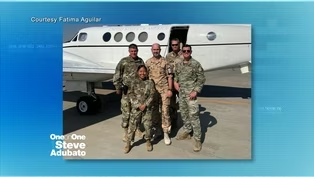
We kick off the program with our miniseries called Honoring Our Vets and we are honored to have Captain Fatima Aguilar, who is a program development specialist at a great organization called Vets4Warriors and Brigade Provost Marshall with the Army National Guard.
Captain, great to have you with us.
- Thank you so much, Steve.
It's great to be here.
- We need a lot more than thank you for your service, but thank you for your service and we'll talk more about that.
Tell everyone what Vets4Warriors is.
The website's up right now.
- Yes, so Vets4Warriors is a veteran peer support network where we have everyone on staff who has served from Vietnam to those still currently serving today like myself, who is with the New Jersey Army National Guard.
And what we do is provide peer-to-peer support.
We are veterans who have walked those same shoes as our callers and our clients who need support.
And we found that a lot of the support that they actually need is from someone that's just done what they've done before.
And they are so much more willing and more open to speak to someone who has put on the uniform and those same boots.
So again, we're just there really to provide support for any service members, veterans, and their families before their situations become a crisis.
- Captain, talk about your experience in the military.
- Yes, so I actually enlisted back right after high school in 2004.
- Why?
- Why?
A lot of different reasons.
So my family migrated from the Philippines back in '98 and something in me felt that I owed something to the US, right?
They gave us so many opportunities that I would've never had presented to myself if I stayed in Philippines.
So my mother immigrated as a nurse and I felt like I needed to give back.
I was just grateful for opportunities.
So I served in the military.
I'll be honest, Steve, I did need a little discipline growing up.
So I figured the military is probably the best approach to kind of take.
And I think it really did a lot for me.
It gave me a sense of purpose.
It allowed me to thank the country that gave my family a lot of opportunities, and it gave me really, a sense of direction and a family that I didn't think that I would gain.
So that's a big reason why I enlisted back then.
- Challenges you faced, not only while in service to our country, but when you came out.
- So a lot, I guess I could start with, so I'm still serving now, but when I transition out of active duty- - I apologize for saying that, you're still serving.
- Yes.
- A big theme is mental health.
And I don't wanna jump ahead here, but to what extent was that an issue for you?
Is it an issue for so many others?
- Yes.
So I think mental health is definitely an issue.
I myself serve because I felt like I was indebted to the US for giving my family an opportunity.
But as a company commander, which I was previously, I found a lot of soldiers put on the uniform because their lives at home wasn't ideal.
That was their escape to get out.
'cause they had different issues at home.
So their escape was to join the military.
They joined the military thinking that their mental health issues are kind of put off to the side 'cause they have the sense of purpose, but they've never actually done the healing that's needed.
So I believe that kind of happened to me.
So I did meet a partner when I was on active duty, 18, 19 years old, who had their own childhood issues and traumas that they never healed either.
So two people came together and it kind of became very chaotic.
Domestic violence, a lot of back and forth and thinking we were just bad people.
But I think I've realized as of we've both gotten older, we weren't bad people.
There was healing that needed to be done before we came together.
And I think those mental health issues kind of transpired when I was in the military.
Uniform was put on, you're away from your family, you're always in a different location, constantly moving.
So I think it kind of brought up old wounds that we never really healed during that time.
- Along those lines, captain, the stigma around mental health, is it, in your view, exacerbated when we're talking about people who have served our country or are serving our country, who are dealing with mental health issues because of the perception of many of us in our minds that you're tougher, you're stronger than the rest of us who have not served.
So therefore, how could you possibly be dealing with mental health issues?
Am I off base on this?
- No, I think you are very accurate, Steve.
So I believe that we are definitely more open to it than it was when I first enlisted in 2005.
So 20 years ago, there was definitely more of stigma, right?
The saying is, suck it up, drive on, drink water, and just get through it, right?
We're gonna get through it, but now I feel like they're more open, they'll definitely have more resources.
There is still a stigma, unfortunately, especially those in leadership positions as sometimes you feel like you can't get help.
And I think that's actually where Vets4Warriors comes in.
The confidentiality peace that we provide, What we tell our callers, especially when they're in that leadership position, the stigma's still there.
I believe that a lot of leadership still feels like there's retaliation, right?
They think you're unstable even though you've been doing your job for 20 plus years, but now you're going through a divorce, a family situation, maybe a death in a family, maybe a death of what we call a battle buddy, right?
Someone who we deployed with and we're allowed to feel those struggles.
And sometimes it feels like we don't.
So when someone does call Vets4Warriors, the confidentiality peace, when we say keep it as confidential as you want, you can give us a fake name, but all we ask is you give the same fake name every time you call.
So we can make sure we're following up the way that we need.
We're providing you the right resources, and you talk to the veteran peer that's gonna help you through your process as you get through it.
- Captain, what has this done for you to be an important part of Vets4Warriors to not just to have served and serving our country actively, but also doing this work.
What has this done for you and for your wellbeing, if you will?
- So I think when I went through active duty and I kind of shared my experience with my ex-husband, the domestic violence, the isolation that I felt, I think my position at Vets4Warriors has allowed me to make purpose of my suffering.
I feel like I didn't suffer for no reason at this point.
I feel like my story to be able to talk to other service members or soldiers who deal with issues at home or their relationships, I can actually give that peer-to-peer support myself.
And I think the problem is when people think they're dealing with, let's say, domestic violence, they think they're the only ones or they're so ashamed that they're unwilling to share with others.
But sharing will allow you to get out of it because now they can see, hey, my commander at some point dealt with this, but she's overcame these obstacles and she's in pretty good situation where she is now.
So I just feel like it's so empowering and that there's a purpose for whatever I dealt with for those that decade that I had domestic violence.
- Which, you know, it's funny, I started out by saying thank you for your service.
It's also thank you for the service you're engaged in right now.
In the less than a minute we have, talk directly to the vets out there right now.
- Yes, so any veterans service members or even family members of veterans who have any concerns, just reach out to another veteran.
We actually found that veterans are eight times more willing to share their story, their struggles with another veteran, regardless of branch.
You know, we have these little challenges, Marine, Army, Navy, right?
Who's better, who's not.
At the end of the day, if someone put those boots on and those uniform on, we can directly speak to you.
We've walked the walk, right?
We talk the talk.
So it's very easy.
And we're available 24 hours, seven days a week.
Doesn't matter what time of day, there's always someone who can reach out to you as well.
So there's always help.
Always.
- Captain Aguilar, thank you so much.
We appreciate everything you and your colleagues are doing every day at Vets4Warriors.
This is part of our honoring, if you will, honoring our veterans.
A lot of work to be done.
Thank you, Captain.
- Yes sir.
Thank you so much.
- You got it.
We'll be right back.
- [Narrator] To watch more One on One with Steve Adubato find us online and follow us on Social media.
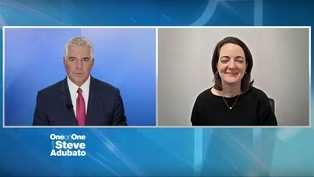
- We're honored to be joined by Dr.
Helen Genova, who is Associate Director of the Center of Autism Research at Kessler Foundation.
Good to see you, my friend.
- Thank you.
You too.
- Do you admit that you were part of a leadership academy that I led at Kessler Foundation?
- I do admit that, and I enjoyed it very much.
- It's easy to say that now you're out of it.
- Yeah.
- Helen, talk to folks about your research.
'Cause we talked a lot about this when we were doing a lot of communication, leadership training and coaching.
You told us about this initiative called KF-Stride.
What is it and how does it connect to your work?
We'll put up the website so people can find out more.
- Wonderful.
So I work with transition age youth who are on the autism spectrum, and if you know anyone who's on the spectrum who is in that age bracket, you know that it can be incredibly difficult for them to obtain and maintain employment.
So there's a huge unemployment rate in this population.
We have studied the specific obstacles to gaining and maintaining employment for autistic individuals, and we've narrowed it down to a few important things that we're trying to help them with.
One of them being the job interview.
And so we know that the job interview is a struggle for anyone who's on the spectrum.
And so what we've done is we've created this program called KF-Stride.
KF-Stride stands for Kessler Foundation, Strength Identification and Expression.
And it basically is a series of animated videos that are fun and engaging and it helps individuals on the spectrum understand what their employable strengths are and then how to talk about them to an interviewer.
- So Helen, you have a close family member dealing with autism.
It matters to you professionally and personally.
- Absolutely.
Yeah.
- What is the most common misconception from your experience, not just as a researcher, as a scientist, as a scholar in the field, but as someone who understands this on a personal level, what's the biggest misconception about those who are on the, as you say, autism spectrum, who wanna live the same happy, healthy, productive life that the rest of us are trying to live?
- I think a lot of people have a lot of misconceptions about autism, partially because it is such a huge spectrum, right?
So you may have people who have cognitive disability, for example, but you may have people who are brilliant and on the spectrum.
And I think that they tend to all get lumped together into one category.
And so you may have an employer who meets someone who's trying to get a job, and they may think that because the person is on the spectrum, they can't do the job, which is absolutely not the case.
So what we're really trying to do is to help them put their best foot forward, to get the message out there that they have these amazing talents and strengths, they can do the job, and we're just trying to get them to make the employer understand that and to put faith in the fact that they're going to be an amazing employee.
- What kinda results have you seen with the research you've done, particularly as it relates to KF-Stride?
- So we're really proud of the results that have recently come out.
So we just published a randomized clinical trial where we had people take KF-Stride program, and we had people who didn't take KF-Stride, just kind of went about their usual services.
And what we found was that the people in the KF-Stride group, the ones who had received KF-Stride, they actually improved their job interview skills from before to after a significantly amount.
And then we found also that those who were job seeking and who took KF-Stride, there were 54% of job seekers in the group that had received KF-Stride who went on to become employed.
And this was really exciting.
When you think about the unemployment rate in the autism population, some people's estimate it's as high as 80%.
So to have a result like that with 54% of them becoming employed was huge.
And we were really excited to see that.
- Helen, you know, I'm curious about this, and I'm not the only one.
There's so much talk about the causes of autism.
That not part of your research portfolio?
- It's not part of my research portfolio.
And I can tell you why.
- Go ahead, please.
- There are millions of people who exist today that are living with autism and have struggles.
And for example, related to what we do, struggle with getting employment, which is such an important part of their lives, really desperately want to be employed.
And so for us, we are trying to help the people who are existing right now, who are living this every single day and helping them to achieve the goals that they wanna achieve.
- I'm sure on some level it's a distraction from the work that you're doing and people can say what they wanna say, think what they want to think, but science is science.
That being said, I've known you a long time.
We've worked together, you've been one of my students and I've learned from you while you were a student.
How personally gratifying is this for you?
- Yeah, it's the biggest, it's the most important part of my career, and I've been a scientist for over 20 years.
And to be able to work directly with this population and to help them and to see the results firsthand has been enormously exciting, rewarding.
I can't even begin to explain it because I know that I'm having a real impact on their lives.
When we hear a teacher say, "I gave KF-Stride to my students, and they became employed," that is just an amazing thing to hear.
And I go to bed every night happy knowing that we've made this difference in their lives.
- Final question.
I know every young person, every child, every young person with autism, they're, as you said, everyone's different, on the spectrum, if you will, autism spectrum.
And I know this is a tricky question because every situation is different, but if you were to give a family member, a parent, someone who cares deeply about a young person on the autism spectrum, give them reason... Share something with them as to why they should be hopeful, even though there are incredible challenges.
- So what I could say is that it may not be apparent to you right now, but your child is capable of so much and has so many strengths within them.
And even some of the things that you find challenging may be an incredible strength that that person has.
So let's say, you have a child at home who's incredibly stubborn.
Well, that child may end up growing into a really powerful leader because they have this ability to stick to what they believe is right.
If you have a child who blurts out something that's truthful in a situation, like, "I don't think that dress looks good on you," or gives an opinion that's honest.
That honesty is so important, especially employment scenarios.
So even though it may not be apparent to you right now, your child is capable of amazing things and it's gonna take time and resources and support, but they're gonna get there.
And yeah.
And we're excited to help you in any way.
- To you, Dr.
Genova, to Roger DeRose the leader of the Kessler Foundation and the great researchers, scientists, and folks doing the work every day to make a difference.
We thank you for your work and there's a lot more to be done.
Thank you, Helen.
- Thank you Steve.
Nice to see you.
- Same here.
Stay with us.
We'll be right back.
- [Narrator] To watch more One on One with Steve Adubato find us online and follow us on Social media.
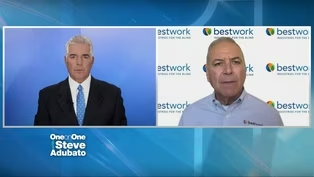
- We're now joined by Jon Katz, who's President and CEO of Bestwork Industries for the Blind.
John, great to have you with us.
- Thank you for having me, - John, this is part of our "Manufacturing Matters" series.
We're doing it in cooperation with our partners of New Jersey Manufacturing Extension Program, NJMEP.
What exactly is Bestwork Industries for the Blind?
- Bestwork is a nonprofit.
We're located in Cherry Hill.
We were founded in 1981 by a veteran, Jim Varsaci.
He was blinded in combat in World War II.
Basically, we're an employment program.
We empower people who are blind or visually impaired by creating employment opportunities, providing them training, and offering blindness and low vision services.
We're the largest employer of people who are blind in the state of New Jersey, and we're the leading advocate and innovator employer for people who are blind and visually impaired.
We're also recognized as a center of excellence for our blindness and low vision services.
We have four lines of business.
We do textile apparel manufacturing.
We have an e-commerce business, document scanning, digital imaging and kitting packaging light assembly, and we're located in four places around the state.
In addition to our headquarters in Cherry Hill, we have satellites in Roselle, Montclair, and our newest one in Egg Harbor City.
- And also I was remiss, spent 20 years with the United States Marine Corps.
Thank you for your service, Jon.
- Thank you.
- This is also part of our series, honoring our Veterans.
Talk to us about the veterans you are serving who are blind.
What are a couple of the most significant challenges they face and what do they need to become gainfully employed?
- Yeah, that's a great question.
The most common misperception people have about blindness is that people who are blind can't function independently, you know, like they can't work, or they have diminished capabilities.
It's just not true.
With the proper training, you know, guides, jigs, fixtures and assistive technology, we can convert just about any job for someone who's blind.
In fact, we have a saying, "There's no such thing as a blind job.
It's all about training, accommodation, and accessibility."
- So go back to that.
I saw that in the notes.
There's no such thing as a blind job.
What does that really mean?
- I mean, exactly what it says.
We were certified by the state of New Jersey in 2022 as a competitive, integrative place of employment.
And what that means is our people who are blind are working right alongside their sighted counterparts, doing either the same or very similar complex operations.
And if you came to visit us, a lot of times it's hard to tell when you're looking at the manufacturing lines, who's blind and who's sighted.
- So someone goes on your website right now, which we'll put up as we speak, the Bestwork website.
What do they find, Jon?
- So they'll find an organization that is, you know, committed to providing opportunities to people who are blind and visually impaired, and, you know, have that full commitment to provide whatever the combination or accessibility is necessary to create a job opportunity for them.
- Hold on, John, how does it do that?
Help us understand the mechanics of this.
Someone goes on the site, okay?
And if someone is visually impaired, someone is blind, how do they navigate that?
How does that happen?
Does someone else have to help them?
I know I'm in the weeds here, but I'm trying to think through the process.
- Oh no, that's a great question, Steve.
So most people who are blind or visually impaired use different tools.
There's a very common software called JAWS, which allows people who are blind to actually see what you and I see on the screen.
It provides them an audio readout at extraordinary speeds.
And they're able to look at a screen, be able to watch us right now and see exactly what they're seeing through the audio feature of the software.
But also, you know, there are programs, you know, Microsoft is incredible with their accessibility features on all their software platforms.
I have a lot of people that are working in the back office using the programs that you and I use through the accessibility features.
And nowadays, smartphones are absolutely incredible.
Their software where people are blind can actually point their camera at objects, at scenes, at rooms, and it'll tell 'em what they're seeing.
- I'm curious, in some ways, while people worry about technology taking jobs away from human beings, from people, you talking about technology, and you and your colleagues at Bestwork Industries are focusing on using technologies to help provide jobs for people who happen to be blind.
- Yeah, absolutely, and you know, a great story, I was hired in 2021 by my board to diversify lines of business.
Historically, we were just a self-sustaining, textile manufacturing facility, and when we decided to launch new lines, like getting packaging and light assembly, or documents scanning, we said, "Where are we gonna find the people who are blind?"
You know, I can't go out on Indeed like everybody else to hire people who are blind.
And, you know, through brainstorming, we realized, we bought an automated folding, we got a grant, actually.
We got a grant with the assistance of NJMEP to purchase an automated folding machine.
And in my community, people shy away from automation because again, they think that it takes jobs away.
But what it did was we taught three people who are blind, how to run the automated folding machine to fold our textile apparel products.
And at the same time, I was able to repurpose about a dozen people in my packaging area to train them in document scanning and digital imaging, and kitting and packaging light assembly.
But so through automation and innovation, we're actually able to create employment.
- Before I let you go, one out of 10, the level of satisfaction you get outta your work is?
- 11 - 30 seconds because... - Oh, well, because I get double bang for my buck.
As you stated, I spend 23 years in the Marine Corps.
You know, obviously, continued service, creating jobs for people who are blind, but double bang for my buck is I'm still supporting the war fighter, and that means a lot to me.
- Jon Katz, President and CEO of Bestwork Industries for the Blind.
To our friends at NJMEP for helping us make this connection part of our series, not only honoring our vets, but also manufacturing matters.
It matters a lot, particularly for those who are challenged and want to work, and just need a little support in making that happen.
Thank you, Jon.
We appreciate it.
- Thank you Steve.
Appreciate it.
- And I'm Steve Adubato, and we appreciate you for watching us on a regular basis.
We'll see you next time.
- [Narrator] One-On-One with Steve Adubato is a production of the Caucus Educational Corporation.
Funding has been provided by Horizon Blue Cross Blue Shield of New Jersey.
RWJBarnabas Health.
Let’s be healthy together.
NJM Insurance Group.
PSE&G.
Johnson & Johnson.
New Jersey Manufacturing Extension Program.
New Jersey Sharing Network.
The North Ward Center.
And by the Adler Aphasia Center.
Promotional support provided by New Jersey Globe.
And by NJ.Com.
- How long you been waiting?
- About a half hour.
- Brutal.
This keeps up, I'm gonna miss my pickleball game.
- I've been waiting eight years for a kidney.
What can you do?
(gentle music) - [Narrator] Over 100,000 people in the US are waiting for a life-saving transplant.
But you can do your part in an instant.
Register as an organ donor today at NJSN.org.
How this organization empowers & employs blind individuals
Video has Closed Captions
Clip: S2025 Ep2871 | 8m 31s | How this organization empowers blind individuals through accessible technology (8m 31s)
Mental health support for military personnel and families
Video has Closed Captions
Clip: S2025 Ep2871 | 9m 46s | Mental health support for military personnel and families (9m 46s)
The role of employment in supporting autistic individuals
Video has Closed Captions
Clip: S2025 Ep2871 | 8m 56s | The role of employment in supporting autistic individuals (8m 56s)
Providing Support for PBS.org
Learn Moreabout PBS online sponsorship
- News and Public Affairs

Top journalists deliver compelling original analysis of the hour's headlines.

- News and Public Affairs

FRONTLINE is investigative journalism that questions, explains and changes our world.












Support for PBS provided by:
One-on-One is a local public television program presented by NJ PBS